
Casino Bonus Codes for Australian Players in 2026: What the Code Buys, What It Costs, and the Offshore Truth
A casino bonus code is a short string of letters and numbers — but for an Australian player it is also the entry point to an offer that sits outside Australian law. No online casino licence exists anywhere in this country. Every bonus code an Australian can enter today was issued by an operator regulated outside Australia, holding player funds outside Australia, and reachable from Australia only because enforcement has not yet closed the door. That is the central fact underneath every “best bonus code Australia” comparison.

Data current as of 16 October 2026. Licence claims verified against the ACMA register; specific bonus-code terms for the ten featured operators could not be independently confirmed this run.
Table of Contents
- Casino Bonus Codes Explained: What They Are and How They Work
- Your Casino Bonus Code: What the Offer Is Worth (and What It Isn’t)
- The 10 Offshore Casinos Australians Are Using for Bonus Codes
- Why Online Casino Bonus Codes Sit Outside Australian Law
- The Safety Net You Give Up With Every Offshore Casino Bonus
- How We Evaluated These Casino Bonus Code Operators
- Should You Claim an Offshore Casino Bonus Code? A Verdict from the Facts
- Frequently Asked Questions
Casino Bonus Codes Explained: What They Are and How They Work
What a casino bonus code actually is
A casino bonus code is a short alphanumeric string — the kind that looks like WELCOME100 or FREESPINS50 — that an online casino uses to identify which promotion a player is claiming. It is not a voucher with a fixed cash value. It is a routing key. When a casino issues a code, the casino is telling its own system: this player, coming in from this campaign, is entitled to whatever this specific promotion pays out.
Casinos use codes because promotion tracking is a business problem, not a generosity problem. A code tells the operator’s marketing team which affiliate, mailing list, social post or search term actually delivered the deposit. Without that link the casino has no way to pay an affiliate fairly or to measure which campaigns bring money in. Codes also let a single operator run dozens of overlapping offers at once — a 100% welcome package here, a 50% reload there, a free-spin drop for an inactive player somewhere else — without mixing the eligibility rules.
Three near-synonyms get used interchangeably and they all mean the same thing. A promo code, a voucher code and a coupon code are not different products at a casino — they are different industry attempts to describe the same line of text. If a cashier says “bonus code” that is the same field a different brand might call “promo code” or “voucher code”. Some operators label theirs as a registration code or sign-up code because the same string may also be tied to the act of opening an account.
What sits underneath the code is what does the work: the offer it unlocks, the wagering multiple attached to whatever it pays out, the maximum cash that can be walked away with, and the date the whole package expires.
How the code turns into bonus funds — step by step
The conversion is the part operators are most reluctant to describe in plain language. A bonus code does not drop money into a player’s cash balance. What it drops is a separate restricted balance, sitting beside the cash one, that the player cannot withdraw until the casino’s wagering conditions are satisfied.
Mechanically, the sequence runs like this. The player enters the code in one of the three places a casino accepts it — registration form, cashier deposit screen or the dedicated promotions page. The casino’s backend validates the string against its current promotions database. If the code is active, the player is eligible, the deposit (if any) meets the minimum, and any other gate — a chosen payment method, a country check, an account-age check — has been passed, the offer is added to the account as bonus funds.
Bonus funds are not real money yet. They cannot be withdrawn, they cannot be used in every game on equal terms, and they cannot be combined with an active bonus at a competing brand — not because the casino cares about your second account but because the wagering requirement is what locks you out. A second active bonus usually voids progress on the first. Wagering the bonus means putting the locked funds through eligible games — usually slots, sometimes with a weighting table — until the cumulative bet total reaches the multiple the operator has set. Only then does what is left become withdrawable cash, and even then only up to a cap the casino sets in advance, called a max cashout.
That sequence, from string to locked balance to potentially-withdrawable cash, is the same across the ten operators in this guide. Where they differ — and they do — is in the wagering multiple, the eligible games, the validity window and the cashout ceiling. None of those numbers could be independently verified for this article, and that is why each operator write-up below comes with the same instruction: read the promotion’s terms before pasting the code.
Where you enter a bonus code — desktop and mobile
The bonus code field lives in the same three spots on desktop and mobile, and a player who knows where to look before depositing wastes less time. The first is the registration form, usually a single optional line at the bottom of the sign-up page labelled “bonus code”, “promo code” or sometimes hidden behind an “I have a code” toggle. The second is the cashier — that is, the deposit screen itself — with a dedicated field above or beside the deposit amount. The third is the operator’s promotions or bonuses page, where some casinos keep a separate input for codes that did not travel with a sign-up offer.
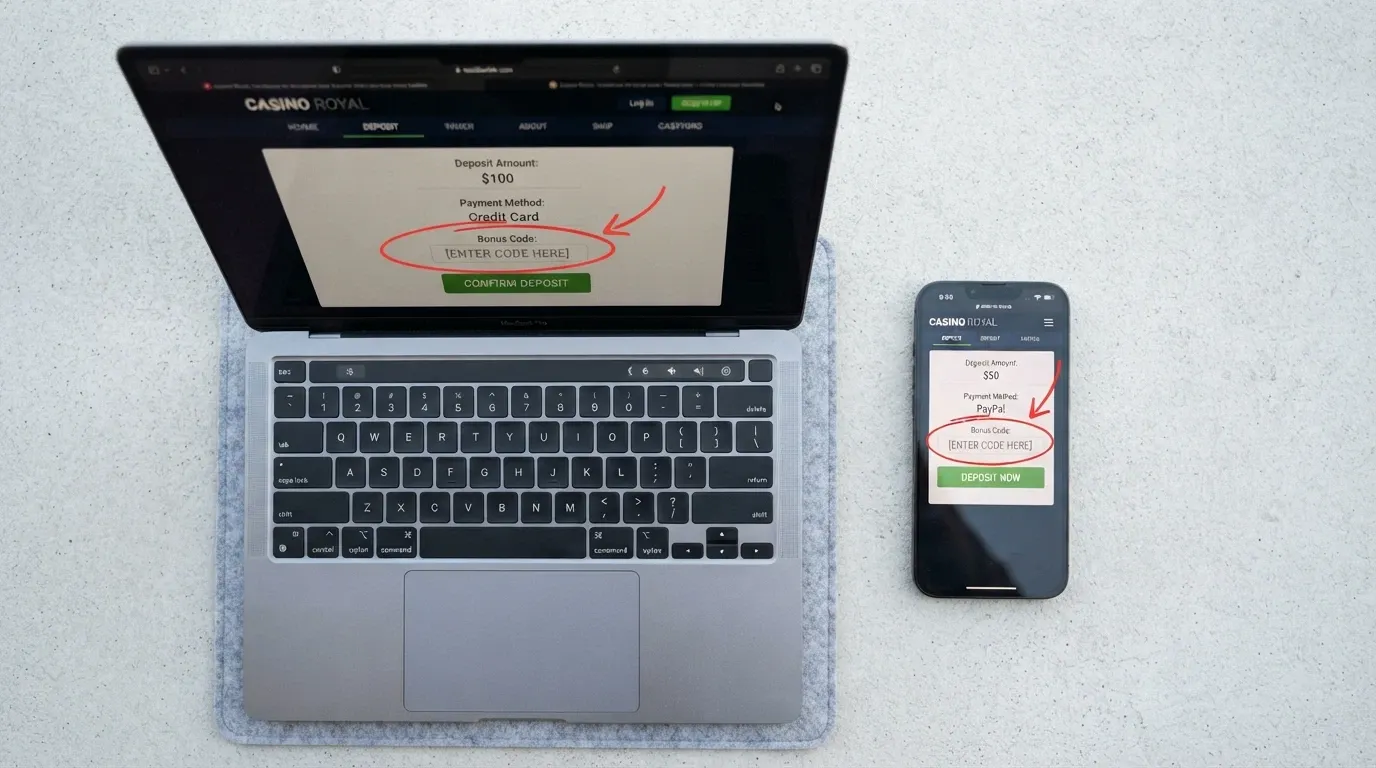
Mobile is not the obstacle it once was. The cashier on a phone browser carries the same field as the desktop cashier. The in-app deposit flow on a casino’s own app carries the same field in roughly the same place. What does change on mobile is prominence. Mobile designs bury the field below the deposit button, behind a banner, or under a “do you have a promo code?” link — because on a small screen, asking for a code is not the action the casino wants to make easy. A player who already has a code should look for the registration form’s “bonus code” field before submitting, and for the cashier’s equivalent before confirming a deposit.
The third entry point — the promotions page — exists because some operators do not put codes on every campaign. A free-spin drop offered to an existing player may sit on the promotions page only, with its own input box. Checking the promotions page after registering is the cheapest way to find codes the cashier does not ask for.
A practical note: codes are case-sensitive in some operators’ setups and not in others. The same string pasted in the wrong case will silently fail to apply at some casinos, and the deposit will go through without the bonus attached. Players who do not see the bonus land after entering a code have not been cheated — they have either missed a field or mistyped the string, and either error costs only the time to contact support.
Your Casino Bonus Code: What the Offer Is Worth (and What It Isn’t)
A bonus code unlocks a set of terms, and the value of the deal sits in those terms — not in the headline number on the offer’s banner. The marketing department has the easy job. The headline it puts on the front of the campaign is almost always the ceiling the player has the worst chance of reaching. What carries the offer is the wagering multiple, the game weighting, the max cashout and the expiry date. The first part of this guide explained the mechanics. This part names the four bonus-code types an Australian player is most likely to meet, and walks through the term that prices every one of them.
Specific bonus amounts, wagering multiples and spin counts for any of the ten operators below could not be confirmed independently for this article. The descriptions that follow are about the type of offer, not about a specific brand’s specific terms. A player considering any single one of these ten should still read that brand’s own promotion page before entering a code.
No-deposit bonus codes — the offer that costs you nothing upfront
The no-deposit bonus is the rarest code type an Australian can find at an offshore casino, and it is the one most likely to come back to bite. The casino gives the player a small amount of bonus credit, or a small bundle of free spins, in exchange for opening an account and confirming an email or phone number. No deposit is required. That is the trade in plain terms: the casino gets registration data, the player gets a chance to play a slot or two before deciding whether to commit money.

Terms on no-deposit offers are tighter than on deposit offers, not looser. Wagering requirements run higher, often well into the multiple figures. Maximum cashout caps are always present and almost always small — sometimes only two or three times the bonus amount itself, sometimes capped in absolute dollar terms. Validity windows are short: a no-deposit bonus that does not get started within twenty-four to seventy-two hours can expire; one that does get started must clear its wagering requirement quickly or the locked balance gets removed. The terms reflect the trade. The casino is giving away cash it can otherwise keep; the cashout cap and the tight window are the part of the price the player does pay.
Players who already have a BetStop exclusion cannot use no-deposit offers at any Australian-licensed operator. At an offshore casino — which is the only place an online no-deposit offer is reachable from Australia at all — the casino does not connect to BetStop. That limitation of self-exclusion is covered in the player-protection section of this guide; what matters here is that the offer is not a route around anything. It is the casino’s standard acquisition tool, scaled down to the price of a registration.
Deposit match bonus codes — how much the casino adds to your stake
The deposit match is the workhorse offer of offshore casinos. The headline reads something like “100% up to A$500” or “200% up to A$300”, and what it says in plain terms is: deposit X, the casino adds up to Y on top, the combined balance is what you play with.
The percentage is loud and the cap is quiet. A “200% up to A$300” deposit match is smaller than a “100% up to A$1,000” one once the cap is reached, even though the percentage is twice as high. The match is the multiplier; the cap is the ceiling. The two together set what the deposit is worth.
Wagering is on the combined amount. By illustration, on a 100% match at A$200, the player deposits A$200, the casino adds A$200, and the wagering requirement — wherever it lands in the thirty-to-fifty-times range that this market tends to cluster around — applies to the A$400 total, not to the A$200 bonus alone. That detail is the one that turns a “great offer” into an arithmetic problem. A heavy match percentage with a heavy wagering multiple on the combined balance can mean the player is grinding through their own deposit plus the bonus at the same time, against an edge that never stops running.
The other lever is game weighting. Slots almost always count 100% against wagering. Table games, live dealer games and most non-slot products count 5–20% or zero. A player who accepts a deposit match and plans to play blackjack has, in most cases, accepted an offer they cannot meaningfully complete — because 5% game weighting against a 40x wagering requirement converts twenty spins into one.
Free spins and free chip bonus codes
Free spins are the most prominent offer type at offshore casinos, and they are the one with the most conditions hidden in plain sight. A free spin bundle is a specific number of plays — 50, 100, 250, sometimes more — on a specific slot title (or a specific provider’s catalogue), at a specific spin value, with winnings from those spins paid as bonus funds subject to wagering before they can be withdrawn.
The spin value is the part that looks small but matters. A 100-spin bundle at A$0.10 per spin is A$10 of wagering volume before the slot’s RTP has even had a chance to act on it. The same bundle at A$0.20 is A$20 — not twice as generous in any meaningful sense, because the wagering requirement on the spin winnings is the same. A player comparing two offers at two different brands should compare what the spin winnings convert to, not the spin count.
Free chips are the cash version of the same mechanic, with no slot attached. A free chip code credits a fixed sum of bonus money — typically A$10 to A$50 — to the player’s bonus balance, with the same wagering and the same cashout cap that any deposit offer would carry. Free chips have no spin value to discount; their worth is exactly what the bonus amount says, less the wagering that turns it from locked credit into withdrawable cash.
The most important thing to verify before claiming either is which game the spins are tied to. Bonus funds tied to a specific slot can usually only be cleared on that slot, and slots at different volatility tiers eat bankrolls at different rates. A high-volatility bonus slot with a 96% RTP and a 5x wagering requirement is a fundamentally different bet from a low-volatility slot with the same RTP and the same 5x — because the way the bonus gets cleared, spin by spin, plays out differently.
Welcome and registration bonus codes
The welcome package is the operator’s largest offer to a new player, and its terms are spread across multiple deposits. A typical shape runs across the first three deposits — the casino matches the first by some percentage up to some cap, then a smaller percentage on the second, then a third sometimes paid in bonus funds and sometimes in free spins. The full package is described on the promotions page as a single number — “up to A$1,500 + 200 free spins” is a recurrent shape — and the line-by-line terms sit several clicks further in.
Registration codes and sign-up codes are different names for the same kind of string. A registration code is entered at the account-creation step; a sign-up code is entered when making the first deposit. Some packages distinguish the two — different codes for the account-opening step and the first deposit. Most do not.
Reload bonuses are what the casino offers to existing players after the welcome package is over. They are smaller by design — the casino has already paid the acquisition price; the reload is closer to a retention discount than to a free handout. A player who intends to play at one operator for more than the welcome window should expect the second and third offers to be smaller than the first, and the reload to be smaller again.
What the welcome package does not include is often more interesting than what it does. Most welcome bonuses exclude live dealer games, many table games, and a long list of slots the operator has flagged as “bonus-abuse-resistant”. The eligible games list, buried near the bottom of the promotion’s terms, is the constraint that decides whether the welcome package can actually be cleared in the time the validity window allows.
How wagering requirements change what a bonus is really worth
A wagering requirement (sometimes called a playthrough) is the multiple that a bonus balance — and sometimes the deposit too — must be turned over before the resulting cash can be withdrawn. By illustration: a 35x bonus wagering requirement on a A$100 bonus means A$3,500 of qualifying bets; the same 35x on a combined bonus-and-deposit balance of A$200 means A$7,000.
The two structures do very different things. A bonus-only wagering requirement locks the casino’s own money in play until cleared; the deposit remains withdrawable in cash the whole time. A bonus-and-deposit wagering requirement locks the player’s own deposit in play alongside the bonus. Offshore deposit-match offers at Australian-facing sites typically wager on the combined balance. That detail is buried in the terms. It is the single most important number on the page the player should be reading.
Bonus-only wagering at 30–40x is steep but not unusual. Combined wagering at 30–40x on a 100% match is the shape of an offer that effectively costs the player to enter, because the player is grinding through their own money to clear bonus money the casino has already given them.
Two secondary terms sit on top. Max cashout caps the winnings that can be withdrawn from a bonus — typically A$100 to A$500 on no-deposit offers, often removed on deposit matches but not always. Game weighting does the work of moving which products count toward the wagering requirement. Slots at 100% are the only meaningful path to clearing most offers; table games and live dealer at 5–20% extend the wagering requirement by between five and twenty times the slot equivalent.
Validity windows are the constraint the casino adds last. A bonus with a 30x wagering requirement on a 100% match has to be cleared in seven, fourteen, or sometimes thirty days. The player who accepts such an offer and then plays slowly is the player who finds the bonus balance quietly removed at expiry.
The arithmetic question — “is this bonus actually worth claiming?” — is built from these four terms. Operators publish the wagering multiple, but they publish it small. The headline percentage is loud; the multiple is quiet; the game weighting table is silent; the max cashout is a footnote. The order in which the terms are buried is the order in which they want the player not to read them.
The 10 Offshore Casinos Australians Are Using for Bonus Codes
Ten offshore casinos sit at the centre of the Australian online casino market. None of them holds an Australian licence, and none can, because no licence for online casino exists anywhere in this country. Every bonus code an Australian player can enter at any of these operators was issued by an entity regulated outside Australia, with player funds held outside Australia, and with recourse if something goes wrong sitting outside Australian consumer law.
What the table below records is the operator set and their legal status in Australia. Specific bonus terms for each operator could not be independently verified for this article; that detail is in the prose beneath the table, not in a column that would invite a guess.
| Operator | Legal Status in Australia |
|---|---|
| Rocket Play | Offshore — no Australian licence |
| Skycrown | Offshore — no Australian licence |
| Royal Reels | Offshore — no Australian licence |
| WinSpirit | Offshore — no Australian licence |
| Stake | Offshore — no Australian licence |
| Rainbet | Offshore — no Australian licence |
| Scream Casino | Offshore — no Australian licence |
| FairGO | Offshore — no Australian licence |
| Bizzo Casino | Offshore — no Australian licence |
| Rocket Casino | Offshore — no Australian licence |
Each operator write-up below states the offshore status plainly, points to what to check on the operator’s promotions page, and closes on a verdict on what kind of player each one suits — given that the protections an Australian licence would carry do not apply at any of them.
Rocket Play
Rocket Play is an offshore casino accessible to Australian players, and like every operator on this list it holds no Australian casino licence because no such licence exists. The brand promotes a welcome package spread across the first deposits; the specific match percentages, wagering multiples and free-spin allocations could not be verified for this article and should be confirmed on Rocket Play’s own promotions page before any code is entered.
What to verify before claiming a bonus code at Rocket Play spans the same five terms that decide every offer on this list: the wagering multiple on bonus funds, and whether it applies to bonus only or to the deposit plus bonus; the eligible games list, with slots at 100% and table games typically at 5–20%; the maximum cashout cap on any no-deposit offer; the validity window for clearing the bonus; and the payment methods the cashier accepts, because a site that takes credit cards or cryptocurrency is operating outside the Australian framework by definition.
Rocket Play is one of ten names on this list, all sharing the same regulatory vacuum. A player whose decision turns on whether an Australian body will do anything about a refused withdrawal should know the answer before depositing: nothing.
Skycrown
Skycrown is an offshore casino accessible from Australia with no Australian casino licence. The promotions page advertises a multi-deposit welcome package and a rotation of reload offers for existing players. None of those specific terms could be confirmed independently for this guide.
Before entering any Skycrown bonus code, a player should read the wagering requirement, the eligible games and the maximum cashout figure as stated on the operator’s promotions page at the moment of deposit. Bonus terms change week to week at most operators in this category, and what was true when one page was published may not be true when the code is actually entered.
Skycrown suits a player who wants a wide game library and accepts that the cost of access is the absence of any Australian regulatory backstop. The cost is structural, not a term the operator can be negotiated around.
Royal Reels
Royal Reels is an offshore casino aimed at the Australian market, and like the rest of the operators on this list it holds no licence to offer online casino games to Australian residents. The brand leans on a slot-heavy welcome offering; the specific terms could not be confirmed for this article and should be checked at the time of claiming.
The trade is the same as the trade at every other name here. A bonus code unlocks a balance the operator can void, freeze or refuse to pay out, with no Australian body authorised to recover the funds on the player’s behalf. If the site is added to the ACMA’s blocking list, the player’s balance can become inaccessible. If a player wants to self-exclude, BetStop does not connect.
Royal Reels is a slot-heavy welcome offer sitting on top of an absent Australian framework. A player who has weighed the structural trade and decided the ceiling is large enough to make the offer worthwhile has chosen their ground.
WinSpirit
WinSpirit is an offshore casino accessible to Australian players with no Australian casino licence. The brand promotes a multi-deposit welcome package and ongoing free-spin promotions targeted at the Australian market. The specific terms, wagering multiples and spin values could not be verified for this guide.
What separates WinSpirit from a hypothetical licensed alternative is the absence of every protection an Australian licence would carry: no BetStop coverage, no Australian regulator to complain to, no ATO certainty about the operator’s tax position, no Australian complaints body for a refused withdrawal. The site can also be added to the ACMA’s blocking list at any time, leaving funds on account inaccessible.
WinSpin’s offering is shaped like the rest of the offshore market — multi-deposit, bonus-and-deposit wagering, free-spin drops — but the value the offering delivers is set by terms the player cannot verify before signing up. The verification the offering asks for is the cost of entry.
Stake
Stake is one of the larger crypto-facing offshore casinos accessible to Australian players. It holds no Australian casino licence and, given the credit-card and cryptocurrency payment ban for online wagering in force since 11 June 2024, its crypto orientation is itself a tell that it sits outside the Australian regulatory framework. The specific bonus-code offering on Stake could not be independently verified for this article.
The arbitration question most relevant to Stake is not promotion size — it is currency. Australian players who deposit in Australian dollars will be exchanging into crypto or into the operator’s internal currency, then exchanging back on withdrawal. Both exchanges carry their own fees and their own price. A bonus code at Stake is the operator’s standard new-player tool; the additional cost is the FX layer the player should price in before committing.
Stake is built for a player who already operates in the crypto deposit layer and treats the offshore framing as the cost of using it. Anyone comparing Stake to SportsBet on payment reach will conclude quickly; the comparison is structural, not negotiable.
Rainbet
Rainbet is an offshore casino accessible from Australia with no Australian casino licence. The brand promotes a welcome bonus structure aimed at the Australian market; the specific match percentage, wagering multiple and max cashout could not be verified for this guide.
The standard warning applies with full force. Rainbet does not connect to BetStop. There is no Australian body to which a player can escalate a dispute about a refused withdrawal. The site can be blocked by Australian ISPs at the ACMA’s direction, and blocked sites have in the past left balances on player accounts inaccessible. The 1,564-site ACMA blocking list, in operation since November 2019, grows; Rainbet’s presence on it tomorrow cannot be ruled out by anything in the operator’s own terms today.
Rainbet is one of ten offshore casinos on this list, indistinguishable in regulatory standing from any of the others. The choice between them is a choice of game library and bonus shape; it is not a choice of safety.
Scream Casino
Scream Casino is an offshore casino accessible to Australian players with no Australian casino licence. The branding is louder than the others on this list; the legal status is identical to all of them. The specific bonus-code terms could not be verified for this article.
A standard offshore offering applies. Bonus codes unlock welcome packages, reload bonuses and free-spin drops on eligible slots. Wagering requirements, cashout caps and validity windows are stated on the promotions page; players should read them as a single block, not skim the headline and ignore the rest.
Scream Casino’s branding outruns its regulatory standing, which is the same as every other operator on this page. A player attracted by the marketing deserves to read the terms they have skipped.
FairGO
FairGO is an offshore casino that explicitly markets itself to Australian players — even its name signals the audience — but it sits in the same regulatory position as the other nine operators in this guide. It holds no Australian casino licence, because no such licence exists, and an Australian player depositing at FairGO is doing so outside the Australian regulatory framework.
What an Australian player should verify before entering a FairGO bonus code is the wagering multiple, the eligible games list, the maximum cashout figure on any no-deposit offer, and the validity window for clearing the bonus. The site offers standard payment methods; the credit-card and crypto payment ban in force in Australia since June 2024 means that any Australian player encountering those options is operating outside the licensed market.
FairGO is the most visibly Australian-facing brand on the list, but visibility is not a substitute for licence. A licence for online casino is what FairGO does not hold, and the marketing does not supply what the licence would have provided.
Bizzo Casino
Bizzo Casino is an offshore operator without an Australian casino licence. The brand publishes a multi-deposit welcome package and reload offerings on its promotions page; specific match percentages, wagering multiples and free-spin allocations could not be verified for this article.
A player comparing Bizzo to the other nine operators on this list will find the offering structure familiar — offshore welcome package, rotating reloads, free-spin drops on selected slots. What a player comparing them will not find is any meaningful regulatory difference. They all sit outside the Australian framework. They all face potential site-blocking. They all refuse withdrawals on terms the player has accepted, with no Australian body to escalate to. What differs is bonus size and game library, and that is the comparison worth making.
Bizzo Casino rounds out the short list as another offshore operator with a multi-deposit welcome package. The comparison to make is on offer terms, not on regulatory standing — they have none of it, equally.
Rocket Casino
Rocket Casino is an offshore casino accessible to Australian players with no Australian casino licence, and it closes this list the way every other operator opened it: with the same regulatory baseline and the same absence of Australian consumer protection. The brand’s bonus-code terms could not be confirmed for this guide and should be checked on the operator’s promotions page at the moment of deposit.
A note on the player’s position: among the ten operators in this ranking, the differences are in bonus size, game library, payment methods and reputation — not in regulatory standing. They are all offshore. They are all outside the Australian framework. They are all reachable from Australia today, with no guarantee any one of them is reachable tomorrow. The comparison a player makes among them is a comparison of offers, not a comparison of safety.
Rocket Casino closes the list as a route inside the offshore market. What the player chooses between the ten is bonus size, library, payment methods and reputation — never safety. They are equal on that variable, and equal at zero.
Why Online Casino Bonus Codes Sit Outside Australian Law
The Interactive Gambling Act 2001 makes providing an online casino to a person physically in Australia an offence. The Act does not name the player as the offender; it names the operator. That distinction is the hinge on which everything in this guide turns: the providers of every bonus code an Australian can enter today are breaking Australian law by offering their service; the player is not prosecuted for using it; the player is also not protected by any Australian body if the service goes wrong.
The next sections explain the statute itself, the regulator that enforces it, the reforms that arrive in 2026, and what the prohibition means in practical terms for a player who chooses to use an offshore bonus code anyway.
The Interactive Gambling Act 2001 — the prohibition in plain terms
The Interactive Gambling Act 2001 is the federal statute that prohibits online casino games, online pokies and in-play sports betting from being provided to persons in Australia. Section 15 of the Act sets the offence at the provider — not the individual player — but the practical effect is wider than that distinction suggests. With no Australian licence available for online casino anywhere in the country, no service an Australian player uses can be licit at the supply side.

What the Act permits is a different and narrower set of products. Wagering on racing and sporting events placed before the event begins is licensable and licensed — through state and territory wagering regimes. Lotteries and keno are also permitted under state regulation. Those products do not include online casino games, which is the entire subject of this guide.
The de facto national online wagering regulator is the Northern Territory Racing and Wagering Commission, administered through Licensing NT, with licences running for terms of up to twenty years. It is important to be precise about what that licence covers. It covers online bookmaking — wagering on sport and racing — not online casino. SportsBet, Bet365, Ladbrokes, TABtouch, PointsBet, Neds, Betr, Picklebet and Betfair hold state or territory wagering licences and are not online casinos. Land-based casinos — Crown, The Star and others — are separately state-licensed; their licences cover their physical premises, not any online casino product.
The minimum age for all commercial gambling in Australia is 18. The IGA, in its prohibition of online casino supply, attaches no consumer protection to the offshore product an Australian player ends up using instead. The protections a player gives up by using an offshore casino are the subject of the next sections of this guide.
ACMA enforcement — site-blocking, fines and withdrawals from the market
The Australian Communications and Media Authority — ACMA — is the federal regulator responsible for enforcing the Interactive Gambling Act. ACMA’s enforcement powers cover investigations, formal warnings, civil penalty proceedings, and referral to the Australian Federal Police for criminal prosecution in serious cases. ACMA also has, since the Interactive Gambling Amendment Act 2017, the power to direct internet service providers to block illegal gambling websites at the DNS level.
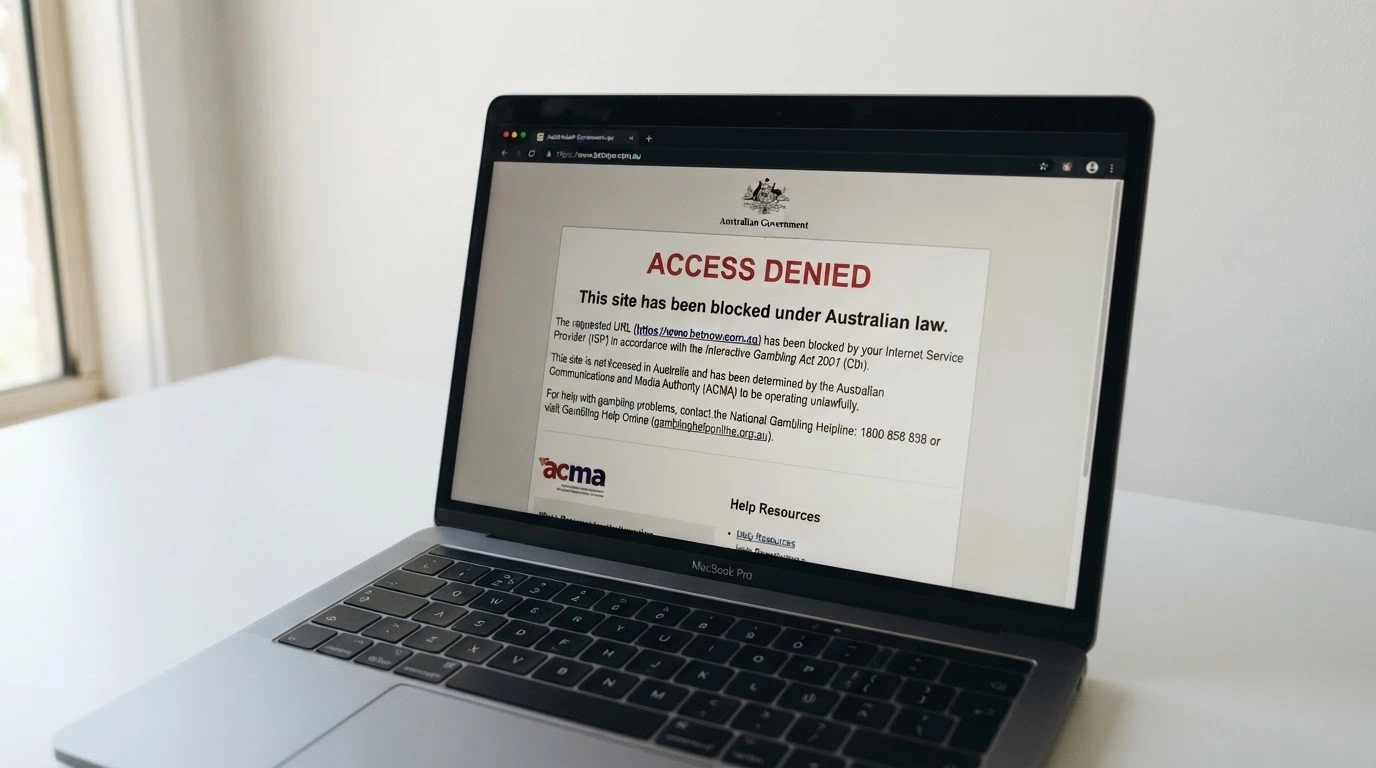
The scale of enforcement is substantial and ongoing. Since the first blocking request in November 2019, 1,564 illegal gambling and affiliate websites have been blocked by Australian ISPs as of March 2026. More than 225 illegal gambling services have withdrawn from the Australian market voluntarily since 2017. Both figures continue to climb.
What that scale does to an Australian player with funds at an offshore operator is the part ACMA’s announcements do not usually spell out. A site added to the blocking list does not return player balances to its customers; it is a domain-name blocking direction, not a wind-down procedure. Players with funds on a blocked site have, on past episodes, had balances become inaccessible for as long as the blocking remains in force. Some operators reopen under new domains; some do not; some simply close the Australian-facing service and the player’s account with it. ACMA’s actions remove access to the operator; they do not enforce player remedies against the operator.
The relevant fact for a player considering a bonus code today: the 1,564 figure is a count up to a single date in March 2026, and the count has been rising every quarter since. There is nothing in any operator’s terms today that prevents the brand from being added to the blocking list tomorrow.
The 2026 reforms — what changes on 1 January 2027
The Interactive Gambling Amendment (Gambling Reform) Bill 2026 passed Parliament on 19 August 2026. Its measures commence on 1 January 2027. The reform is the largest package of changes to Australian gambling law in a decade, and most of its consumer-facing provisions address the offshore casino problem through mechanisms that target operators’ reach into the Australian market.
The advertising and inducement rules are the most visible part. From 1 January 2027, no more than three wagering advertisements per hour may be broadcast between 6:00 am and 8:30 pm. A live-sport blackout applies to wagering advertising from fifteen minutes before to five minutes after a live event. Radio advertisements for wagering are barred during school drop-off and pick-up times. Broadcasting sporting odds is banned outright; online wagering advertisements may only be shown to logged-in, age-verified users who have not opted out. Wagering advertisements inside sports venues or on uniforms are prohibited. Athletes, celebrities and influencers are barred from promoting wagering products.
The inducement rules run separately and directly target bonus-code marketing. From 1 January 2027, direct marketing of inducements — sign-up offers, referral bonuses, free bets — is prohibited for fourteen days after a customer signs up with an Australian-licensed wagering operator. It is prohibited for three months after a person deregisters from BetStop. It is prohibited indefinitely for customers identified as at-risk.
The mechanism that reaches offshore operators is the payment-provider authority. From 1 January 2027, banks and licensed payment providers gain express statutory authority to block transactions to illegal gambling operators. Credit-card and crypto deposits have already been banned for online wagering since 11 June 2024 under the Interactive Gambling Amendment (Credit and Other Measures) Act 2023, with non-compliance penalties of up to A$247,500. The 2027 change extends the principle from banning specific payment methods to empowering banks and payment providers to decline or block transactions on their own initiative.
None of these rules bind an offshore casino. A Curaçao- or Malta-licensed operator offering bonus codes to Australians does not change its advertising or its inducements because Australian law changed. What the reforms do is reduce the tools the operator has to reach an Australian player, by limiting licensed marketing channels and empowering payment providers to refuse the deposits that fund the account. The casino offering the bonus code in 2026 is the same casino offering the bonus code in 2027; the path the Australian player takes to reach it is the part the law is closing.
What Australians give up when playing at an offshore casino
The previous sections set the legal framework. This section names what the framework would have given a player at a licensed Australian operator, and what an Australian playing at an offshore casino leaves behind. None of the items below is theoretical. Each is a consumer protection attached to an Australian wagering licence that an offshore operator does not provide.
| Protection | Licensed Australian Wagering | Offshore Casino |
|---|---|---|
| Australian licence | State or territory wagering licence (NTRWC for online bookmaking); licence exists for racing and sport only | None — no online casino licence is issued in Australia |
| Regulator oversight | State or territory wagering regulator; ACMA enforces the IGA online | None in Australia; an offshore regulator (commonly Curaçao or Malta) is the only recourse |
| BetStop coverage | Single registration excludes from every Australian-licensed online and phone wagering service | BetStop does not connect; an offshore casino will continue accepting a self-excluded player |
| Consumer complaint body | State or territory regulator, with escalating avenues | ACMA can pursue the operator but cannot compel a payout or recover player funds |
| Payment method rules | Debit card, bank transfer, PayID/Osko and BPAY only; credit cards and crypto banned since 11 June 2024 | Credit cards and crypto are commonly accepted — a tell that the site is outside Australian rules |
| Site-blocking risk | None — the operator is licensed | The operator can be added to the ACMA’s blocking list at any time; 1,564 sites already blocked since November 2019 |
| Tax treatment of winnings | Ordinary punter winnings are not assessable income (ITAA 1997 s 6-5) | The same — non-assessable for an ordinary punter; the rule is identical regardless of licensing |
The table covers the structural differences. What it does not cover is the asymmetric cost. An Australian who has a dispute with SportsBet over a refused withdrawal can escalate through state and territory regulators; an Australian who has the same dispute with an offshore casino has, in practice, no escalation path. ACMA can investigate the operator, can pursue civil penalties, can refer the matter for enforcement; ACMA cannot recover player funds. The same pattern runs across every row in the table — Australian-licensed operators carry a set of obligations that, taken together, set a floor of protection. Offshore operators do not.
The payment-method detail is its own tell. An Australian who is asked for a credit-card or cryptocurrency deposit by a gambling site is, in the working sense recognised by the regulation regime, being served by someone outside the Australian rules. Credit cards, credit-related products and digital currency (crypto) have been banned as payment for online wagering in Australia since 11 June 2024. Legal deposit routes at Australian-licensed operators are debit card, bank transfer, PayID, Osko and BPAY, with identity verification required. A site offering credit-card or crypto deposits is offering them because it is not bound by the ban — and an offer bound by no rule is an offer the player has limited ability to enforce.
The site-blocking risk runs in the same direction. The ACMA has directed ISPs to block 1,564 illegal gambling and affiliate websites since November 2019; more than 225 illegal services have withdrawn from the Australian market since enforcement strengthened in 2017. An offshore casino can be added to that list at any time. When it is, balances on player accounts do not return themselves; the blocking direction is not a wind-down procedure.
Tax treatment of winnings is the one item where the offshore player and the licensed player end up in the same place. Under section 6-5 of the Income Tax Assessment Act 1997, betting and gambling winnings are not assessable income for an ordinary punter, and losses are not deductible under section 8-1. That holds whether the punter bets at SportsBet or at an offshore casino — provided the punter is not carrying on a business of betting, which most are not. No Australian case has held ordinary punter winnings assessable. The tax column is the one column where the licensed-versus-offshore comparison is a tie, and that is because the rule in question is not about licensing — it is about the player’s status as a punter or a business.
The Safety Net You Give Up With Every Offshore Casino Bonus
The previous section listed what an Australian licence gives an Australian player. This section looks at the safety net directly — at self-exclusion, deposit limits, activity statements and the support services a player can reach regardless of where they play. Each of these protections is shaped by the IGA framework; each one stops at the Australian border; each one matters.
BetStop and offshore casinos — why self-exclusion has a blind spot
BetStop is Australia’s National Self-Exclusion Register. It went live in August 2023 and, in a single registration, excludes a person from every Australian-licensed online and phone wagering service. A BetStop registrant cannot open a new account with a licensed wagering operator while their exclusion is active, and existing wagering accounts are deactivated. Operators must not send marketing to excluded persons.
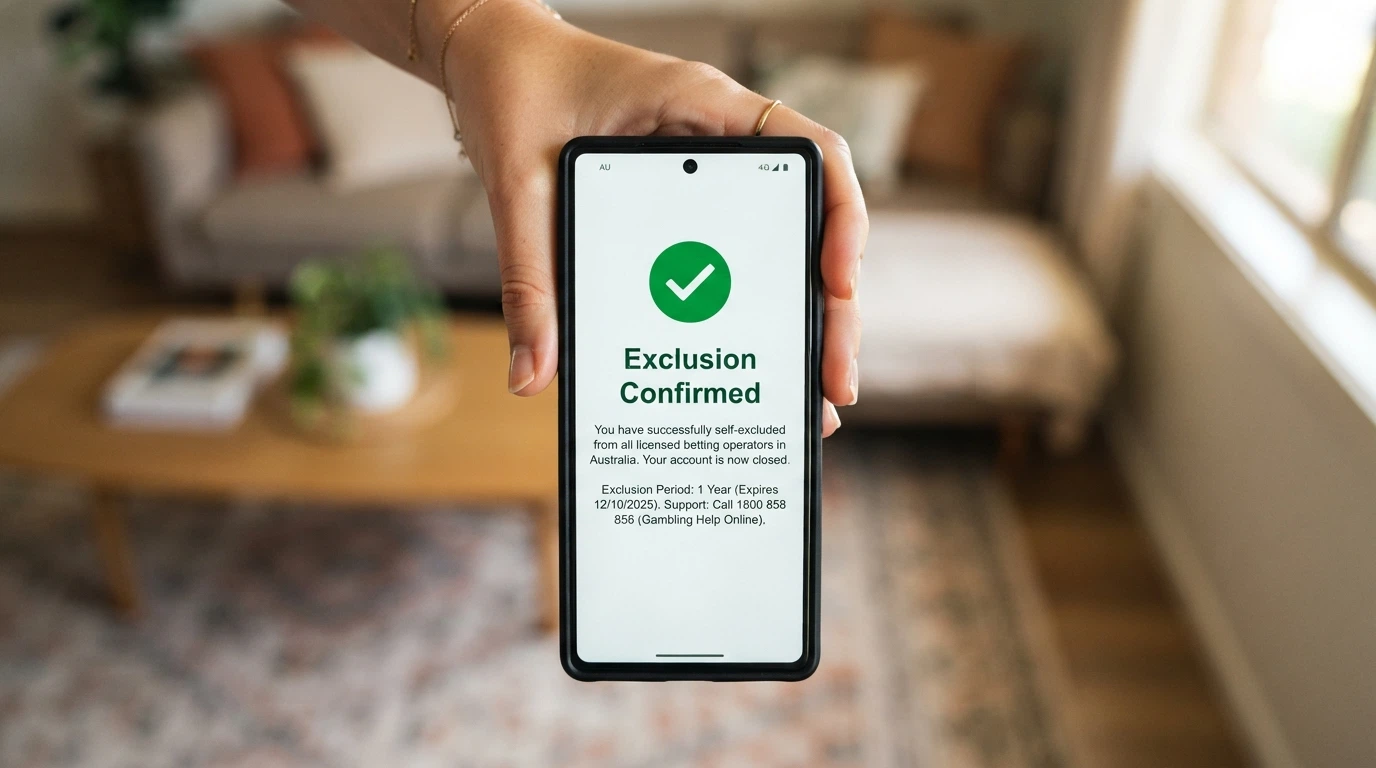
BetStop has been used at scale. As at 31 July 2026, the register had received 67,480 registrations, of which 41,290 exclusions were still active — more than sixty per cent of total registrations. Seventy-eight per cent of registrants were under forty years old at the time of registration, and thirty-eight per cent chose a lifetime exclusion. The age distribution matters because it tells you who is using it. The lifetime share matters because it tells you how many have decided it is a permanent decision, not a cooling-off.
The BetStop limit that matters for this guide is its reach. BetStop binds Australian-licensed wagering services only. An offshore casino is not connected to the register. A person who registers with BetStop and then attempts to play at an offshore casino will not be stopped by their own exclusion; the offshore casino has no way of knowing about it. The exclusion is honoured at the door of the licensed market, not at the door of every site that offers a bonus code to Australians.
The 2026 reform package begins to close this asymmetry, but only at the marketing side. From 1 January 2027, direct marketing of inducements is prohibited for three months after a person deregisters from BetStop. An offshore casino cannot, after that date, market to an Australian who recently came off BetStop. The casino can still accept that person if the person opens an account directly. BetStop’s blind spot on the offshore side remains.
Deposit limits and activity statements — tools that don’t travel offshore
Australian-licensed wagering operators are required to offer customer-set deposit limits and activity statements. A player can set a daily, weekly or monthly cap on deposits, and the operator must enforce it. The activity statement is the corresponding record: a periodic summary of deposits, withdrawals, wagers and net position, sent to the player on request or on schedule. Both tools are part of the licensing framework, not part of the product.
Deposit limits and activity statements do not travel offshore. An offshore casino may offer them; it is not required to. An offshore casino that does offer them can change the offer’s terms or quietly remove them in a subsequent update. A player at an offshore casino relying on a deposit limit is relying on a tool the operator is not obligated to provide, and that an operator under financial pressure will sometimes quietly scale back.
The credit-card and crypto payment ban that came into force on 11 June 2024 is the structural layer beneath the deposit-limit tool. Banning credit cards and crypto as payment methods for online wagering removes the payment methods most associated with deposits that exceed the player’s ability to repay. The ban’s reach is limited to Australian-licensed operators; offshore operators accepting credit-card or crypto deposits are operating outside that limit, and the deposits they accept are not subject to it.
The 2027 reform package adds a further lever. From 1 January 2027, banks and payment providers gain express authority to block transactions to illegal gambling operators. That authority is the closest the framework comes to enforcing deposit limits at offshore operators: a bank acting on the new power can decline a transaction to a flagged operator the same way it declines a transaction to a sanctioned entity. The mechanism is not a deposit cap on the player; it is a transaction block by the bank. It does the same job by a different route.
For a player at an offshore casino in 2026, none of these protections apply. The deposit limit is a setting on the operator’s own platform; the bank block does not yet exist; the credit-card and crypto ban cannot reach the offshore operator’s cashier. What protects the player is whatever self-discipline the player brings to the session.
Where to get help — the Gambling Helpline and support services
The safety net that does not require an Australian licence is the help infrastructure. The National Gambling Helpline — 1800 858 858 — is free, confidential and staffed twenty-four hours a day, seven days a week. Gambling Help Online — gamblinghelponline.org.au — provides online chat and counselling. Both services are funded by the Australian government and are available regardless of whether the caller has ever claimed a bonus code.

The figures behind why this infrastructure exists are uncomfortable to read. According to the Australian Institute of Health and Welfare, about 2.1 per cent of Australian adults — roughly 430,000 people — experience problem gambling, with a further 1.8 per cent at high risk. Those numbers are not the populations of offshore casinos specifically; they are the population that the offshore market — and the licensed market alongside it — is operating in. An industry that captures problem gamblers disproportionately is an industry the problem-gambling data describes.
A player who has registered with BetStop and recognises the offshore blind spot should not treat the offshore casino as a workaround. BetStop exists because the Australian framework determined that an exclusion register is one of the more effective interventions in problem gambling; an offshore play session bypasses that exclusion at the moment the player is least equipped to bypass it. The Helpline number is the alternative workaround — the path to support that does not require the player to be playing.
The 1800 858 858 number is the single line on this page the reader cannot reach any other way. The Australian Communications and Media Authority can block offshore casinos; BetStop can exclude a person from the licensed market; ATO guidance can clarify the tax treatment of winnings. None of those can pick up the phone. The Helpline can.
How We Evaluated These Casino Bonus Code Operators
The ranking in this guide is built on the Australian regulatory framework. Every operator in the ten-name list was checked against the same legal standard: that no Australian licence exists for online casino, that every operator in the list is therefore offshore, and that the protections an Australian licence would carry do not apply at any of them. The basis for that check is the Interactive Gambling Act 2001, the ACMA’s enforcement data and site-blocking register, the BetStop registry figures published by the ACMA, the Australian Institute of Health and Welfare prevalence data for problem gambling, and the operator-tracking data identifying which offshore brands Australian players most commonly access.
Within that fixed baseline, the ranking orders the operators by accessibility to Australian players and by bonus-code offering type as it appears on the operators’ own platforms. Specific bonus amounts, wagering multiples, free-spin counts, max cashout caps, bonus validity periods, game-provider rosters, licence jurisdictions and domain addresses for each operator could not be independently confirmed this run and are not represented as confirmed. No weightings or scoring methodology beyond the legal baseline was applied; the table at the head of the operator section records each operator’s name and legal status in Australia. The intent is to give a reader a defensible shortlist of the brands Australians actually use, with enough information on each to know what to verify before entering a code, and with the legal frame that makes the absence of an Australian licence explicit on the page rather than implicit.
Should You Claim an Offshore Casino Bonus Code? A Verdict from the Facts
The page above has walked through what a bonus code is, how it becomes a balance, what the offer’s terms do to the offer’s value, who the ten operators are, and why every one of them sits outside Australian law. The decision this guide cannot make is for the reader. What the guide can do is restate the trade.
The offer is real. A bonus code at an offshore casino unlocks a balance the operator is willing to put into play. A welcome package at 100% match up to a stated cap is the casino’s largest price concession to a new player. Compared to depositing at SportsBet or Bet365 on a non-promotional week, the offshore package looks larger.
The catch sits one click further in. The wagering requirement makes the actual value of the bonus a fraction of its headline. The cashout cap makes the maximum winnings less than they appear. The eligible-games list restricts the player’s ability to clear the bonus to slots the player did not pick. The validity window puts a deadline on the grinding. The marketing department does not put this on the offer’s banner.
The protection gap is the larger cost. No Australian licence exists for online casino, which means no BetStop coverage, no ACMA complaints mechanism for withheld winnings, no Australian regulator to refer a dispute to, no guarantee that a domain on the ACMA’s blocking list today is the same domain the player deposited at yesterday. The 1,564 sites blocked by ACMA is the scale of the enforcement problem; the 225 services withdrawn from the Australian market is the scale of the industry’s response to it. A casino that takes an Australian player’s deposit today can be unreachable by Australian ISPs tomorrow.
The prevalence data sits behind both. About 430,000 Australian adults experience problem gambling; the offshore market does not reduce that number. It operates in the same population, with the same at-risk share, and offers fewer of the protections the Australian framework was built around. BetStop has 41,290 active exclusions and cannot reach offshore casinos. The Helpline is free and 24/7 because the demand justifies it.
The only honest recommendation the page can give is that an Australian who chooses to claim an offshore bonus code should do so with the protections in mind. The page does not pick an operator, does not recommend a code, and does not send the reader to a place to play. The advice that holds regardless of which operator a player picks: read the terms page, find the wagering multiple and the max cashout figure before depositing, set a personal deposit limit that is smaller than the offer’s cap, and have the Helpline number — 1800 858 858 — written down before the casino is opened. If any of those actions feels like more than the bonus deserves, that is the answer the page is pointing at.
The page is not the only place to look. The Interactive Gambling Act 2001 is published on the Federal Register of Legislation; the ACMA’s blocked sites list is published at acma.gov.au; the BetStop register is at betstop.gov.au; the Australian Institute of Health and Welfare publishes the prevalence data behind the help services. A reader who wants to verify anything in this guide can verify it there.
Frequently Asked Questions
These are the questions Australian players most often bring to a casino bonus code. The answers summarise the law, the mechanism and the protections — and they end at the only place a complete answer can end.
Are bonus codes legal in Australia?
Bonus codes are not themselves illegal — text is not regulated. The Interactive Gambling Act 2001 prohibits providing an online casino to a person in Australia, which is what every issuer of a code does. Claiming a code is not an offence because the Act targets the provider. Australian consumer protection does not extend offshore.
How do I use a casino bonus code when signing up?
The bonus code goes in one of three places: the registration form, the cashier deposit screen, or the dedicated promotions page. Enter it before the deposit clears — most operators will not apply a bonus retroactively. A typed-in error is more often the cause of a missing bonus than a refusal.
What is a no-deposit bonus and can I claim one from Australia?
A no-deposit bonus unlocks a small credit or free-spin bundle without a deposit — the rarest code type an Australian can find. The terms reflect the trade: high wagering multiples, low cashout caps and short validity windows. The code is reachable; the conditions are what make it expensive in practice.
Can I self-exclude from an offshore casino?
Not through BetStop, which excludes a person from every Australian-licensed wagering service in a single registration but binds the licensed market only. Offshore casinos do not connect to the register and will not honour an Australian self-exclusion. The Helpline on 1800 858 858 is the support pathway the framework does guarantee.
What payment methods can I use to deposit at online casinos from Australia?
Debit card, bank transfer, PayID, Osko and BPAY are the legal deposit routes at Australian-licensed operators; credit cards and crypto have been banned for online wagering since 11 June 2024. Offshore casinos taking either method sit outside Australian rules — and from 1 January 2027 banks gain authority to block such transactions under the 2026 reform.
What happens if an offshore casino refuses to pay my winnings?
ACMA can pursue the operator, but cannot compel a payout, recover player funds, or hold balances in trust. The offshore licence carries its own dispute process, but enforcing a foreign judgement against an offshore operator is rarely worth the cost. Operationally, do not deposit more than you can lose without recourse.
Are casino bonus winnings taxable in Australia?
For an ordinary punter, no — section 6-5 of the ITAA 1997 leaves betting and gambling winnings non-assessable, with losses non-deductible under section 8-1. The rule is the same at Australian-licensed operators and at offshore casinos. The exception is the small group carrying on a betting business under ATO criteria in IT 2655.