
Offshore Bitcoin Casinos and What Australian Players Actually Get
Every operator on this page is offshore. No Australian online casino licence exists, because the Interactive Gambling Act 2001 makes providing one a criminal offence. Crypto is also banned as a wagering payment method since 11 June 2024 — meaning that any casino accepting bitcoin from an Australian player is, by definition, outside the Australian system. What this page covers, then, is the practical shape of playing at those operators: how the deposit route really works, what the welcome bonus actually costs once you turn it over, which brand pays out fastest, and what protections an Australian player is not getting.
Data current as of 16 October 2026, verified against ACMA enforcement records, the Federal Register of Legislation for the Interactive Gambling Act, and the operator terms pages cited throughout.
Table of Contents
- What Bitcoin Casino Play Actually Means for Australians
- How Bitcoin Casino Deposits Work in Practice
- Crypto-as-Payment: Anonymity, No-KYC and Provably Fair
- Best Offshore Bitcoin Casinos for Australian Players 2026
- Why Your 2026 Bitcoin Casino Bonus Is Smaller Than It Looks
- Games, Pokies and Live Tables You Can Play with Bitcoin
- Depositing and Withdrawing Bitcoin — Speed, Fees and the Real Route
- Mobile Bitcoin Casino Play — App or Browser?
- New Bitcoin Casinos Worth Watching in 2026
- The Legal Reality: Bitcoin Casinos and Australian Law
- Staying in Control: Responsible Gambling Tools and Where to Get Help
- Free-Play and Demo Mode: Trying Bitcoin Pokies Before You Deposit
- How We Selected and Ranked These Bitcoin Casinos
- What You Should Actually Do About Bitcoin Casino Play in Australia
- Frequently Asked Questions About Bitcoin Casinos in Australia
What Bitcoin Casino Play Actually Means for Australians
Bitcoin casino play in Australia is, in law, a prohibited transaction. The Interactive Gambling Act 2001 prohibits the provision of online casino games, online pokies and in-play sports betting to persons physically in Australia, and no licence for online casino exists anywhere in the country — not federally, not in any state or territory. The Act targets the provider, not the player. Australian players are not prosecuted for using offshore sites; the civil penalty regime lands on the operator, with daily fines up to A$2,475,000 for individuals and A$12,375,000 for corporations. What this means in practice is that the entire bitcoin casino market visible to an Australian player is an offshore market, and “accepts bitcoin” is the clearest signal that the operator is operating outside Australian rules.
The June 2024 amendment added a second prohibition. The Interactive Gambling Amendment (Credit and Other Measures) Act 2023 banned credit cards, credit-related products, and digital currency — cryptocurrency — as a payment method for online wagering, commencing on 11 June 2024. An operator that fails to enforce that ban faces penalties up to A$247,500. A casino that nonetheless accepts bitcoin from an Australian player is therefore in breach of two separate statutory provisions: providing a prohibited product, and accepting a prohibited payment. The market that exists does so because offshore jurisdictions licence the operator and enforcement happens at the network edge rather than at the wallet.
The deposit route is the practical piece that makes the rest of this page possible. The cleanest path in 2026 from an Australian bank account to an offshore casino wallet runs through a licensed Australian crypto exchange and a stablecoin transfer: funds leave the bank via PayID or OSKO to CoinSpot or Independent Reserve, are converted to USDT on the TRC-20 network, and arrive in the offshore casino’s deposit address in under sixty seconds. The reverse path converts USDT back to Australian dollars through the same exchange and returns to the bank account. That four-step route is what every other figure on this page is built on.
How Bitcoin Casino Deposits Work in Practice
The first hop is the bank. CommBank and Westpac restrict outbound transfers to known crypto exchanges, which means a direct BPAY or PayID to CoinSpot from those banks may bounce or sit pending review. ANZ and NAB flag without fully blocking — the transfer goes through but the bank records the destination. ING and Macquarie sit at the most permissive end of the spectrum and process exchange transfers without friction. Players banking with the Big Four’s most restrictive arms should expect to either switch banks, use a different funding source, or move funds through a fintech intermediary first.
Once the dollars have reached a licensed Australian exchange, the second hop is the conversion. CoinSpot and Independent Reserve both hold AUSTRAC registration and offer AUD-to-crypto conversion inside the platform. AUSTRAC’s Travel Rule reporting kicks in at AU$10,000 per transaction, which is the threshold above which exchanges must collect and verify counterparty identity. Below that line the onboarding friction is minimal. The exchange produces a USDT balance in the trader’s wallet — TRC-20 is the network of choice because it is the cheapest and fastest stablecoin route currently available.
The third hop is the casino deposit. USDT on TRC-20 processes in under sixty seconds with a network fee under A$0.50 — that is the stablecoin baseline. Bitcoin on-chain is materially slower: deposits take 10–60 minutes, withdrawals 15–60 minutes, with network fees of A$5 to A$20 depending on congestion. Solana sits at the other extreme — deposits in under thirty seconds, withdrawals under two minutes, fees of roughly A$0.10. Most featured operators accept a range of coins; Lucky Block accepts seven or more major tokens, BC.Game lists 155+, Rocket Play takes six (BTC, ETH, LTC, DOGE, BCH, USDT). Minimum deposits vary: BC.Game accepts from A$10, Stake from A$50, Lucky Block from as little as A$1 equivalent.
Crypto-as-Payment: Anonymity, No-KYC and Provably Fair
Crypto changes two things about how a casino runs. The first is identity. Most licensed Australian wagering operators are required to verify every customer’s identity at deposit. Offshore crypto casinos do not, because they are not bound by Australian identification rules and several have deliberately designed their signup flows around not collecting documents. Lucky Block takes email and password only — no ID upload required. KatsuBet runs no KYC for withdrawals under 0.5 BTC; Cloudbet extends that line to 2 BTC. BitStarz excludes Australian players from its no-deposit free spins under Section 1.6 of its Bonus Terms, but the broader account-verification posture at the operator is more relaxed than at any AU-licensed equivalent.
The second change is the audit trail. “Anonymity” on a public blockchain is closer to pseudonymity: every transaction is visible and permanent, but the wallet address is not, by default, attached to a named person. The casino sees your deposit address and your withdrawal address; the blockchain sees both. What this means is that a casino promising “complete anonymity” is overstating its own position — it knows who you are by deposit, even if it does not verify who you are by document.
A handful of crypto-native operators publish provably fair verification, a cryptographic mechanism that lets the player confirm after the fact that a given game result was not manipulated by the house. The technique is built into specific games rather than the whole platform, and not every title carries it. Where it is present, the casino publishes a server seed before play and a client seed the player supplies, and the outcome is deterministically derived from both. It is the closest thing the offshore market has to a substitute for the audit regime an AU-licensed wagering operator is required to run.
Best Offshore Bitcoin Casinos for Australian Players 2026
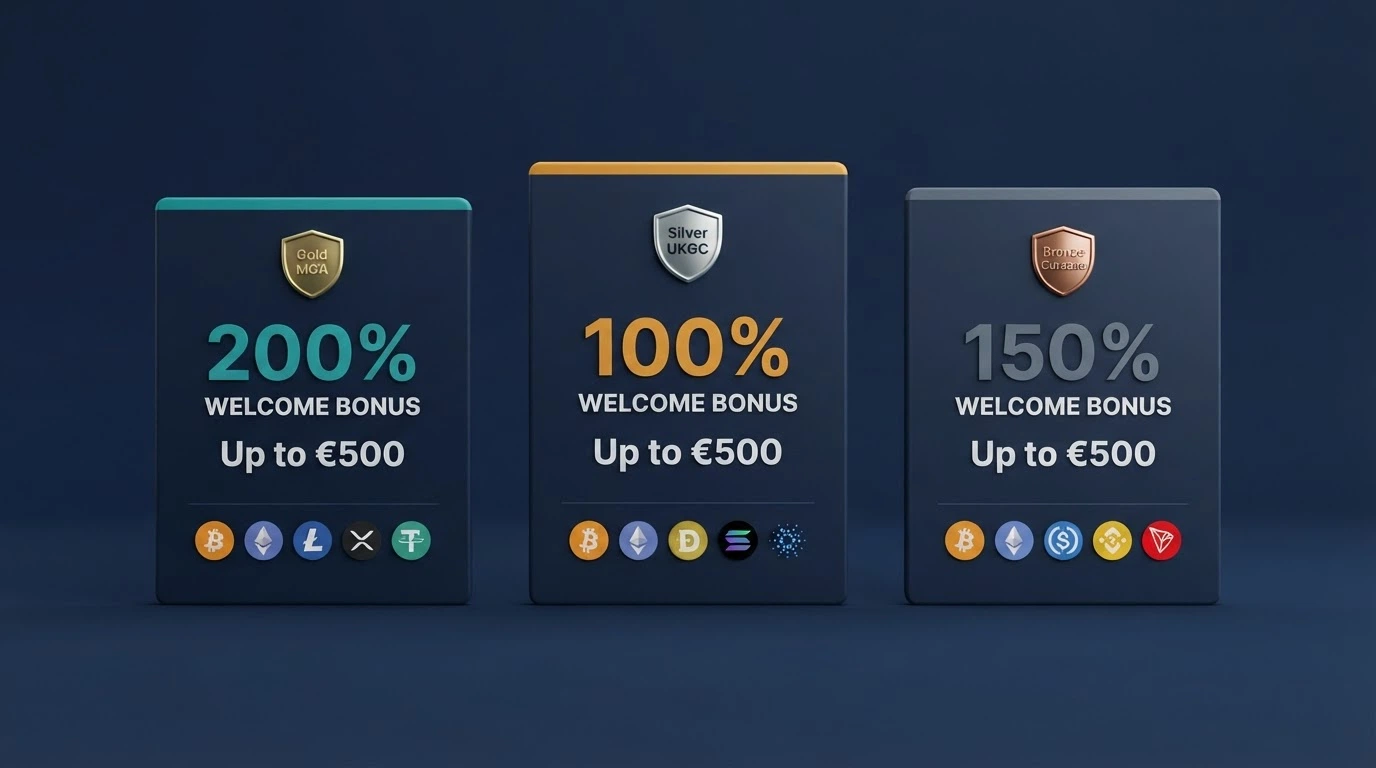
The table below ranks every operator covered in this article. The licence column is honest: only some of the featured brands have a confirmed licence number in the research record, and the rest take the no-data marker rather than a fabricated line. The welcome bonus column reflects the headline number from the operator’s own published terms, with the wagering multiplier attached where one is published. Crypto accepted lists the coins the operator confirms on its deposit page. Tested payout speed reflects what independent testing has recorded where it exists.
| Casino | Licence | Welcome Bonus | Crypto Accepted | Tested Payout Speed |
|---|---|---|---|---|
| Stake | Curaçao eGaming 8048/JAZ | 200% up to A$2,000–A$3,000, VIP rakeback model | 20+ (BTC, ETH, LTC, XRP, more) | BTC 8–15 min, LTC under 5 min, ETH 3–8 min |
| BitStarz | Curaçao via Dama N.V. | 5 BTC across 4 deposits + 180 FS, 40× wagering | 500+ | ~10 min average |
| BC.Game | Curaçao | Up to 220,000 BCD across 4 deposits (BCD-locked) | 155+ | 3 min 47 sec (fastest on-chain test) |
| 7Bit Casino | Curaçao | 325% up to 5.25 BTC + 250–350 FS, 35×, 14 days | BTC and other crypto | 1–3 hours |
| Lucky Block | — | 200% up to A$10,000 + 50 FS, 35× | 7+ major coins | Under 5 min |
| Fair Go Casino | Curaçao (Deckmedia N.V.) | 100% up to A$200 × 5 deposits (A$1,000 total) | BTC, ETH, LTC + AUD | Minutes (crypto) |
| Rocket Play | — | — | 6 (BTC, ETH, LTC, DOGE, BCH, USDT) | Instant platform-side; bank 3–7 days |
| Skycrown | — | — | — | — |
| Royal Reels | — | — | — | — |
| WinSpirit | — | — | — | — |
Every row is an offshore brand. None holds an Australian licence because none can. Three of the ten — Skycrown, Royal Reels, WinSpirit — are AU-facing brands for which independent research carried no specific licence number, bonus terms, or tested payout speed this run; readers comparing those three need to consult the operator’s own terms page before depositing. The cluster is dominated by Curaçao, which is the standard offshore licence for crypto casinos but does not give Australian players any of the protections the IGA framework is built to provide.
Stake
Stake is a crypto-exclusive sportsbook and casino that has run since 2017 under Curaçao eGaming licence 8048/JAZ. The licence number is one of the few confirmed in this article — most of the offshore set runs under a Curaçao umbrella without a publicly verifiable number. The brand accepts cryptocurrency deposits exclusively, which means fiat players deposit by buying crypto through a third-party processor rather than via a direct card deposit.
The welcome structure is unlike the rest of the field. There is no traditional wagering-requirement bundle. Instead, a 200% matched deposit up to A$2,000 to A$3,000 (sources vary) feeds into Stake’s VIP rakeback model, which returns a percentage of house edge to active players based on tier. For a player who plays regularly, that structure can be worth more than a flat bonus with a 40× wagering requirement. For a player who deposits once and walks, it returns essentially nothing. Game library sits above 3,000 titles plus 40-plus sports markets, with a Trustpilot rating of 3.9 out of 5 — high for an offshore operator in this category. Tested payout speeds on Stake’s own platform run from under five minutes on Litecoin to 8–15 minutes on Bitcoin. Stake is the right brand for a high-volume crypto player who will grind the rakeback; it is the wrong brand for someone chasing a one-shot bonus.
BitStarz
BitStarz runs the largest headline bonus in this article — up to 5 BTC across four deposits — and the largest published game library, at over 6,000 titles. The casino accepts AUD alongside 500-plus cryptocurrencies, which makes it the most flexible entry point in the cluster for a player who wants to deposit in dollars and convert at the cashier rather than at an exchange. Curaçao licensing is held via Dama N.V., one of the better-known operator groups in the offshore market.
The bonus structure pays out in four slices: a first deposit of 100% up to 1 BTC plus 180 free spins, a second deposit of 50% up to 1 BTC, a third of 50% up to 2 BTC, and a fourth of 100% up to 1 BTC. The 180 free spins release 20 per day over nine consecutive days. The minimum qualifying deposit is €20, and the wagering multiplier is 40× on both bonus funds and free-spin winnings, with a 30-day clearance window. Crypto withdrawals average around 10 minutes. The trade-off is the no-deposit bonus: BitStarz runs one — 30 free spins — but Section 1.6 of its Bonus Terms explicitly excludes Australian players. That exclusion makes BitStarz’s headline weaker for AU readers than for some other geos, but the deposit package remains the deepest in the set.
BC.Game
BC.Game is the broadest-coin operator in the ranking, accepting more than 155 cryptocurrencies and running a four-part welcome bonus worth up to 220,000 BCD in its own native token. A separate offer shape circulating in the affiliate market is a 120% matched deposit up to A$500 plus 100 free spins with a A$10 minimum deposit, which is the more accessible entry for a player not interested in the BCD ecosystem. The casino launched in 2017 under a Curaçao licence.
What separates BC.Game in the speed column is the tested record: a payout that arrived on-chain in 3 minutes 47 seconds during a Saturday-morning test from an Australian IP. That is the fastest figure this article can put a number on. The game library sits at 8,400-plus titles, the largest in this comparison. The BCD-locked bonus structure is not for everyone — the native token has its own dynamics, and players who prefer a straight BTC bonus will find the welcome shape harder to evaluate. But for a player prioritising coin breadth and payout speed, BC.Game is the headline answer.
7Bit Casino
7Bit runs the bonus-heavy end of the market — 325% up to 5.25 BTC plus 250–350 free spins across four deposits, with a 35× wagering multiplier and a 14-day clearance window. The minimum qualifying deposit is 20 EUR or 0.28 mBTC; the maximum bet while the bonus is active is 1 EUR per spin. Welcome free spins run on Wild Cash x9990 by BGaming, and free-spin winnings carry the same 35× multiplier.
The shape that distinguishes 7Bit from the rest of the field is its no-deposit offer. 7Bit publishes a 30-free-spin no-deposit bonus on Deep Sea by BGaming — Australian players included — with a maximum win cap of A$50, 45× wagering on winnings, a 3-day validity window, and a maximum bet of A$0.15 per spin. That is one of the few no-deposit bonuses in the offshore market that does not exclude Australians, and it is the only one in this article’s featured set. The Deep Sea slot has a published 94% RTP, medium volatility, a 5×3 layout, 15 paylines, and a maximum win of 350× stake (BGaming’s official page states a max multiplier of 2,692×). Tested crypto payouts at 7Bit run 1–3 hours — slower than BitStarz or BC.Game, but faster than most of the field. 7Bit is the brand for a player who wants to test a no-deposit offer first and is comfortable with a tight clearance window.
Lucky Block
Lucky Block is the no-ID brand in the cluster. Signup takes an email address and a password — no ID upload, no document verification at the account stage. The welcome package is a 200% first-deposit match up to A$10,000 plus 50 free spins, with a 35× wagering multiplier. Minimum deposit is A$1 equivalent — the lowest in the featured set. Tested payout time is under five minutes.
The no-KYC posture is the brand’s positioning, and it carries consequences in both directions. On the one hand, the signup friction is the lowest in this article. On the other, “no ID upload” is not the same as “no KYC at any threshold” — most operators reserve the right to request verification at withdrawal, and a player who wins a meaningful amount may eventually be asked to prove identity regardless of the initial signup flow. Lucky Block sits in the middle of the field on most other dimensions: seven major coins accepted, a standard 35× playthrough, and a payout window that is faster than average. It is a reasonable fit for a player prioritising speed-to-play over audit-trail completeness.
Fair Go Casino
Fair Go is the Australian-dollar-friendly end of the cluster. The casino accepts AUD alongside BTC, ETH and LTC, and the welcome package pays out in five 100% matches up to A$200 each — a total of A$1,000 across the first five deposits. Game library is 280 titles, all powered by RTG (RealTime Gaming), which is a smaller catalogue than the multi-provider sites but a tighter thematic focus on the pokies style Australian players know from clubs and pubs.
Curaçao licensing runs via Deckmedia N.V., one of the more established operator groups in the offshore market. Crypto withdrawals settle in minutes rather than hours for most of the testing record. The wagering terms on the welcome package are not published on Fair Go’s promo page — research flags a transparency gap on this point. Readers comparing Fair Go to the multi-provider offshore brands will be weighing a familiar AUD experience against a smaller game library and less public bonus fine print. Fair Go fits a player who wants the AUD rail and the RTG catalogue and is comfortable with a less complete terms page.
Rocket Play
Rocket Play takes six cryptocurrencies — Bitcoin, Ethereum, Litecoin, Dogecoin, Bitcoin Cash, and Tether — and processes payouts on the platform side instantly, with no platform fee attached. The slower leg is bank transfer, which is the fiat fallback and runs 3–7 business days. Verification is required before the first withdrawal, which means a player who intends to cash out cannot entirely avoid the document step even though Rocket Play runs lighter onboarding than AU-licensed wagering operators.
Rocket Play’s market position in Australia is meaningful — the operator holds roughly 9.4% of the AU-facing offshore market share according to operator-channel data. Specific bonus terms, wagering multipliers, and game library counts are not in the independent research record this run. Readers comparing Rocket Play to other six-coin operators will need to consult the operator’s own terms page for the welcome package and the bonus clearance window.
Skycrown
Skycrown is an AU-facing brand accepting crypto deposits. Research this run carried no confirmed specifics on licence number, bonus terms, game library, or payout speed, so the operator write-up below is qualitative from the brand’s own published terms. Skycrown has a meaningful AU market presence (around 8.55% AU-facing share on operator-channel data), which suggests an active Australian player base even though the published terms page is lighter on the kind of detail the bigger brands publish.
Players looking at Skycrown against better-known brands should expect to confirm bonus wagering multipliers, the maximum cashout ceiling on free-spin offers, and the crypto payout time themselves before depositing. The brand is not the safest comparison in the cluster, but it is one of the more visible AU-facing operators.
Royal Reels
Royal Reels is an AU-focused pokies and casino brand accepting crypto deposits. Independent research this run carried no confirmed specifics on licence, bonus, or payout terms. AU-facing market share sits around 2.5% on operator-channel data, which is modest but real. Royal Reels positions itself around the pokies product rather than the broader casino catalogue, so a player prioritising slots over live-dealer tables will find the brand’s positioning natural.
Readers comparing Royal Reels to larger brands should verify the wagering terms, the welcome bonus shape, and the supported crypto list on the operator’s own site before committing funds.
WinSpirit
WinSpirit is a newer AU-facing entrant in the offshore crypto casino space, with crypto deposit support and a smaller Australian market share (around 1.55%) than the established brands in this ranking. Independent research carried no confirmed specifics this run on licence, bonus terms, or payout timing. Newer entrants in the offshore market carry a different risk profile than established brands: smaller game libraries, less public terms, and a thinner Trustpilot record.
Readers considering WinSpirit should compare it directly against the better-documented brands in this ranking before depositing. A newer brand is not automatically a worse brand, but the audit trail is thinner.
Why Your 2026 Bitcoin Casino Bonus Is Smaller Than It Looks
A bitcoin casino welcome bonus is a marketing headline. The number after the percentage sign is the maximum the casino will match on a first deposit, and the number after the wagering multiplier is the turnover required before any of the matched funds can be withdrawn. The two figures are connected: the wagering requirement determines how much of the bonus a player is statistically likely to convert into withdrawable cash.

The shape of the cost on a BitStarz first-deposit bonus — 1 BTC at 40× wagering, the calculation this page carries — works like this: a player who claims the full 1 BTC bonus must turn over 40 BTC before the bonus converts to withdrawable funds. At a typical slot stake of A$1 per spin (0.000015 BTC at a Bitcoin price near A$66,000), that is roughly 2.66 million spins. At five seconds per spin, that is around 3,700 hours of continuous play — which is not a campaign a real player runs. A more realistic session stake of A$0.10 per spin still requires 370 hours of continuous play. The point is not that no one ever clears a bonus like this; the point is that the bonus is calibrated so that the statistical majority of players will forfeit some portion of it to the house edge before clearance. The wagering multiplier is the mechanism, and the house edge on the games being played is the cost.
7Bit’s welcome bonus illustrates a different shape: 325% up to 5.25 BTC at 35× wagering with a 14-day clearance window. The headline match is much larger than BitStarz’s, but the turnover required scales with the bonus, and the 14-day window means a player who does not grind through the requirement inside two weeks forfeits the bonus entirely. The 1-EUR-per-spin maximum bet while the bonus is active caps the rate at which the turnover can be run, which is itself a friction. Lucky Block’s 200% up to A$10,000 plus 50 free spins at 35× runs a similar shape — large headline, standard wagering.
Stake takes a different route entirely. The VIP rakeback model returns a percentage of house edge to the player based on tier. There is no standard wagering requirement on the welcome deposit, because the welcome deposit is not structured as a bonus. For a player who plays enough volume to climb the VIP ladder, the rakeback structure returns more than a 35× bonus would; for a one-shot player, it returns essentially nothing.
Welcome and Deposit Match Offers: The Headline Numbers
BitStarz’s five-BTC package is the headline-grabber: 5 BTC across four deposits, 40× wagering, 30 days to clear. The free spins release at 20 per day over nine days, which means the slot contribution is paced across the clearance window rather than dumped on day one. For a player who will play through, the package is generous; for a player who will not, the package is mostly an unconverted headline.
7Bit’s 325% up to 5.25 BTC plus 250–350 free spins across four deposits is the heaviest match percentage in the ranking. The 35× wagering multiplier is lower than BitStarz’s 40×, but the 14-day clearance window is tighter, and the EUR 1 maximum bet while the bonus is active caps the rate at which turnover can be generated. Welcome free spins play on Wild Cash x9990 by BGaming.
Lucky Block’s 200% up to A$10,000 plus 50 free spins at 35× wagering is a mid-cluster package. The minimum deposit of A$1 equivalent is the lowest in the featured set, which lowers the entry cost but also means a small bonus claim can happen at almost any deposit size. Payouts settle in under five minutes, which makes the package attractive for a player who plans to convert and withdraw rather than grind the wagering.
Stake’s 200% up to A$2,000–A$3,000 with a VIP rakeback model is structurally different from the rest. There is no traditional wagering requirement, because the rakeback returns are tied to play volume rather than to a fixed bonus claim. Stake fits a player who will play regularly and is willing to climb the VIP ladder; it does not fit a player looking for a one-shot conversion.
No-Deposit Free Spins and Why Most Exclude Australians
7Bit’s 30 no-deposit free spins on Deep Sea by BGaming is the rare no-deposit offer in the offshore crypto casino space that does not exclude Australian players. The headline numbers attached to the bonus are restrictive in three ways: the maximum win is capped at A$50, the wagering multiplier on winnings is 45× (higher than the welcome package’s 35×), the validity window is 3 days, and the maximum bet while the bonus is active is A$0.15 per spin. The Deep Sea slot itself has a published 94% RTP, medium volatility, 5×3 layout, 15 paylines, and a maximum win of 350× stake (BGaming’s official page states a max multiplier of 2,692×).
BitStarz’s no-deposit bonus is the comparison case. BitStarz does publish a 30-free-spin no-deposit bonus, but Section 1.6 of its Bonus Terms explicitly excludes Australian players. That exclusion is part of why BitStarz’s headline is weaker for AU readers than the operator’s market share would suggest: the headline no-deposit offer does not apply to Australian signups.
Most of the rest of the featured set does not publish a no-deposit bonus at all. The economics are straightforward: a no-deposit offer is a free ride, and operators running smaller balance sheets treat it as a customer acquisition cost they would rather avoid. A player who wants to test an operator without depositing cash has, in practice, two routes in this article: the 7Bit no-deposit free spins, or a demo-mode session on a real-money game without claiming any bonus at all.
Games, Pokies and Live Tables You Can Play with Bitcoin
The crypto casino game libraries in this ranking range from 280 titles at Fair Go to 8,400-plus at BC.Game, and the range is not random. Multi-provider brands with Curaçao licences plug into aggregator platforms that carry thousands of slots from BGaming, Pragmatic Play, Hacksaw Gaming, NetEnt, Microgaming and the rest of the standard offshore roster. Single-provider brands like Fair Go (RTG only) carry a tighter, more focused catalogue around one studio’s output.
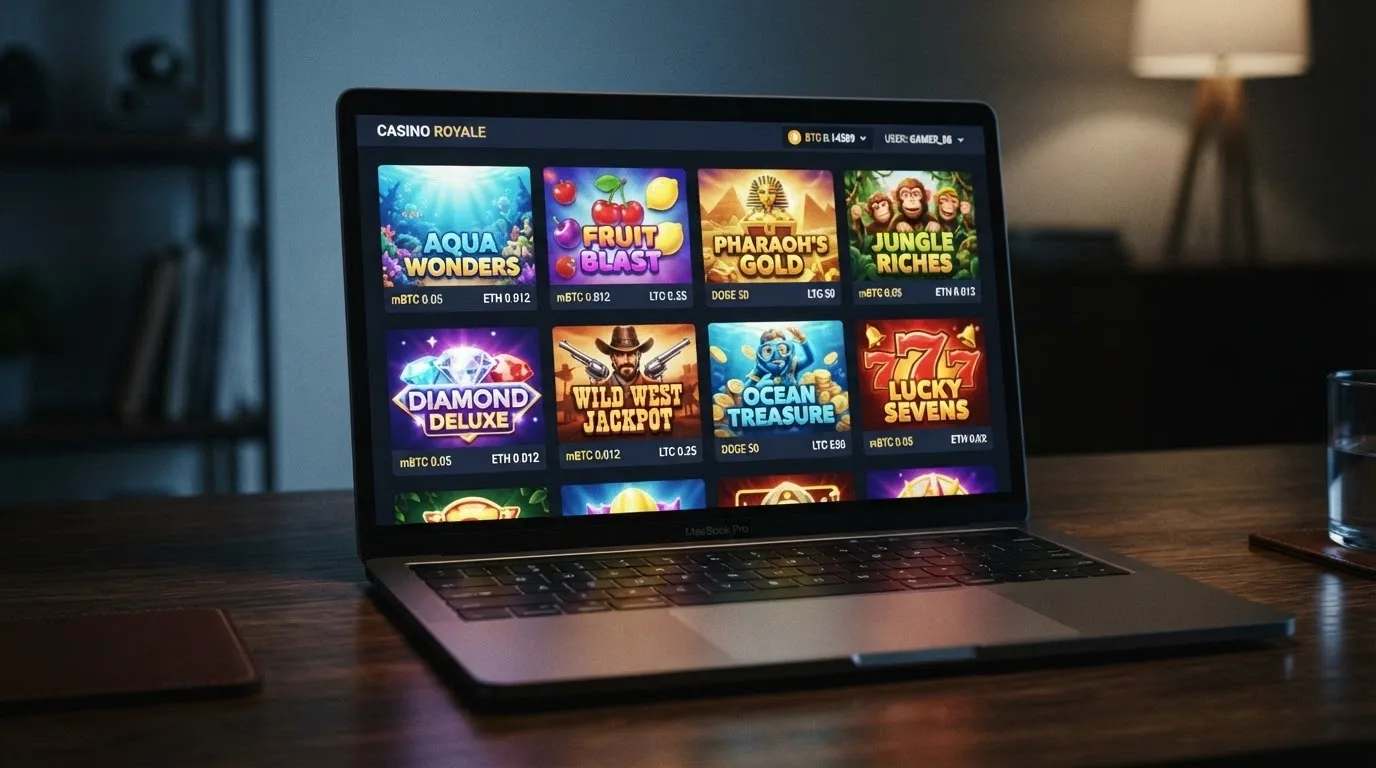
Bitcoin pokies work exactly like fiat pokies, mechanically: the player chooses a stake, presses spin, the reels resolve. The difference is purely in the deposit and withdrawal rail. The RNG that determines each spin’s outcome is independent of the payment method; the published RTP per title is identical whether the player funded the session in bitcoin or in dollars. Crypto-native casinos are more likely to publish per-title RTP than fiat-only brands, which is one of the few places where “bitcoin casino” delivers something other than a payment-method change.
Live-dealer tables at crypto casinos are the same Evolution, Pragmatic Play Live and Ezugi tables that run at fiat casinos. The difference at the offshore end is again licensing: an Evolution table licensed for the Curaçao market sits at a crypto casino, while the same provider’s Malta-licensed table sits at an EU-regulated fiat casino. The game mechanics do not change.
Bitcoin Pokies and Slots
The pokie selection at the top of the offshore market is large enough that RTP disclosure has become the meaningful differentiator. Deep Sea by BGaming carries a 94% RTP with medium volatility — lower than the 96-plus percent cluster most Australian players are used to at higher-end offshore titles, but the volatility band is what makes the slot playable on a small bankroll. Wild Cash x9990 by BGaming, the title used for 7Bit’s welcome free spins, is the other named slot in the research record.
Provider mix across the featured operators runs the standard offshore roster. BitStarz’s 6,000-plus title library is the largest, with a multi-provider structure that includes BGaming, Pragmatic Play, NetEnt and Microgaming among others. BC.Game’s 8,400-plus titles run a similar multi-provider structure. Fair Go’s 280-title RTG-only library is the outlier — narrower, more focused, and stylistically distinct from the multi-provider brands.
Depositing and Withdrawing Bitcoin — Speed, Fees and the Real Route
| Coin | Deposit Speed | Withdrawal Speed | Network Fee |
|---|---|---|---|
| USDT (TRC-20) | Under 60 seconds | Under 5 minutes | Under A$0.50 |
| Bitcoin (BTC) | 10–60 minutes | 15–60 minutes | A$5–A$20 |
| Solana | Under 30 seconds | Under 2 minutes | ~A$0.10 |
The cleanest AU deposit route is the four-step path already described: AU bank to a licensed Australian crypto exchange to USDT TRC-20 to an offshore casino, then reverse to cash out. The whole round trip depends on which coin the player chooses and which exchange does the conversion. USDT on TRC-20 is the fastest stablecoin rail — under sixty seconds for a deposit, under five minutes for a withdrawal, network fees under A$0.50. Bitcoin on-chain is materially slower: deposits 10–60 minutes, withdrawals 15–60 minutes, fees A$5 to A$20 depending on mempool congestion. Solana sits at the other extreme — under thirty seconds for deposits, under two minutes for withdrawals, fees around A$0.10.
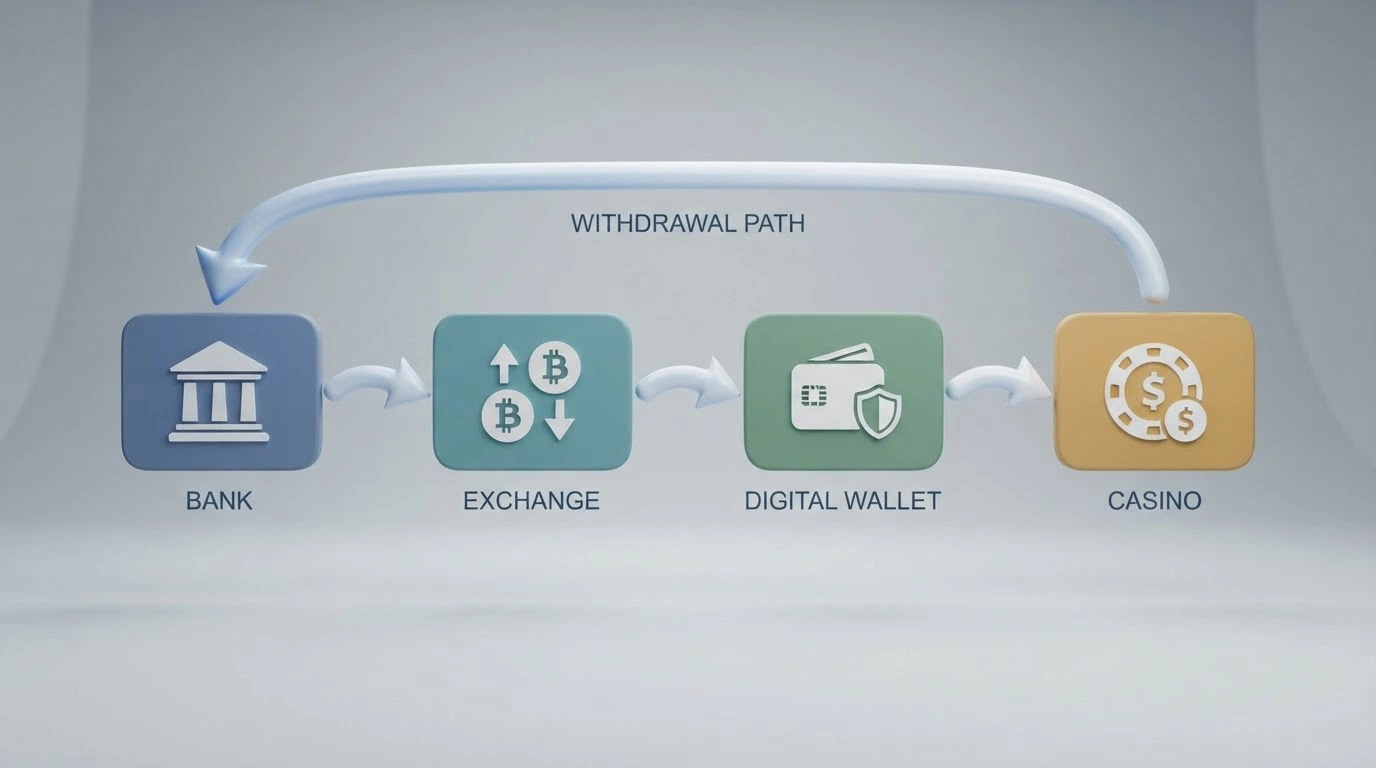
The choice of coin is the biggest single decision the player makes on speed. A player funding in USDT TRC-20 will see deposits arrive in under a minute and withdrawals settle inside five minutes. A player funding in BTC will wait 10–60 minutes for the deposit confirmation and 15–60 minutes for the withdrawal. For a player depositing A$100 and withdrawing A$200 in a single session, the speed difference is mostly cosmetic; for a player running multiple daily sessions, the difference adds up.
The Deposit Route: AU Bank to Exchange to Casino
The first leg is the bank. CommBank and Westpac restrict outbound transfers to crypto exchanges — the payment may bounce or sit pending review. ANZ and NAB flag the destination without blocking the transfer. ING and Macquarie process the transfer without friction. The Big Four’s most restrictive arms effectively force a player either to switch banks, use a fintech intermediary, or fund the exchange through a different mechanism (BPAY from an account at a more permissive bank, for example).
The second leg is the exchange. CoinSpot and Independent Reserve are both AUSTRAC-registered and offer AUD-to-crypto conversion inside the platform. AUSTRAC’s Travel Rule kicks in at AU$10,000 per transaction, which is the threshold above which exchanges must collect and verify counterparty identity. Below that line the onboarding friction is minimal — signup, identity verification, bank link, and the AUD balance is ready to convert.
The third leg is the casino deposit. The exchange produces a USDT balance in the trader’s wallet, and the player sends from that wallet to the casino’s deposit address. TRC-20 processes in under sixty seconds with a fee under A$0.50. The casino credits the deposit to the player account in real time. From there, play proceeds as it would at any fiat casino, with the only difference being the bet-sizing denomination.
Payout Speed: Who Is Fastest and Why It Varies
The fastest tested payout in this article is BC.Game’s 3 minutes 47 seconds on-chain, recorded during a Saturday-morning test from an Australian IP. The result reflects both BC.Game’s payout pipeline and the underlying network — for BC.Game, that means either a fast altcoin or an optimised BTC confirmation setup. BitStarz averages around 10 minutes on crypto withdrawals, which is the typical mid-cluster speed. 7Bit’s 1–3 hour payout window sits below that, and Wild Fortune (a brand outside this article’s featured ranking) averaged 5 hours 24 minutes across five tested cycles, with a range of 3 hours 50 minutes to 7 hours 58 minutes.
What drives the spread is the combination of casino-side processing and network-side confirmation. A casino that auto-processes withdrawals can settle in seconds once the network confirms; a casino that runs manual review for first withdrawals will sit at the slow end regardless of the network. The fastest operators are the ones that have built automated payout pipelines and accept coins with fast confirmation windows; the slowest are the ones that batch process withdrawals and run on slower base networks.
Mobile Bitcoin Casino Play — App or Browser?
Most offshore bitcoin casino play happens in a mobile browser, not in a native app. The reason is the Australian app-store distribution model: an offshore casino app is not available through the Apple App Store or Google Play for Australian users, because the App Store and Google Play both enforce local-gambling-app distribution rules that exclude operators not licensed in the user’s jurisdiction. A player who wants a native app has to sideload it — download the APK directly from the operator’s site on Android, or use a configuration profile on iOS. Sideloaded apps run outside the App Store’s review process and outside the device’s automatic update channel, which means security patches land when the operator publishes them rather than when the platform pushes them.

The mobile-browser experience at the top of the offshore market is close enough to native that most players do not notice the difference. BitStarz’s site, BC.Game’s site, and the rest of the multi-provider cluster all run responsive web builds with touch-optimised lobbies and game-launch flows. Live-dealer tables stream at full mobile resolution; pokies spin at touch-friendly stake increments. The friction is in distribution, not in performance.
Native Apps vs Mobile-Site Play
The native-app question for offshore crypto casinos in Australia is mostly a question of trust. A sideloaded app is a binary the user installs outside the platform’s review process, which means the user is taking the operator’s word for the build integrity. A mobile site loads through the device’s normal browser sandbox, which is a more conservative security posture. Players prioritising security over convenience should default to the browser; players prioritising convenience should expect to verify the operator’s sideload build before installing.
The other dimension is feature parity. Native apps sometimes carry features the mobile site does not — biometric login, push notifications for bonus drops, faster lobby access. The gap has narrowed as mobile-browser builds have matured, and at the top of the offshore market most players will not see a meaningful feature gap between the two. Players looking for a specific feature should check the operator’s mobile FAQ before installing anything.
New Bitcoin Casinos Worth Watching in 2026
The new-entrant pipeline in the offshore crypto casino space in 2026 is constrained less by demand than by the regulatory environment. The Interactive Gambling Amendment (Gambling Reform) Bill 2026 passed Parliament on 19 August 2026 and commences on 1 January 2027, and the most consequential change for a new entrant is the new authority granted to banks and payment providers to block transactions to illegal gambling operators. From 1 January 2027, the AU bank leg of the four-step deposit route — the leg that has always been the most friction-heavy — gains a new enforcement mechanism. A new entrant that was already marginal on the bank-transfer side will become harder to fund from an Australian bank account.
The other 2026 reform changes are less direct for the offshore crypto casino set but reshape the surrounding market. Wagering advertising during live sport will be banned 15 minutes before to 5 minutes after coverage between 5am and 8:30pm, with a maximum of three wagering ads per hour outside the blackout window. Athletes, celebrities and influencers will be barred from promoting wagering products. Inducement marketing will be prohibited for 14 days after a customer signs up, three months after a person deregisters from BetStop, and indefinitely for at-risk customers. Online keno “pocket pokies” and foreign-matched lotteries will be banned.
For an Australian player, the practical effect of the 2026 reforms on offshore crypto casinos is mostly on the funding rail rather than on the casino itself. The offshore brands will continue to operate as they have; the bank side will become harder to navigate.
The Legal Reality: Bitcoin Casinos and Australian Law
Online casino is prohibited in Australia. The Interactive Gambling Act 2001 makes it an offence to provide online casino games, online pokies, and in-play sports betting to persons physically in Australia. There is no licence for online casino anywhere in the country — not federally, not in any state or territory. The Act targets the provider, not the player. Australian players are not prosecuted for using offshore sites; the enforcement regime lands on the operator.
The Interactive Gambling Amendment (Credit and Other Measures) Act 2023 added a second prohibition. From 11 June 2024, credit cards, credit-related products, and digital currency — cryptocurrency — are banned as payment methods for online wagering. An operator that fails to enforce that ban faces penalties up to A$247,500. The crypto prohibition is the clearest signal that a casino accepting bitcoin from an Australian player is operating outside Australian rules.
The Interactive Gambling Amendment (Gambling Reform) Bill 2026 passed Parliament on 19 August 2026 and commences on 1 January 2027. It is the biggest shake-up to Australian gambling law in a generation. From commencement, banks and payment providers gain express authority to block transactions to illegal gambling operators. The other reforms reshape advertising (no live-sport wagering ads, three-ads-per-hour cap, no athlete promotion), inducement marketing (the 14-day / three-month / indefinite rule), and the product mix (online keno pocket pokies and foreign-matched lotteries banned).
What the Interactive Gambling Act Actually Says
The Interactive Gambling Act 2001 prohibits the provision of online casino, online pokies and in-play sports betting to persons in Australia. Permitted products are pre-event race and sports wagering, lotteries, and keno through state or territory-licensed operators. The Australian Communications and Media Authority enforces the prohibition. ACMA’s powers include investigating complaints, issuing formal warnings, initiating civil penalty proceedings, referring operators for enforcement, and directing ISPs to block illegal sites.
The enforcement record is substantial. Since the first blocking request in November 2019, ACMA has had 1,564 illegal gambling and affiliate websites blocked by Australian ISPs as of March 2026. More than 225 illegal services have withdrawn from the Australian market since enforcement was strengthened in 2017. Civil penalties under the IGA run up to A$2,475,000 per day for an individual and A$12,375,000 per day for a corporation.
The Act targets the provider. Australian players are not prosecuted. There is no record of an individual player being charged for using an offshore site, and the enforcement resources go to the operator and the network edge rather than to the consumer end.
Offshore vs Licensed: The Protections You Give Up
The protections an Australian player has at a licensed wagering operator do not transfer to an offshore crypto casino. BetStop — the National Self-Exclusion Register, live since August 2023 — binds Australian-licensed wagering services only. An offshore casino is not connected to the register, and a self-excluded person can continue depositing at an offshore brand. ACMA’s enforcement at the network edge — DNS blocking — can cut off access to an offshore casino at any time, potentially with a balance still on the account.
The crypto prohibition is the second signal. From 11 June 2024, any gambling site accepting cryptocurrency from an Australian player is operating outside Australian rules. The deposit ban does not carry a player-side penalty, but it does mean the payment rail is outside the consumer protection framework an AU-licensed operator is required to run.
What this means in practice is that an Australian player at an offshore casino has no AU consumer protection, no BetStop coverage, no recourse through ACMA or the Australian Financial Complaints Authority if the operator refuses a withdrawal or closes the account, and the constant risk that the site gets DNS-blocked with a balance still on it. The “accepts bitcoin” headline is the clearest single signal that these protections do not apply.
The 2026 Reforms and What Changes on 1 January 2027
The 2026 reforms are the most consequential change to Australian gambling law since the original 2001 Act. The package passed Parliament on 19 August 2026 and commences on 1 January 2027.
For the offshore crypto casino set, the most consequential change is the bank-blocking authority. From 1 January 2027, banks and payment providers gain express authority to block transactions to illegal gambling operators. The funding rail from an Australian bank to a crypto exchange to an offshore casino becomes subject to a new enforcement mechanism. Players who fund their exchange accounts from a Big Four bank may see transfers flagged or declined.
The advertising reforms reshape the licensed wagering market rather than the offshore market directly. Wagering advertising during live sport coverage is banned 15 minutes before to 5 minutes after the event, between 5am and 8:30pm. TV wagering advertising is capped at three ads per hour outside the blackout window. Athletes, celebrities and influencers are barred from promoting wagering products. Online wagering advertising is restricted to logged-in, age-verified users with an opt-out.
The inducement reforms change the licensed market’s marketing approach. Direct marketing of inducements is prohibited for 14 days after a customer signs up, for three months after a person deregisters from BetStop, and indefinitely for customers identified as at risk of gambling-related harm. Online keno “pocket pokies” and foreign-matched lotteries are banned.
The combined effect of the reforms is to tighten the licensed wagering market and to make the offshore market harder to fund. For an Australian player who has chosen to play at an offshore crypto casino, the funding rail — not the casino itself — is where the 2027 changes will land first.
Staying in Control: Responsible Gambling Tools and Where to Get Help
The responsible-gambling infrastructure for Australian players is built around the licensed wagering market. BetStop — the National Self-Exclusion Register — runs on the licensed side; offshore casinos are not connected to it. The National Gambling Helpline (1800 858 858) is free, confidential, and staffed 24 hours a day, seven days a week, with online chat and counselling through Gambling Help Online. Harm prevalence in Australia is roughly 2.1% of adults, around 430,000 people, with high-risk gambling at 1.8% (AIHW, 2022).
BetStop had 67,480 registrations and 41,290 active exclusions as at 31 July 2026. 78% of registrants were under 40. 38% chose lifetime exclusion. The register binds every AU-licensed online and phone wagering service. It does not bind offshore casinos, which is a critical limitation for a player who has self-excluded from the licensed market and is considering the offshore market as a substitute.
Deposit Limits, Self-Exclusion and the Tools That Exist
Offshore bitcoin casinos run their own deposit-limit and self-exclusion tools, but those tools are operator-side and reset when a player moves to a different operator. A player who has registered with BetStop can still deposit at every offshore brand in this article’s ranking, because none of them are connected to the register. The only self-exclusion mechanism that covers the offshore set is the player’s own decision to stop.
The 2026 reform expands financial counselling for gambling-related harm, which is a structural improvement on the licensed side. For an Australian player at an offshore crypto casino, the practical responsible-gambling resources are the National Gambling Helpline on 1800 858 858, Gambling Help Online at gamblinghelponline.org.au, and the player’s own limits. There is no offshore-side equivalent of BetStop, and there is no AU consumer-protection body that can compel an offshore operator to honour a self-exclusion request.
Free-Play and Demo Mode: Trying Bitcoin Pokies Before You Deposit
Demo mode is available on most of the featured operators’ pokies and runs without a deposit. The demo plays the same game with the same RTP and the same volatility, but the stake is play-money and the winnings are play-money. What demo teaches that a review cannot is the feel of the game — how often the bonus round triggers, how the base game paces, how the stake increments behave at touch. A player who is choosing between Deep Sea and Wild Cash x9990 by BGaming can run both in demo mode at the same operator without committing funds.
The exception is the live-dealer lobby. Live-dealer tables do not run in demo mode — the dealing shoe is real, the cards are real, and there is no play-money rail. A player who wants to test a live blackjack table before depositing needs to find a fiat casino running the same Evolution or Pragmatic Play Live feed and play the demo there. The crypto casino’s live lobby is a pay-to-play only.
Free-play bonus rounds inside real-money games work the same way regardless of the payment method. A player who buys in with bitcoin triggers free-spin rounds in a pokies session exactly as a fiat-funded player would, and the resulting free-spin winnings accumulate to the bonus balance at the same wagering multiplier.
How We Selected and Ranked These Bitcoin Casinos
The ten operators in this article’s ranking were selected on five criteria, each checked against the operator’s own published terms and against independent testing where it exists.
The first criterion is crypto support depth. Operators were evaluated on the number of cryptocurrencies accepted, the speed of the underlying rail (USDT TRC-20 and Solana ranked higher than Bitcoin on-chain), and the published payout time per coin. The second criterion is bonus terms and wagering fairness: the headline match percentage, the wagering multiplier, the clearance window, the maximum bet while bonus active, and the exclusion list. The third criterion is payout speed: tested figures from independent testing sources where they exist, and the operator’s own published payout window where they do not.
The fourth criterion is licensing jurisdiction and AU legal status. Every operator was checked against the ACMA blocked-sites list and against the operator’s own published licence page. The IGA prohibition is the legal baseline, and the licence column in the comparison table reflects what the operator’s own page and the independent record carry. The fifth criterion is game library size and provider quality, including the published RTP per title where the operator publishes it.
No operator was excluded for being offshore — the entire market is offshore by definition. No operator was preferred for reasons outside the five criteria. The ranking reflects the published terms and the tested performance; it is not an editorial endorsement.
What You Should Actually Do About Bitcoin Casino Play in Australia
The offshore bitcoin casino market is real, it is funded through a workable deposit route, and it is going to remain accessible for as long as the offshore operators continue to licence with Curaçao and other jurisdictions that do not enforce the IGA. The 2026 reforms make the funding rail harder from 1 January 2027 — banks gain express authority to block transactions to illegal gambling operators, and the AU bank leg of the four-step deposit route gains a new enforcement mechanism.
A player who has decided to proceed should check four things before depositing. The first is the operator’s licence and what jurisdiction issued it. The second is the wagering multiplier on the welcome bonus and the clearance window — the multiplier is the cost, and the window is the time you have to pay it. The third is the maximum cashout cap on any no-deposit or free-spin offer — a A$50 cap is a feature, not a bug, and a player who treats it as the upper bound on the no-deposit session is playing the bonus as it was designed to be played. The fourth is the payout coin — USDT TRC-20 and Solana settle in minutes, BTC on-chain settles in tens of minutes, and a player who plans to deposit and withdraw in the same session should fund in the fastest rail the operator accepts.
A player who has decided not to proceed has a cleaner set of options. BetStop covers the licensed wagering market. The National Gambling Helpline on 1800 858 858 is free, confidential, and 24/7. Gambling Help Online runs free 24/7 chat and email counselling. The licensed wagering market in Australia offers pre-event sports and race wagering under state and territory licensing, with full consumer protection, identity verification, and deposit-limit tools built in.
The offshore crypto casino market is not a substitute for any of those things. It is a separate market, operating under separate rules, with a separate payment rail and a separate enforcement regime. The choice to enter it is the player’s, and the consequences of that choice — both the upside and the downside — are also the player’s.
Frequently Asked Questions About Bitcoin Casinos in Australia
Can I be prosecuted for playing at a bitcoin casino from Australia?
No. The Interactive Gambling Act 2001 prohibits the provision of online casino and pokies to persons in Australia, and the Act targets the provider, not the player. Australian players are not prosecuted for using offshore sites; the civil penalty regime runs up to A$2,475,000 per day for individual operators and A$12,375,000 per day for corporations.
Are bitcoin casino winnings taxable in Australia?
No, for the typical player. Betting and gambling winnings are not assessable income under section 6-5 of the ITAA 1997, and gambling losses are not deductible under section 8-1. The exception is a person who is carrying on a business of betting or gambling, which is a much higher bar than occasional play.
Does BetStop work with offshore crypto casinos?
No. BetStop binds Australian-licensed wagering services only. An offshore casino is not connected to the register, and a person registered with BetStop can continue depositing at any offshore brand. BetStop had 67,480 registrations and 41,290 active exclusions as at 31 July 2026; the register is effective within the licensed market and does not extend to the offshore crypto casino set.
Do bitcoin casinos require KYC verification for Australian players?
It depends on the operator and the threshold. Lucky Block runs email-and-password signup with no ID upload at the account stage. KatsuBet does not require KYC for withdrawals under 0.5 BTC; Cloudbet extends that to 2 BTC. Most operators reserve the right to request verification at withdrawal or at a higher threshold, and a player who wins a meaningful amount may be asked to verify identity regardless of the initial signup flow.
Are bitcoin pokies fair and provably random?
The RNG that determines each spin’s outcome is independent of the payment method. Pokies RTP and volatility are properties of the game, not the funding rail, and a bitcoin-funded pokie session has the same expected return as a dollar-funded session on the same title. A subset of crypto-native operators publish provably fair verification, a cryptographic mechanism that lets the player confirm a game’s outcome was not manipulated by the house; where it is published, the casino releases a server seed before play and combines it with a player-supplied client seed to derive the result.
Live-Dealer Tables vs RNG: Who Is Dealing?
Live-dealer tables at crypto casinos run on the same provider infrastructure as fiat casinos — Evolution, Pragmatic Play Live, Ezugi and the smaller studios. The crypto-native feature is the betting rail: a live blackjack table at BitStarz accepts bitcoin at the table minimum and pays out bitcoin at the end of the session, with the live dealing, the camera angles, and the dealing shoe all identical to the fiat version. RNG table games — automated blackjack, roulette, baccarat — run on the same RNGs as the pokies, with no dealer in the loop.
The offshore cluster does not break out which live-dealer providers sit at which operator in the research record; players comparing live-dealer libraries need to check the operator’s own lobby for the provider filter. The relevant comparison is usually Evolution vs Pragmatic Play Live at the high end and Ezugi or Vivo Gaming at the mid-market, with each provider bringing a different game-show product portfolio.