
No Wager Casino Bonuses in Australia: What the Label Is Worth After the Fine Print
A no-wager casino bonus promises the rarest thing in online gambling: keep what you win, no playthrough. In a market where the standard offer demands thirty-five times the bonus in turnover before a cent withdraws, “zero wagering” sounds like a structural shortcut around the usual trap. It is not nothing, and it is not the same as free money. Every such offer still wears a cap, a clock, and a licence from a jurisdiction that is not Australia — and those three details decide what a player walks away with.

Data current as of 16 October 2026 against ACMA, Curaçao Gaming Control Board and Anjouan ALSI licence registers.
Table of Contents
- Why Your 2026 No-Wager Bonus Isn’t What It Looks Like
- The Best No-Wager Casino Bonuses Available to Australians in 2026
- Playing at Offshore No-Wager Casinos — What Australian Law Actually Means for You
- The Fine Print Every No-Wager Bonus Hides in Plain Sight
- No-Wager Free Spins vs No-Deposit Cash — Which One Puts More in Your Pocket
- Getting Your No-Wager Winnings Out — Payments That Work for Australians
- The Pokies That Give You a Fighting Chance With a No-Wager Bonus
- Crypto No-Wager Bonuses — Faster Payouts, Same Offshore Reality
- How We Picked the Best No-Wager Casino Bonuses for Australian Players
- Should You Claim a No-Wager Casino Bonus in 2026?
- Frequently Asked Questions About No-Wager Casino Bonuses in Australia
Why Your 2026 No-Wager Bonus Isn’t What It Looks Like
The label sells itself on a single feature — zero playthrough — and the marketing copy rarely widens from there. The full picture includes a typical A$100 win cap on no-deposit offers, a 24-hour to 7-day expiry window, and a licence held outside Australia, because the Interactive Gambling Act 2001 does not let any operator offer these products from within the country. The cap is the part that quietly defines the offer. A $50 no-deposit bonus that caps winnings at $100 is not a $50 gift; it is, at most, a $100 gift that costs you nothing upfront and asks for your time and your documents.
What follows is the framework that decides whether a no-wager bonus is worth claiming, what kind of player it suits, and what to do before the cap eats the clock.
What “No Wager” Actually Means
A no-wager bonus is one with a zero-playthrough requirement — winnings become withdrawable as soon as they land, subject to the offer’s other conditions. Casino.Guru frames the mechanic plainly: “A no wager bonus means zero playthrough requirement; winnings are withdrawable immediately subject to standard caps.”
“Keep what you win” reads as a clean promise, and against the standard market it largely is. Standard 35x bonus wagering means a $100 bonus must turn over $3,500 before withdrawal opens, and the house edge runs through every dollar of that turnover. A no-wager offer skips the multiplier entirely. What it does not skip is everything else: the maximum cashout, the expiry, the eligible games, and the identity check that gates the withdrawal button.
In practice, “no wager” means two practical things for the player. First, time-to-cash is shorter — there is no requirement to grind through a turnover figure. Second, the expected loss is structurally lower, because the bonus is paid out before any extended play. The arithmetic moves from a multi-day obligation to a short session.
The standard conditions still apply. A win cap on no-deposit offers averages A$100 according to industry data; a 24-hour to 7-day expiry window applies; game eligibility is restricted. The cap is the binding constraint, not the wagering, which is the inversion of how a normal bonus reads.
How Standard Wagering Requirements Trap Players
Standard welcome bonuses in the Australian-facing market carry wagering multiples between 30x and 45x the bonus. Royal Reels, for example, runs 35x wagering on the bonus portion of its welcome pack. At 35x, a $100 bonus requires $3,500 in qualifying play before withdrawal. The expected loss on that turnover, at a typical 96% return-to-player, is roughly $140 — already larger than the bonus itself.
The arithmetic works against the player because the house edge compounds through every spin during the clearing period. A $3,500 turnover at 96% RTP returns about $3,360 in expected play-money, leaving the player down $140 of real money before any winning spin has been paid out. Add a $100 maximum cashout clause on free-spin-derived winnings and the gap widens. The bonus can pay less than the cost of clearing it.
That is the trap the no-wager label sidesteps. The marketing line is “no playthrough” but the practical line is “no grinding through a number larger than the bonus itself, against a house edge that runs the whole way.” Skip the multiplier, skip the compounding loss, accept the cap.
How You Claim and Clear a No-Wager Bonus
The path from sign-up to withdrawal follows a fixed sequence at most offshore operators. Register an account, confirm an email address, optionally verify a phone number to unlock sweeteners (Royal Reels, for instance, offers an A$10 no-deposit bonus after phone verification). The bonus then credits automatically or via an opt-in button, and play begins against a clock — typically 24 hours to 7 days depending on the offer.
Clearing is a misnomer in the no-wager case. There is no turnover target to hit, so “clearing” the bonus is really just playing through the bonus funds or the free spins within the expiry window. The win cap, where it applies, is enforced on the way out: a $100 maximum cashout on a no-deposit offer means anything above $100 is removed at withdrawal. The bonus itself is effectively a capped coupon.
Withdrawal is where the friction concentrates. Know Your Customer (KYC) checks usually require a government ID, a proof of address, and sometimes a proof of payment method. Operators in the offshore market apply these checks selectively — most pass cleanly, but KYC stalls are a known tactic at less reputable brands to delay or avoid paying out.
The no-wager label tells you nothing about whether the operator behind it will pay. It only tells you the math is shorter. Players should still check the licence, read recent player feedback, and start with a small withdrawal test before committing a bankroll.
What Counts as Wagering Before You Can Withdraw
Even on a no-wager bonus, terms still govern which games count toward any playtime requirements and which bets are allowed. Most pokies count 100% — every dollar staked counts as a dollar played. Table games (blackjack, roulette, baccarat) typically count 10% or less, sometimes nothing at all. Live casino games often sit in the same restricted category.
Maximum bet rules apply regardless of wagering. A common cap is A$5 per spin or hand while a bonus is active; exceeding it can void winnings outright. Restricted titles — usually a list of high-RTP pokies like Book of 99 or jackpot slots — sit in the excluded list. The full list lives in the bonus terms, not on the offer page.
The mechanics matter less on a no-wager bonus than on a standard one, because the no-wager player has no turnover target to meet. They still matter for game eligibility (a free spin locked to one pokie cannot be moved to another) and for max-bet enforcement (a voided bonus for over-betting is rare but possible). The reading is shorter, but the reading still needs to happen.
The Best No-Wager Casino Bonuses Available to Australians in 2026
Every operator on this list is offshore, because no Australian online casino holds a local licence to offer these products. The Interactive Gambling Act 2001 prohibits online casino games and online pokies, so what reaches an Australian player comes from Curaçao, Anjouan, or comparable jurisdictions. That is the trade-off a reader accepts the moment they open an account: the bonus may be generous, the licence is not Australian, and the consumer protections that follow a local licence do not apply.
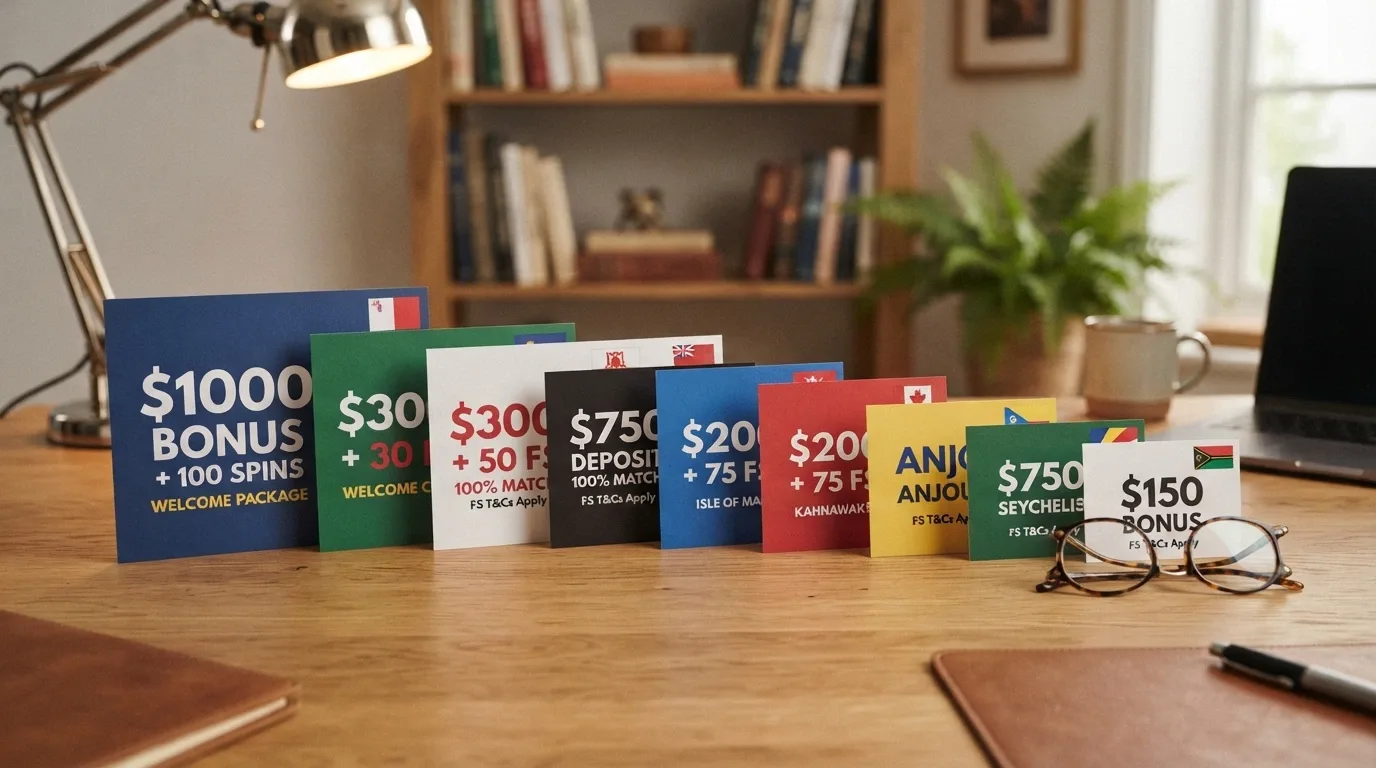
The table below compares the ten featured operators on the terms research actually covered. Cells the source did not specify are marked with an em dash, which is the article-language way of saying “the source did not carry this figure,” not “the figure is zero.”
| Operator | Licence | Welcome Bonus | Free Spins | Pokies |
|---|---|---|---|---|
| Royal Reels | Curaçao (claims unverifiable) | A$2,500 + 50 FS (35x wagering) | 50 | 5,400+ |
| Skycrown | Curaçao OGL/2023/176/0095 | A$8,000 + 400 FS | 400 | 7,200+ |
| Rocket Play | Curaçao | A$2,000 + 100 FS | 100 | — |
| Stake | Curaçao | Rakeback (0× wagering) | 0 | — |
| WinSpirit | Curaçao | 100% + FS (terms vary) | Varies | — |
| Fair Go | Curaçao | A$1,000 (5-tier) | 0 | 280 |
| Bizzo | Curaçao OGL/2024/590/0758 | A$7,250 + 175 FS | 175 | 8,000+ |
| Rainbet | Anjouan ALSI-152406029-FI2 | Rakeback + $1.7M monthly races | 0 | 7,000+ |
| Scream Casino | Curaçao | FS/Match (terms vary) | Varies | — |
| Wazamba | Curaçao | FS/Match (terms vary) | Varies | — |
The two columns that earn their place are licence and welcome bonus. The free-spin count is only known for a few operators, the pokie count for fewer still. Comparing bonus size without comparing the wagering requirement is misleading: Royal Reels’ A$2,500 carries 35x playthrough, while Stake’s rakeback model carries none.
Royal Reels — A$2,500 Welcome Pack With 35x Wagering
Royal Reels is the largest AU-facing welcome pack in the set, spread across three deposits and topped with 50 free spins. The number is big; the wagering is not zero. At 35x on the bonus portion, a player clearing the full A$2,500 across the three deposits faces $87,500 in qualifying turnover before the bonus converts to withdrawable cash. Even at 96% RTP, that turnover carries an expected loss north of $3,500 — larger than the bonus itself.
What the brand does offer is depth: more than 5,400 pokies from over 40 providers, which puts it in the upper third of the table on game library. Royal Reels also extends an A$10 no-deposit bonus after phone verification, which is one of the few genuinely free offers in the set and worth claiming as a low-risk test of the platform before any deposit.
The licence situation is the part research flagged: Curaçao claims for Royal Reels are unverifiable per source. That is a meaningful gap — a Curaçao licence number is the bare minimum of credibility, and a brand that does not produce one is asking the player to take the operator’s word. The welcome figure is large, the underlying licence is thin, and the wagering makes the bonus expensive to clear. A player with a small bankroll and a taste for big libraries may still find value in the A$10 sweetener, but the headline pack is for high-volume players who can absorb the clearing cost.
Skycrown — A$8,000 + 400 Free Spins With a Curaçao Licence
Skycrown holds the largest headline bonus figure in the featured set: A$8,000 plus 400 free spins, against a verifiable Curaçao Gaming Control Board licence under registry number OGL/2023/176/0095. The licence number is on file and checkable, which puts Skycrown ahead of the operators whose Curaçao claims did not verify.
The game library sits at 7,200+ titles, the second-largest in the set behind Bizzo. That range matters when free spins are part of the package — 400 spins locked to one pokie is a narrow experience, and a deep library gives the bonus more playable surface.
The cap is the one to watch. Free-spin and no-deposit offers at Skycrown sit under a typical A$100 maximum cashout, which is the market average for the format. A player who hits a large win on a free spin is paid up to the cap and loses the rest — the headline is “400 free spins,” the ceiling is A$100 on the spin-derived winnings. For a player who values library depth and a verifiable licence over a tiny cap, Skycrown sits near the top of the shortlist. The free-spin cap, though, is the rule, not the exception.
Rocket Play — A$2,000 + 100 Free Spins, Curaçao-Regulated
Rocket Play’s welcome package sits in the mid-tier of the set: up to A$2,000 across a deposit match plus 100 free spins, operating under a Curaçao Gaming Authority licence. The figure is more modest than Skycrown’s A$8,000 or Bizzo’s A$7,250, but the smaller bonus usually means a smaller turnover target, which a player clearing the offer can finish faster.
The cleanest read on Rocket Play is the licence: Curaçao Gaming Authority is the standard jurisdiction for the offshore market, and Rocket Play’s licence is verifiable per source. What research does not specify is the game library size, the maximum cashout, or the exact terms of the 100 free spins — the latter of which is where a player should look before depositing.
For an AU player who values a mid-sized welcome over the headline-grabbing A$8,000, Rocket Play is a reasonable middle option. Verify the wagering multiple and the free-spin cap on the terms page before claiming; the rest of the package is standard for the format.
Stake — Zero Wagering Across Every Reward
Stake is the structural outlier in the set. The platform runs a 0× wagering model across every reward, with no traditional welcome match bonus at all. What Stake offers instead is a rakeback system: a percentage of every wager is returned to the player regardless of outcome, and that returned amount is withdrawable immediately.
The model is genuinely different. A standard bonus pays the player for staying; a rakeback model pays the player for playing. The trade-off is volume: rakeback scales with how much a player wagers, so a casual player sees small returns and a high-volume player sees larger ones. The VIP tier system sits on top, with progressively better rakeback rates for higher-tier accounts.
Stake is also crypto-native, with Bitcoin, Ethereum, Litecoin, and USDT as primary banking options. The platform does not accept Australian dollars as a base currency, which means AU players fund their accounts in crypto and the value fluctuates with the exchange rate. For a player who already holds crypto, who plays at meaningful volume, and who would rather see cashback than grind through a turnover target, Stake’s model provides the most direct experience for the crypto-active user.
WinSpirit — 100% Match With Variable Free Spins
WinSpirit runs a 100% deposit match plus free spins, operating from a Curaçao licence. The shape is conventional; the specifics are not stable. Free-spin count and maximum cashout vary by promotion, and the welcome offer shifts between review periods, so a player reading the current terms at deposit time is the only way to know the actual numbers.
The variation is not unique to WinSpirit — Scream Casino and Wazamba in this set run the same pattern — but it does mean a player should not lock in expectations from a third-party review. Open the terms page, check the free-spin count, check the cap, check the expiry, then decide. That sequence applies to most offshore welcome offers, and it applies more sharply when the offer itself moves.
WinSpirit is a reasonable pick for a player who reads terms carefully and is comfortable with an offer that does not stay still. Those preferring the same number on the page as on the cashier should instead choose a fixed-figure operator (Skycrown, Bizzo, Royal Reels).
Fair Go — A$1,000 Five-Tier Welcome, 280 Pokies
Fair Go is the compact option in the set. The welcome package totals A$1,000 spread across five deposit tiers, with no free-spin component. The game library is 280 titles — a small figure against the 7,000+ libraries elsewhere in the set, but enough to cover the standard RealTime Gaming catalogue that has run the brand for years.
Fair Go is also one of the older AU-facing brands in the offshore market, with a long operating history under a Curaçao licence. That longevity is a different kind of credibility than a fresh Curaçao number, though it is not a substitute for one. A player who values a smaller, more curated game library, who prefers the RTG format, and who is comfortable with a five-deposit structure will find Fair Go’s A$1,000 adequate. A player who wants depth will find 280 titles thin.
The five-tier structure is also worth pricing out. A $200-per-deposit welcome across five deposits, with 30x–40x wagering on each, adds up to a meaningful clearing task. The smaller headline figure does not automatically mean a smaller clearing cost.
Bizzo — A$7,250 + 175 Free Spins, 8,000+ Titles
Bizzo pairs a near-top welcome figure with the largest game library in the set: A$7,250 plus 175 free spins against 8,000+ titles, under Curaçao licence OGL/2024/590/0758. The library figure is the standout — more than 1,000 games beyond the next-largest operator in the set, which gives a player meaningful variety when the free spins are tied to a single pokie.
The licence number is verifiable, which puts Bizzo in the same tier as Skycrown on the credibility check. The welcome figure is large, and as with every large welcome, the wagering multiple is the part to read. Industry-standard 40x wagering on the bonus portion is typical for the format and means a player clearing the full A$7,250 faces A$290,000 in qualifying turnover — a task that runs into the multi-thousand-dollar expected-loss range even at favourable RTPs.
For a player who wants library depth and a verifiable Curaçao licence, Bizzo is the strongest match in the set. Headline figures this large may prove difficult for those seeking a modest, quickly cleared bonus.
Rainbet — Anjouan-Licensed, Rakeback-Driven With US$1.7M Monthly Races
Rainbet is the only Anjouan-licensed operator in the set, holding licence ALSI-152406029-FI2 issued 14 June 2024 and expiring 13 June 2027. The licence is verifiable against the Anjouan register, and the Anjouan jurisdiction is a newer alternative to Curaçao for crypto-facing operators. The two regimes are not equivalent: Anjouan’s compliance and dispute-resolution infrastructure is less mature than Curaçao’s, which is itself a less rigorous regulator than the UKGC or the MGA.
What Rainbet offers in lieu of a traditional welcome is a rakeback-and-race structure. The headline figure is the prize-pool scale: nearly US$1.7 million in monthly race prize pools, plus a US$20,000 weekly raffle. The game library sits at 7,000+ titles including 14 provably fair games — the latter being a crypto-native format where the player can verify each spin’s randomness on-chain.
The structure suits a player who is already comfortable with crypto and provably fair gaming, and who values prize-pool competition over deposit matches. For a player who wants a clearable welcome with a known dollar figure, Rainbet focuses on leaderboard performance rather than a one-time deposit boost.
Scream Casino — Curaçao Licence, Free-Spin and Match Promotions
Scream Casino is a Curaçao-licensed offshore operator with bonus terms that move between free-spin and match formats. The specifics were not fixed at the time of research, which is itself a useful fact: a player landing on the site should expect the offer to have changed since any third-party review was written.
The pattern is common across newer Curaçao operators. The licence framework allows broad discretion on welcome offers, and operators use that discretion to run rotating promotions. The upside is variety; the downside is that a player claiming a bonus this week may not see the same offer next week. The advice is the same as for any variable-terms operator: read the terms page at the moment of deposit, and do not commit a bankroll on the strength of a review from a different calendar week.
Wazamba — Curaçao-Licensed With Rotating Bonus Offers
Wazamba is the second of the variable-terms operators in the set, operating from a Curaçao licence with welcome offers that change frequently. The site’s mascot-led branding is a stylistic choice; the licence is standard. The real-time terms check applies the same way it does to Scream Casino: what the third-party review said and what the cashier shows today may not match.
For a player who likes variety and reads terms carefully, Wazamba is a reasonable option. For a player who wants a stable offer, the rotating format is a friction point. The Curaçao licence puts it in the standard offshore category on credibility — neither better nor worse than its peers.
Playing at Offshore No-Wager Casinos — What Australian Law Actually Means for You
The legal position is the part of the offer no marketing page explains. Online casino games and online pokies are prohibited services under the Interactive Gambling Act 2001; no operator holds an Australian licence to offer them. Every no-wager bonus an Australian player can claim comes from an offshore operator, which means every claim sits outside Australian consumer law, outside the Australian self-exclusion register, and outside the dispute-resolution mechanisms a local licence provides.
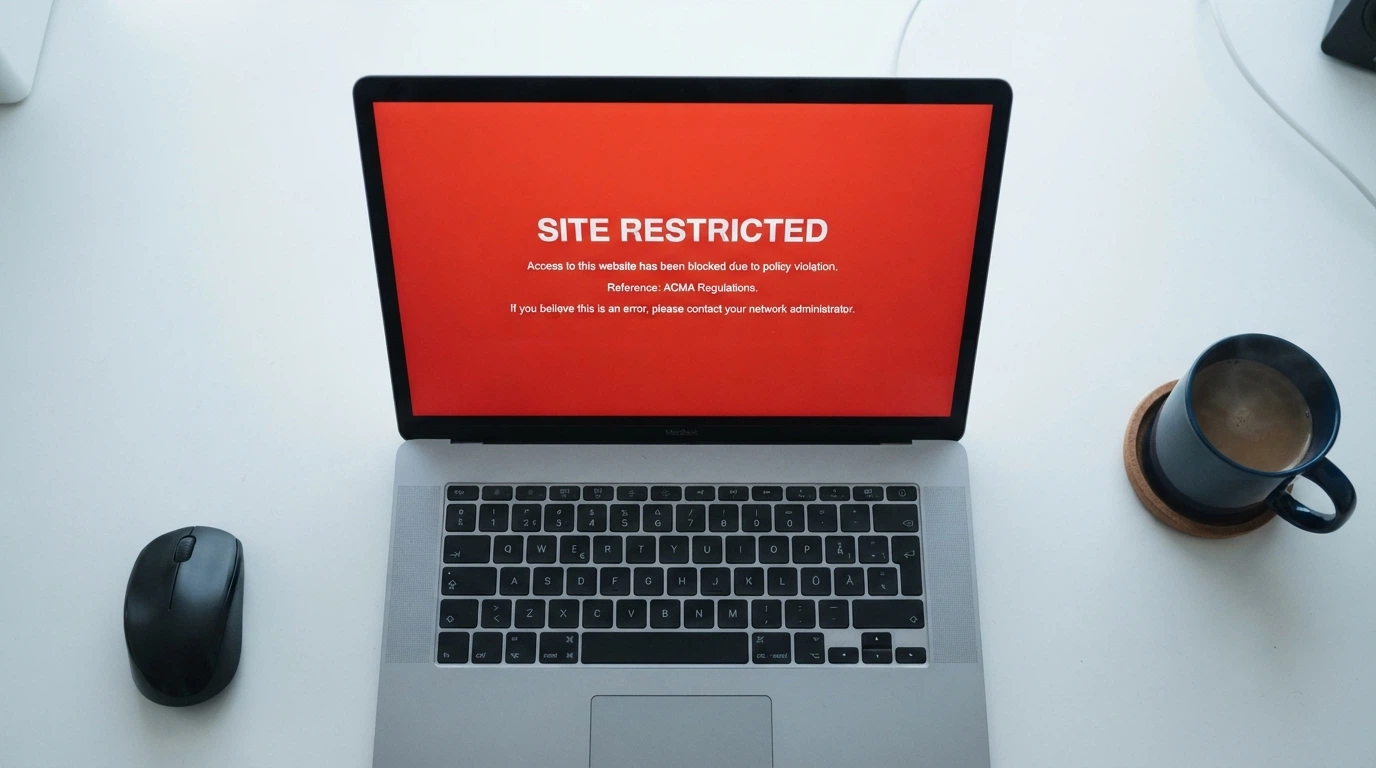
Players are not prosecuted for gambling at offshore sites. ACMA’s enforcement targets the operators, not the customers. The trade-off is the protection layer: no BetStop coverage on offshore play, no Australian Financial Complaints Authority (AFCA) route, and no statutory recourse if an operator withholds a withdrawal. The bonus is real, the cap is real, the licence is overseas, and the consumer protection is not Australian.
Who Regulates Online Gambling in Australia — ACMA and the IGA
The Australian Communications and Media Authority (ACMA) is the regulator. Its powers come from the Interactive Gambling Act 2001 (IGA) and the Interactive Gambling Amendment Act 2017, which strengthened the original statute. The IGA prohibits the supply of online casino games, online pokies, and in-play sports betting to Australian customers. Permitted services are limited to wagering on races and sports placed before the event, licensed by state and territory bodies like the Northern Territory Racing and Wagering Commission (NTRWC).
ACMA enforces through several tools. The most visible is DNS blocking: since the first blocking request in November 2019, 1,788 illegal gambling and affiliate websites have been blocked by Australian ISPs. Beyond that, 230+ illegal services have withdrawn from the Australian market since 2017. The Interactive Gambling Amendment (Gambling Reform) Bill 2026 passed Parliament on 19 August 2026, with measures commencing 1 January 2027 — strengthening ad restrictions and BetStop provisions.
The reform also extended the payment ban: since 11 June 2024, credit cards, credit-related products, and digital currencies (crypto) are banned as payment for online wagering at Australian-licensed operators. The ban applies to the AU-licensed wagering market, which is the sports and racing side, not the offshore casino side — but it shapes the payment options a player can use domestically.
Why Every No-Wager Casino You Can Access Is Offshore
The structural answer is the IGA. Australia does not issue online casino licences. No operator can lawfully offer online pokies, blackjack, or roulette to an Australian customer from an Australian base. The brands that do reach Australian players operate from Curaçao, Anjouan, and similar jurisdictions — which is the offshore reality the IGA creates rather than an oversight.
Curaçao’s Gaming Control Board issues the most common offshore licence in the set. The licence is a regulatory credential, not a guarantee: a Curaçao licence means the operator has met baseline compliance and reporting requirements, but the regime is less rigorous than the UK Gambling Commission or the Malta Gaming Authority. The two Curaçao licence numbers in this set, OGL/2023/176/0095 (Skycrown) and OGL/2024/590/0758 (Bizzo), are verifiable against the Curaçao register, which is the credibility floor. Anjouan is a newer jurisdiction, with Rainbet’s ALSI-152406029-FI2 (issued 14 June 2024, expires 13 June 2027) as the verifiable entry in the set.
The offshore market captures meaningful revenue. Blask’s data shows 56% of Australia’s online betting revenue goes to offshore operators — a majority share, which is the structural reason these brands invest in marketing at Australian players. The market is large, the regulation is offshore, and the player takes the trade-off in exchange for a product no AU-licensed operator can offer.
What You Give Up When You Play at an Unlicensed International Operator
The trade-off is concrete. A player at an offshore casino loses the consumer protection that follows an Australian licence, and the list of what that means is longer than it first looks.
BetStop, the National Self-Exclusion Register, had 67,480 registrations as at 31 July 2026. The register covers Australian-licensed wagering operators; offshore operators are not bound by BetStop. A player who self-excludes through BetStop and then opens an account at an offshore casino is still subject to the offshore operator’s own self-exclusion policy, which may or may not exist. The protection is in the AU system, not in the player’s willpower.
The age and exclusion data is the part that makes BetStop relevant. 78% of BetStop registrants were under 40, and 38% chose lifetime exclusion. The under-40 concentration suggests the register catches the demographic most exposed to offshore marketing. The lifetime figure suggests a meaningful share of registrants had reached the point where only the heaviest exclusion tool would do.
Beyond self-exclusion, the offshore player loses the AFCA dispute route, which is the body that resolves disputes between customers and Australian financial services. The player also loses the regulatory escalation path: an ACMA complaint against an offshore operator is not a path to recovered funds. A player whose withdrawal is delayed, capped inconsistently with the terms, or refused outright has no Australian statutory recourse. The remedies are limited to the operator’s internal complaints process, the Curaçao or Anjouan regulator (where applicable), and the operator’s reputation in the affiliate-review ecosystem.
KYC friction is the practical friction that follows. Offshore operators that pay out cleanly usually do so within a few days of a clean KYC submission. Operators that stall tend to request additional documents in a loop, each round resetting the timer. A small test withdrawal before committing a bankroll is the practical hedge.
Responsible Gambling — Help That Is Actually Here
The responsible-gambling resources below are Australian, free, and 24/7. They are not offshore; they sit inside the AU system regardless of where a player has been gambling.
The National Gambling Helpline is 1800 858 858. Gambling Help Online provides web and chat support at gamblinghelponline.org.au. BetStop, the National Self-Exclusion Register, is at betstop.gov.au. A player who wants to exclude themselves from AU-licensed wagering registers through BetStop; the offshore side requires separate action at each operator, which is part of the trade-off the offshore market imposes.
The context is the part that makes the resources necessary. Australians lost approximately $32.2 billion on legal forms of gambling in 2023-24 — the highest losses per capita in the world, at roughly A$1,521 per adult. That figure is for legal gambling; the offshore side sits outside the data. The number is the per-capita anchor that the helpline, the online support, and BetStop exist against.
The Fine Print Every No-Wager Bonus Hides in Plain Sight
The fine print is where the no-wager offer stops being a gift and starts being a contract. The cap, the expiry, the game eligibility, the KYC threshold, and the withdrawal minimum are the five terms that decide the actual payout, and every one of them applies on a no-wager offer as much as on a standard one.
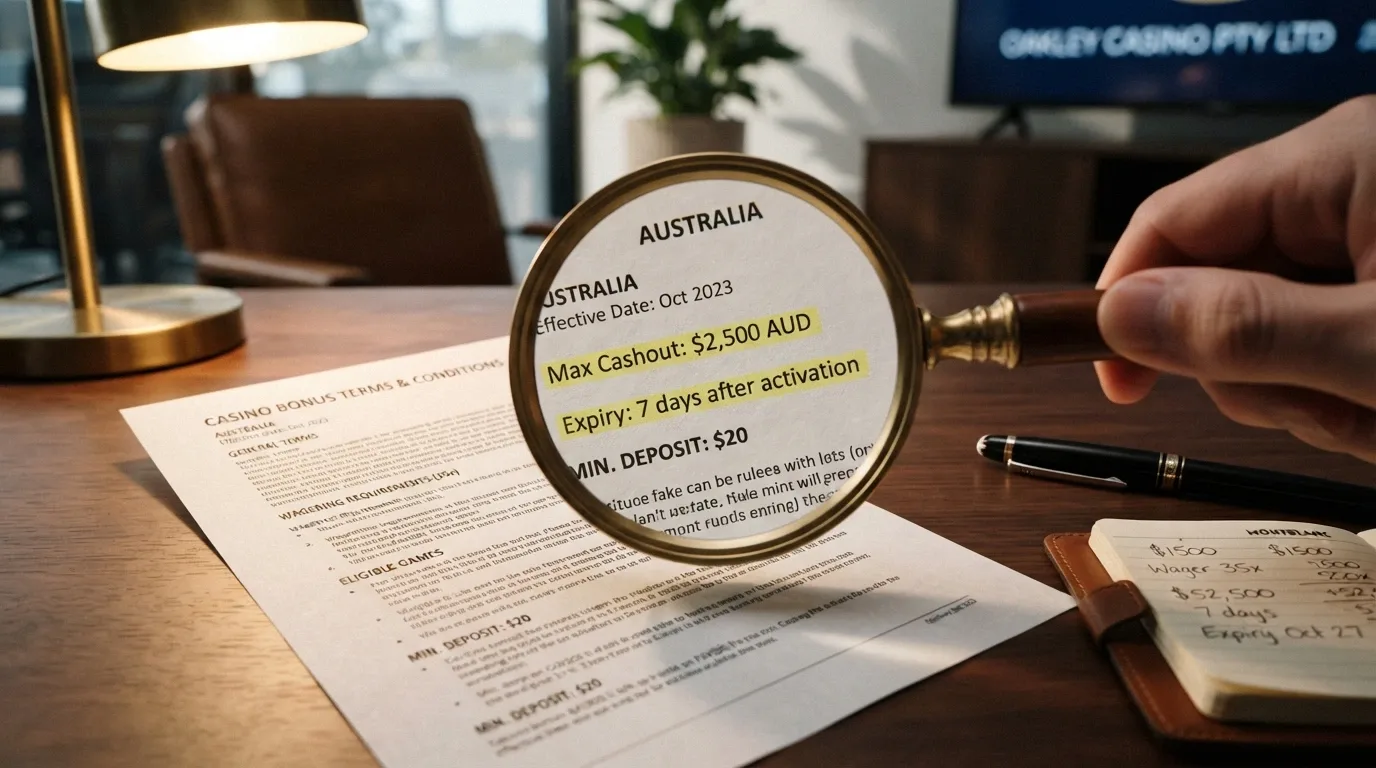
The no-wager label changes the math; it does not eliminate the small print. A player who reads only the headline walks away with a misimpression. A player who reads the bonus terms page walks away with the actual offer.
How Wagering Is Calculated on a Bonus — and Why No-Wager Skips It
The standard wagering arithmetic is straightforward: required turnover equals the bonus multiplied by the wagering factor. A $100 bonus with 35x wagering means $3,500 in qualifying turnover before withdrawal opens. The expected loss on that turnover, at 96% RTP, is $140 — already more than the bonus itself.
The no-wager offer collapses the multiplier to zero, which collapses the turnover to zero. The bonus and any winnings from it become withdrawable as soon as they land, with no grinding through a turnover target. The arithmetic skips the compounding house edge that a standard bonus imposes during clearing.
What the no-wager offer does not skip is the cap. A A$100 maximum cashout on a no-deposit offer means the player keeps up to A$100 of winnings and loses the rest. The bonus is now a coupon, not an open-ended gift, and the player’s edge over the operator sits inside that ceiling rather than extending beyond it.
The two offers are not directly comparable. A 35x bonus is a higher expected value on paper but requires volume and time; a no-wager offer is lower headline value but shorter in time and clearer in structure. The right choice depends on how much volume the player is willing to commit.
Max Cashout Caps — The Real Limit on Your No-Wager Win
The cap is the single most important number on a no-wager bonus. Industry data puts the average win cap on no-deposit bonuses at A$100, with a typical range from A$50 to A$200 across the format. The cap is enforced at withdrawal: anything above the cap is removed, and the player is paid the cap amount.
The cap matters most on the no-deposit and free-spin formats. A deposit-match welcome with a 35x wagering requirement has no cap in the same way — the bonus itself is large, and the wagering is the constraint. A no-deposit or free-spin offer with zero wagering is small, and the cap is the constraint. The two offers trade constraints: standard offers trade the cap for the turnover, no-wager offers trade the turnover for the cap.
For a player evaluating a no-wager offer, the cap is the ceiling on the expected value. A 50-spin bundle at A$0.20 each, against a 96% RTP pokie, has a raw expected value of about A$9.60. With an A$100 cap, the cap does not bind. A 50-free-spin offer at A$0.10 per spin against a 96% RTP pokie has an expected value of about A$4.80, and the cap is irrelevant. The cap binds when a player hits a large win — which is rare on free spins but possible — and the offer then pays out at the cap, not at the actual win.
Expiry Timers and KYC — What Kills a Bonus Before You Touch It
The clock is the second-most important number. Free spins and bonus cash usually expire within a day of activation, depending on the offer. A no-deposit bonus of A$20 that expires in 24 hours is functionally a test drive, not a sustained offer; a deposit-gated package that expires in 7 days gives the player a real window to play.
KYC sits on top of the clock. Know Your Customer checks require a government ID (passport, driver’s licence), a proof of address (utility bill, bank statement, usually under three months old), and sometimes a proof of payment method. Operators in the offshore market usually process a clean KYC submission within a few days; the friction comes from the operators that ask for additional documents in a loop, each round resetting the timer.
The combined effect is a clock-versus-KYC race. A player who delays KYC until the moment of withdrawal may find the bonus has expired, the win cap has been enforced, and the operator is asking for documents that take 48 hours to verify. The fix is simple: complete KYC before claiming the bonus, not before withdrawing from it. That sequence removes the friction the offshore market is most likely to use as a delay tactic.
No-Wager Free Spins vs No-Deposit Cash — Which One Puts More in Your Pocket
The two dominant no-wager formats are free spins and no-deposit cash, and the question of which puts more in the player’s pocket comes down to spin count, spin value, RTP, and cap. Below is a direct comparison of the two formats against the figures research actually carries.

| Format | Typical Size | Per-Unit Value | Win Cap | Best Suited To |
|---|---|---|---|---|
| No-deposit cash | A$20–A$50 | — | A$100 | Players who prefer table games or larger single bets |
| Free spins | 20–50 spins | A$0.10–A$0.20 each | A$100 | Players comfortable on pokies at the offered stake |
The expected-value arithmetic makes the comparison clear. A 50-spin set at A$0.20 each on a 96% RTP pokie has a raw expected value of about A$9.60. A A$20 no-deposit cash bonus on a 96% RTP pokie at A$1 per spin (20 spins) has a raw expected value of about A$0.80, but the cash format gives the player the freedom to choose stake, game, and bet size. The two are not directly substitutable; they serve different play styles.
No-Wager No-Deposit Bonuses — Free Cash With Strings Attached
A no-deposit no-wager bonus is a small cash credit (typically A$20–A$50) that becomes withdrawable as soon as winnings land, subject to the cap (typically A$100) and the expiry (typically 24 hours to 7 days). The format is the cleanest expression of the no-wager mechanic: no turnover, no grinding, just play and withdraw.
The cap is the binding constraint. A player who runs the A$20 bonus up to A$100 through a single lucky spin withdraws the full A$100. A player who runs it to A$200 withdraws A$100 and loses A$100. The expected value of a A$20 no-deposit bonus, on a 96% RTP pokie with a A$100 cap, depends heavily on the game’s volatility — high-volatility pokies give the player a small chance of hitting the cap, low-volatility pokies give the player a longer but lower-variance run.
For a player evaluating a no-deposit offer, the cap and the game eligibility are the two terms to read. The A$100 average cap is the ceiling; the eligible games are the surface the bonus can be played on. The rest of the offer follows from those two.
No-Wager Free Spins — Small Spins, Predictable Outcomes
No-wager free spins are typically 20–50 spins at A$0.10–A$0.20 each, locked to a specific pokie or short list of pokies. As low as A$0.01 per spin shows up in the market, but the A$0.10–A$0.20 band is the norm. The arithmetic is predictable: 50 spins at A$0.20 against a 96% RTP pokie returns about A$9.60 in expected play-money, with the A$100 cap meaning the ceiling on actual cash withdrawal is well above the raw expected value.
A worked example using the prescribed calculation. With a 50-spin allocation at A$0.20 each on Wolf Gold (96.01% RTP), the expected loss across the full spin allocation is 50 × A$0.20 × (1 − 0.9601) = A$0.40. The expected return to the player is A$9.60. The A$100 cap does not bind at expected value; it only binds if the player hits a disproportionately lucky run. This is the structural shape of the format: small expected value, low clearing cost, and a cap that protects the operator from a freak run rather than the average player.
The volatility of the assigned pokie is the practical lever. A low-to-medium volatility pokie like Blood Suckers (98% RTP) gives the player a longer, more predictable run, but the absolute ceiling per spin is lower. A high-volatility pokie like Book of Dead (96.21% RTP) gives the player more variance — longer losing runs, but more frequent large wins. The cap is the same; the path to the cap is different.
Getting Your No-Wager Winnings Out — Payments That Work for Australians
Payment options at offshore casinos diverge sharply from the AU-licensed wagering market. Credit cards and crypto have been banned as payment for online wagering at Australian-licensed operators since 11 June 2024, which shapes the domestic side. On the offshore side, the same payment options remain available — the ban does not extend to operators outside the AU-licensed regime — and the practical options are PayID, bank transfer, USDT, and BTC.
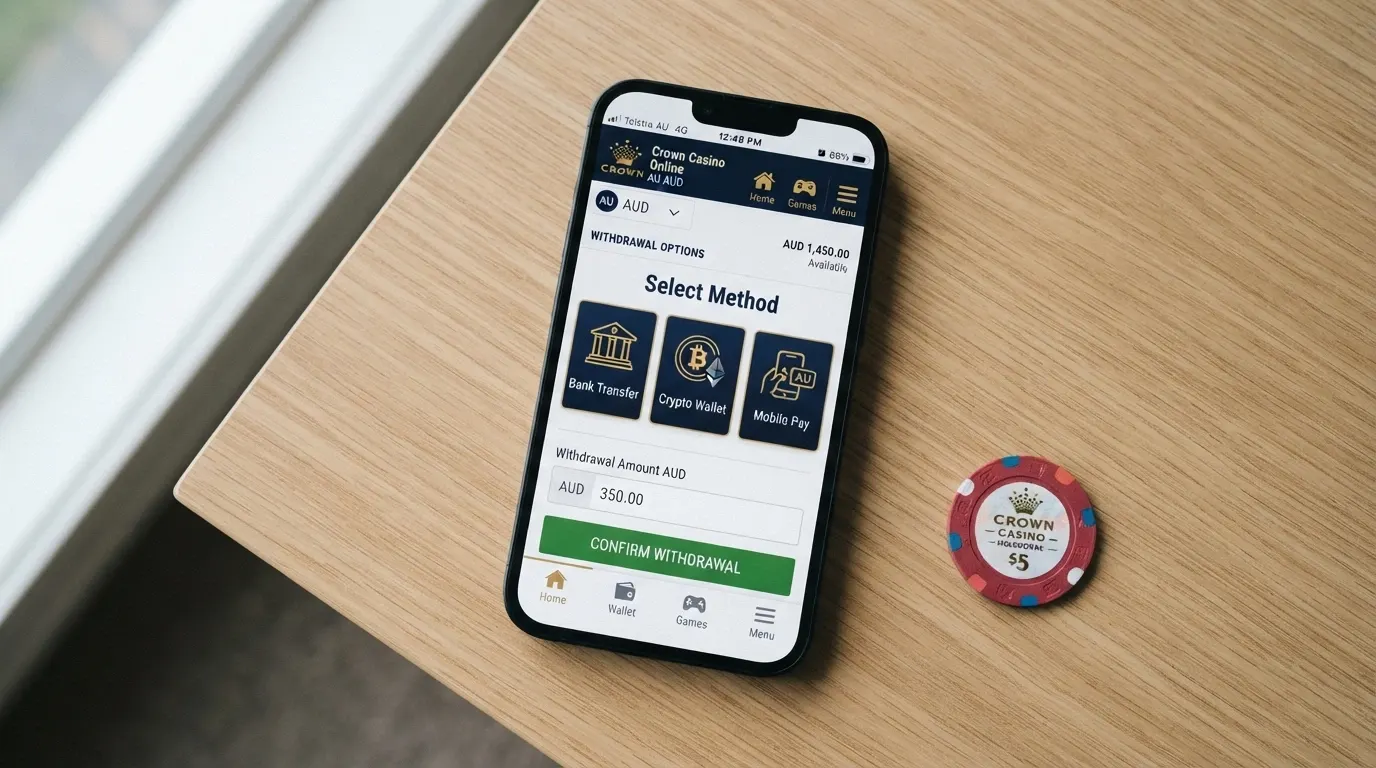
The two methods that work fastest for AU players are PayID (for AUD-denominated play) and USDT on the TRC-20 network (for crypto play). Bank transfers work but are slower; BTC is the original crypto option but is more expensive to move and slower to confirm than USDT TRC-20.
PayID, Osko and Bank Transfers for Casino Deposits
PayID is the AU player’s default choice for AUD-denominated offshore play. The system links a bank account to a simple identifier (a phone number, email, or ABN) and routes the transfer through the Osko network for near-instant settlement. For deposits, PayID lands in the casino account within seconds; for withdrawals, the operator processes the payout back to the same PayID, usually within 24 hours on a clean KYC.
Not every offshore operator accepts PayID. The acceptance list is operator-specific, and the absence of PayID is a real friction point for an AU player who does not want to hold crypto. Bank transfer is the fallback — same idea, slower settlement, no near-instant guarantee. The practical workflow is: check the operator’s banking page before depositing, confirm PayID is listed, confirm the AUD denomination is supported, and run a small test deposit before committing a bankroll.
Mobile and Pay-by-Mobile No-Wager Options
Pay-by-mobile is a deposit method at some offshore casinos, charging the deposit to the player’s mobile phone bill or deducting it from prepaid credit. The format suits small, casual deposits and is popular with players who do not want to enter bank details on an offshore site. The friction is the withdrawal path: a pay-by-mobile deposit usually cannot be withdrawn back to the same method, and the player needs a separate withdrawal channel (PayID, bank transfer, or crypto) for the payout.
Pay-by-mobile no-wager bonuses exist but are uncommon. The intersection of “no-wager” and “pay-by-mobile” is a narrow niche, and most no-wager offers in the AU-facing offshore market route through PayID or crypto instead. A player who specifically wants pay-by-mobile should expect to do more reading on the operator’s banking page to find the right offer.
The Pokies That Give You a Fighting Chance With a No-Wager Bonus
The pokie the free spins land on decides what the bonus is worth. A 50-spin deal at A$0.20 each on a 99% RTP pokie has a raw expected value of A$9.90; the same offer on a 92% RTP pokie has an expected value of A$9.20. The headline offer is the same; the player’s expected return is not.
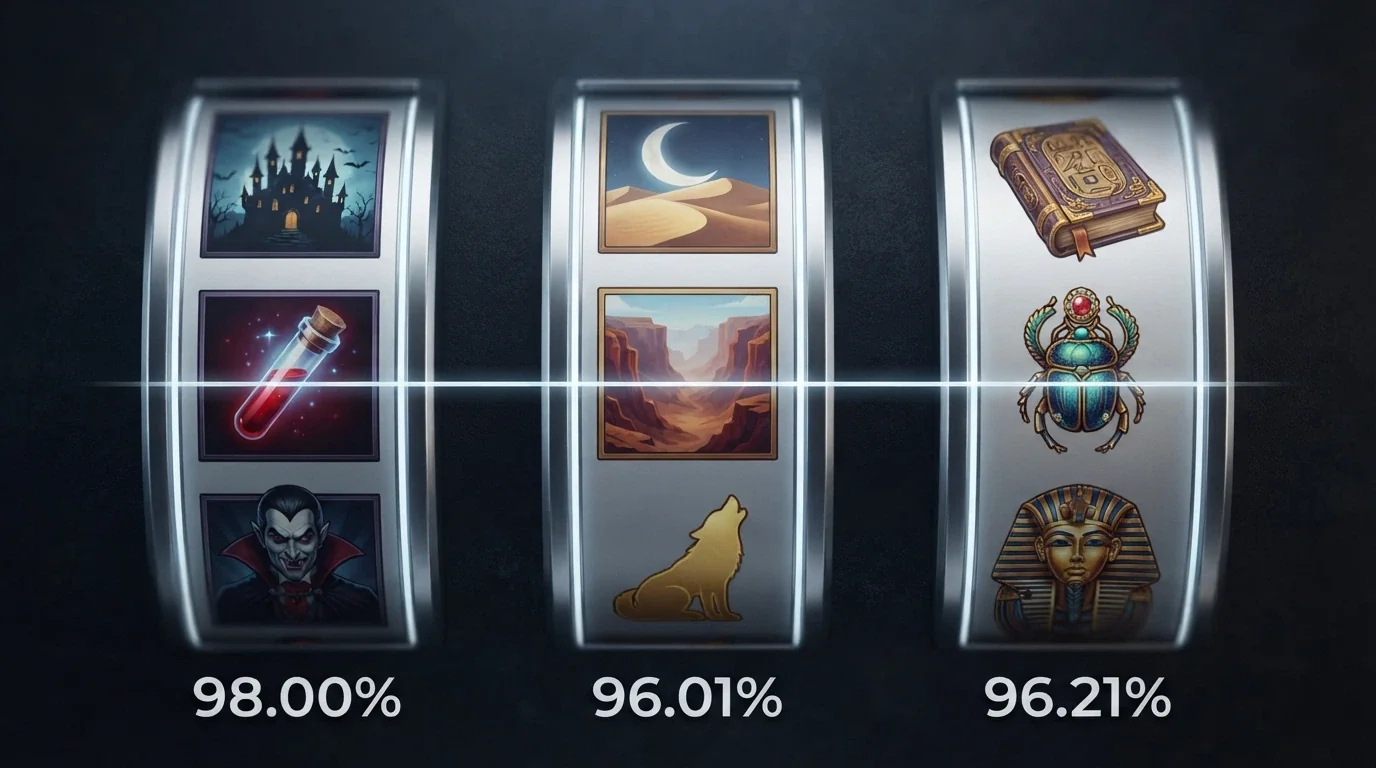
RTP (Return to Player) is the percentage of all wagered money a pokie returns to players over its lifetime. A 96% RTP pokie returns A$96 for every A$100 wagered across the full player base. Volatility is the variance around that average: low-volatility pokies pay small wins frequently; high-volatility pokies pay large wins rarely. The two work together: high RTP plus low volatility gives the player a long, predictable run; high RTP plus high volatility gives the player a short, swingy run with a higher ceiling.
The table below compares the five highest-RTP pokies commonly featured in AU-facing no-wager packages. Cells the source did not specify are marked with an em dash.
| Pokie | Provider | RTP | Volatility |
|---|---|---|---|
| Mega Joker | NetEnt | 99.00% | — |
| Book of 99 | Relax Gaming | 99.00% | — |
| Blood Suckers | NetEnt | 98.00% | Low-to-medium |
| Book of Dead | Play’n GO | 96.21% | Very high |
| Wolf Gold | Pragmatic Play | 96.01% | Medium |
Mega Joker and Book of 99 sit tied at the top of the table at 99% RTP, but the figure is misleading without the context. Mega Joker only delivers 99% with full Supermeter play at maximum bet — base-game play returns between 76.9% and 85.1%, which is a meaningfully different number. A player landing free spins on Mega Joker at sub-Supermeter stake is not playing the 99% pokie; they are playing the 76.9–85.1% one. Book of 99 is the cleaner high-RTP option, delivering its 99% figure across the regular paytable.
RTP and Volatility — What They Mean for Your Free Spins
RTP is the long-run return to the player. A 96% pokie returns A$96 of every A$100 wagered, on average, across millions of spins. A 98% pokie returns A$98. The 2-point difference compounds: across A$100 of wagering, the higher-RTP pokie gives the player an extra A$2 in expected return. Across the 50 free spins at A$0.20 each (A$10 in spin value), the difference is A$0.20 — a small absolute figure, but a 20% relative improvement in the spin’s expected return.
Volatility is the more practical variable for a free-spin offer. A low-volatility pokie pays small wins frequently, so 50 free spins on a low-volatility game tend to return a predictable, low-variance amount. A high-volatility pokie pays large wins rarely, so 50 free spins on a high-volatility game are more likely to return zero, with a small chance of a much larger payout. The cap is the same either way; the path to the cap is what differs.
For a free-spin offer, the optimal pokie depends on the player’s preference. A player who wants the highest expected return plays the highest-RTP game available. A player who wants the best chance of a meaningful cash payout plays a high-volatility game and hopes for the large win. The two preferences point at different pokies: Blood Suckers (98% RTP, low-to-medium volatility) for the expected-value player, Book of Dead (96.21% RTP, very high volatility) for the payout-chasing player.
No-Wager Slot Sites — Where to Find the Best Pokies
Game-library size is a different metric from game quality, but it sets the ceiling on what a player can access. Bizzo sits at the top of the set with 8,000+ titles; Skycrown follows with 7,200+; Rainbet at 7,000+ games plus 14 provably fair; Royal Reels at 5,400+ pokies from 40+ providers; Fair Go at 280. The Royal Reels provider count (40+) is the relevant figure for pokie quality, since it implies a curated mix of major studios — NetEnt, Pragmatic Play, Play’n GO, and Microgaming are likely inclusions, which means Blood Suckers, Wolf Gold, Book of Dead, and Book of 99 are all plausibly on the platform.
Fair Go’s 280-title library is the outlier. The small library is the trade-off for a brand that has run on a RealTime Gaming catalogue for years, and the player’s pokie selection is narrower. A player who values variety will find Fair Go thin; a player who values the RTG format specifically will find it adequate.
The provably fair format at Rainbet is worth flagging for crypto-native players. Provably fair games allow the player to verify each spin’s randomness against an on-chain hash, which is a structural transparency that non-provable pokies cannot match. The 14 provably fair titles in Rainbet’s library are a small but meaningful subset of the 7,000+ total.
Crypto No-Wager Bonuses — Faster Payouts, Same Offshore Reality
Crypto is the structural advantage of the offshore casino market. USDT on the TRC-20 network settles in under 60 seconds and costs less than A$0.50 in network fees, which makes it the fastest and cheapest payment rail available to an AU player. BTC is the original crypto option, with broader acceptance and deeper liquidity but slower confirmations and higher fees. ETH sits in between.
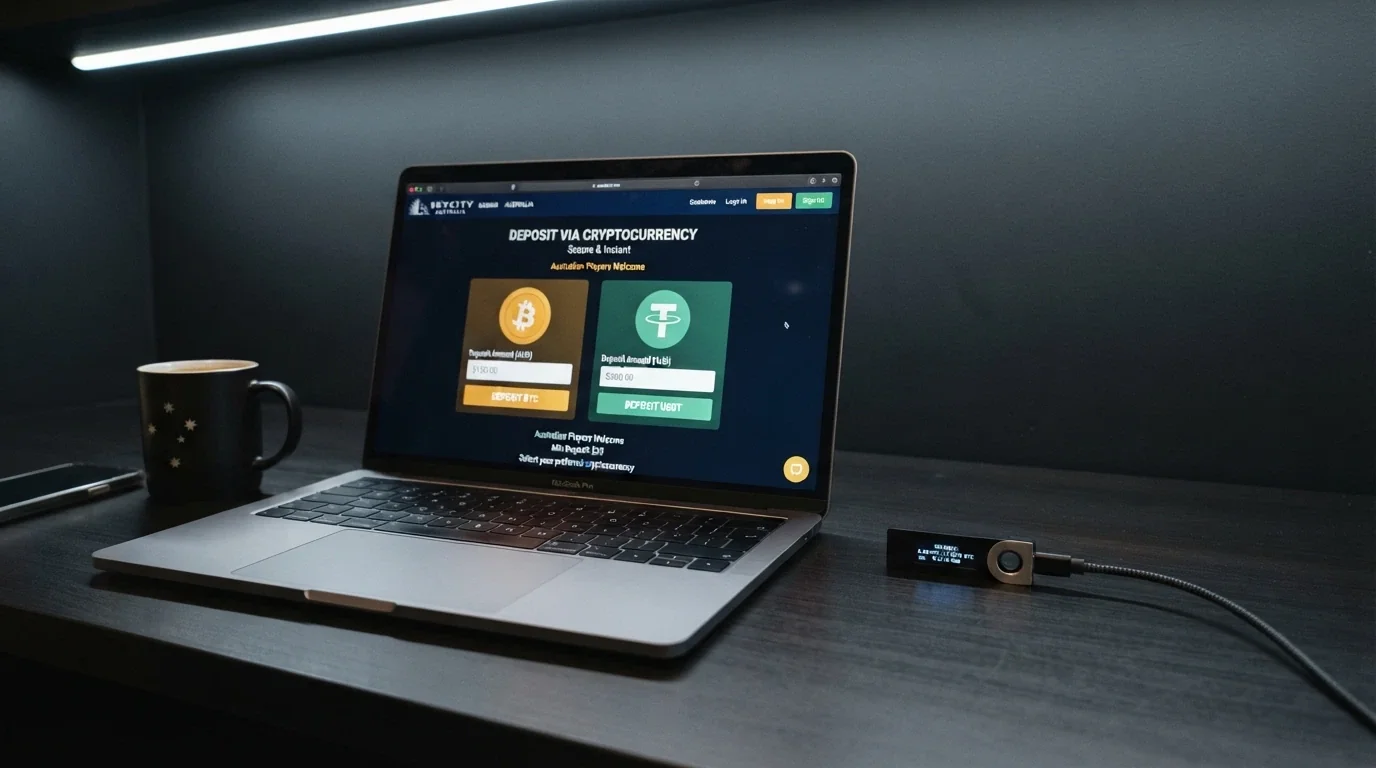
The crypto angle on no-wager bonuses is twofold. First, crypto deposits clear instantly and unlock the bonus without the bank-transfer delay. Second, crypto withdrawals avoid the AU-licensed wagering ban on credit cards and crypto for that segment, which does not apply to offshore operators but shapes the broader AU payments landscape. The trade-off is exchange-rate risk: a player who deposits in BTC and withdraws in BTC over a period of weeks is exposed to BTC’s price volatility. USDT, as a stablecoin, removes that risk on the network side but does not protect against the operator’s exchange-rate spread.
Crypto No-Wager Deposit Bonuses — USDT, BTC and the Rest
A crypto no-wager deposit bonus follows the same structure as a fiat one: deposit, get a bonus, play, withdraw winnings subject to the cap. The difference is the rail. A USDT TRC-20 deposit lands in the casino wallet in under a minute, which means the bonus activates quickly and the clock starts immediately. The same USDT TRC-20 deposit on the way out clears the operator’s hot wallet in under a minute, which means the player receives the payout within minutes rather than the 24–72 hours a PayID or bank transfer typically takes.
The exchange-rate spread is the part crypto players should price in. An offshore operator that accepts USDT but does not price its games in USDT will apply an exchange rate at deposit and again at withdrawal, and the spread between the two rates is the operator’s margin. A player who deposits A$200 worth of USDT, plays, and withdraws A$200 worth of USDT receives less than A$200 of USDT in net terms. The spread varies by operator; the structural fact does not.
For AU players specifically, the credit-card and crypto ban for AU-licensed wagering does not affect offshore play, so the crypto path remains open. The path is also the only one that gives the player a true under-a-minute settlement on both ends, which is why USDT TRC-20 has become the default for serious crypto players in the offshore market.
BTC No-Wager Casinos — The Bitcoin-First Operators
Stake is the benchmark BTC-native no-wager operator in the set, running a 0× wagering rakeback model with no traditional welcome match bonus. Every reward on the platform is paid through the rakeback system, with percentages that scale against VIP tier. The model is structurally aligned with the no-wager concept — there is no turnover to clear, because there is no bonus to clear in the first place.
Rainbet sits in the same crypto-first category but with a different reward structure. Rather than rakeback alone, Rainbet runs nearly US$1.7 million in monthly race prize pools and a US$20,000 weekly raffle, against an Anjouan licence and a 7,000+ game library that includes 14 provably fair titles. The Anjouan licence (ALSI-152406029-FI2, issued 14 June 2024, expires 13 June 2027) is verifiable, and the Anjouan regime is the operator’s chosen alternative to Curaçao.
The trade-off between Stake and Rainbet is reward shape. Stake gives the player cashback on every wager, which compounds with volume. Rainbet gives the player tournament entry and prize-pool access, which favours players who enjoy the race format. The two are not direct substitutes; they are different reward structures within the same crypto-first offshore market.
How We Picked the Best No-Wager Casino Bonuses for Australian Players
The ranking above draws on three sources: the ACMA register (for licence and enforcement context), the Curaçao Gaming Control Board and Anjouan licence registers (for operator credentials), and affiliate review data for the bonus terms and game-library figures. Each operator was checked for the licence status, the welcome offer shape, the free-spin count, and the game library size; operators whose Curaçao claims could not be verified against the register were flagged but retained, on the basis that the AU-facing offshore market is short on alternatives.
The ranking criteria were: licence verifiability (a verifiable Curaçao or Anjouan licence number ranks above an unverifiable claim), bonus shape (fixed welcome figures rank above variable offers, and no-wager mechanics rank above standard wagering where both exist), game library size (larger libraries rank higher on the assumption that more games means more eligible titles for free spins), and AU-facing availability (operators confirmed to accept AU players rank above those whose AU acceptance is unconfirmed).
Excluded from the ranking were AU-licensed sportsbooks and racing operators, which do not offer online casino products. Also excluded were aggregator pages and bonus-code sites, which do not operate as casinos. The set is the operators the research covered, ordered by the criteria above, with the proviso that the offshore-only reality of the AU-facing casino market means every entry sits outside Australian consumer-protection law.
Should You Claim a No-Wager Casino Bonus in 2026?
The answer depends on what the player is optimising for. A no-wager bonus is a real offer with a real cap, and the cap is the binding constraint. An A$100 average cap on a no-deposit offer means the most a player walks away with from that format is A$100, regardless of how the spins land. The bonus is not a path to a large payout; it is a path to a small, fast payout with no clearing cost.
The offshore trade-off is the part that compounds. Every operator in the ranking is offshore, every licence is Curaçao or Anjouan, and the Australian consumer-protection layer does not apply. The 56% offshore share of Australia’s online betting revenue is the structural fact: the AU-facing market is offshore by default, and the player accepts that trade-off in exchange for a product no AU-licensed operator can offer. The credit-card and crypto ban for AU-licensed wagering does not extend to offshore play, but the broader reality — that the IGA prohibits the product and the offshore operator exists in a regulatory gap — does.
For a player with a small bankroll, a taste for pokies, and a willingness to read terms carefully, a no-wager bonus is worth claiming. Start with the no-deposit sweeteners (Royal Reels’ A$10 after phone verification is the cleanest in the set), confirm KYC before withdrawing, and run a small test payout before committing further. For a player optimising for a large payout, the format is the wrong tool — the cap is the ceiling, and the format is built around small, fast wins rather than large ones.
The closing position is this: a no-wager bonus is the cleanest offer in an offshore market that the IGA does not let exist domestically. The label is honest, the cap is real, the licence is overseas, and the consumer protection is not Australian. Claim the small offers, read the terms, complete KYC before withdrawing, and treat the bonus as a test of the platform rather than a path to a meaningful payout. The A$100 cap is the ceiling; the offshore licence is the floor; everything else is the terms page.
Frequently Asked Questions About No-Wager Casino Bonuses in Australia
What is a no-wager casino bonus and how does it work for an Australian player?
A no-wager bonus carries a zero-playthrough requirement, so winnings are withdrawable as soon as they land, subject to the offer’s other conditions. For an Australian player, this means shorter time-to-cash than a standard bonus, but the product is only available from offshore operators because the Interactive Gambling Act 2001 prohibits online casino games and online pokies from being offered by Australian-licensed brands.
Are there any fully licensed Australian online casinos that offer no-wager bonuses?
No. Online casino games and online pokies are prohibited under the Interactive Gambling Act 2001, so no Australian-licensed operator offers them. Every no-wager bonus an Australian player can access comes from an offshore operator under a Curaçao or Anjouan licence, which means Australian consumer protections, BetStop coverage, and AFCA dispute recourse do not apply to that play.
What is the catch with a no-wager casino bonus?
The catch is the cap, the expiry, and the offshore licence. The average win cap on no-deposit bonuses sits at A$100, free spins usually expire within 24 hours to 7 days, and every operator in the offshore market sits outside Australian consumer-protection law. The wagering requirement is removed, but the cap, the clock, and the licence gap remain.
Can I use PayID to claim a no-wager bonus from Australia?
PayID works at offshore casinos that accept it, but acceptance varies by operator. The deposit settles through the Osko network within seconds, and the withdrawal back to the same PayID usually clears within a day on a clean KYC. For operators that do not accept PayID, USDT on the TRC-20 network is the alternative, settling in under 60 seconds for under A$0.50 in network fees.
What can I do if an offshore casino blocks my withdrawal after a no-wager win?
The remedies are limited because the operator is outside Australian jurisdiction. The first step is the operator’s internal complaints process; the second is the relevant offshore regulator (Curaçao Gaming Control Board for Curaçao-licensed brands, Anjouan for Anjouan-licensed brands). Australian statutory recourse through ACMA or AFCA is not available for offshore play, which is why a small test withdrawal before committing a bankroll is the practical hedge.
Do no-wager free spins always come with a maximum cashout limit?
Most do, and the average is A$100 across no-deposit and free-spin offers. The cap is enforced at withdrawal, so a player who hits a large win on a free spin is paid up to the cap and loses the rest. Operators do occasionally run cap-free spin offers, but the A$100 average is the market baseline and a player should treat the cap as the default rather than the exception.