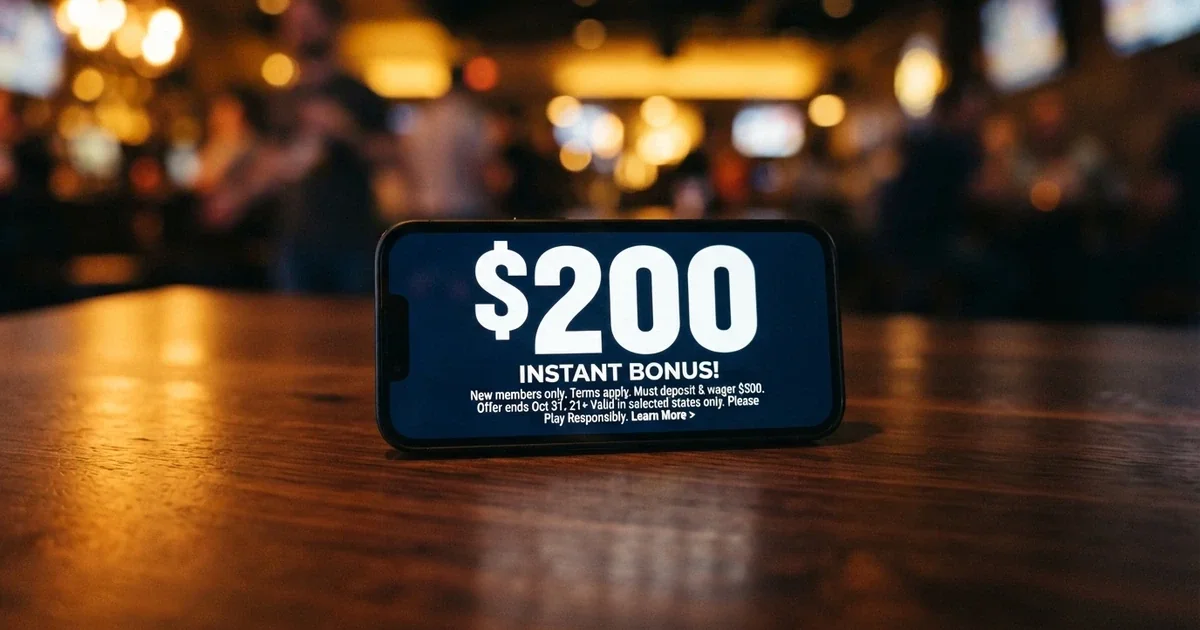
The $100 no-deposit casino bonus Australia search — and the legal gap underneath it
 Available in AU
The number is everywhere in Australian search results: “$100 no deposit bonus casino australia”. A hundred dollars of house money, free, before you ever reach for your wallet. The pages that promise it are polished, the codes look specific, and the operators behind them carry names that sound familiar. What none of those pages say, up front, is that no Australian-licensed casino can offer one — because no Australian casino licence exists. Online casino games, online pokies, and in-play betting are prohibited under the Interactive Gambling Act 2001. Every “$100 no deposit” offer an Australian player sees is being made by an offshore operator that the Australian Communications and Media Authority (ACMA) considers illegal, even when the operator’s marketing looks nothing like an illegal operation.

This page works through that gap. It explains what the Interactive Gambling Act actually bans and what it does not, why ACMA has spent the past decade blocking offshore sites, and what consumer protections an Australian player actually has — and loses, the moment they sign up offshore. It also sets out the licensed wagering operators an Australian can legally use, ranked by market share, and the responsible-gambling tools that come with each one. No $100 no-deposit bonus is on that list, because none is permitted. The aim is to give a reader who typed that search phrase enough context to know what they are looking at, what is on offer, and what the offer costs in protections they may not have realised they were trading away.
Data current as of 24 October 2026, verified against the ACMA public register and the National Self-Exclusion Register (BetStop).
Table of Contents
- Why Australia has no licensed $100 no-deposit casino bonus
- The $100 casino bonus Australian search results keep showing you
- Every bonus type behind the ‘$100 no deposit’ headline
- The platforms Australians can legally use — and why none of them run a casino
- Your PayID deposit lands in seconds — where does it actually go?
- What actually keeps you safe when the operator answers to nobody
- How we researched the $100 no-deposit bonus landscape for Australian players
- Your money, your call: what to actually do about the ‘$100 no-deposit’ search
- Frequently asked questions
Why Australia has no licensed $100 no-deposit casino bonus
The Interactive Gambling Act: what it actually bans
The Interactive Gambling Act 2001 — the IGA — has, for a quarter of a century, made it an offence to provide online casino games, online pokies, or in-play betting to a person in Australia. The prohibition was tightened in 2017, after a review found the original wording left exploitable gaps. What it does today is close them. A “prohibited interactive gambling service” is any service that offers a casino game — roulette, blackjack, baccarat, craps, slots dressed up as pokies — to someone physically present in Australia. The provider bears the penalty, not the punter: the IGA targets the operator supplying the product, not the individual player who signs up and deposits.
That distinction matters for the search result sitting in front of you. The Australian playing on an offshore site is not committing an offence. The offshore site is. Which means enforcement falls on the operator’s side — the blocking, the fines, the withdrawal notices — and on the Australian payment system’s side, where credit cards, credit-related products, and digital currency have been banned as payment for online wagering since 11 June 2024. The structural effect is that no Australian company can lawfully build a “$100 no-deposit casino” product. A bank cannot process the bonus. A licensed wagering operator cannot attach it to a sports account. The whole category is missing from the regulated market by design.
ACMA enforcement: site blocking, operator withdrawals and penalties
ACMA’s enforcement record since 2017 is the practical reading of the statute. Since November 2019, ACMA has had 1,564 illegal gambling and affiliate websites blocked at Australian ISPs — not just the casino operators themselves, but the affiliate sites that publish “best of” listicles pointing Australian players at offshore brands. More than 225 illegal services have withdrawn from the Australian market since enforcement was strengthened in 2017, deciding the legal risk had become unsustainable. The penalties are not symbolic: an operator that fails to enforce the credit and crypto payment ban faces penalties of up to $247,500 per breach, and from 1 January 2026 banks and payment providers gain express authority to block transactions to illegal gambling operators outright. The reform bill — the Interactive Gambling Amendment (Gambling Reform) Bill — passed Parliament on 19 August 2026, so the legal framework an Australian player meets at an offshore casino has been actively tightening, not loosening.
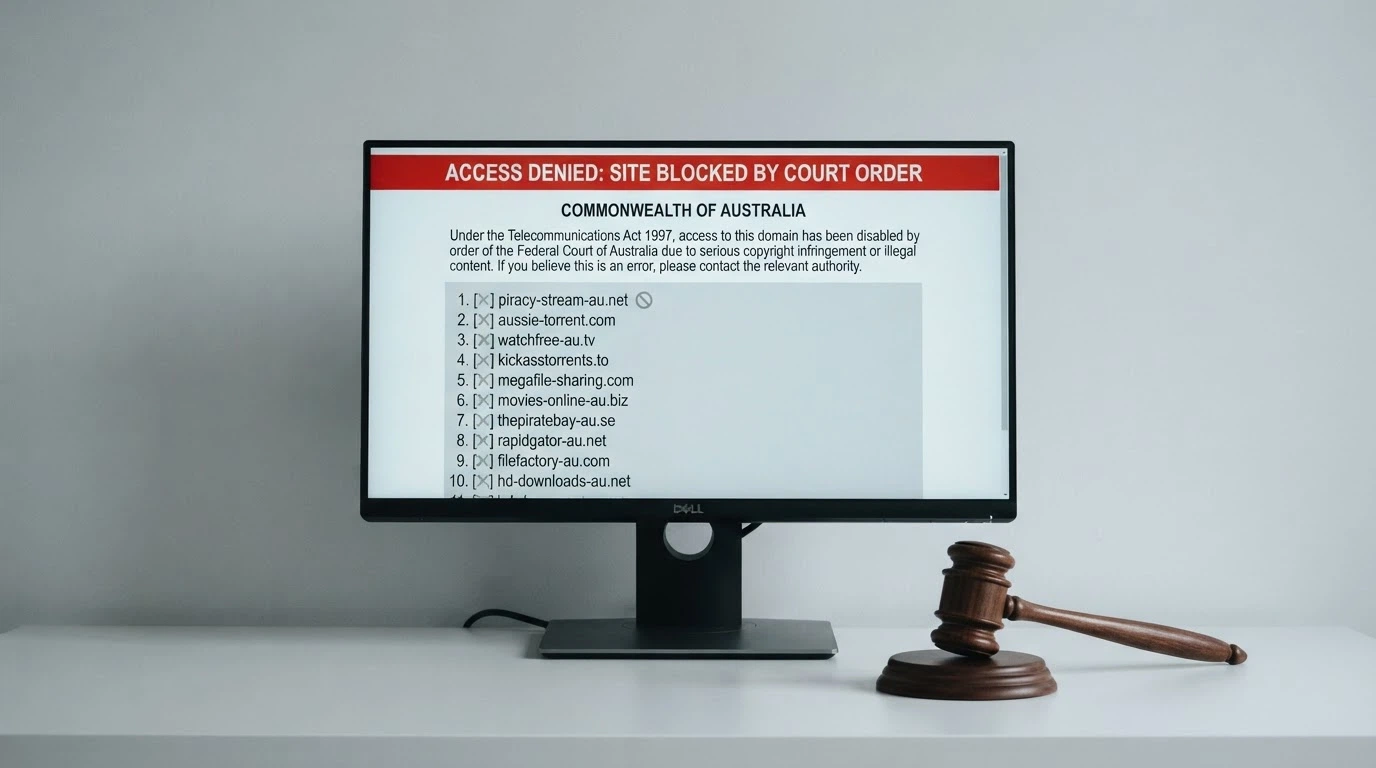
That is why the search results for “$100 no deposit bonus casino australia” return offshore brands even when the user is browsing from Sydney or Perth. The licensed market is barred by statute from competing for this search term. The affiliate pipeline that does compete for it runs on offshore operators, most of which ACMA has either blocked, attempted to block, or scheduled for blocking. A reader landing on those pages is being offered a product the Australian regulator considers illegal to supply — and the offer itself is part of why.
BetStop and the consumer protections you actually have
BetStop — Australia’s National Self-Exclusion Register — has been live since August 2023, and as of 31 July 2026 carries 67,480 registrations, with 41,290 exclusions still active. Seventy-eight per cent of registrants were under 40. Thirty-eight per cent chose lifetime exclusion. The numbers matter because they describe the size of the population that has formally asked every Australian-licensed wagering operator to refuse their bets — and they describe the gap that opens up when a player steps offshore. ACMA’s own statement on this is blunt: “BetStop binds Australian-licensed wagering services. An offshore casino is not licensed here, is not connected to the register, and will keep taking a self-excluded person’s money.” The protection register exists; the offshore sites are not on it. The licensed wagering operators that are on it must also offer customer-set deposit limits and activity statements as part of their licence conditions. An offshore casino answers to neither obligation.
The $100 casino bonus Australian search results keep showing you
Free money vs your own stake: how a no-deposit bonus differs from a deposit match
A no-deposit bonus is house money fronted by the operator before the player has deposited. A deposit match is the operator’s promise to double — or partly double — what the player puts in. The two offers read similarly on a marketing page but cost the operator, and the player, very different amounts. A no-deposit bonus is a small, fixed credit. A deposit match scales with what the player funds, which is why match bonuses carry heavier wagering requirements and stricter game weighting. The wagering requirement — the multiple the bonus amount must be turned over before any winnings can be withdrawn — sits at the centre of both, and it is the number that determines what the headline figure is actually worth.
What Australian search results offer, when they offer “$100 no deposit”, is the smaller end of the bonus category. The amount is low enough that the operator can absorb a few winners without breaking the model, and the wagering multiple is what turns the headline into a turnover target. The same offshore operators also offer deposit-match packages with much larger headline figures — “200% up to A$2,000” is a common shape — but those require a deposit first and carry wagering requirements that scale with the bonus paid out. Both categories sit outside what an Australian-licensed operator can lawfully supply.
The claim pathway: sign-up, verification, bonus code, play
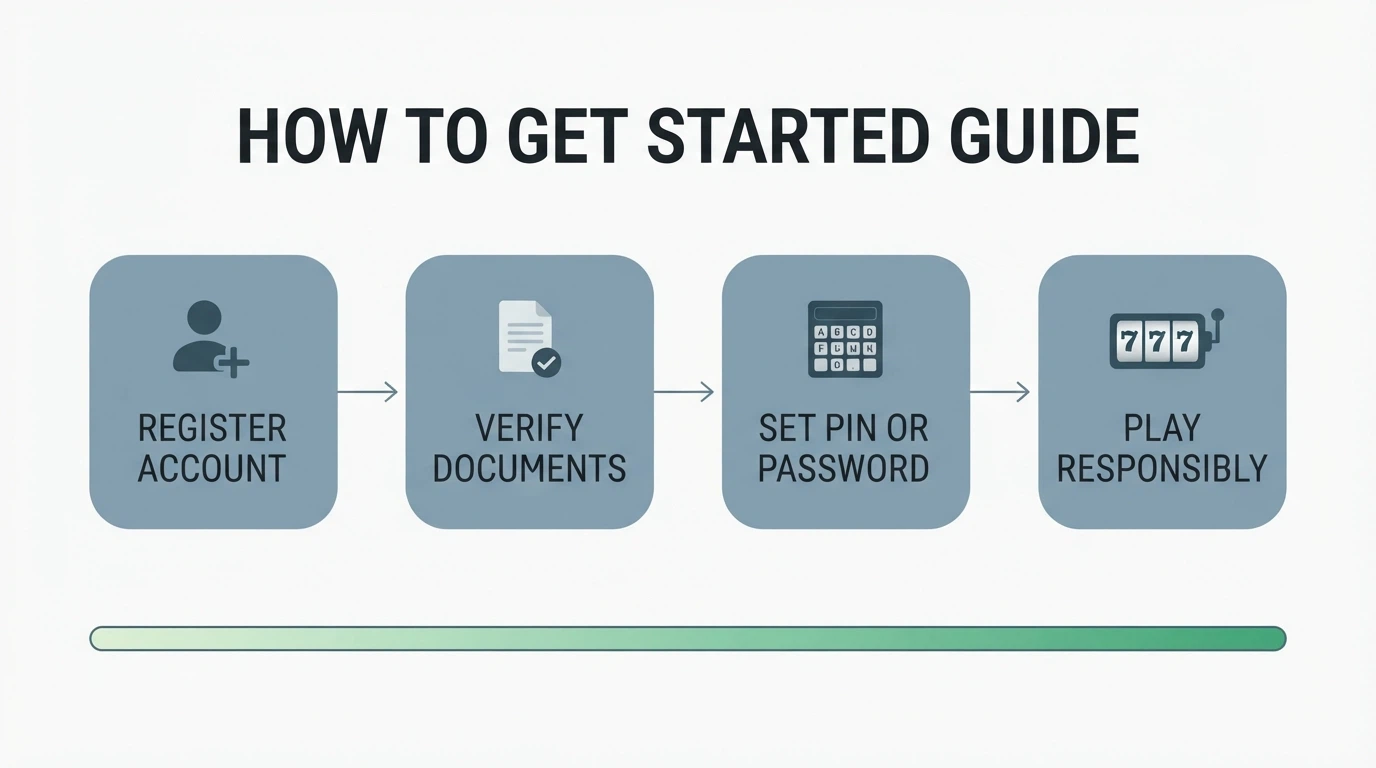
The standard offshore claim flow runs through four gates. The first is account creation: an email address, a chosen password, the country listed as Australia. The second is identity verification — a driver licence or passport, a proof of address, sometimes a selfie. The third is bonus code entry, either during registration or at the cashier before the first deposit. The fourth is the play itself, restricted to a list of eligible games. The verification step looks protective; in practice it is the operator meeting its own anti-fraud obligations rather than the player’s, because the player has no Australian regulator to complain to if their winnings are later voided for an alleged verification failure. The bonus code step is mechanical, and a missed code is not usually reversible — the player has deposited, the welcome bonus is forfeit, and the customer-service ticket that follows rarely changes the outcome.
A reader working through this list for the first time should read it as the operator’s terms in action. Every gate is a moment the operator can refuse the bonus, the deposit, or the withdrawal. A licensed Australian operator has a relationship with the regulator that constrains how those refusals work; an offshore operator does not.
Why offshore casinos target Australian Google searches with this exact offer
The affiliate ecosystem that produces the Australian search results is large enough to dominate the first page for almost every casino-bonus query — and ACMA’s enforcement record includes affiliate sites among the 1,564 domains blocked at Australian ISPs. The pipeline runs from a casino operator that wants Australian sign-ups, through an affiliate that wants Australian clicks, to a reader who wants the bonus. The licensed Australian market cannot compete for that traffic because it cannot offer the product. So the search-engine results page for a query an Australian player has typed — “$100 no-deposit bonus”, “free spins”, “pokies welcome bonus” — is filled by exactly the offshore operators ACMA considers illegal to supply. The economic logic of search advertising and the legal logic of the IGA point in opposite directions, and the page the reader lands on is the gap between them.
Every bonus type behind the ‘$100 no deposit’ headline
The $100 no-deposit bonus: house money with strings attached
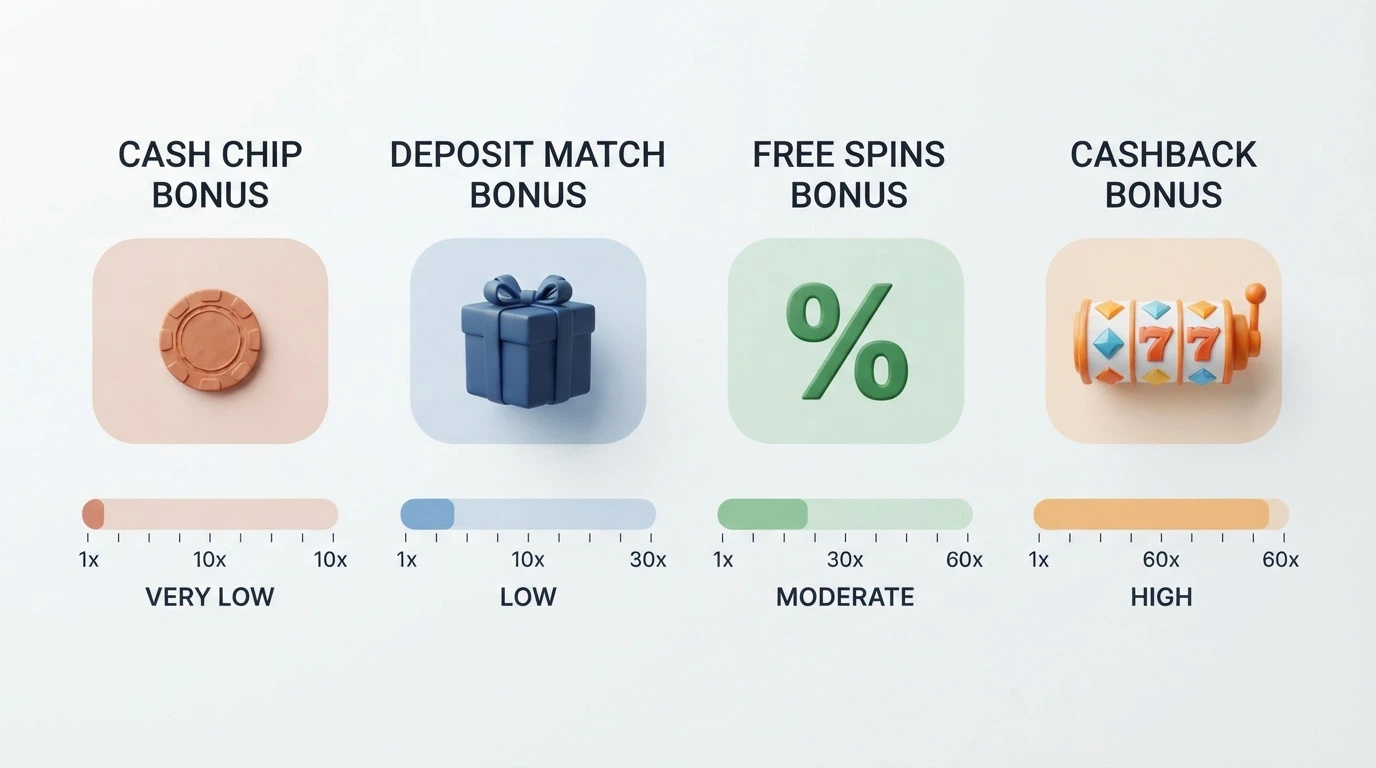
The “$100 no-deposit bonus” is a fixed credit — usually issued as a “free chip” or a “sign-up bonus” — credited to a new account before any deposit. The credit is not withdrawable. The wagering requirement, typically somewhere between 20 and 60 times the bonus amount, must be cleared on eligible games before any winnings become withdrawable, and there is almost always a maximum cashout cap — a ceiling on what can be taken out even after wagering is complete. A typical offshore $100 no-deposit offer, in industry-standard terms, asks the player to turn over several thousand dollars on a narrow list of slots before a withdrawal is permitted, and limits what can be withdrawn to a figure well below what an unconstrained win on those slots could produce. The “free money” framing is the marketing. The wagering multiple and the cashout cap are the product.
Welcome and sign-up bonuses: what a $100 offer actually costs you
A welcome bonus is the broader category the no-deposit offer sits inside. It usually combines a no-deposit credit on sign-up with a deposit match on the first fund-in, plus a bundle of free spins tied to a small list of pokies. The headline number is the largest figure a player can capture across all three components. The wagering requirement is applied to each component separately, often at different multiples. A $100 welcome package might require 50 times the bonus on the chip, 35 times the deposit plus bonus on the match, and 40 times the winnings on the free spins. The player who reads the headline and skips the wagering line ends up with a turnover target several thousand dollars higher than the bonus amount itself, plus a clock — most welcome bonuses expire within 7 to 30 days.
Deposit match and first-deposit bonuses: doubling your money at a price
A 100% deposit match doubles the player’s bankroll: deposit $100, play with $200. The wagering requirement attaches to the deposit plus the bonus — the full $200, not just the bonus portion — and the multiple is usually between 25 and 50. Game weighting complicates the picture: slots typically count 100% toward wagering, table games often count 10% or less, and some games are excluded entirely. A player who enjoys blackjack finds that a $200 bonus effectively requires them to put several thousand dollars through slots before any withdrawal clears. The product is a multiplier on turnover, not on fun.
Bonus codes: the string of letters that locks the offer
A bonus code is a short string — letters, sometimes numbers — that the player enters at registration or in the cashier to attach a specific offer to their account. Offshore operators use them to track which affiliate delivered the player, which promotion is being claimed, and whether the offer is “exclusive” to a particular partner site. A missed code usually means the default welcome bonus — often less generous — applies instead, and the difference is rarely reversible once the deposit has gone through. The codes themselves are not a meaningful feature for the player; they are the operator’s distribution mechanism. The offer they unlock is the same offer the player would have found without one, with a smaller bonus attached.
Pokies and slots bonuses: free spins dressed as a dollar figure
A “$100 bonus” that is actually a free-spin bundle works differently. The operator assigns a per-spin value — A$0.10 to A$1 is the typical range — and issues a number of spins that multiplies out to the headline dollar figure. The spins are locked to a short list of eligible pokies, the wagering requirement is applied to the spin winnings (not the bonus value), and there is usually a maximum cashout on the resulting balance. A “100 free spins at A$1 each” offer is functionally a $100 no-deposit bonus, but the wagering applies only to what the spins actually pay out, which is almost always far less than the headline. The player ends up running a small balance through a high wagering multiple on a narrow game list. The dollar figure on the marketing page is what those spins might be worth at full retail; it is not what the player is likely to walk away with.
The platforms Australians can legally use — and why none of them run a casino
| Operator | Licence (regulator) | Market share (%) | Products |
|---|---|---|---|
| Sportsbet | NTRWC (NT) | 19.57 | Racing, sports |
| Tab | State/territory | 11.54 | Racing, sports |
| Bet365 | NTRWC (NT) | 6.56 | Racing, sports |
| Ladbrokes | NTRWC (NT) | 4.53 | Racing, sports |
| TABtouch | State/territory | 4.28 | Racing, sports |
| PointsBet | NTRWC (NT) | 2.66 | Racing, sports |
| Neds | NTRWC (NT) | 2.25 | Racing, sports |
| Betr | NTRWC (NT) | 0.94 | Racing, sports |
| Picklebet | NTRWC (NT) | 0.79 | Racing, esports |
| Betfair | NTRWC (NT) | 0.62 | Exchange, racing, sports |
Where the search result meets reality: no $100 NDB among licensed operators
Every operator in the table above holds a wagering licence issued by either the Northern Territory Racing and Wagering Commission or a state or territory regulator. None holds a casino licence, because no Australian casino licence exists. The product column is therefore the same in every row — racing, sports, and (for one brand) esports — and the welcome bonus column is empty for the same statutory reason. A reader arriving from a “$100 no-deposit bonus” search sees a marketplace that does not contain the product they were looking for. The reasons it does not are the ones the Interactive Gambling Act lays down, and the table simply states them in operator form.
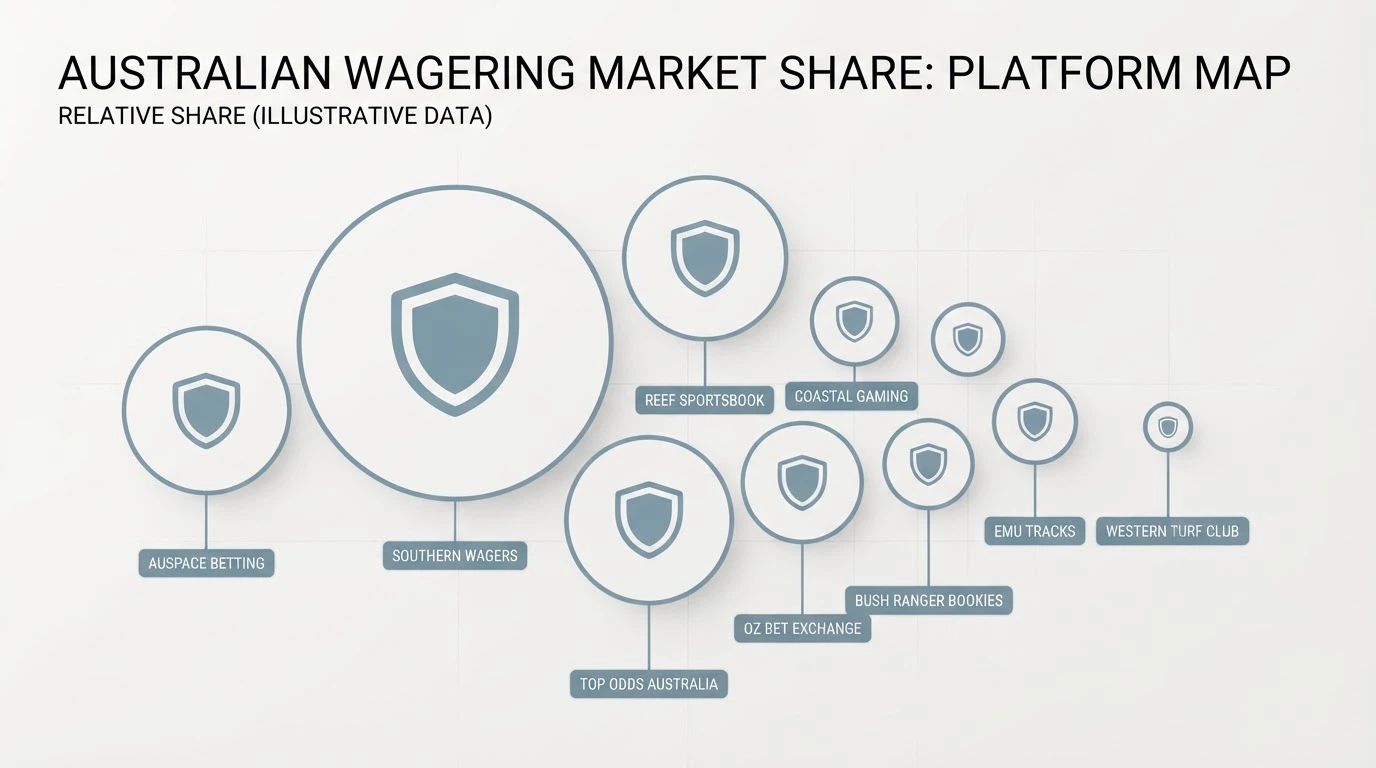
The spread of market share above also describes the depth of the licensed market: one operator commands nearly 20% of the wagering dollar, two clear brands (Tab and Bet365) sit in the next tier, and the rest of the top ten share the remaining volume down to under one per cent each. The licensed market is real, large, and active. It is also, by design, closed to the offer that brought the reader to the search.
Wagering, eligibility and the terms that replace bonus fine print
What governs the licensed platforms instead is a framework of turnover rules, minimum-bet terms, and promotional conditions, none of which resemble the offshore bonus fine print. From 1 January 2026, direct marketing of inducements is prohibited for 14 days after a customer signs up, and for three months after a person deregisters from BetStop — two measures that further narrow what a new account holder can be offered and when. The licensed platforms also run ID-verification at sign-up, deposit-limit tools that the player sets themselves, and activity statements that summarise monthly play. Those are the consumer-facing instruments. There is no bonus code, no wagering multiple, no cashout cap, because the product they would attach to does not exist.
How we compared the platforms: licence, market share, product range
The ranking in the table is built from three verifiable sources and only those. Licence status was confirmed against the ACMA public register and the relevant state and territory registers. Market share is drawn from the BLASK BRANDS-2 dataset, which publishes a quarterly Australian wagering snapshot by operator. Product range was checked directly against each operator’s Australian site, and confirmed to be racing and sports only — no online pokies, no online casino games. No invented score, no subjective ranking criterion, and no editor’s pick sits behind the order of the table. The market shares add context; the licence column carries the meaning.
Sportsbet
Sportsbet is the largest wagering operator in Australia by market share — 19.57% — and runs on a Northern Territory licence issued by the NTRWC. Its product is racing and sports, with the deepest market coverage of any licensed brand in the country. The familiar blue-and-yellow interface shows the wagering-only reality of the Australian licensed market: form guides, fixed-odds multis, exotics, and a racing product that has been refined for two decades. There is no casino tab because the licence does not permit one, and no welcome bonus because inducements are restricted at the state level in any case. Sportsbet is the operator a reader comparing licensed Australian platforms will encounter first, and the gap between what its homepage offers and what a “$100 no-deposit bonus” search result advertises is the gap this page is built around.
Tab
Tab is the state-backed wagering institution — collectively the various state and territory TABs that share the brand — and holds 11.54% of the Australian market. Its licence is state-issued rather than Northern Territory, which is the structural reason Tab owns the retail footprint of Australian wagering: counter betting at the pub, the club, the racecourse. The digital offering mirrors the retail one, with racing and sport the only products, and the same consumer-protection framework as every other licensed operator. Tab is the brand a reader who has walked into a TAB agency will already know, and the licensed-market alternative to the offshore pipeline that produced the search result.
Bet365
Bet365’s Australian arm sits on 6.56% of the local market under a Northern Territory licence, a smaller slice than its global footprint would suggest but a substantial one in a closed market. The product is racing and sports, with live odds and in-play pricing that the global brand is known for — though “in-play” here means odds updated during a sports event, not in-play betting, which the IGA prohibits in Australia. The verification at sign-up, the deposit-limit tools, and the activity statements all apply. Bet365 in Australia is what the international brand looks like when the casino product is removed and the regulatory framework is the Australian one.
Ladbrokes
Ladbrokes holds 4.53% of the Australian market and operates on a Northern Territory licence. The name carries weight from the high-street bookmaking era; the Australian product is the digital continuation of that brand, focused on racing and sport. The same inducement restrictions, the same deposit-limit framework, the same responsible-gambling obligations apply as on every other licensed platform. Ladbrokes is what an Australian reader who recognises the brand from the UK or from the old Australian retail scene finds when they look for it here — a wagering bookmaker, not a casino.
TABtouch
TABtouch is Western Australia’s own wagering platform — 4.28% market share, state-licensed through the Western Australian Racing and Gaming Commission. The product is racing and sports, with a strong focus on WA racing that reflects the state-licence structure. TABtouch’s market position shows how state-issued licences have held ground in the era of the Northern Territory-dominated digital market: a WA customer with a TABtouch account has signed up with their state’s operator, and the protection framework that comes with it is the state one. Like every other entry on the table, there is no casino product because none is permitted.
PointsBet
Pointsbet is the spread-betting specialist — 2.66% of the Australian market, Northern Territory licence, with a points-betting product that lets the punter back the margin of victory rather than the binary outcome. The wagering-only product range and the same responsible-gambling framework apply. Pointsbet is the brand a reader interested in a different kind of wager will find; it does not change the underlying reality that no casino bonus, no-deposit or otherwise, is available through any licensed channel.
Neds
Neds holds 2.25% of the Australian market on a Northern Territory licence, with a racing-and-sports product and a brand voice pitched at the casual punter. The inducement framework, the deposit-limit tools, and the verification at sign-up are all in place. Neds is a wagering operator, and the difference between its offering and an offshore casino’s offering is the entire subject of this page.
Betr
Betr is the newest of the licensed operators on this list — 0.94% market share, Northern Territory licence, racing and sports only. Its small share reflects both its recent entry to the market and the difficulty of building share against operators that have been refining their product for years. The responsible-gambling framework and the inducement restrictions apply from day one, and the casino product does not appear because it cannot.
Picklebet
Picklebet sits at 0.79% of the Australian market with a Northern Territory licence and a product range that crosses esports and racing. The crossover is unusual among the licensed set and reflects the platform’s origins in the esports wagering market. The same statutory limits apply: no casino, no pokies, no in-play betting on a sporting event once it has started. Picklebet is the operator a reader interested in esports wagering will find on the licensed side, and it is also a reminder that even the narrower corners of the Australian licensed market sit inside the same prohibition that closes the rest of it.
Betfair
Betfair closes the table at 0.62% market share — the smallest of the licensed top ten, but the only one running a betting-exchange model rather than a traditional bookmaker. The Northern Territory licence covers the operation; the product is peer-to-peer wagering on racing and sports. The exchange structure is genuinely different from the rest of the market: a punter backs and lays against other punters rather than against the house. It is still not a casino, still not eligible for any form of bonus offer tied to casino play, and still subject to the same responsible-gambling framework as every other row in the table.
Your PayID deposit lands in seconds — where does it actually go?
The $100 deposit step: what happens after you fund an account
PayID and Osko together settle Australian bank transfers in seconds — the A$100 deposit arrives in the operator’s account before the player has closed the confirmation screen. BPAY is the slower alternative, settling by the next business day, and POLi is the third option for players who prefer to authorise a transfer from their bank rather than enter a BSB and account number. The licensed wagering operators accept all three. Offshore casinos accept PayID through intermediaries in some cases — the deposit looks instant, the actual clearing runs through a payment processor offshore — but the offshore route to a PayID deposit is not the same as the licensed route. The Australian payment system has, since 11 June 2024, banned credit cards, credit-related products, and digital currency for online wagering. A reader who tries to fund an offshore casino account with a credit card will be declined at the bank. A reader who tries crypto will be declined at the exchange. PayID is the path that is still open, and the path the offshore affiliate sites route Australian players toward.
A $100 deposit at a licensed Australian wagering operator becomes A$100 of wagering credit, with no bonus attached and no match waiting on the other side of the deposit. A $100 deposit at an offshore casino becomes whatever the welcome bonus multiplies it into — 200%, 300%, sometimes higher — but with a wagering requirement and a cashout cap attached to the bonus, and with no Australian regulator behind the operator if the bonus terms are not honoured.
Getting money out: withdrawal speed and the offshore trap
The test of any platform is what happens at the withdrawal screen. Licensed Australian wagering operators run withdrawals back through the same PayID, Osko, or BPAY rails as deposits, with verification holds that range from same-day to a few business days depending on the operator and the withdrawal method. The verification is regulatory: the operator must confirm the player’s identity before paying out, and the time it takes reflects that requirement.
An offshore operator has no such requirement, and no such constraint. The withdrawal can be approved in seconds and the funds never arrive. Or the operator can demand additional verification documents at the moment of payout — a fresh utility bill, a notarised ID — that the player cannot easily supply. Or the bonus terms, buried in the fine print at sign-up, can be invoked to void winnings: the maximum bet was exceeded, the wrong game was played, a technical irregularity was detected. The Australian player has no regulator to complain to, no dispute resolution body to escalate to, and no realistic path to recovering funds the offshore operator has decided not to release. The risk is structural: the operator holds the money, the operator sets the rules, and the player has agreed to those rules by signing up.
What actually keeps you safe when the operator answers to nobody
| Protection | Licensed Australian wagering operator | Offshore casino |
|---|---|---|
| Australian regulator | Yes (ACMA, NTRWC, or state) | None |
| BetStop enforcement | Yes | None |
| Customer-set deposit limits | Required | None |
| Monthly activity statements | Required | None |
| Credit card / crypto deposits | Banned | Variable |
| Dispute resolution | Australian avenues | Operator’s own terms |
| Site blocking by ACMA | No — licensed | Frequently |
Deposit limits, time limits and activity statements: what licensed operators must give you
Every Australian-licensed wagering operator must offer customer-set deposit limits, take-a-break tools, and monthly activity statements as part of the licence conditions. The deposit limit is set by the player, not by the operator, and once set it applies across the licensed platform. The activity statement is a monthly summary of deposits, withdrawals, and net position that the operator must produce and the player can request. Take-a-break is a short self-exclusion window — typically 24 hours to several months — that sits inside the operator’s own platform. None of these tools is optional from the operator’s side. They are licence conditions.
BetStop: how Australia’s National Self-Exclusion Register actually works
BetStop registration can be completed online in a few minutes. The player chooses an exclusion period — three months, six months, twelve months, two years, five years, or lifetime — and the registration is shared with every Australian-licensed wagering operator. Once active, the operator must refuse the player’s bets, close marketing communications, and prevent the account from being used to deposit. As of 31 July 2026, 67,480 Australians had registered with BetStop. Forty-one thousand two hundred and ninety exclusions were still active. Seventy-eight per cent of registrants were under 40. Thirty-eight per cent chose lifetime exclusion. Those numbers describe a population that has formally asked the licensed market to refuse their money — and the licensed market must comply.
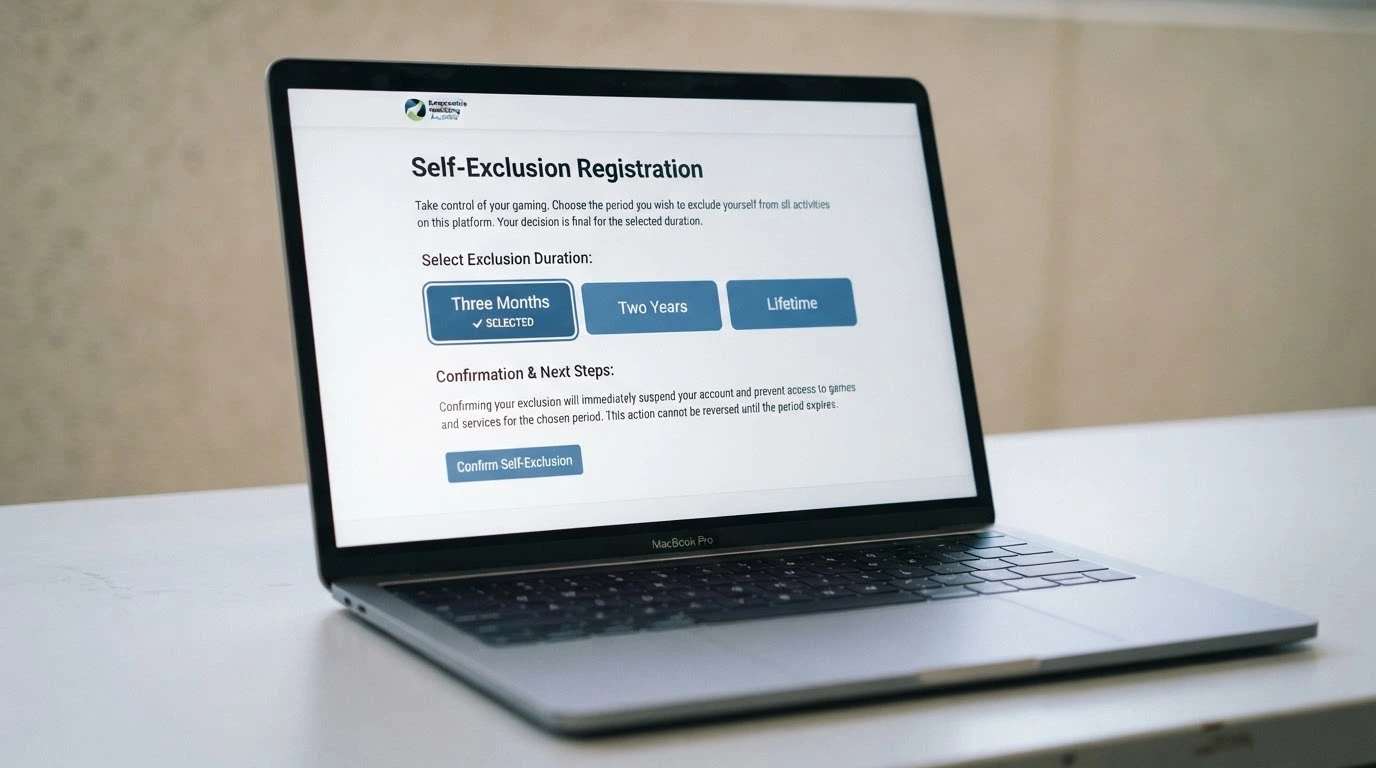
What BetStop cannot do is reach an offshore casino. The register is Australian; the offshore sites are not on it. A person who has registered with BetStop can still sign up at an offshore casino, deposit, and play. ACMA’s statement on this is the clearest reading of the gap: the offshore operator answers to no Australian register, will accept the self-excluded player, and will keep taking their money. The protection exists inside the licensed system. Outside it, the protection does not travel.
Where to get help: the numbers and services that work right now
The National Gambling Helpline — 1800 858 858 — is free, confidential, and staffed 24 hours a day. Gambling Help Online, at gamblinghelponline.org.au, runs the same service over web chat and email. About 2.1% of Australian adults — roughly 430,000 people — experience problem gambling, with high-risk gambling sitting at 1.8% as of the 2022 Australian Institute of Health and Welfare figures. The services exist, they are reachable, and they are independent of any operator. A reader who feels their own play slipping, or who is reading this page on behalf of someone they are worried about, has somewhere to call today. The number is the same at any hour, and the line does not require a deposit.

How we researched the $100 no-deposit bonus landscape for Australian players
The figures on this page come from three primary sources and one secondary. The primary sources are the Australian Communications and Media Authority’s public register and enforcement data, the Northern Territory Racing and Wagering Commission’s licence register, and the state and territory wagering registers for non-NT operators. The market-share figures are drawn from the BLASK BRANDS-2 dataset, which publishes quarterly snapshots of the Australian wagering market by operator. The BetStop statistics are taken from ACMA’s published register data as at 31 July 2026. The secondary source is the Australian Institute of Health and Welfare’s problem-gambling prevalence research, which provides the 2.1% adult figure and the 430,000-person estimate.
Every operator on the licensed-platform ranking was checked against the relevant register. Every market-share figure was carried forward exactly as the BLASK BRANDS-2 dataset publishes it. The responsible-gambling obligations — deposit limits, activity statements, take-a-break — are stated as they appear in the licence conditions, not paraphrased from operator marketing. Where the data did not cover an operator (no published deposit-limit threshold, no publicly disclosed wagering turnover rule), the figure was not invented; the page states the limitation instead.
Your money, your call: what to actually do about the ‘$100 no-deposit’ search
A reader who arrived at this page from a “$100 no-deposit bonus” search has been shown an offer that no Australian-licensed operator can lawfully make. The legal architecture that makes the offer illegal — the Interactive Gambling Act 2001, the ACMA enforcement record, the credit and crypto payment ban — has been tightening rather than loosening, and the 2026 reform that passed Parliament on 19 August 2026 adds further restrictions commencing 1 January 2026: banks and payment providers gain express authority to block transactions to illegal operators, inducements are restricted for the first 14 days after sign-up and for three months after a BetStop deregistration, and wagering advertising is capped across broadcast and digital channels. The trend is away from the offshore pipeline that produced the search result.
The licensed alternative is wagering on racing and sport through an Australian-licensed operator, with the consumer protections that come with the licence: BetStop coverage, customer-set deposit limits, monthly activity statements, and a regulator that can enforce the rules. The product is different. The market is closed to online casino games, online pokies, and in-play sports betting by statute. The protections are real and enforced. An Australian who chooses the licensed market trades the offshore bonus headline for the protection framework, and the trade is the one the law has decided to make for them. The $100 no-deposit bonus on the search-engine results page is a marketing artefact of a market the regulator is actively dismantling; the licensed wagering operators above are what remains when that market is set aside.
Frequently asked questions
Are $100 no-deposit bonuses legal for Australian players?
No Australian-licensed operator offers one, because online casino games and pokies are prohibited under the Interactive Gambling Act 2001. Every “$100 no-deposit” offer an Australian sees is from an offshore operator ACMA considers illegal to supply. The individual player is not prosecuted, but the site can be blocked and the bank can decline the deposit under the payment restrictions in force since 11 June 2024.
What are the wagering requirements for a $100 NDB?
Offshore $100 no-deposit bonuses typically carry wagering requirements between 20 and 60 times the bonus amount, applied to a narrow list of eligible games, with a maximum cashout cap and an expiry window of 7 to 30 days. The exact multiple, eligible games and cap vary by operator; the headline figure is the smallest number on the page.
What is the maximum withdrawal for a $100 no-deposit bonus?
Most offshore $100 no-deposit offers cap withdrawable winnings well below what an unconstrained win would produce — commonly A$100 to A$500 after wagering is complete. The cap is set by the operator and enforced at the withdrawal screen. A player who wins more than the cap on an eligible game forfeits the excess once wagering is cleared.
Do I need a bonus code for a $100 no-deposit offer?
Offshore casinos often tie their headline offers to a bonus code, which is entered at registration or in the cashier before the first deposit. The code is the affiliate’s tracking mechanism; the offer unlocked by it is the same offer the player would find on the casino’s own promotions page, with a smaller default bonus if the code is missed. A missed code is rarely reversible after the deposit has gone through.
What happens if I win money at an unlicensed casino?
The offshore operator’s terms govern. The operator can demand additional verification at payout, invoke bonus terms to void winnings, or simply refuse to release the funds. The Australian player has no Australian regulator to complain to, no dispute resolution body to escalate to, and no realistic recovery path. ACMA can block the site, but blocking does not return money already deposited.
Are there any licensed $100 no-deposit bonuses in Australia?
No. Australian-licensed wagering operators are prohibited from offering online casino games, online pokies, and any bonus attached to them. The ten operators ranked on this page hold wagering licences for racing and sports only; none can lawfully offer a $100 no-deposit casino bonus because none holds an Australian casino licence, and none exists.
Written by the editors at Casino Promo Code AU.