
No Deposit Bonus Casino Australia: The 2026 Offshore Reality
A no deposit bonus costs nothing to claim. That part is genuine. A free-spin pack lands in a brand-new account, the reels spin, and a real-money balance appears. None of that is the catch. The catch sits behind the bonus: a wagering requirement that demands turnover before withdrawal, a game-contribution weighting that quietly defunds the requirement when the player wanders off the pokies, a time limit that turns five days into an empty balance, and a max cashout cap that flattens a lucky streak into the same A$50 to A$180 every other player walks away with. Free is the entry fee. The terms decide whether anything walks out.

Every casino on this page sits outside Australia. The Interactive Gambling Act 2001 makes it an offence to provide an online casino product to a person physically in Australia, and no licence for that product exists in any state or territory. The Australian Communications and Media Authority (ACMA) has directed Australian ISPs to block 1,564 illegal gambling and affiliate websites since November 2019, and more than 225 illegal services have withdrawn from the Australian market since enforcement was strengthened in 2017. That is the regulatory backdrop against which every offer below is structured, and it is also why no consumer-protection body, no complaints pathway, and no self-exclusion register sits between an offshore operator and a player who hits a wall at withdrawal. ACMA’s most recent published quarter (Q1 2025) recorded 350 enquiries, 22 investigations into 25 gambling sites, 33 IGA breaches, 12 formal warnings and 61 new website blocks. The enforcement is active and ongoing.
Data current as of 16 October 2026, verified against the ACMA blocked-domain register and the Curaçao Antillephone N.V. licence register where the operator claimed one.
Table of Contents
- What a No Deposit Bonus Gives You — and What It Quietly Takes Back
- Why Your Free Spins Aren’t Worth the Number on the Banner
- The Offshore No Deposit Bonuses Australians Can Actually Claim in 2026
- New Casinos, New No Deposit Offers — What’s Different in 2026
- The Legal Reality: Why Every No Deposit Casino Here Is Offshore
- Getting Paid: How PayID and Other Methods Actually Work from a No Deposit Win
- Crypto No Deposit Bonuses — Anonymous but Not Without Risk
- Claiming No Deposit Bonuses on Mobile: What Works in 2026
- Free Play vs Real Money: What Demo Mode Actually Teaches You
- Staying in Control When the Bonus Feels Like Free Money
- How We Evaluated Every No Deposit Bonus on This Page
- Your 2026 No Deposit Bonus — Claim It or Leave It?
- Frequently Asked Questions
What a No Deposit Bonus Gives You — and What It Quietly Takes Back
A no deposit bonus is a credit the operator issues without taking a deposit first. The headline number — “20 free spins”, “50 free spins”, sometimes a small free chip — is real. The real-money balance that appears after the spins is also real. What is also real is the contract attached: wager through the winnings a set multiple of times, on eligible games, inside a validity window, before any of it can leave the account. The bonus is a sample, not a gift, and the sample is sized to convert the player into a depositing customer rather than to enrich them.
The typical no deposit bonus in the Australian-facing offshore market delivers 20 to 100 free spins at registration, with wagering requirements running from 30x to 50x and a maximum cashout in the A$50 to A$200 band. The free-spin form dominates because it is easier to issue at scale and easier to gate to a single game — the operator keeps the bonus liability on a title it has already loaded with promotional weighting. Free chips are rarer in this market because a chip can theoretically be played on any eligible game, which makes the operator’s exposure harder to model. Welcome bundles sometimes include a no-deposit leg before the deposit match starts, but the standalone NDB on registration is the form the reader is most likely to encounter.
The Mechanics: How a No Deposit Bonus Lands in Your Account
The flow varies by operator. At Skycrown the bonus arrives after phone verification — a one-time code sent to a mobile number, entered into the registration form, and 20 free spins on Aztec Clusters (a BGaming title) appear in the account within minutes. No code is required, no deposit is required. At WinSpirit and Bizzo Casino the trigger is an app install: Bizzo uses a progressive web app that adds to the home screen, WinSpirit uses a native app installation, and in both cases the spins credit automatically once the install is detected. At Rocket Play the path is stranger: the player writes a verified third-party review of the operator and submits it through live chat, after which 20 spins on Book of Pyramids are issued.
In each case the activation step is the gate, and the gate is what the operator uses to filter the bonus from a marketing claim into a delivered balance. The technical term is friction, and it is doing two jobs: it slows the mass-claim bots, and it pushes the player into a particular surface — a phone-verified account, an installed app, a verified reviewer profile — that the operator can later monetise. The bonus is the front door. Everything behind it is retention infrastructure.
Free Spins, Free Chips and Welcome Bundles — Three Paths to the Same Door
The three forms a no-deposit offer takes in the AU-facing offshore market are not interchangeable. Free spins are by far the most common: a fixed number of spins on a named slot at a fixed stake, with the wagering requirement applied to whatever the spins win. Free chips are scarcer — a small cash-equivalent credit (typically A$10 to A$25) that can be played across a wider game set, with wagering on the chip amount itself rather than on winnings. Welcome-bundle no-deposit legs attach a small NDB to a larger deposit match, gating the package so the player sees a “free” entry before the first deposit screen.
The arithmetic that separates them matters. One hundred free spins at A$0.05 per spin add up to A$5 in total bonus value; fifty free spins at A$0.25 per spin work out to A$12.50. Per-spin value outweighs spin count, and operators structure offers so the count looks generous while the per-spin value stays low. A 100-spin headline at A$0.05 is a smaller gift than a 50-spin headline at A$0.25, even before the wagering requirement is applied to either. The reader who scans only the spin count is reading the wrong number.
The Fine Print: Why “Free” Is Never the Whole Story
Four terms do almost all of the work in shrinking a headline bonus into a real-money outcome. The wagering multiple is the first: 25x at the low end of the featured set, 60x at the high end, with most offers sitting between 30x and 50x. The multiple is applied to winnings from the spins, not to the face value of the bonus, which means a player who turns A$5 in spin value into A$80 in winnings at 40x wagering owes A$3,200 in qualifying turnover before any of it is withdrawable. Game-contribution weighting is the second: pokies contribute 100% toward that turnover, table games contribute 10%, and live casino and video poker contribute 5%. A player who tries to clear the requirement on blackjack moves the turnover needle at one-twentieth of the pace. Time limits are the third: Skycrown’s spins are valid for 5 days after activation and must be activated within 7 days of registration. Most NDBs sit somewhere in that band. The max cashout cap is the fourth, and it is the hard ceiling — even after wagering is cleared, the operator will not pay out more than the cap, typically A$50 to A$200. A run of luck that produces A$400 in withdrawable balance pays out at A$180, and the A$220 above the cap is voided.
The wagering requirement is the loudest of the four because it is the one printed on the offer page. The max cashout cap is the one that costs the player the most, because it is the only one that operates after the player has already done the work.
Why Your Free Spins Aren’t Worth the Number on the Banner
The gap between “20 free spins” and “A$40 withdrawable” is not a rounding error. It is the structure of the offer. Per-spin value, wagering multiple, game contribution and cashout cap each compress the headline number by an order of magnitude before any money moves, and the compression compounds. A 20-spin offer at A$0.25 per spin on a 96% RTP pokie, with no wagering and no cashout cap, would be worth roughly A$4.80 in expected return. The same headline with a 40x wagering multiple and a A$75 cashout cap is worth whatever the player can grind through the turnover requirement before the timer runs out — which, for most players, is nothing.
Per-spin value is the variable the reader controls least. The operator picks the slot and the stake; the player presses the button. Spin count is the variable the operator advertises because it is the one that looks biggest on a banner. Wagering multiple is the variable the reader is most likely to underweight, because the page says “40x” and the reader reads it as “a number” rather than as a turnover obligation measured in thousands of dollars. The cashout cap is the variable that flattens the upside. Every offer in the featured set has all four working against the player simultaneously.
Free Spins vs Free Chips: Two Very Different Offers
A free spin is a stake on a single named game, paid for by the operator, with wagering applied to whatever the spin wins. A free chip is a credit that can be moved across eligible games, with wagering applied to the chip amount itself. The two formats have different value profiles because the operator’s risk is different. On a free spin, the operator has already chosen the slot and the stake; the exposure is bounded. On a free chip, the player can theoretically grind the chip through low-house-edge table games — though contribution weighting makes this slow going — and the operator’s exposure depends on how the player uses the credit.
In the Australian-facing market, free spins dominate. The bonus cost is bounded, the contribution math is simple, and the player cannot move the bonus off a high-margin pokie onto a 99% RTP blackjack variant. The reader who encounters a free chip offer should read it as a different product, not a better one, and check the wagering multiple against the chip’s face value. A A$20 chip at 40x is A$800 in turnover; twenty free spins at 40x on winnings is whatever the spins happen to win, multiplied by 40.
Wagering Requirements: The Multiplier That Decides If You Keep Anything
The wagering requirement is the single term that converts a bonus into real money or into a voided balance. Three multipliers appear across the featured set, and each one plays out differently in dollars.
- Skycrown: 25x on free-spin winnings — the lowest in the set, sitting with a A$40 cashout cap.
- Bizzo Casino and WinSpirit: 40x on free-spin winnings — the band most of the AU-facing market occupies, paired here with A$75 caps.
- Fair Go: 60x on free-spin winnings — the steepest in the set, paired with the highest cashout ceiling at A$180.
The trade-off between multiple and cap is the trade-off every NDB negotiates. A low multiple with a low cap is a fast-clear offer that pays out small. A high multiple with a high cap is a high-ceiling offer that pays out only if the player survives the turnover grind. The reader who picks between them is choosing between a quick small win and a slow uncertain one — and the wagering multiple is the lever, not the spin count.
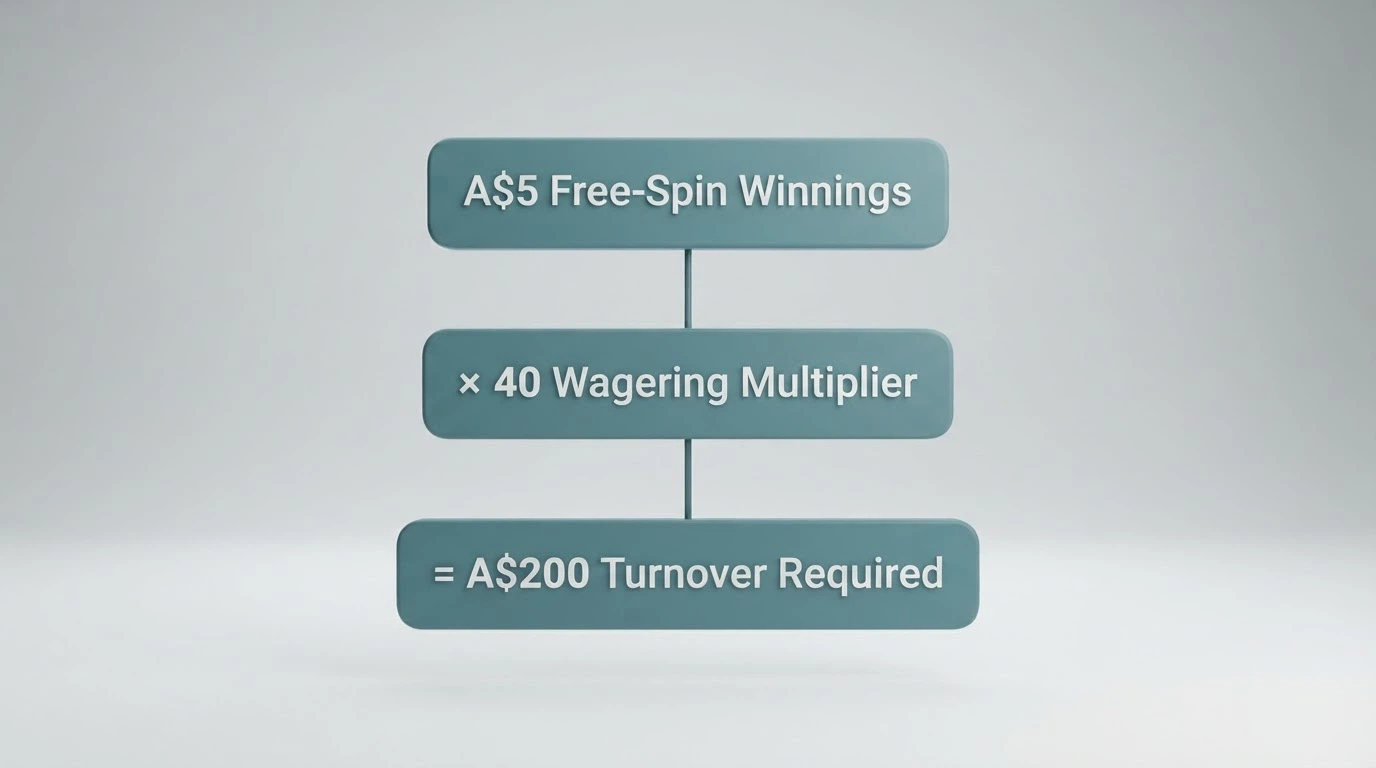
What 40x looks like in practice: at A$0.10 per spin on a 96% RTP pokie, A$5 in free-spin winnings requires A$200 in qualifying turnover, which is 2,000 spins at the minimum stake. At five seconds per spin that is roughly 2.8 hours of play, all of it on the same game, all of it contributing 100% to wagering, all of it inside a validity window that is typically shorter than the player expects. The arithmetic is mechanical, but it is mechanical on the operator’s side, and the player is the variable.
The Offshore No Deposit Bonuses Australians Can Actually Claim in 2026
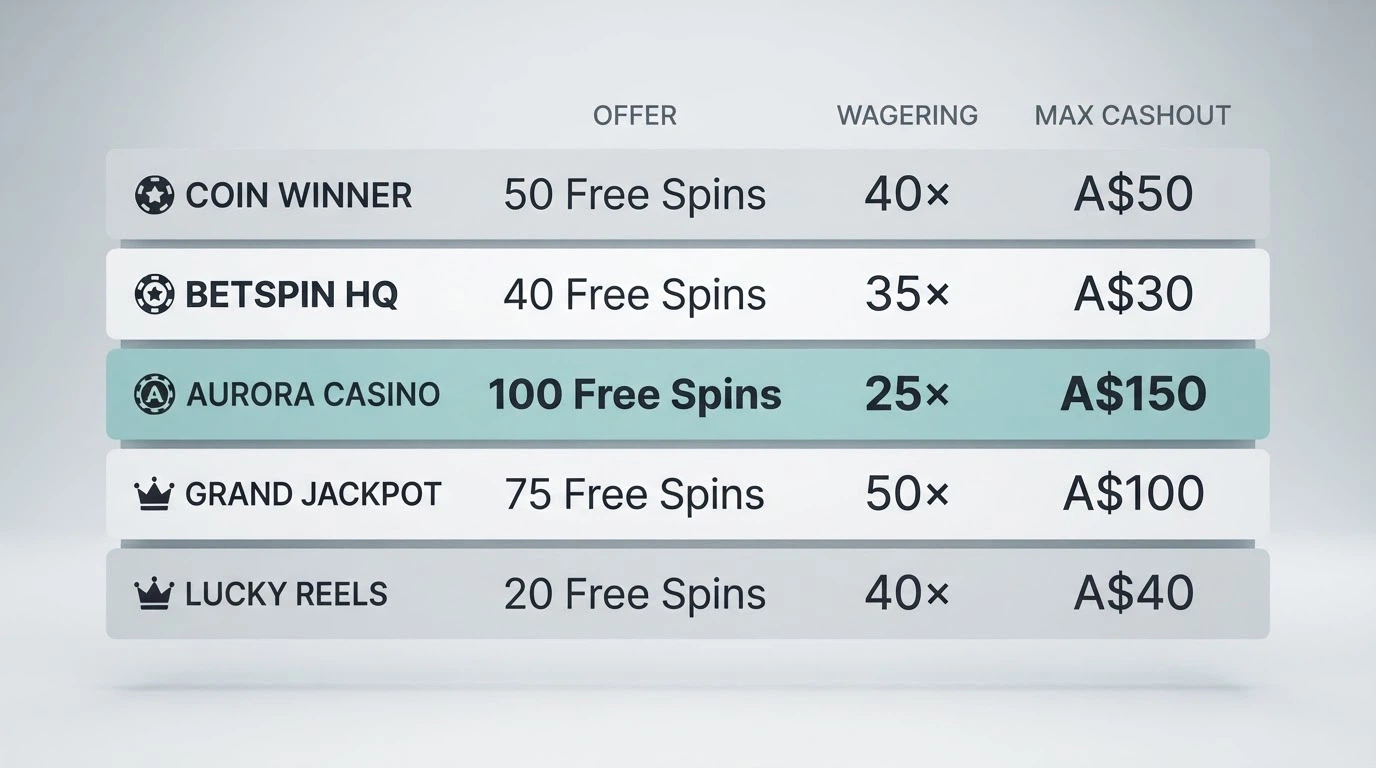
The table below compares the ten offshore casinos that Australian players reach in 2026, ranked by the terms of their no-deposit bonus where those terms are confirmed. Where research did not surface a figure this run, the cell carries an em dash rather than an estimate. Operators are listed in the priority order the evaluation established, not by market share alone — though the two correlate. Every brand below is offshore, none holds an Australian online casino licence, and all sit outside the reach of BetStop and any Australian consumer-protection body. The comparison is on what each operator offers, not on what each one will pay.
At a Glance: No Deposit Bonus Terms Compared
| Casino | Status | No Deposit Bonus | Wagering | Max Cashout |
|---|---|---|---|---|
| Skycrown | Offshore, Curaçao-licensed, ACMA-blocked | 20 FS on Aztec Clusters (phone verification) | 25x on FS winnings | A$40 |
| Rocket Play | Offshore, ACMA-blocked | 20 FS on Book of Pyramids (review submission) | 40x on FS winnings | ~A$85 |
| Royal Reels | Offshore, licence not confirmed | — | — | — |
| Fair Go | Offshore, Curaçao-licensed, first ACMA-blocked site (Nov 2019) | 20 FS on Kevs Bush Bonanza | 60x on FS winnings | A$180 |
| Bizzo Casino | Offshore, TechSolutions Group N.V., ACMA-blocked | 10 FS (PWA app install) | 40x on FS winnings | A$75 |
| WinSpirit | Offshore, Curaçao Antillephone N.V. (8048/JAZ2014-053), ACMA-blocked July 2025 | 20 FS on Totem Mystique (app install) | 40x on FS winnings | A$75 |
| Stake | Offshore, crypto-focused | — | — | — |
| Rainbet | Offshore, licence not confirmed | — | — | — |
| Scream Casino | Offshore, licence not confirmed | — | — | — |
| Rocket Casino | Offshore, ACMA-blocked | — | — | — |
The columns that repeat one value down the column — every “40x” at Bizzo, WinSpirit and Rocket Play, every “A$75” at the same pair — were not collapsed because the consistency is information: it tells the reader that the 40x-and-A$75 slot is the modal offer in this market, and the operators that vary from it (Skycrown lower, Fair Go higher) are deliberately positioned against the centre.
Skycrown — 20 Free Spins, 25x Wagering, A$40 Cap
Skycrown sits at the low-friction end of the featured set. The 20 free spins on Aztec Clusters credit after a phone-verification step, the wagering multiple is the lowest in the comparison at 25x, and the max bet during the bonus is A$3. The cap is also the lowest at A$40, which sets a clear ceiling on what the bonus can ever pay. Spins are valid for 5 days after activation and must be activated within 7 days of registration — a tight window that punishes the player who registers and forgets.
Behind the no-deposit offer sits the full welcome package: up to A$8,000 in matched bonuses and 400 free spins across four deposits, each tier at 40x wagering with a A$7.50 max bet and a A$300 cap on free-spin winnings. The catalogue is large — more than 10,400 games from over 50 providers including Pragmatic Play, NetEnt, Microgaming, Play’n GO, BGaming, Hacksaw Gaming and Nolimit City. A Skycrown PayID withdrawal of A$180 was recorded reaching a nominated Australian bank account in 2 hours and 29 minutes during independent testing. ACMA has the operator’s domain on its blocked list.
Skycrown is the right pick for a player who wants the lowest clearance hurdle in the set and is content with the A$40 ceiling. The fast PayID withdrawal is the practical upside. The blocked-domain status is the regulatory downside — the site can be added to a new blocking request at any time, and a balance on the account when that happens is the player’s problem.
Rocket Play — 20 Free Spins Earned by Review, ~A$85 Cap
Rocket Play issues 20 free spins on Book of Pyramids to players who submit a verified third-party review through live chat. The activation step is unusual — there is no auto-credit, no phone verification, no app install — and the review requirement filters the bonus toward players who are willing to spend time producing content for the operator. The wagering is 40x on winnings and the cashout cap sits at roughly A$85 (50 EUR equivalent).
The deposit welcome is split: 100% up to A$500 plus 100 free spins on the first deposit, then 200% up to A$500 on the second. Wagering is 40x on the bonus amount with a A$7.50 max bet and a A$25 minimum deposit. ACMA has the operator’s domains on its blocked list.
Rocket Play is a match for the player who enjoys the review-writing side of the deal and is willing to spend a few hours of effort to claim. The 40x-and-A$85 profile is mid-set: not as forgiving as Skycrown, not as punishing as Fair Go. The activation step is the only real friction, and it is more psychological than technical.
Royal Reels — No Confirmed No Deposit Bonus This Review
Royal Reels holds a 2.51% share of the Australian-facing offshore market, which puts it ahead of WinSpirit, Stake, Rainbet and the smaller brands in this comparison. What this review could not confirm is a current no-deposit bonus. No offer terms surfaced in this run’s searches, and the operator is not on ACMA’s blocked-domain record under the names checked, though the offshore status means no Australian licence exists and no BetStop coverage applies.
The gap here is for the reader to fill: Royal Reels’ own site is the place to check for a current NDB. The page can describe the market position but cannot quote terms that did not surface. A 2.51% share is significant — it means Australian players are reaching the brand — and the absence of a confirmed offer this run should be read as a snapshot, not a verdict.
Fair Go — 20 Free Spins, 60x Wagering, A$180 Cap
Fair Go carries the most distinctive regulatory profile in the set: it was the first site ACMA ever ordered blocked, back in November 2019, and the brand has continued operating through mirror domains since. The no-deposit bonus is 20 free spins on Kevs Bush Bonanza, wagered at 60x on winnings with an A$180 cap. The 60x multiple is the steepest in the comparison; the A$180 ceiling is the highest. The trade-off is therefore built into the offer design.
The game catalogue runs on RealTime Gaming (RTG), a long-established studio whose pokies are familiar to the AU market but whose catalogue is smaller than the multi-studio lobbies at Skycrown or Bizzo. The deposit welcome is a 100% match up to A$200 redeemable 5 times at 30x on deposit plus bonus, with 20x on free-spin winnings. The promotional listing the NDB was sourced from carried an end date of 25 March 2026, which means the reader should check the operator’s site for a current offer rather than rely on the figure published here.
Fair Go suits the player who wants the highest cashout ceiling in the set and is prepared to grind through 60x wagering to reach it. The regulatory history is the caveat: ACMA has been blocking this brand’s domains for six years, and a player who keeps a balance on a domain that gets blocked has no Australian recourse.
Bizzo Casino — 10 Free Spins for App Install, A$75 Cap
Bizzo runs the smallest spin count in the confirmed set — 10 free spins credited after the player installs the operator’s progressive web app and adds it to the home screen. The wagering is 40x on winnings and the cap is A$75. The headline spin count is modest, but the per-spin value matters more than the count, and the operator has paired the bonus with the largest game catalogue in the featured set.
Bizzo was launched in 2021 by TechSolutions Group N.V. and now runs more than 8,000 games from over 70 studios. PayID works for both deposits and withdrawals. The full welcome package reaches up to A$7,250 in matched bonuses plus 175 free spins over four deposits, with the first-deposit tier of 125% requiring a A$250 minimum and the rest at A$8 max bet and 40x wagering. ACMA has Bizzo’s domain on its blocked list.
Bizzo is the right match for a player who values game variety above all else and is comfortable with the PWA install as the activation step. The 10-spin count is the smallest in the set; the 8,000-plus library is the largest. The trade-off is on the player’s side.
WinSpirit — 20 Free Spins on Totem Mystique, A$75 Cap
WinSpirit credits 20 free spins on Totem Mystique after the player installs the operator’s native app. Wagering is 40x on winnings, the cap is A$75. The licence is on public record: WinSpirit is operated by Complete Technologies N.V. under Curaçao Antillephone N.V. licence No. 8048/JAZ2014-053. ACMA blocked WinSpirit’s mirror domains in July 2025, bringing the total blocked count to 1,279 as of that date.
The game catalogue was not fully confirmed this run, though Totem Mystique is the named NDB title. The welcome package runs 100% up to C$200 plus 100 free spins on the first deposit and 200% up to C$1,000 on the second, with 40x on bonus amounts and free-spin winnings.
WinSpirit suits the player who wants a Curaçao-licence number on record and is comfortable with the app-install activation. The licence does not change the offshore status or open Australian consumer protection, but it does provide a registration number a reader can verify independently — a small but real difference from brands whose licence could not be confirmed.
Stake — Crypto-Focused, No Classic No Deposit Bonus Confirmed
Stake is a different product. The brand runs a crypto-focused sportsbook and casino hybrid and holds a 1.28% share of the Australian-facing offshore market, but no classic no-deposit free-spin or free-chip offer was confirmed in this review. Stake’s bonus culture is built around rakeback, reloads and sports promos rather than the registration-credit model the rest of this page compares.
The regulatory tell sits on the cashier page. Credit cards and crypto have been banned as payment for online wagering in Australia since 11 June 2024, with penalties of up to A$247,500 for non-compliance. An operator that takes Bitcoin deposits is, by definition, outside the Australian-licensed wagering framework — the payment method itself signals the regulatory category. Stake is not the right match for a reader looking for a 20-free-spin-on-signup deal. It is the right match for a reader already operating in the crypto space who has decided that offshore casino is the only available category and wants the operator with the deepest crypto rails.
Rainbet — No Confirmed No Deposit Bonus This Review
Rainbet holds a 1.28% share of the Australian-facing offshore market, the same figure as Stake, and no bonus-terms data surfaced in this review. The operator is offshore and not licensed in Australia, and no BetStop coverage applies. Like Royal Reels and Scream Casino, the gap here is one the reader must close on the operator’s own site. The market share is the figure the page can quote; the bonus terms are the figure the page cannot.
Scream Casino — No Confirmed No Deposit Bonus This Review
Scream Casino holds a 0.99% share of the Australian-facing offshore market. No bonus-terms data surfaced this run, and the operator is offshore without an Australian licence. The page can describe the position in the market; it cannot quote a no-deposit bonus it did not find. The reader who reaches this comparison is reading it because the brand appears in the Australian market-share data, and the right next step is a direct check on the operator’s own pages.
Rocket Casino — No Confirmed No Deposit Bonus, ACMA-Blocked
Rocket Casino is distinct from Rocket Play despite the naming overlap and holds a 0.57% share of the Australian-facing offshore market. ACMA has the operator’s domain on its blocked list. No bonus-terms data surfaced in this review. The page can name the brand, place it in the market, and note the ACMA status. The offer terms are the figure the reader will need to source elsewhere.
New Casinos, New No Deposit Offers — What’s Different in 2026
The “new” label on an AU-facing offshore casino in 2026 is usually a marketing claim backed by a recent launch date and a Curaçao registration. The bonus structure on a fresh brand does not usually diverge from the established pattern — 20 to 100 free spins at registration, 30x to 50x wagering, A$50 to A$200 cashout cap — because the operators are competing against the same incumbents with the same product economics. What changes is the friction: a new operator has a thinner reputation, a smaller game catalogue, and a payment mix that is less likely to include PayID. The player who picks a new operator for the launch offer trades an unproven brand for a fresh bonus, and the trade-off has no automatic resolution.
Bizzo is the worked example. The brand launched in 2021 and now runs more than 8,000 games from over 70 studios with PayID support for both deposits and withdrawals — a four-year arc from new entrant to one of the larger catalogues in the market. The trajectory is not guaranteed. Other new entrants in the same window did not survive ACMA enforcement and the migration to mirror domains, and the player who picks a brand on the strength of its launch offer is making a bet on the operator’s operational durability as much as on its bonus terms.
New No Deposit Codes on Launch — What to Watch For
A launch NDB is a 20 to 100 free-spin offer at 30x to 50x wagering with an A$50 to A$200 cashout cap, in line with the rest of the market. The terms a player should read carefully before signing up are the same terms that apply to the established brands: the wagering multiple, the cashout ceiling, the contribution weighting on table games and live casino, the validity window on the spins, and the licence number the operator claims to hold.
The licence is the cleanest differentiator. A Curaçao registration number can be verified against the Curaçao Gaming Control Board register. A licence that the operator declines to publish, or that does not appear in the register when checked, is a licence the player cannot confirm. The reader who skips the licence check skips the only external gate that exists for an offshore operator, and there is no Australian gate behind it.
ACMA’s Q1 2025 enforcement numbers — 350 enquiries, 22 investigations, 33 IGA breaches, 12 formal warnings, 61 websites blocked — describe an active regulator. A launch offer from a brand with no track record and no verifiable licence is a launch offer into a market where ACMA is already directing ISPs to block 60+ sites per quarter.
New Aussie-Facing Online Casinos — The 2026 Crop
A “new” Australian-facing online casino in 2026 typically arrives with three features: a progressive-web-app-first build that pushes the player toward an install, a PayID or crypto payment mix that does not depend on the Australian credit-card ban, and a Curaçao licence issued through a long-standing master licensee. The profile is recognisable across recent entrants and reflects what the Australian market has rewarded since the 2024 credit-card ban closed off the licensed-payment channel for offshore operators.
The trade-off is structural. A new operator with a PayID-ready cashier and a fresh bonus is offering a cleaner first session than the legacy offshore brands, but it is also offering an unproven dispute history, an unconfirmed game catalogue depth, and an unknown regulatory trajectory. The 2026 reform — the Interactive Gambling Amendment (Gambling Reform) Bill 2026, passed 19 August 2026 with measures commencing 1 January 2027 — gives banks and payment providers express authority to block transactions to illegal gambling operators from the start of 2027. That is a headwind for every new offshore entrant, because the cleaner the PayID rail, the more visible the transaction is to the bank. More than 225 illegal services have already withdrawn from the Australian market since 2017. The 2027 authority is a reason to expect more.
The Legal Reality: Why Every No Deposit Casino Here Is Offshore
Online casino is prohibited in Australia. The Interactive Gambling Act 2001 makes it an offence to provide an online casino, online pokies or in-play sports betting to a person in Australia, and no licence for that product exists anywhere in the country — not federally, not in any state or territory. ACMA enforces the prohibition by investigating complaints, issuing formal warnings, referring operators for civil penalty proceedings, and directing Australian ISPs to block illegal services at the DNS level. The 2017 amendments to the IGA closed the loopholes the early operators had used and gave ACMA the blocking powers it has since used 1,564 times.
The 2026 reform — passed by Parliament on 19 August 2026 and commencing 1 January 2027 — extends the framework rather than reversing it. From January 2027 the inducement restrictions are tightened: direct marketing of wagering offers is prohibited for 14 days after a customer signs up, for three months after a person deregisters from BetStop, and indefinitely for customers identified as at risk. The bank-blocking authority kicks in on the same date. Influencers promoting illegal online gambling face civil penalties of up to A$59,400 individually; those facilitating access face up to A$2,475,000. None of this makes the offshore casino legal. It raises the cost of operating one.
How Australian Law Shapes Every No Deposit Bonus You See
The prohibition does not prosecute the player. The IGA targets the provider. A player who signs up at an offshore casino has not committed an offence; the operator that took the sign-up has. What the prohibition shapes is what the player sees at the cashier and on the offer page. The credit-card and crypto payment ban — in force since 11 June 2024 — applies to Australian-licensed wagering only, which means a casino that takes Bitcoin is operating outside the Australian rules by definition. The payment method on the cashier page is a regulatory tell.
The 2026 reform adds a second tell. From 1 January 2027 an AU-facing operator cannot market a welcome offer for 14 days after a customer signs up, cannot market to a BetStop deregistrant for three months after they leave the register, and cannot market at all to a customer flagged as at risk. An offshore operator that ignores these rules is breaking the reform on top of breaking the prohibition itself. The reader who sees a welcome-bonus email the day after registering at an offshore casino is looking at an operator that has chosen to disregard Australian advertising law in addition to the IGA.
BetStop, the National Self-Exclusion Register, binds Australian-licensed wagering services only. As of 31 March 2026 the register had 59,830 registrations and 37,247 active exclusions. An offshore casino is not connected to the register and will keep accepting a self-excluded person’s money. That is the single most concrete harm of the offshore route, and the data on it is thin: only 33.5% of wagerers know BetStop exists, according to the Australian Gambling Research Centre. A self-excluded player who reaches for an offshore site because BetStop does not is making a decision the system is not built to prevent.
AU-Licensed Wagering vs Offshore Casino — What Protection You Actually Have
| Player Protection | AU-Licensed Wagering | Offshore Curaçao Casino | Offshore Unconfirmed |
|---|---|---|---|
| BetStop Coverage | Yes — register binding on the operator | No — register does not reach the operator | No |
| Dispute Body | State/territory complaints pathway and the operator’s ADR | None — no Australian complaints body | None |
| Deposit Safeguard | Operator segregation requirements and oversight | None — operator’s house rules | None |
| Regulator Oversight | ACMA at federal level, state/territory racing and wagering commission | Curaçao Gaming Control Board (verifiable licence only) | Unverifiable |
The table reads the way it reads because the underlying regimes are different. AU-licensed wagering sits inside a regulatory framework with an enforcement authority, a self-exclusion register, a complaints pathway and deposit-safeguard rules. Offshore casino sits inside a contractual relationship with an operator that holds a licence in another jurisdiction and is not subject to Australian consumer law. The reader who picks the offshore route picks the regulatory profile that matches it. The table is not editorial; it is the difference between the two markets.
Getting Paid: How PayID and Other Methods Actually Work from a No Deposit Win
A no-deposit bonus wins real money only when the player can withdraw it. The payment method that connects the operator’s cashier to an Australian bank account determines how fast that withdrawal lands, and PayID is the fastest route the featured set supports. PayID ties a withdrawal to a mobile number or email address rather than to a BSB and account number, and the receiving bank credits the funds through the Osko rail — typically in minutes, sometimes in under an hour, occasionally in a few hours depending on the operator’s processing queue.
The KYC gate is the step that runs before the PayID transfer. Every legitimate offshore operator verifies the player’s identity before processing a withdrawal, regardless of how the deposit was made. The verification is a compliance requirement under the operator’s licence and a fraud-control measure for the cashier. The player who has not completed KYC before clearing the wagering requirement will see the withdrawal sit in “pending verification” rather than “processing” — and the verification process can take 24 to 72 hours depending on the document set the operator requests.
PayID Withdrawals — Speed Tested from No Deposit Bonus Winnings
Independent testing recorded a Skycrown PayID withdrawal of A$180 reaching a nominated Australian bank account in 2 hours and 29 minutes. VegasNow recorded a faster profile: PayID withdrawals on bonus winnings averaged 12 minutes across 8 test cashouts, with a range from 5 to 22 minutes. Bizzo supports PayID for both deposits and withdrawals. The featured set’s PayID support is uneven — not every operator in the comparison offers it, and the player who wants PayID as the withdrawal route should check the cashier before committing to an NDB.
KYC must complete before any of these speeds matter. Bizzo’s terms require verification before withdrawal, and the same applies across the offshore market. The verification process is document-based: a government ID, a proof of address and sometimes a source-of-funds check for larger withdrawals. The player who supplies the documents at registration rather than at withdrawal moves the verification queue forward before the wagering is even cleared.
Depositing After the No Deposit Bonus — What Methods Are Safe
Once the player converts the NDB and wants to deposit, the payment method sits between speed, security and the AU payment-ban landscape. Debit card, bank transfer, PayID and Osko, and BPAY are the legal deposit routes for AU-licensed wagering. Credit cards and crypto are not legal for AU-licensed wagering — that has been the rule since 11 June 2024 — which means a deposit method that involves either of those is a deposit method that signals the operator is outside Australian rules. Identity verification is required for any deposit under AU-licensed wagering rules, and the same applies offshore even though the regulatory framework is different.
From 1 January 2027 banks gain express authority to block transactions to illegal gambling operators. The change is targeted: the transaction the bank is asked to block is the one going to the operator the regulator has identified as illegal. PayID is visible to the bank at the transaction level. The player who plans to deposit through PayID into an offshore casino in 2027 is making a transaction the bank has the power to refuse, and the bank will not necessarily warn the customer before doing so.
Crypto No Deposit Bonuses — Anonymous but Not Without Risk
Bitcoin and crypto no-deposit bonuses are an edge case in the AU-facing market. The mechanics are the same as a fiat NDB — free credit on registration, wagering requirement, cashout cap — but the payment rails run through a wallet address rather than a bank account. The operator’s cashier accepts BTC, ETH, USDT and the usual altcoins, the player sends crypto from a wallet, and the bonus credits. The appeal is the no-bank-in-the-loop profile: no credit card on file, no debit card statement, no PayID record on the bank app.

The regulatory tell is the cashier page itself. Crypto deposits are banned as payment for AU-licensed wagering since 11 June 2024, with penalties of up to A$247,500 for non-compliance. An operator that accepts Bitcoin is operating outside the Australian-licensed wagering framework by definition — there is no licensed wagering operator in Australia that takes crypto. The payment method is the regulatory category, and the category is offshore.
No-KYC Anonymous Play — What You Give Up
No-KYC play sounds like a feature: no identity documents, no proof of address, no source-of-funds check. The trade-off is that anonymity cuts both ways. The operator that did not verify identity at sign-up is under no obligation to verify identity at withdrawal — and the operator that refuses to verify at withdrawal can argue the account was never legitimately opened. An offshore casino that voids a withdrawal because the KYC check was skipped is not in breach of any Australian consumer law, because there is no Australian consumer law applicable to the operator. The player who chose no-KYC for the privacy chose no-KYC for the dispute too.
The Australian regulatory position on KYC is that identity verification is a baseline requirement for AU-licensed wagering. The offshore route is the route that skips it. The player who values anonymity should also value the absence of recourse that comes with it, because the two are the same trade.
Claiming No Deposit Bonuses on Mobile: What Works in 2026
The mobile screen is the claim point, not just the play point, for most of the AU-facing offshore market in 2026. Bizzo gates the NDB behind a PWA install — the player adds the operator’s web app to the home screen and the bonus credits. WinSpirit gates it behind a native app installation. Skycrown credits on phone verification after the player opens the site in a mobile browser. Rocket Play credits after a verified review is submitted through the mobile live chat. Every one of these flows is mobile-first, and every one of them is doing the same job: pushing the player onto a surface the operator controls.
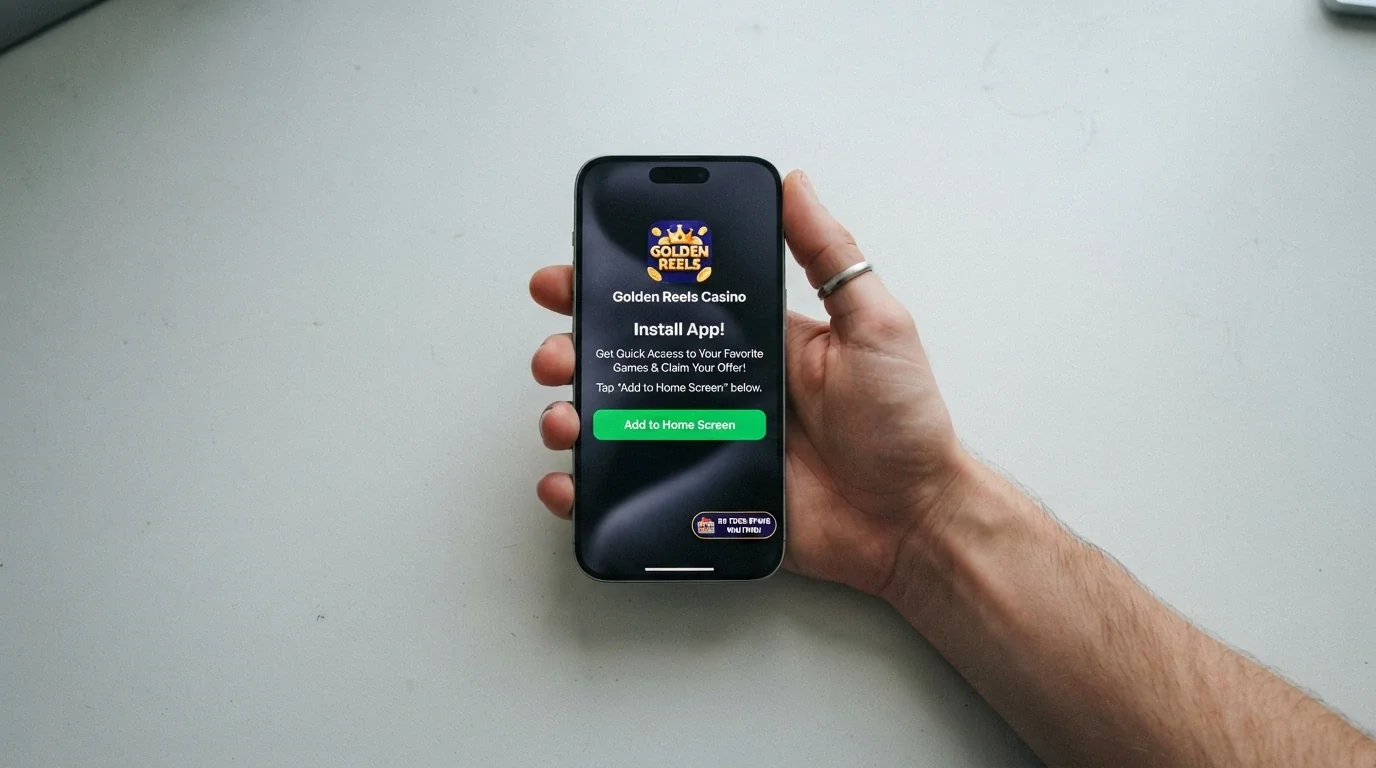
PWA, native app and mobile browser are three different surfaces. The PWA is a website that installs as an app icon and runs without a browser address bar — it gets push notification access and home-screen visibility without going through an app store review. The native app is a downloadable binary from the operator’s site, often outside the Google Play and Apple App stores because those platforms restrict real-money gambling apps. The mobile browser is the unmodified web version of the casino, which works but does not give the operator the same retention hooks.
On-the-Go No Deposit Redemption — The Claim Flow from Phone to Pokies
The mobile claim path runs from search result to first spin in a sequence the operator has engineered. The player lands on the site through an affiliate link or a search result. The site detects a mobile browser and offers an app install or a PWA add-to-home-screen prompt. The player accepts the prompt. The app or PWA opens, the registration form appears, and the verification step runs — phone number, email, or in Rocket Play’s case a review-submission through live chat. The bonus credits, the game lobby opens, and the first spin is one tap away.
The reason offshore operators push the mobile install so hard is that the install gives them push notification access, which is the most direct retention channel in the mobile stack. The player who installs the PWA will receive notifications when a new bonus is available, when a tournament starts, when the account has been idle. The player who uses the mobile browser will not. The retention infrastructure is the reason the bonus is gated behind the install, and the install is the reason the bonus terms are what they are. Skycrown’s 10,400-plus games across 50-plus providers run on both surfaces; the install is the question, not the catalogue.
Free Play vs Real Money: What Demo Mode Actually Teaches You
Demo mode runs on play money. The reels spin, the features trigger, the balance refills itself, and nothing leaves the screen. No deposit spins run on a real-money balance — the same reels, the same features, the same mathematical model, but a balance that can be won and a balance that can be lost. The visual difference is small. The economic difference is everything.
Demo play is a learning tool, not a substitute for the real-money experience. Starburst (NetEnt) returns 96.09% RTP at low volatility — frequent small wins, long dry stretches between feature triggers. Book of Dead (Play’n GO) returns 96.21% at high volatility — infrequent wins, larger outcomes when they land. Big Bass Bonanza (Pragmatic Play) returns 96.71% at medium-high volatility with a 4/5 volatility rating and a maximum win of 2,100x the stake. Gates of Olympus (Pragmatic Play) returns 96.50% at high volatility. Wolf Gold (Pragmatic Play) returns 96.01% at medium volatility. Demo mode lets a player see the volatility profile before committing real spins. Real-money mode lets the player feel it.
Free Pokies vs No Deposit Spins — The One Difference That Matters
Demo pokies run on play money with no cap because there is nothing to cap. No deposit spins run on a real-money balance with a hard ceiling — typically A$50 to A$200 — and a wagering requirement before withdrawal. The two modes share a reel layout, a paytable and a feature set. They do not share a balance, and they do not share a cap. A player who confuses the two has not yet understood what the NDB is for.
The configurable-RTP caveat matters here. Big Bass Bonanza ships in multiple RTP configurations — 96.71%, 95.48%, or lower — depending on the operator’s setting. A demo session at one RTP does not guarantee the real-money session runs at the same RTP. The player who tests the game in demo, likes the hit frequency, and commits NDB spins to it is playing a slot whose RTP may sit below the published figure. The variance between configurations is the operator’s decision, and the decision is not visible to the player at the cashier.
Staying in Control When the Bonus Feels Like Free Money
A no-deposit bonus costs nothing to claim, but the play it triggers is real gambling. The data on gambling harm in Australia is concrete. Risky gambling rose from 13.7% in 2024 to 19.4% in 2025, a near-doubling since the COVID-19 lockdowns of 2020–2021. Overall gambling participation sat at 58.8% in 2025. Approximately 3.29 million Australians aged 5 and above are affected annually by their own or another person’s gambling. Around 14 in every 100 Australian adults are directly affected by gambling harm; 9.2 are classified as at-risk or problem gamblers. The Australian Gambling Research Centre survey recorded that 15% of people experienced gambling harm in the past 12 months, up from 11% in 2019.
Gambling Help Online received almost 13,000 counselling requests in 2023–24, up 67% year-on-year, with online gambling now making up half of all calls. Most callers are aged between 20 and 34, and 70% are male. The trend line points the same direction as the participation data. A no-deposit bonus is a low-friction entry point into a product that is producing the calls.
What to Do If the Free Spins Stop Feeling Free
The first port of call is the National Gambling Helpline on 1800 858 858 — free, confidential, staffed 24 hours a day, 7 days a week. Gambling Help Online at gamblinghelponline.org.au offers free 24/7 chat, email counselling and phone support. Both services are free, confidential and built for the moment a session drifts. The 13,000 counselling requests Gambling Help Online received in 2023–24 are a reminder that the help line is a working service, not a theoretical one.
BetStop — the National Self-Exclusion Register — is the second step. As of 31 March 2026 the register held 59,830 registrations and 37,247 active exclusions. One registration excludes a person from every Australian-licensed online and phone wagering service. The caveat that matters for the reader of this page is the same one the legal section carries: BetStop binds AU-licensed wagering services only. An offshore casino is not connected to the register. A self-excluded person who moves to an offshore site will not be stopped by BetStop, because BetStop was never designed to reach the offshore market. Only 33.5% of wagerers know BetStop exists, which is the reason the awareness gap matters: the player who reaches for a self-exclusion tool needs to know which market it covers and which it does not.
Practical harm-minimisation steps sit alongside the formal help lines. Session limits, reality checks and cooling-off periods are tools the AU-licensed wagering operators must offer. Offshore operators are not bound by the same requirements, which means the player who wants session controls has to set them on themselves — a deposit cap at the cashier, a timer on the device, a withdrawal threshold that triggers a pause.
How We Evaluated Every No Deposit Bonus on This Page
The ranking above draws on operator-published terms pages, independent affiliate testing records and the ACMA blocked-domain register. The ACMA register was consulted to confirm the blocked status claimed for each operator; the Curaçao Antillephone N.V. register was consulted where the operator claimed a licence number. The criteria that ordered the ranking were the no-deposit bonus terms (where confirmed), the wagering multiple, the cashout cap, the PayID withdrawal profile where tested, and the game catalogue breadth — used qualitatively, with no fabricated weightings assigned to any criterion.
No operator on this page holds an Australian online casino licence. The “Status” column in the comparison table reflects the offshore position every brand shares, with the regulator name included where one could be confirmed. Where research did not surface a figure — a cashout cap, a wagering multiple, a launch date — the cell carries an em dash rather than an estimate, because an estimate is a fact the page would then have to defend.
Your 2026 No Deposit Bonus — Claim It or Leave It?
The arithmetic on a typical AU-facing no-deposit bonus produces a real-money outcome of A$50 to A$180, after the player has cleared a 30x to 50x wagering requirement on free-spin winnings inside a validity window that runs from 5 to 14 days. The time cost sits in the same band: 2,000 to 4,000 spins at the minimum stake, two to six hours of play, on the same game, at the same reel, with the same features. The legal risk sits outside the offer entirely. The site can be blocked at any time, with a balance on the account. The operator does not answer to an Australian regulator. There is no BetStop coverage, no Australian consumer law, no complaints body. The A$50 to A$180 the player walks away with is the most they will ever walk away with from a single NDB at any of these brands, and the time it takes to get there is the cost of finding out.
The decision is the reader’s. The page can describe the offer, the terms, the licence, the enforcement record and the payment speed. The page cannot make the call between a 20-spin offer at 25x and an A$180 ceiling, and a 100-spin offer at 50x and an A$75 ceiling, for a reader it cannot see. The figure that decides the call is the figure the reader assigns to their own time, and that figure is not on this page. What is on the page is the arithmetic the reader runs the figure against.
The ATO side is uncomplicated: gambling winnings are not assessable income under section 6-5 of the ITAA 1997, and losses are not deductible under section 8-1 unless the person is carrying on a business of betting. A free-spin win is not a tax event. A free-spin loss is not a deduction. The reader who clears the bonus keeps whatever the operator pays out, and the reader who does not has lost the time spent trying. Neither outcome changes the Australian tax position.
Frequently Asked Questions
What is a no deposit bonus at an Australian online casino?
A no deposit bonus is a credit the offshore casino issues without taking a deposit first — typically 20 to 100 free spins on a named slot at registration, sometimes a small free chip. The bonus is real money in a technical sense, but the wagering requirement and the cashout cap determine what actually leaves the account. Every brand offering one in the Australian-facing market is offshore, because no Australian online casino licence exists.
Can you win real money from a no deposit bonus in Australia?
Yes, in the sense that the bonus lands in a real-money balance and the winnings are credited in Australian dollars. The ceiling on what the player can withdraw is the cashout cap, which runs from A$40 at the low end to A$180 at the high end of the featured set, after the wagering requirement is cleared. The winnings are not assessable income under the ATO’s ITAA 1997 section 6-5.
What are wagering requirements on no deposit bonuses?
Wagering requirements are the turnover multiple the player must complete before any withdrawal processes. The featured set ranges from 25x (Skycrown) to 60x (Fair Go), with most offers at 40x. The multiple applies to free-spin winnings, not to the face value of the bonus, and pokies contribute 100% while table games contribute 10% and live casino contributes 5%.
What is the maximum you can cash out from a no deposit bonus?
The maximum cashout cap runs from A$40 at Skycrown to A$180 at Fair Go, with most of the featured set at A$75. The cap applies after the wagering requirement is cleared and is the hard ceiling on what the bonus can pay, regardless of how large the winnings grow during play.
Do I need to verify my identity (KYC) before withdrawing no deposit bonus winnings?
Yes. Every offshore casino in the featured set runs a KYC check before processing a withdrawal, regardless of how the bonus was claimed. The check is document-based — a government ID, a proof of address and sometimes a source-of-funds request for larger withdrawals. Verification can take 24 to 72 hours, which is why the player who completes KYC at registration clears the queue before the wagering is done.
Does BetStop self-exclusion apply to offshore casino sites?
No. BetStop — the National Self-Exclusion Register — binds Australian-licensed wagering services only. An offshore casino is not licensed in Australia, is not connected to the register, and will keep accepting a self-excluded person’s deposits and play. BetStop is the right tool for the licensed market; it is not a tool that reaches the operators on this page. Only 33.5% of Australian wagerers know BetStop exists, which is the reason the gap matters.
Bonus Codes: Do You Still Need One in 2026?
The bonus code has not gone away, but it has lost its monopoly. Skycrown credits the bonus on phone verification without a code. WinSpirit credits it after app installation without a code. Bizzo credits it after the PWA is added to the home screen without a code. Rocket Play credits it after a verified review is submitted through live chat without a code. Auto-credit and behavioural triggers have replaced the typed string in most of the featured set, and the player who lands on a code-entry box is more likely to be at a smaller operator with thinner infrastructure than at the brands with the bigger game catalogues.
Where codes still appear, they are usually distributed through affiliate sites rather than published on the operator’s homepage. The reader who follows an affiliate link is more likely than not to receive the auto-credit version of the bonus, with the code field left blank. The code is now a tracking artefact more than a claim gate. That is a real change from the early 2020s, when a missed code meant a missed bonus.