
Twenty-five free spins without a deposit — what an Australian player is actually signing up for
The offer is the easy part of the sentence. Twenty-five free spins, no deposit required. The harder half is everything that comes after — the wagering multiple, the cashout ceiling, the expiry window, and the fact that the casino sending the email is operating outside Australian law. This page walks through each of those in turn, ranks the offshore brands reaching Australian screens in 2026, and puts the maths alongside the marketing so a reader can see what A$2.50 in “free” spins is really worth once the terms are read.

Verified against the ACMA’s published register of blocked services and the Interactive Gambling Act framework as of 16 October 2026.
Table of Contents
- Why your 25 free spins aren’t as free as they look
- The 10 offshore casinos targeting Australian players in 2026 — and what they actually offer
- Is online casino legal in Australia? The IGA reality check
- What you lose when BetStop can’t reach your casino
- How we chose and ranked these operators
- Your move: knowing what you’re really signing up for
- Frequently asked questions
Why your 25 free spins aren’t as free as they look
A “free spin” is a single wager on a real pokie reel paid for by the house rather than the player. Twenty-five of them, at the typical A$0.10 denomination, give you A$2.50 of real spin value before any winnings land. That figure is where the offer starts — and where most explanations stop. The terms are what shape the rest.

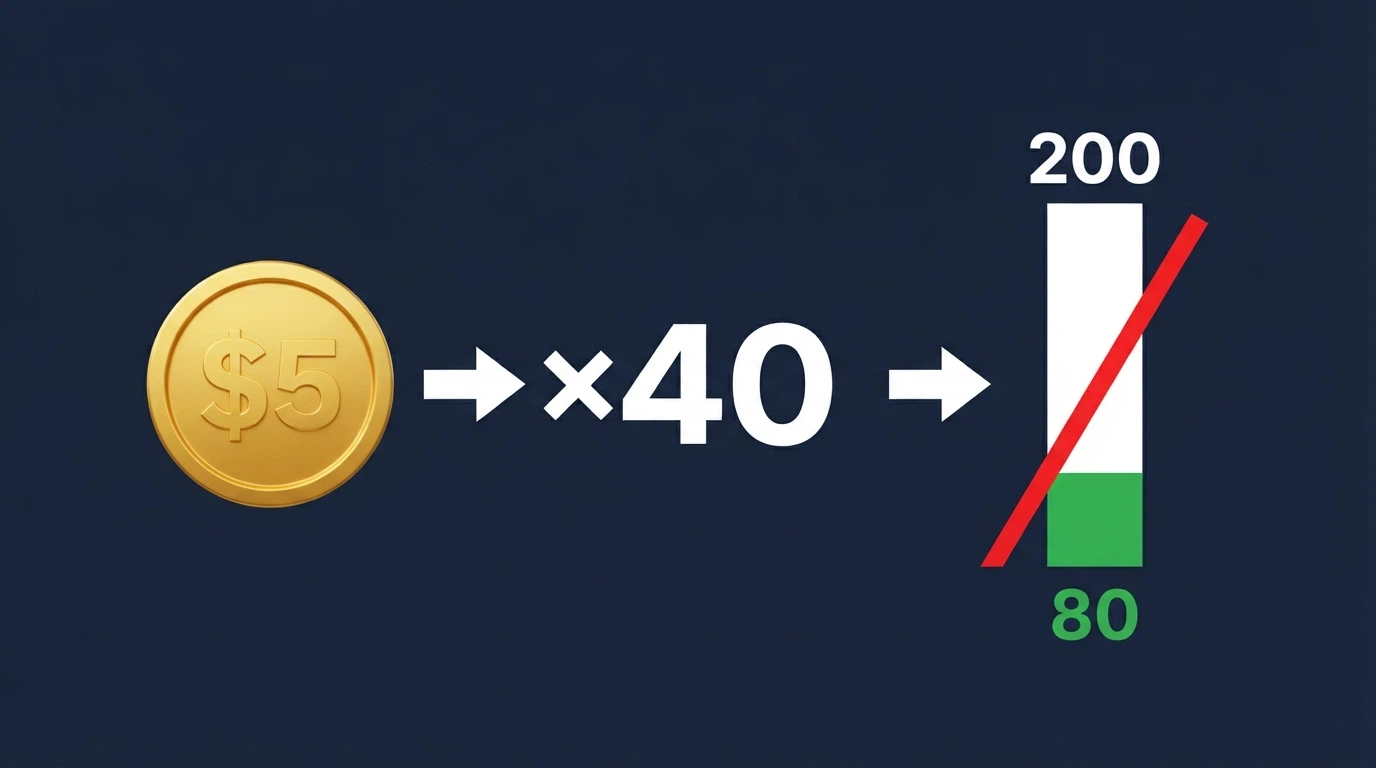
Every no-deposit free-spin offer is gated by three rules that work in sequence. First, the wagering requirement, which is a multiple applied to the winnings, not to the spin value itself: a A$5 win at 40× demands A$200 in play-through before any of it is yours to withdraw. Second, the maximum cashout cap, which sits at A$80–A$100 for most current offers and can stretch from A$50 up to A$200 in the wider market. Third, the expiry window, which is usually one to seven days from credit and occasionally extends to thirty. Miss any one of those and the bonus balance — including the winnings built up inside it — disappears.
The arithmetic gets uglier the longer you look at it. A typical range for wagering on no-deposit free-spin offers sits between 30× and 50×; anything above 50× is practically unclearable because the variance on a 25-spin batch rarely produces the line of winning rounds that would let a player grind out the requirement. The cap then catches whatever does survive: clearing A$200 in turnover to collect a maximum of A$80 is the trade most players meet on their first no-deposit bonus, and the marketing language around “real money wins” does not warn them about it.
What “25 free spins no deposit” actually means
Each of the three words in the offer name does a specific job. The “25” is the spin count — the number of rounds the casino pays for. “Free spins” means each round plays a real pokie at the denomination the casino has set, almost always A$0.10 in this market. “No deposit” means no real-money transfer is needed to claim: the offer credits on registration or after a single verification step.
What it does not mean is more important. It does not mean a no-deposit bonus, which is a cash credit on the same registration (Royal Reels’ A$10 sign-up is the closest example in the current set). It does not mean a deposit match, which is the larger category that almost every “free spins” headline actually belongs to once you read past the first paragraph. And it does not mean the winnings are withdrawable as cash the moment the spin stops — every offer in the market carries some version of the three-gate structure above.
Two mechanics worth knowing up front. Most offers auto-credit once registration and email verification are done, but some require a code typed in at the cashier. And the maximum bet while a bonus balance is active is typically A$5 per spin — exceeding it can void the bonus and the winnings with it, which is the one rule that punishes a player without warning in the small print.
Wagering requirements — the catch that turns “free” into a maths problem
Wagering is the multiplier that converts a bonus balance into real, withdrawable money. On a 25-spin no-deposit offer, the multiplier is applied to the winnings, not to the original A$2.50 in spin value. A A$5 win on a 40× offer becomes A$200 of required play-through. A A$20 win on the same offer becomes A$800. The spins themselves do not count toward wagering in most cases — only the winnings they generate, and only after those winnings have been credited as a bonus balance.
The contribution rules narrow the path further. Standard video pokies contribute 100% of each wager toward clearing the requirement. Table games contribute 10–20%, or are excluded entirely. Live dealer games are excluded almost universally. A player who tries to grind through A$200 of turnover on blackjack, expecting to make the maths less volatile, will find that A$20 of every A$100 they wager counts — and that the rest of the requirement never closes. The offer is, in practice, a pokies-only promotion.
The 30×–50× band is where most current offers sit. At 30×, the offer is workable: a small win can realistically be cleared by a player who understands variance and is willing to grind low-volatility pokies at minimum denomination. At 50×, the offer is steep: the same win needs roughly twice the turnover, and the player’s expected loss during the grind rises with it. Above 50×, the requirement is usually unclearable from a 25-spin starting point — the house edge over the required volume eats the winnings before the cap ever comes into view.
Maximum cashout caps — why your A$200 win might only pay A$80
Even after the wagering requirement is cleared, a second gate holds. The maximum cashout cap is the ceiling on how much of a bonus balance can be withdrawn, regardless of how much was actually won. The current typical range in the Australian-facing market is A$80 to A$100, with the wider spread sitting between A$50 and A$200. Three operators in the current set have named their cap explicitly: Crocoslots at AU$82, BetandPlay at AU$82, and Rocket Casino at A$75 for its no-deposit winnings.
The cap matters because it interacts with the wagering requirement in a way the marketing never explains. A player who clears A$200 of turnover to convert their bonus balance is not necessarily collecting A$200 — they are collecting whatever sits below the cap. Clearing A$200 to take home A$80 is the most common shape this trade takes, and it is the trade the small print is built to deliver. The cap is not a failure mode; it is the design.
What is harder to judge without reading the terms is which operators publish their caps clearly and which bury them. A cap stated in the bonus terms before a player claims is a known cost. A cap revealed only at withdrawal, or capped per-game rather than per-bonus, is a different proposition entirely, and one the section on operator reviews returns to.
The pokies your 25 spins will land on
The spin is only as good as the game it plays. Four Pragmatic Play titles dominate the AU-facing free-spin landscape, and each one carries a different volatility profile that decides whether a 25-spin batch returns anything at all.

| Pokie title | RTP | Volatility | Max win | Provider |
|---|---|---|---|---|
| Sweet Bonanza | 96.51% | High | 21,100× | Pragmatic Play |
| Gates of Olympus | 96.50% | High | 5,000× | Pragmatic Play |
| Big Bass Bonanza | 96.71% | Medium-High | 2,100× | Pragmatic Play / Reel Kingdom |
| Wolf Gold | 96.01% | Medium | 2,500× | Pragmatic Play |
The volatility column is the one that decides a 25-spin outcome more than any other. A high-volatility title like Sweet Bonanza or Gates of Olympus can deliver zero return across 25 spins and still be operating exactly as designed — the 21,100× and 5,000× max-win ceilings are real, but they are reached on distributions so wide that a 25-round sample sits firmly in the long tail. Big Bass Bonanza, at medium-high, splits the difference: more frequent line hits than the high-volatility pair, but still variance-heavy enough that a 25-spin batch often returns little.
Wolf Gold is the closest thing to a steady earner in the set, with a medium volatility profile and three fixed jackpots — Mini at 30×, Major at 100×, Mega at 1,000× — that pay independently of the base game. For a 25-spin batch on a no-deposit offer, the medium-volatility choice is the one most likely to convert the spin value into a withdrawable balance, even if the headline max-win figure is the lowest in the table. The headline-grabbing 21,100× ceiling is a marketing number, not a 25-spin expectation.
No-wagering spins vs standard spins — the real difference
A no-wagering free-spin offer is the closest thing to free money a casino will ever advertise. The winnings from each spin land as real cash the moment the reel stops, with no multiplier to clear and no bonus balance to convert. The trade-off shows up in the offer structure itself. No-wagering deals typically carry a lower spin count, a tighter cashout ceiling, and a shorter validity window than their standard counterparts — the operator is paying real cash, so the offer is sized down to make the economics work.
The standard offer, by contrast, lets the casino advertise a bigger headline number with the knowledge that the wagering requirement will filter most of what is won. The 30×–50× band is not an accident; it is the range that produces the most generous-feeling offer on the page while remaining enforceable in practice. A reader weighing the two should know which they are looking at before claiming, because the real-money value of the two offer types is not comparable on spin count alone.
Reading the bonus terms tells the two apart. “Winnings are subject to a wagering requirement of 40×” means a standard offer. “Winnings are paid as cash” or “no wagering requirement” means the rarer variant. Caps still apply on most no-wagering deals — the gate does not vanish entirely, it just moves upstream of the multiplier.
Sign-up spins, promo codes, and where the offers actually live
The registration path is the same on every site that runs an honest version of this offer: register an account, verify the email address, and the spins appear in the pokie lobby either automatically or after a manual opt-in. Some offers require a code entered at the cashier — an old-school mechanism that survives because affiliate sites still trade in code lists. Most current no-deposit offers auto-credit on verification, BetandPlay being the named example in this set.
Three sub-channels complicate the picture. Mobile-app spins are a separate category at operators like Bizzo, where downloading the progressive web app triggers a 10 free spin no-deposit credit — the closest match to a genuine no-deposit free-spin offer in the current operator set, even though the count is half the headline expectation. Crypto casinos run a different gate entirely: Stake and Rainbet serve Australian crypto users but do not compete on free-spin or no-deposit bonuses at all. New casinos cycle through sign-up offers that are usually time-limited and tied to a single launch week. The provider angle matters too — Pragmatic Play is the dominant anchor in this market because its titles appear in the bonus terms of most AU-facing offers.
The 10 offshore casinos targeting Australian players in 2026 — and what they actually offer
The headline finding is plain and needs to lead. The exact 25-free-spins no-deposit offer the key names is not carried by any operator in the featured set this run. Every brand below is offshore and Curacao-licensed. None holds an Australian licence, because none can — online casino is prohibited under the Interactive Gambling Act 2001. The table ranks by relevance to the no-deposit and free-spin angle, not by welcome-package size, and the column “Best free-spin or no-deposit offer” states what each operator actually has rather than what its banner suggests.
| Operator | Licence | Best free-spin or no-deposit offer | Wagering on winnings |
|---|---|---|---|
| SkyCrown Casino | Curacao (OGL/2023/176/0095) | A$8,000 + 400 FS welcome (deposit-gated) | 40× |
| RocketPlay Casino | Curacao | A$2,000 + 100 FS welcome (deposit-gated) | 40× |
| Royal Reels Casino | Curacao | AUD 10 no-deposit (cash, not spins) | 30–40× |
| WinSpirit Casino | Curacao | 200% + 25 FS welcome (deposit-gated) | 40× |
| Bizzo Casino | Curacao (8048/JAZ2017-067) | 10 FS no-deposit on mobile app download | 40× |
| Rocket Casino | Curacao | Up to 120 FS no-deposit via Missions (prior A$30 deposit) | 45× |
| Stake Casino | Curacao | No welcome bonus; VIP + rakeback | n/a |
| FairGO Casino | Curacao | Not confirmed this run | — |
| Scream Casino | Curacao | Not confirmed this run | — |
| Rainbet | Curacao | Not confirmed this run | — |
Every operator in this table is offshore. The Australian-facing operator space does not have a licensed counterpart to compare against because the product itself is prohibited.
SkyCrown Casino
SkyCrown runs the largest welcome package in the set: a 450% deposit match across four deposits, up to A$8,000 and 400 free spins bundled in. The free spins themselves are split across the four deposits — 125 on Wolf Treasure with the first, 75 on Coin Volcano with the second, 50 on 15 Dragon Pearls with the third, 150 on Mighty Wild: Panther with the fourth. The wagering requirement is 40× on the bonus amount, the minimum deposit sits between A$20 and A$30 depending on the stage, and bonus validity runs 14 days on the standard path or 5 days on the high-roller variant. The maximum cashout from the welcome bonus is A$5,000.
What SkyCrown does not have, this run, is a no-deposit free-spin offer. The 400 free spins on the banner are deposit-gated — every one of them sits behind a transfer. The licence is Curacao OGL/2023/176/0095, held by Hollycorn N.V. The game library runs to 7,000+ titles including Pragmatic Play and Evolution Gaming. SkyCrown ranks first here on raw welcome package size, but it does not belong on a list of no-deposit offers.
RocketPlay Casino
RocketPlay is the mid-weight deposit-match offer in the set: up to A$2,000 and 100 free spins across the first two deposits, with a 100% match plus 100 spins on the first and a 200% match on the second. The wagering requirement is 40× on the bonus amount, with a minimum deposit of A$20 on the first stage and A$75 on the second. The game library sits at 3,000+ titles.
The licence is Curacao, and the licence date was not confirmed this run. The bonus validity and maximum cashout on the welcome offer were not confirmed either. There is no confirmed 25-free-spins no-deposit offer on RocketPlay’s terms this run, so the operator competes on the deposit-match welcome, not on the no-deposit angle. RocketPlay represents a standard mid-sized deposit welcome, not a no-deposit path.
Royal Reels Casino
Royal Reels is the closest match to a genuine no-deposit sign-up offer in the set — but the no-deposit credit is cash, not free spins. New registrations receive AUD 10 with no deposit required, alongside the deposit-gated welcome bonus of 100% up to AUD 500. The wagering requirement on the no-deposit credit sits at 30–40×. The game library runs to 2,000+ titles from 30+ providers, including Pragmatic Play, Evolution Gaming, Yggdrasil and Hacksaw Gaming. The licence is Curacao.
For a reader who values a no-deposit entry point, Royal Reels is the cleanest option in the set. The trade-off is the form of the credit: A$10 in cash, wagered through the standard contribution rules, rather than 25 free spins that could have delivered a bigger headline. The deposit welcome package sits behind the standard first-transfer gate. The licence date, bonus validity, and maximum cashout on the welcome offer were not confirmed this run.
WinSpirit Casino
WinSpirit is the operator whose name promises the headline offer: 200% welcome bonus + 25 free spins. The 25 free spins are real, and the welcome is large. The catch is in the gate. The 25 free spins are part of the deposit welcome bonus — they sit behind a first deposit, not at the door. The wagering requirement is 40×, and the operator carries a Trustpilot rating of 4.6/5.
For a reader sorting the set by offer name, WinSpirit reads as the headline match. It is not a no-deposit offer in any meaningful sense. The bonus slot title for the 25 free spins was not confirmed this run, nor was the spin value. The licence is Curacao. WinSpirit is best read as a deposit-gated welcome with a generous free-spin bundle, not as a no-deposit path.
Bizzo Casino
Bizzo runs the closest genuine no-deposit free-spin offer in the set, even though the count is half the headline expectation. The mechanic is a 10 free spin no-deposit credit for downloading the mobile progressive web app — no deposit required, no code to chase, no minimum transfer to trigger the offer. The wagering requirement on spin winnings is 40×, with a 7-day expiry from credit. The licence is Curacao 8048/JAZ2017-067, held by TechSolutions Group N.V. and authorised by Antillephone N.V.
Beyond the no-deposit credit, Bizzo runs a deposit-gated welcome of up to A$7,250 and 175 free spins plus a bonus game, with 8,000+ titles from a multi-provider aggregator setup. Payment options include crypto, PayID and e-wallets. The maximum cashout on the no-deposit offer was not confirmed this run, which is the gap a reader should resolve in the operator’s terms before claiming. For a reader prioritising genuine no-deposit access, Bizzo is the strongest match in the set, even at half the headline spin count.
Rocket Casino
Rocket Casino runs the biggest no-deposit spin count in the set — up to 120 free spins through its Missions feature. The catch is the unlock. Missions requires a prior deposit of A$30+ before the no-deposit spins become available, so the “no-deposit” label describes the spins themselves, not the path to them. The wagering requirement on the no-deposit winnings is 45×, and the maximum cashout from any no-deposit bonus is capped at A$75. The deposit-gated welcome bonus is 150% up to A$1,500 plus 150 free spins.
The licence is Curacao. The bonus slot title and spin value for the Missions free spins were not confirmed this run. For a reader with a small first deposit who wants the highest possible no-deposit spin count, Rocket is the most generous operator in the set. For a reader who needs the spins to be free at the door, the A$30 unlock gate is a real cost — small, but it is a cost.
Stake Casino
Stake is the outlier of the set. It operates under a Curacao licence, supports 40+ cryptocurrencies, runs 13 Stake Originals plus third-party providers, and offers no standard welcome bonus, no free-spin offer, and no no-deposit promotion of any kind. The structure is a VIP program, a rakeback of 0.1–0.5% per bet, and weekly challenges. Mandatory KYC has been in place since 2026.
Stake.com is geo-blocked for Australian users, so reaching it requires the kind of workarounds the prohibition makes necessary. For a reader sorting the set on free-spin or no-deposit offers, Stake is not a competitor. For a crypto-first reader looking for a casino that pays rakeback and does not chase deposit bonuses, it remains a known brand in the wider market — but not one this page is recommending as a path to 25 free spins.
FairGO Casino
FairGO carries the Australian branding and reaches Australian players, but it is a Curacao-licensed offshore casino, not an Australian-licensed operator. The name signals the market; the licence does not. Specific free-spin or no-deposit bonus terms did not surface this run — the brand is included for completeness as one of the AU-facing offshore operators a comparison reader may encounter, not on the strength of confirmed terms.
For a reader landing on FairGO from an affiliate link, the gap between the Australian-facing name and the offshore licence is the first thing to verify on the operator’s own terms page before claiming any promotion. The licence status alone does not disqualify a brand; the missing bonus terms do.
Scream Casino
Scream is another Curacao-licensed brand reaching Australian players, included in the set for completeness. Free-spin and no-deposit bonus terms did not surface this run, so the write-up is brief on specifics. The audit gap is honest: an operator covered without confirmed bonus terms is an operator covered thinly, not an operator endorsed.
Rainbet
Rainbet is a cryptocurrency-first casino with a Curacao licence, included because it reaches Australian players through the crypto channel. Covers’ comparison of no-deposit offers does not list Rainbet among them, which means the operator competes on crypto access, payment flexibility and game selection rather than on bonus generosity. No free-spin or no-deposit offer was confirmed this run.
For a reader holding crypto and looking for a casino that accepts it without chasing them through bonus pop-ups, Rainbet remains a known option in the offshore market. It is not a path to the 25-free-spin offer the key names.
Is online casino legal in Australia? The IGA reality check
The answer is a flat no, and the framing matters as much as the answer. Online casino is prohibited in Australia — not grey, not unregulated, not in a transition period. The Interactive Gambling Act 2001 makes it an offence to provide online casino games, online pokies or in-play sports betting to a person physically in Australia. There is no licence for online casino anywhere in the country: not federally, not in any state, not in any territory. Every 25-free-spins offer reaching an Australian screen is offshore by definition, because no Australian-licensed casino can run one.

The federal regulator is the Australian Communications and Media Authority, the ACMA. It investigates complaints, issues formal warnings, runs civil penalty proceedings, refers operators for enforcement, and directs Australian ISPs to block illegal services at the DNS level. The model is closer to the French prohibition than to the British licensing regime — the product is banned, and the enforcement effort goes into keeping the banned product out rather than licensing it.
Online wagering on racing and sport is licensed and legal, but only when placed before the event begins. Lotteries and keno are licensed and legal through state and territory operators. Online casino, online pokies and in-play sports betting are not. The 11% of Australians who gambbled online in 2022 — up from 8% in 2020 — were overwhelmingly using offshore operators, because the domestic alternative for the products they wanted does not exist.
The Interactive Gambling Act — what it actually prohibits
The IGA draws a hard line. On one side of it sit the services Australians can lawfully bet on: pre-event racing and sport wagering through licensed bookmakers, lotteries, keno. On the other side sit the prohibited services: online casino games, online pokies, in-play sports betting. The 2017 amendment closed the offshore loopholes that had allowed international operators to serve Australian customers without consequence, and gave the ACMA the enforcement and blocking powers it uses today.
The reform package passed in 2026 tightens the perimeter further. The Interactive Gambling Amendment (Gambling Reform) Bill 2026 passed Parliament on 19 August 2026 and its measures commence on 1 January 2027. From that date, wagering advertising on television is capped at three ads per hour between 6:00 am and 8:30 pm, with a live-sport blackout running from fifteen minutes before an event to five minutes after. Athletes, celebrities and influencers are barred from promoting wagering products. Wagering advertising in sports venues and on player uniforms is banned. Broadcasting sporting odds is banned outright. Foreign-matched lotteries and online keno are prohibited.
Direct marketing of inducements is restricted on a sliding scale: fourteen days after a customer signs up, three months after a person deregisters from BetStop, and indefinitely for customers identified as at-risk. From the same date, banks and payment providers gain express authority to block transactions to illegal gambling operators — a tool the ACMA’s DNS-level blocking does not by itself provide.
Offshore casinos and the ACMA’s blocking regime
The ACMA’s primary offshore tool is DNS-level blocking directed at Australian ISPs. The count, as at March 2026, is 1,564 illegal gambling and affiliate websites blocked since the first request in November 2019, with more than 225 illegal services having withdrawn from the Australian market since enforcement was strengthened in 2017. The number includes affiliate pages, not just operator domains — the comparison sites, the code-aggregator blogs, the mirror domains an operator spins up after a block.
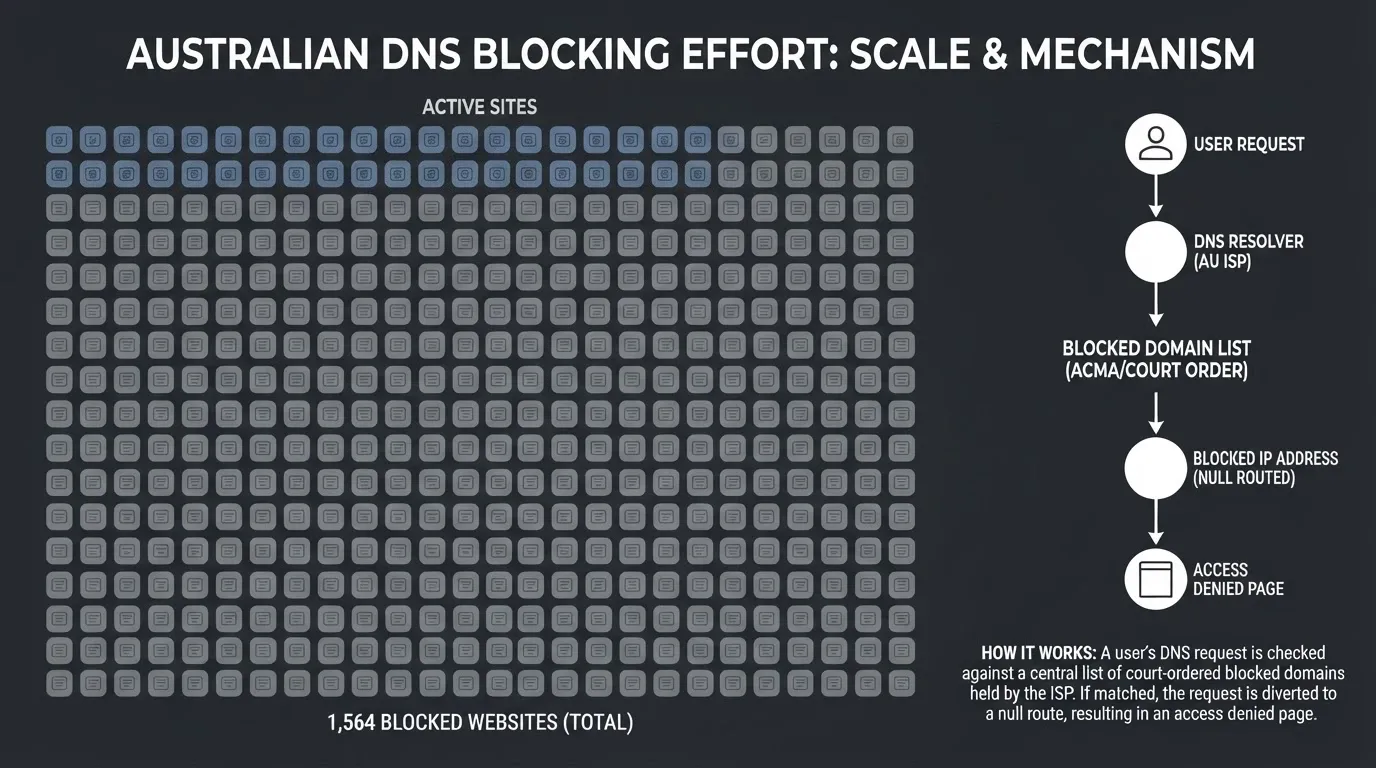
What blocking means for a player with a balance on the site is the part the marketing never covers. The site can be taken down at any time. The balance on it at that moment does not follow the player somewhere safe. There is no Australian complaints body to escalate to, no statutory dispute resolution scheme, no recourse under Australian consumer law. A blocked offshore casino is, in practical terms, a closed business — and the player’s claim against it is a private claim against an offshore entity with no Australian presence to enforce against.
The credit card and crypto ban is the second tell. Since 11 June 2024, credit cards, credit-related products and digital currencies have been banned as payment for online wagering, with penalties up to A$247,500 for operators that accept them. Any site asking for a credit card or a crypto transfer is, by definition, operating outside Australian rules. From 1 January 2027, banks and payment providers gain the authority to refuse transactions to those operators, which makes the offshore payment channel narrower as well as more legally exposed.
Player protections you forfeit with an offshore site
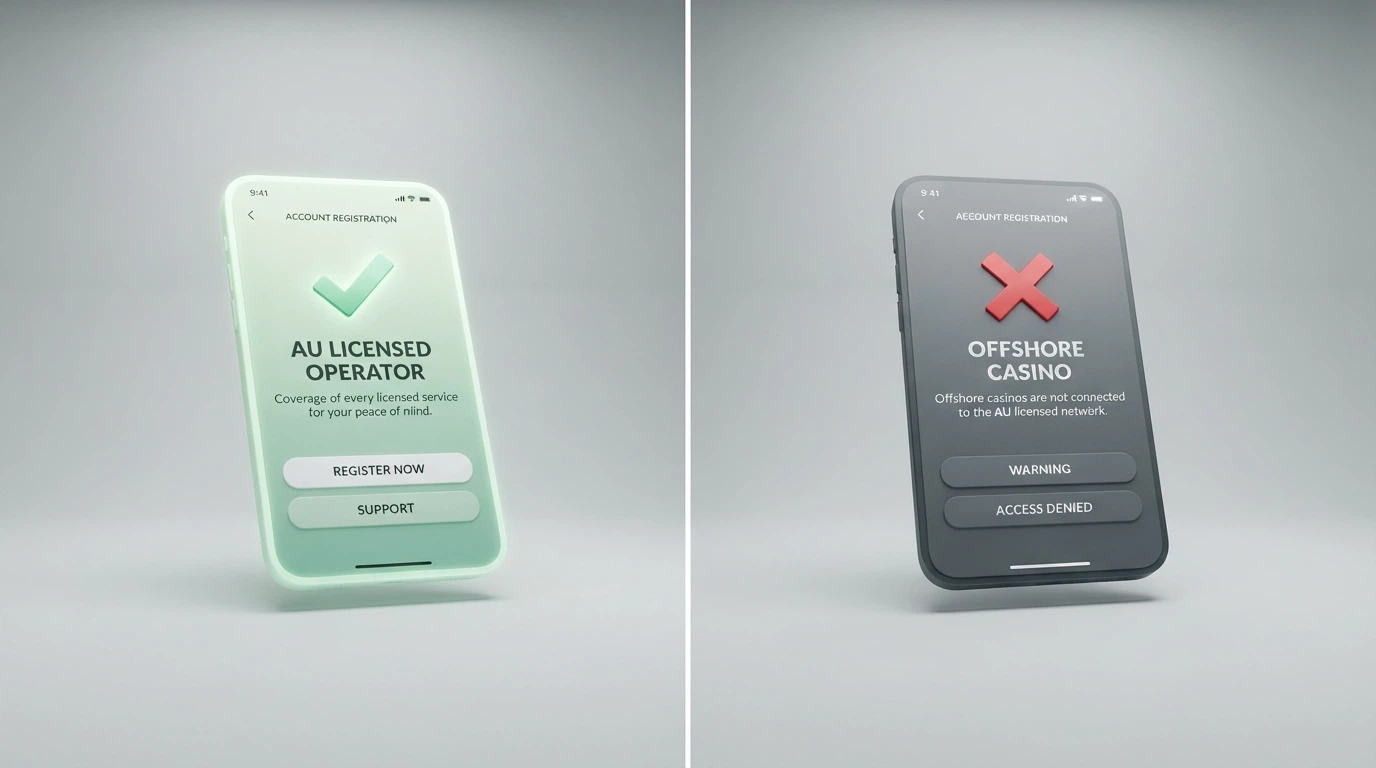
The protections an Australian-licensed wagering customer has do not travel with them to an offshore casino. State and territory complaints bodies resolve disputes with licensed operators; an offshore casino falls outside every one of them. BetStop, the National Self-Exclusion Register, binds Australian-licensed wagering services only — an offshore casino is not connected to it and will keep taking a self-excluded person’s money. Customer-set deposit limits and activity statements are required on licensed services and absent on most offshore ones.
What a Curacao licence gives the player is, in practice, very little. The regulator authorises the operator to run an international gaming business; it does not guarantee payouts, does not adjudicate disputes, does not provide a complaint mechanism an Australian player can use without engaging an overseas lawyer. The provider is prosecuted under the IGA, not the player — the Act targets the supply, not the customer. But the absence of Australian consumer law on the other side of the transaction means a player who is refused a withdrawal has fewer remedies than they would have on a licensed wagering service, and the same absence means there is no Australian body to escalate to.
The tax position is the one piece of clarity. Betting and gambling winnings are not assessable income for ordinary punters under section 6-5 of the ITAA 1997. Gambling losses are not deductible under section 8-1 unless the person carries on a business of betting. The ATO does not tax the casual gambler’s wins, and does not let them offset the losses either.
What you lose when BetStop can’t reach your casino
BetStop is the single most concrete harm of the offshore route, because the register is real, it is effective, and the offshore casino is not on it. The National Self-Exclusion Register launched on 21 August 2023. To the end of Q3 FY 2025–2026 (31 March 2026), 59,830 people had registered to self-exclude, with 37,247 active exclusions. One registration excludes a person from every licensed Australian online and phone wagering service at once, for a minimum three-month exclusion period that can be extended.
The outcomes data on the registered population is the strongest signal in the responsible-gambling literature. Of those who registered, 77% reported a better overall quality of life, 79% reported improved mental health, and 96% said they had either completely stopped betting (81%) or decreased their betting (15%). The register is doing the job it was designed to do — for the wagering services it covers. The offshore casino, by definition, is not one of them.
BetStop — what it is and why offshore casinos ignore it
BetStop works through a single registration that propagates to every Australian-licensed online and phone wagering service. The licensed operators are required by law to check the register before accepting a new account and to refuse service to anyone listed. The minimum exclusion period is three months and can be extended up to a lifetime exclusion. The infrastructure is free, the registration is nationwide, and the enforcement is mandatory on the licensed side.
The awareness gap is the limit on the register’s reach. Only 33.5% of wagerers know BetStop exists, and around 26.5% of Australian adults are aware of it. The mismatch between the population in need and the population registered is the most cited figure in the responsible-gambling literature: an estimated 400,000 high-risk gamblers nationwide against roughly 30,000 active exclusions. The gap is awareness, not capacity.
The offshore casino sits outside this structure entirely. A self-excluded person who opens an account at an offshore brand will not be flagged, will not be blocked, and will not be detected by the Australian register. The mechanism that works for licensed wagering is invisible to the operator that is not licensed. That asymmetry is the concrete cost of the offshore route, and it is the one a reader sorting offers on headline value alone is least likely to weigh.
Self-set limits, cooling-off and where to get help
The help infrastructure that reaches every Australian — regardless of where they play — is worth naming in one place.
The National Gambling Helpline is 1800 858 858. It is free, confidential, and staffed around the clock. Gambling Help Online, at gamblinghelponline.org.au, provides online chat and counselling for people who would rather type than talk. State-based services, including Gambler’s Help in Victoria and the equivalent in other jurisdictions, run face-to-face counselling. Self-test tools and structured self-exclusion support are available through Gambling Help Online and through the BetStop pathway for the licensed wagering side.
Help-seeking data shows that at-risk regular online bettors use a mix of channels: 37.9% call a helpline, 35.8% browse a gambling help website or forum, 30.5% seek help from family or friends, and 27.4% speak to a doctor, psychologist or counsellor. The numbers overlap — most people who seek help use more than one channel — but the takeaway is that the first step is short, free and does not require a casino account.
Self-set deposit limits and activity statements are a feature of licensed wagering operators, not offshore casinos. Take-a-break and cooling-off tools work the same way — present on the licensed side, absent on the offshore side. The licensed operator is built around customer-set guardrails. The offshore operator is not.
The numbers — how many Australians gambling harm actually affects
The prevalence data puts the offshore-casino risk in context. Approximately 2.1% of Australian adults — roughly 430,000 people — experience problem gambling. The Australian Institute of Health and Welfare put high-risk gambling at 1.8% in 2022. A model published in 2026 estimates roughly 1.97 million adults with at-risk or problem gambling, and 3.29 million Australians affected annually by their own or another person’s gambling.
The impact is unevenly distributed. 27.1% of Aboriginal and Torres Strait Islander Australians are at risk of gambling harm, compared to 14.6% of non-Indigenous Australians. The differential is the largest single demographic gap in the responsible-gambling literature, and the offshore channel compounds it: an Australian-licensed wagering customer has BetStop coverage and state complaints bodies; an offshore casino customer has neither, and the higher the underlying risk the more that asymmetry costs.
The gap between the 400,000 high-risk gamblers and the 30,000 active BetStop exclusions is the operational gap the register was built to close. The offshore casino is the part of the market that sits outside the closure. Every player who moves from a licensed wagering service to an offshore casino, and every high-risk player who starts there, widens the gap by one.
How we chose and ranked these operators
The list is ordered by relevance to the no-deposit and free-spin angle the page is built around, not by welcome-package size. Royal Reels and Bizzo rank high because they offer genuine no-deposit entry points; SkyCrown and RocketPlay rank in the middle because their welcome packages are large but deposit-gated; Rocket ranks lower than its spin count suggests because the no-deposit label sits behind a A$30 unlock. Stake ranks low because it does not compete on free-spin bonuses at all. FairGO, Scream and Rainbet rank last because their bonus terms did not surface this run and they are included for completeness, not on confirmed data.
Where the data comes from and how we checked every licence
The two primary sources for this page are the ACMA’s published register of blocked services and operator terms pages. The ACMA register is the licence-status authority — every brand on this page was checked against the official record, and none of them holds an Australian online casino licence, because none can. Operator terms pages are the source for bonus specifics: wagering multiples, cashout caps, expiry windows, eligible games. Where a terms page did not publish a figure, the gap is named in the operator write-up rather than estimated.
Cross-referencing came from affiliate aggregators and community feedback sites — Pokiesroo, PokiesAustralia, AustralianGamblers, Casino.org AU among them — and from the operator’s own promotional material. Where the aggregator and the operator disagreed, the operator’s terms page was treated as authoritative, because the player is bound by what the operator publishes regardless of what an affiliate describes.
The licence check ran the same way for every brand: confirmed as offshore, confirmed as Curacao-licensed (or equivalent), confirmed as not licensed in Australia. None of the ten operators on this list can hold an Australian casino licence, because the product they sell is prohibited under the IGA. The licence status is a property of the product, not of the operator’s character.
The ranking criteria and what we could not confirm
The ranking criteria, in order, were: relevance to the no-deposit and free-spin angle, transparency of terms, and confirmation status of the bonus data. Welcome-package size was deliberately demoted as a criterion because the page is built around no-deposit access, not deposit-gated welcome value. A reader looking for the largest welcome bonus in the offshore market would rank the set differently; a reader looking for the closest match to the headline offer ranks it the way this page does.
The limitation is named. FairGO, Scream and Rainbet carry unconfirmed bonus terms this run and are included for completeness among the AU-facing offshore operators. The instruction to the reader is to check the operator’s own terms page before acting on any offer — particularly on the three brands at the bottom of the list, where the page itself has the least to say. An operator ranked low because its terms did not surface is not an operator endorsed by the ranking; it is an operator covered thinly because the data is thin.
Your move: knowing what you’re really signing up for
The page has laid out the offers, the maths, and the law. The decision belongs to the reader, and it turns on a single trade. A$2.50 in free spins, gated by a 30×–50× wagering multiple and an A$80–A$100 cashout cap, played at an offshore casino that the ACMA can block at any time. The reading is not that the offer is worthless — A$2.50 in spin value is real, and a small win on a medium-volatility title like Wolf Gold is possible. The reading is that the value of the offer and the cost of the channel it runs through are different questions, and they have to be weighed separately.

The real value after the terms gate — what A$2.50 in free spins actually costs you
The chain runs in three links. The headline offer is A$2.50 — twenty-five spins at A$0.10. A A$5 win at 40× wagering demands A$200 in play-through before any of it converts to withdrawable cash. The cashout cap — typically A$80 to A$100, with the wider band running A$50 to A$200 — is the final gate, and it keeps everything above the ceiling regardless of how much was actually won.
The combined effect is the figure a player should weigh. The most a player realistically keeps from a no-deposit 25-spin offer, on the typical terms in the current market, sits at the cashout cap. The turnover required to reach that cap is several multiples of the original spin value, and the expected loss over that turnover is not zero — at a 96.5% RTP on a representative pokie, the house edge over A$200 of play-through is roughly A$7. The bonus’s real cost is the time, the variance, and the A$7 in expected loss against a capped payout. The reader can decide whether that exchange is worth making. The page’s job is to make the exchange visible, not to make it for them.
No BetStop, no complaints body, and the risk the site disappears
The protections absent on the offshore side are concrete. BetStop does not reach an offshore casino, so a self-excluded person remains exposed. There is no Australian complaints body to escalate a withheld withdrawal to, and no Australian consumer law to apply. The ACMA’s blocking regime has taken 1,564 sites down since November 2019 — a figure that includes affiliate pages, not just operator domains — and a blocked site takes the balance on it with it.
The closing frame is not a recommendation. The reader now has the terms, the maths and the law. They know that the offer is real, that the value is small, that the terms are steep, and that the channel carries risks the licensed alternative does not. The choice is theirs to make with the information laid out in front of them.
Frequently asked questions
Can I really get 25 spins without depositing a cent?
Yes, but the offer is narrow. Crocoslots and BetandPlay both run 25-spin no-deposit offers this year, with AU$82 caps and 45×–50× wagering. Royal Reels offers a AUD 10 no-deposit cash credit on sign-up rather than spins. Bizzo runs 10 FS no-deposit for downloading its mobile app. The 25-spin no-deposit headline exists in the market, but the wider category is a mix of spins and small cash credits gated by terms that flatten most of the value.
How much of my free-spin win can I actually cash out?
The typical cap sits at A$80 to A$100, with the wider range running A$50 to A$200 across the market. Named caps in the current set include Crocoslots at AU$82, BetandPlay at AU$82, and Rocket Casino at A$75 on no-deposit winnings. The cap is the final gate: clearing A$200 in wagering to collect A$80 is the trade most players meet on a standard no-deposit offer, regardless of how much the bonus balance reaches during play-through.
Do I need a promo code or does the offer auto-credit?
It depends on the operator. Most current no-deposit offers auto-credit on registration and email verification — BetandPlay is the named example in this set. Some offers still require a code entered at the cashier, particularly through affiliate aggregator sites. The terms page is the source of truth: if the offer says “auto-credited”, no code is needed; if it lists a code, the code is required before the spins appear in the pokie lobby.
How do I spot an offshore casino that isn’t safe?
Three tells. First, the licence: a Curacao or equivalent offshore licence is the only kind an AU-facing online casino can hold, because Australian casino licensing does not exist for this product. Second, the payment methods: a site asking for credit card or crypto is operating outside Australian rules, because both are banned for licensed wagering since June 2024. Third, the operator’s own publication of its terms — wagering multiples above 50×, cashout caps hidden until withdrawal, and bonus slot titles not named in the offer are all signs the small print is doing work the marketing is hiding.
Why can’t I just play through the wagering on table games?
Standard video pokies contribute 100% toward wagering requirements. Table games contribute 10–20%, or are excluded entirely. Live dealer games are excluded almost universally. The offer is, in practice, a pokies-only promotion, and a player trying to grind through the requirement on blackjack finds that A$20 of every A$100 they wager counts toward the target. The path to clearing the bonus runs through the pokies lobby, not the table games floor.
What happens if the casino site gets blocked while I have money in it?
The ACMA can request DNS-level blocking of an offshore site at any time, and 1,564 sites have been blocked since November 2019. A blocked site does not migrate the player’s balance somewhere safe — the site goes dark, and the balance on it goes with it. There is no Australian complaints body to escalate to and no Australian consumer law to apply. The risk is real and the page has covered it in the section on offshore casinos and the ACMA’s blocking regime.