
Payment Methods for Australian Online Casino Players: Speed, Safety and the Law
 Available in AU
The choice an Australian player makes at the casino cashier is not a small one. It decides how quickly money lands, how quickly winnings come back, whether a single bank policy can stall a withdrawal, and whether the player has any complaint body to turn to if the operator refuses to pay. Every method on this page sits inside a legal framework that bans the product outright, and that framework shapes what each rail can deliver.
Data current as of 24 October 2026 and verified against the ACMA register and Australian Government legislation.
Table of Contents
- The Payment Methods That Actually Work for Australian Players
- PayID — Australia’s Home-Grown Speed Advantage
- Cards and Bank Transfers — Familiar but Filtered
- E-Wallets and Prepaid Vouchers — The Flexible Middle Ground
- Crypto Payments — Privacy at a Price
- Why Australia’s Laws Shape Every Payment You Make
- Deposit Limits, Self-Exclusion and Staying in Control
- Which Operators Give You the Payment Methods Australians Actually Use
- Comparing Payment Methods Side by Side — Speed, Fees and Availability
- How We Evaluated These Payment Methods
- What Your Payment Method Says About the Casino You’re Choosing
- Frequently Asked Questions
The Payment Methods That Actually Work for Australian Players
Online casino games are prohibited in Australia under the Interactive Gambling Act 2001. There is no licence for the product anywhere in the country, which is why every casino accepting Australian players is an offshore operator, and every payment method they offer runs outside Australian rules. That prohibition is also why the method set an Australian player sees is narrower than what European or Canadian players encounter. The 2024 credit-card and crypto ban for licensed wagering removed two familiar rails from the regulated side of the market; the offshore side kept them, but offshore exposure carries its own costs.
What a Casino “Payment Method” Actually Covers
A payment method is not just the funding button a player taps. It is a deposit rail, a withdrawal rail, a set of built-in limits, and a chain of identity verification that the casino and the underlying payment provider apply. The most important distinction is the one between depositing and withdrawing. Most methods that fund an account in seconds cannot return money to it at all. POLi is the sharpest example in the Australian context: deposits land instantly, but the rail is not used for payouts at most sites. PayID splits similarly. Deposits clear through the New Payments Platform and the Osko overlay in seconds to under one minute; true PayID-out, an outbound NPP payout, is rare and is replaced by a BECS bank transfer that takes one to three business days. A method that deposits fast may withdraw slowly, and a method that withdraws fast may not deposit at all. The choice a player makes is not between faster and slower. It is between two different transactions going in opposite directions.
Why the Australian Payment Landscape Looks Different
The Interactive Gambling Act 2001 prohibits online casino, online pokies and in-play sports betting for anyone in Australia. That prohibition is aimed at operators under Section 8AA, not at players, but it does decide which Australian payment rails survive inside the regulated system. Since 11 June 2024, licensed Australian wagering operators cannot accept credit cards, credit-related products including digital wallets linked to credit, or digital currency. The legal deposit routes for licensed wagering are debit card, bank transfer, PayID/Osko and BPAY. Outside that licensed system, offshore casinos accept a wider set, including crypto and credit cards at some brands, but the player gains no Australian consumer protection in exchange. The market an Australian player actually faces is therefore a two-tier one: a regulated tier with a narrow method set and full Australian safeguards, and an offshore tier with a wider method set and no safeguards at all. Every payment decision on this page is a decision about which tier the player is on.
How Your Method Choice Shapes Speed, Fees and Safety
Speed is the most visible difference between methods. PayID deposits clear in seconds. Crypto deposits take minutes to about an hour. Visa and Mastercard deposits are instant. E-wallet withdrawals are commonly processed within 24 hours. Visa and Mastercard withdrawals, by contrast, take two to five business days. Bank transfers through the older BECS rail take one to three business days. The withdrawal side is where most of the gap between methods lives. Fees are a quieter variable. Research does not give a per-method fee schedule for the operators on this page, and fees differ across brands even within a single method, so the practical advice is to check the cashier before depositing rather than assume. Safety is the variable that matters most and the one players look at last. A method backed by an Australian bank or a major card network carries dispute mechanisms. A method routed through an offshore crypto casino carries none of them. The same PayID deposit that takes seconds can also be the transaction an Australian bank declines without explanation if the destination is flagged.
PayID — Australia’s Home-Grown Speed Advantage
PayID is the fastest-deposit method available to Australian casino players and the most popular mobile payment option in the country. The deposit experience is exceptional. The withdrawal story is more complicated than the deposit speed suggests, and the difference matters for anyone planning to cash out winnings rather than keep them on the platform.

How PayID Deposits Work — and Why They Clear in Seconds
PayID runs on the New Payments Platform, with the Osko overlay delivering near-real-time settlement between participating Australian banks. A player creates a PayID identifier linked to their bank account, enters it at the casino cashier, types the amount, and the money arrives at the casino in seconds to under one minute. In a 2026 test run by an industry reviewer, a Neospin AU$100 PayID deposit from a Commonwealth Bank account landed instantly. That speed is reliable because it does not depend on the casino’s processing queue. Once Osko confirms, the funds move. The rails work the same way for a transfer to a friend as they do for a transfer to an offshore casino cashier, and that is why the speed holds even when the receiving party is unregulated. PayID is also the most popular AU mobile payment option, which means the deposit flow fits the device most Australian players actually use.
The PayID Withdrawal Reality — NPP Is Rare, BECS Is the Norm
The deposit side of PayID gets the headlines, but the withdrawal side is where the marketing meets the operational reality. A true PayID-out, an outbound NPP payout from the casino to a player’s PayID, takes seconds once approved. The “once approved” qualifier is doing a lot of work, and the rarity qualifier is doing more. Most offshore casinos do not support NPP outbound at all. They route the withdrawal through the older BECS rail, which takes one to three business days. The casino’s cashier page may advertise PayID as a withdrawal option, but the rail behind it is BECS, and the speed behind it is days rather than seconds. The way to tell which rail a casino uses is to ask support directly, before depositing, what the actual settlement window is on a PayID withdrawal.
Cards and Bank Transfers — Familiar but Filtered
Debit cards and bank transfers are the methods every Australian already has. They are not, however, a default. The deposit-to-withdrawal speed split on cards is the widest of any method on this page, and Australian banks have begun actively blocking gambling transactions, which means a method the player already owns may not always work.
Visa and Mastercard — Instant Deposits, Multi-Day Withdrawals
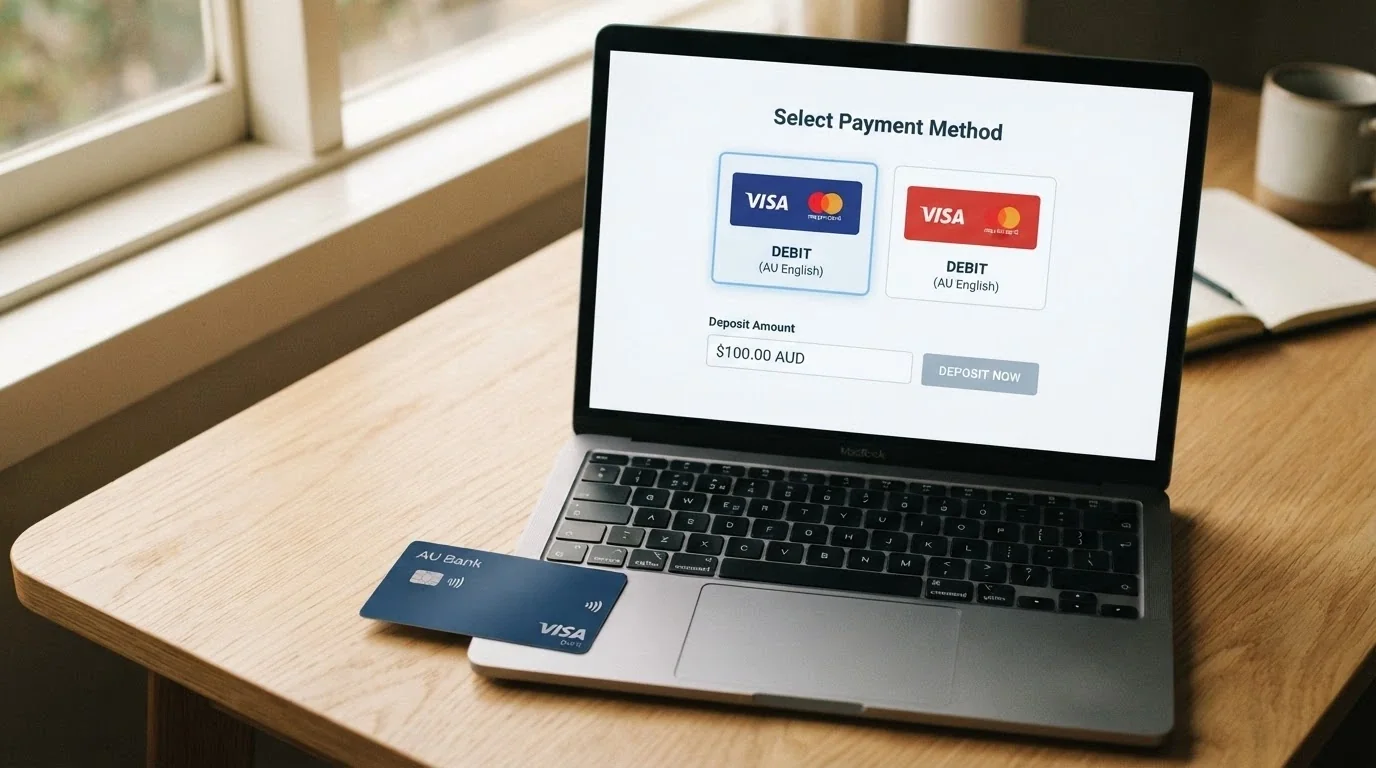
Visa and Mastercard debit deposits are instant. Authorisation comes back in a second. The withdrawal window is two to five business days, because the money has to move through the card network and back into the player’s bank account, and each leg of that journey adds a day. The other constraint is credit. Credit cards have been banned as payment for licensed online wagering since 11 June 2024. At offshore casinos, credit cards are mostly blocked by the card-issuing bank or by the casino’s own processing, leaving debit as the realistic option. Some Australian banks also block gambling transactions on Visa and Mastercard outright. A deposit that returned “approved” yesterday can return “declined” today, and the player has no way to predict which it will be without contacting their bank.
POLi, BPAY and Direct Bank Transfers — Deposit-Only Workhorses
POLi is an Australian online banking payment service that lets a player authorise a casino deposit from their bank account without sharing card details. Deposits clear instantly. Withdrawals are not supported at most sites, because POLi was built as a deposit rail, not a payout rail. BPAY is a similar story. It is a familiar Australian bill-payment method, it works for casino deposits, and it is not used to send winnings back to a player. Direct bank transfers, the BECS rail, do work for withdrawals, and the cost is one to three business days. The pattern across all three is that the deposit side is fast and the withdrawal side is either absent or slow, which is why a player who wants a round trip in one session needs to pair one of these deposit methods with a different withdrawal method.
Why Australian Banks Block Gambling Transactions on Your Card
Australian banks are not neutral pipes. Commonwealth Bank and Westpac have actively restricted outbound transfers to crypto exchanges since mid-2023, and some Australian banks block gambling transactions on Visa and Mastercard. The reason sits at the intersection of consumer-protection law and the Travel Rule. AUSTRAC’s Travel Rule kicks in at AU$10,000, which means any transfer above that threshold attracts enhanced scrutiny, but the bank-level blocking of gambling transactions operates below the Travel Rule and is driven by each bank’s own risk policy. From 1 January 2027, the picture changes again. The Interactive Gambling Amendment (Gambling Reform) Bill 2026, which passed Parliament on 19 August 2026, gives banks and payment providers express statutory authority to block transactions to illegal gambling operators. Until that date, bank blocking is a private policy choice. After it, it is a statutory power.
E-Wallets and Prepaid Vouchers — The Flexible Middle Ground
E-wallets and prepaid vouchers sit between cards and crypto. They are faster than bank rails for withdrawals, more private than cards, and they have a narrower Australian lineup than European players see. They also split into two camps with very different use cases: e-wallets that move money both ways, and vouchers that move it one way only.
E-Wallets That Reach Australian Players — Skrill, Neteller and MuchBetter
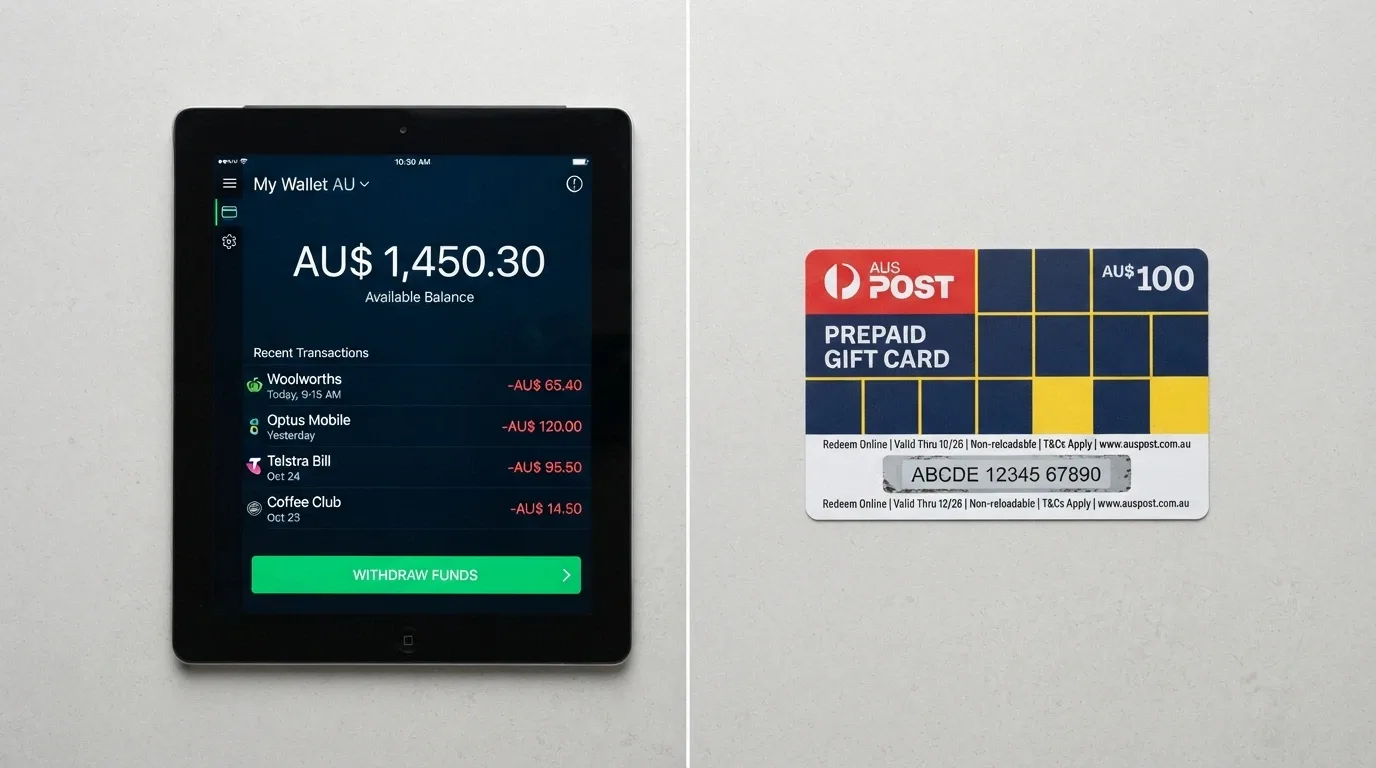
The e-wallet set available to Australian casino players is smaller than the European lineup. Skrill and Neteller are the two most consistently available, with MuchBetter emerging as a newer, Australian-friendly alternative. PayPal is not widely offered at AU-facing offshore casinos. The withdrawal profile is what makes e-wallets useful: e-wallet withdrawals are commonly processed within 24 hours, which puts them ahead of cards and bank transfers on the side that matters most for cashing out. The trade-off is that deposits usually need to clear through the e-wallet first, so the funding flow is wallet-to-casino rather than bank-to-casino, and the player needs to have funded the wallet already. The deposit speed of each e-wallet varies and research carries no per-wallet deposit-time data, so the practical advice is the same as for fees: check the cashier before committing.
Neosurf and Prepaid Vouchers — Fixed-Amount Discipline
Neosurf vouchers and similar prepaid products let a player fund a casino account without handing over bank credentials or card details at all. The trade-off is a hard deposit ceiling set by the voucher’s denomination, and the fact that prepaid methods cannot receive withdrawals. The hard ceiling is also a feature. A player who wants to fix their spend at, say, AU$100 can buy a single voucher and stop when it is spent, without the friction of a deposit-limit setting. Research does not carry Neosurf denomination or per-operator availability details, so the exact denominations and brands accepting Neosurf vary and need to be checked at the cashier.
Mobile Wallets and In-App Checkout at AU-Facing Casinos
Mobile casino payment in Australia is dominated by PayID, which is the most popular AU mobile payment option. Beyond PayID, mobile wallets such as Apple Pay and Google Pay appear at some AU-facing offshore casinos but not consistently, and carrier billing exists as a deposit rail for a small number of brands. Research carries no per-operator data on either, so the practical reality is that PayID is the dependable mobile deposit rail and the others are add-ons whose availability is a per-operator question.
Crypto Payments — Privacy at a Price
Crypto delivers the fastest withdrawals of any casino payment method and the most privacy. The trade is the consumer-protection gap. Australian banks actively obstruct the on-ramp, and using crypto means surrendering every safeguard an Australian-regulated product would carry.
How Bitcoin and Crypto Deposits Work at Offshore Casinos
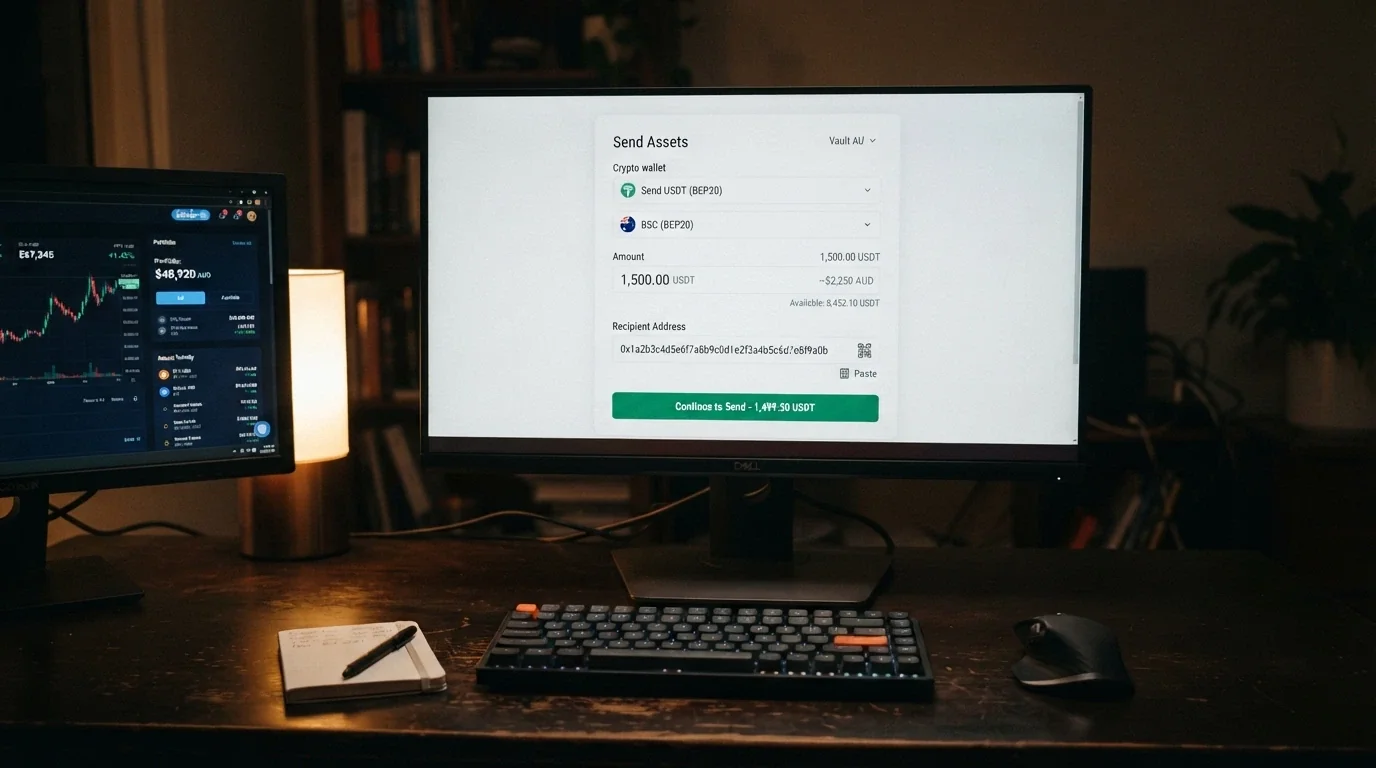
A crypto casino deposit runs through three hops: an Australian bank funding an Australian exchange account, the exchange sending crypto to a player wallet, and the wallet sending it to the casino’s deposit address. The cleanest route in 2026, on the evidence available, runs AU bank to CoinSpot or Independent Reserve, then USDT on the TRC20 network to the offshore casino. Deposits at the casino end take minutes to about an hour. Withdrawals take minutes to hours. In a 2026 industry test, a Neospin crypto withdrawal was approved in 14 minutes. Wild Fortune Casino’s crypto withdrawals averaged 5 hours 24 minutes across the same period. Those figures are the strongest withdrawal speeds on this page by a margin, and they are the reason crypto-first operators exist. The cost of that speed is what happens at the first hop, between the Australian bank and the exchange.
The Bank-to-Exchange Hurdle — CommBank, Westpac and Crypto Restrictions
The hardest part of funding a casino with crypto is not the casino. It is getting Australian dollars onto an exchange. Commonwealth Bank and Westpac have, since mid-2023, run public policies that decline or limit payments to “high-risk” crypto exchanges, with daily caps in the AU$10,000 region. In a March 2026 test run by an industry reviewer, two of three AU$5,000 PayID transfers from an Australian bank to Binance Australia were declined outright. A transfer to CoinSpot went through but was held for four hours under a flag of “additional checks”. AUSTRAC’s Travel Rule, which kicks in at AU$10,000, is the regulatory floor for enhanced scrutiny, but bank-level restrictions are a private policy layer that operates below that threshold. The implication is straightforward: a player who wants to use crypto needs to plan for the first hop to take longer than the last hop, and may need to try more than one exchange before finding one their bank will fund without a hold.
The KYC Trade-Off — Anonymity Versus the Safety Net You Give Up
Crypto casino deposits can reduce the identity data a player hands over to the casino itself. The same gap means there is no BetStop coverage for the casino, no Australian complaints body, and no recourse if the operator refuses to pay. The Interactive Gambling Act 2001, Section 8AA, prohibits operators from providing services to Australian residents, not residents from playing, so the legal risk sits with the operator, not the player. The practical risk sits with the player. An offshore casino site can be blocked by Australian ISPs at any time, with funds still on the account, and ACMA cannot recover anyone’s money because ACMA has no consumer-protection role over offshore operators. That asymmetry is the trade: speed and privacy on the way in, and zero protection on the way out.
Why Australia’s Laws Shape Every Payment You Make
Every payment method on this page exists inside a legal framework that bans the product outright. The Interactive Gambling Act 2001, the 2024 credit and crypto ban, and the 2026 reforms together decide which rails work and what protections the player keeps.

The IGA 2001 Prohibition — What It Actually Bans (and What It Doesn’t)
The Interactive Gambling Act 2001 makes it illegal for gambling providers to offer online casino games, online pokies and in-play betting to people in Australia. ACMA’s wording is plain: the IGA “makes it illegal for gambling providers to offer some online services to people in Australia. Banned services include: online casinos.” What is licensable is narrower: pre-event wagering on races and sport, lotteries and keno. The prohibition targets the provider, not the customer, which is why an Australian resident can deposit at an offshore casino without breaking the law, while the offshore operator offering the game is committing an offence under Section 8AA. ACMA enforces this by directing Australian internet service providers to block illegal sites: since November 2019, 1,788 illegal gambling and affiliate websites have been blocked, and over 230 illegal services have withdrawn from the Australian market since 2017. The maximum penalty is $360,000 per day for individuals and $1.8 million per day for bodies corporate. The size of those penalties is why no Australian-licensed entity offers an online casino; there is no licence to hold, because no such licence exists.
Credit Cards and Crypto Banned for Licensed Wagering Since June 2024
Since 11 June 2024, licensed Australian wagering operators cannot accept credit cards, credit-related products including digital wallets, or digital currency. The Interactive Gambling Amendment (Credit and Other Measures) Act 2023 is the statute. The remaining legal deposit routes for licensed wagering are debit card, bank transfer, PayID/Osko and BPAY. The ban does not reach offshore casinos, and that is the bright line. A casino that accepts credit card or crypto is, by definition, not inside the licensed Australian system, because the licensed system cannot accept those payment types. For a player comparing operators, the credit-card and crypto acceptance test is a regulatory litmus test: if the cashier offers them, the operator is offshore, with the consumer-protection consequences that follow.
The 2026 Reforms — New Bank Blocking Powers from 1 January 2027
The Interactive Gambling Amendment (Gambling Reform) Bill 2026 passed Parliament on 19 August 2026 and its measures commence on 1 January 2027. The change that matters most for payment methods is express statutory authority for banks and payment providers to block transactions to illegal gambling operators. Until that date, bank-level blocking of gambling payments is a private policy decision each bank makes on its own risk appetite. After 1 January 2027, it is a power granted by statute. The reform also tightens advertising: no more than three wagering ads per hour between 6:00 am and 8:30 pm, with a live-sport blackout running from 15 minutes before to 5 minutes after an event. Inducements are restricted too: direct marketing is banned for 14 days after signup, for three months after a BetStop deregistration, and indefinitely for at-risk customers. None of these measures legalise online casino. They make the existing prohibition easier to enforce.
What You Risk When You Pay an Offshore Operator
Using an offshore casino is not illegal for the player. The risk is the gap around the transaction. There is no Australian consumer protection for funds held by an offshore operator. There is no BetStop coverage, because BetStop reaches only licensed Australian wagering operators. There is no ACMA complaints path for a withheld withdrawal or a voided win, because ACMA’s role is regulatory enforcement, not consumer redress. A site can be blocked at any time, and the player’s money stays on the platform with no Australian body able to recover it. ACMA has had 1,788 illegal gambling sites blocked since November 2019 and 230 services withdrawn since 2017; those numbers are evidence of an active enforcement regime, not evidence that funds are protected. The licensed wagering protections and the offshore exposure are two different worlds. The payment method a player chooses does not bridge them.
Deposit Limits, Self-Exclusion and Staying in Control
Payment methods are the front line of responsible gambling. Every method carries its own limit structure, and Australia’s BetStop register adds a layer that works inside the licensed system but stops at the offshore border.

How Deposit Limits Work Across Payment Methods
Deposit limits operate at three levels: the method’s own cap, the operator’s platform setting, and the bank’s transaction filter. The level that bites first depends on how a player pays. Under the National Consumer Protection Framework, which includes ten measures, licensed wagering operators offer customer-set deposit limits on a daily, weekly and monthly basis. The most common operator-level single-transaction maximum on Visa Debit deposits is AU$5,000, AU$10,000 or AU$25,000, depending on the brand. Neosurf vouchers impose their own ceiling by virtue of fixed denominations. Bank-imposed limits operate on the rail itself. AUSTRAC’s Travel Rule at AU$10,000 adds a record-keeping layer for transfers above that threshold. None of these limits exist in a vacuum; they stack, and the lowest one wins.
BetStop — What Australia’s Self-Exclusion Register Covers (and What It Doesn’t)
BetStop, Australia’s National Self-Exclusion Register, had 67,480 registrations as at 31 July 2026, with 41,290 exclusions still active. Seventy-eight per cent of registrants were under 40, and 38 per cent chose lifetime exclusion. BetStop is the strongest responsible-gambling tool an Australian player can use inside the licensed system. It does not reach offshore casinos. The register binds licensed Australian wagering operators, and no offshore brand on this page is bound by it. The practical consequence is straightforward: a player who self-excludes through BetStop still has open access to every offshore casino the ACMA has not yet blocked, and ACMA’s blocking is a regulatory tool, not a personal protection. BetStop is the right move for anyone playing inside the licensed system. It is not, by itself, enough.
Where to Get Help — Helpline, Counselling and Support Services
About 2.1% of Australian adults, roughly 430,000 people, experience problem gambling, and high-risk gambling prevalence sits at 1.8%. The services that work are free and available right now. The National Gambling Helpline is 1800 858 858, free, confidential and staffed 24 hours a day. Gambling Help Online, at gamblinghelponline.org.au, offers online chat and counselling. Neither service asks whether the player uses a licensed or offshore operator. Both are reachable regardless.
Which Operators Give You the Payment Methods Australians Actually Use
The table below lines up the ten offshore operators featured on this page on payment-method availability and primary payment approach. All ten are offshore; none holds an Australian online-casino licence, because no such licence exists. Payment methods are the primary differentiator between them.
| Operator | Licence Status | Payment Methods | Primary Approach |
|---|---|---|---|
| Rocket Play | Offshore (not AU-licensed) | PayID, crypto, Visa/Mastercard, e-wallets | Multi-method |
| Skycrown | Offshore (not AU-licensed) | PayID, crypto, Visa/Mastercard, e-wallets | Multi-method |
| Royal Reels | Offshore (not AU-licensed) | PayID, crypto, Visa/Mastercard, e-wallets | Multi-method |
| WinSpirit | Offshore (not AU-licensed) | PayID, crypto, Visa/Mastercard, e-wallets | Multi-method |
| Stake | Offshore (not AU-licensed) | Crypto, PayID, Visa/Mastercard | Crypto-first |
| Rainbet | Offshore (not AU-licensed) | Crypto, PayID, Visa/Mastercard | Crypto-first |
| Scream Casino | Offshore (not AU-licensed) | PayID, crypto, Visa/Mastercard, e-wallets | Multi-method |
| FairGO | Offshore (not AU-licensed) | PayID, crypto, Visa/Mastercard, e-wallets | Multi-method |
| Bizzo Casino | Offshore (not AU-licensed) | PayID, crypto, Visa/Mastercard, e-wallets | Multi-method |
| Rocket Casino | Offshore (not AU-licensed) | PayID, crypto, Visa/Mastercard, e-wallets | Multi-method |
Rocket Play
Rocket Play is a multi-rail offshore casino with the full Australian-facing method set: PayID, crypto, Visa/Mastercard and e-wallets. The game-provider mix (Pragmatic Play, BGaming, NetEnt, Play’n GO, Quickspin) is the same as the rest of the offshore cohort on this page. Welcome-bonus specifics, free-spin allocations, wagering requirements, bonus validity and maximum cashout from the offer were not confirmed for Rocket Play at the time of review. Rocket Play stands out as a strong candidate for those who value variety in their deposit and withdrawal rails.
Skycrown
Skycrown matches the core multi-rail offshore profile: PayID, crypto, Visa/Mastercard and e-wallets all in one place, with the standard Pragmatic Play, BGaming, NetEnt, Play’n GO and Quickspin provider stack. Welcome-bonus and offer specifics were not confirmed for Skycrown at the time of review. Where Skycrown earns its place is breadth of access: a player who wants PayID for deposits and an e-wallet for withdrawals finds both at the same cashier.
Royal Reels
Royal Reels rounds out the multi-rail group with the same PayID, crypto, Visa/Mastercard and e-wallet set and the same five-provider game roster. Welcome-bonus details were not confirmed at the time of review. The verdict is the same as for the other multi-method operators on this page: Royal Reels is a representative of the AU-facing offshore cohort, not a distinctive pick within it.
WinSpirit
WinSpirit offers the standard multi-rail lineup: PayID, crypto, Visa/Mastercard and e-wallets, with Pragmatic Play, BGaming, NetEnt, Play’n GO and Quickspin in the games library. Promotional terms for this operator were not available at the time of review. WinSpirit represents a standard, solid choice for players seeking a consistent multi-rail gaming experience.
Stake
Stake is the better-known of the two crypto-first operators on this page. The payment rail is dominated by digital currency, with PayID and Visa/Mastercard available as secondary options. The crypto-primary approach is what separates Stake from the multi-method cohort: deposits and withdrawals move on the blockchain, the withdrawal times are minutes to hours rather than days, and the bank-to-exchange hurdle discussed earlier is the on-ramp cost. Welcome-bonus specifics were not confirmed at the time of review. Stake is the right pick for a player whose priority is crypto speed and who has solved the exchange-funding step.
Rainbet
Rainbet is the second crypto-first operator on the list, with digital currency as the primary rail and PayID and Visa/Mastercard as fallbacks. The withdrawal profile matches Stake’s: minutes to hours on crypto, with the same bank-to-exchange obstacle at the funding stage. Welcome-bonus details were not confirmed at the time of review. The verdict for Rainbet mirrors the verdict for Stake: it suits a player who has decided that crypto is the primary rail and wants a second crypto-first option to compare.
Scream Casino
Scream Casino carries the standard multi-rail lineup: PayID, crypto, Visa/Mastercard and e-wallets, with the same five-provider game roster as the rest of the multi-method cohort. Welcome-bonus specifics were not confirmed at the time of review. Scream Casino is a peer of Rocket Play, Skycrown, Royal Reels, WinSpirit, FairGO, Bizzo Casino and Rocket Casino on payment breadth.
FairGO
FairGO completes the multi-method cohort with PayID, crypto, Visa/Mastercard and e-wallets. Game providers are the standard Pragmatic Play, BGaming, NetEnt, Play’n GO and Quickspin stack. Promotional details remain unverified. FairGO is a dependable alternative for multi-rail enthusiasts who prioritise range in their payment selection.
Bizzo Casino
Bizzo Casino rounds out the multi-method group with the same PayID, crypto, Visa/Mastercard and e-wallet set and the same five-provider library. Welcome-bonus details were not confirmed at the time of review. Bizzo Casino is a representative of the offshore cohort rather than a distinctive pick within it on payment-method grounds.
Rocket Casino
Rocket Casino closes the featured set with the standard multi-rail offshore profile: PayID, crypto, Visa/Mastercard and e-wallets, with the same provider stack as the rest. Welcome-bonus specifics were not confirmed at the time of review. A player who wants method breadth at a single cashier has eight options in this group, and Rocket Casino is one of them.
Comparing Payment Methods Side by Side — Speed, Fees and Availability
The table below lines up every payment method covered on this page by deposit speed, withdrawal speed and whether the method handles deposits, withdrawals or both.
| Payment Method | Deposit Speed | Withdrawal Speed | Type |
|---|---|---|---|
| PayID | Instant (seconds to under 1 minute) | Seconds once approved (NPP, rare); 1–3 business days (BECS fallback) | Both |
| Visa/Mastercard (debit) | Instant | 2–5 business days | Both |
| POLi | Instant | Not used for payout at most sites | Deposit only |
| BPAY | — | Not used for payout at most sites | Deposit only |
| Bank Transfer (BECS) | — | 1–3 business days | Withdrawal |
| E-wallets (Skrill, Neteller, MuchBetter) | — | Commonly within 24 hours | Both |
| Crypto (BTC/ETH/USDT) | Minutes to ~1 hour | Minutes to hours | Both |
| Neosurf / Prepaid Vouchers | Instant | Not available | Deposit only |
How We Evaluated These Payment Methods
The facts on this page are drawn from the Australian Communications and Media Authority (ACMA), Australian Government legislation, the Department of Social Services, the Australian Institute of Health and Welfare, and four industry publishers whose payment-method testing underpins the speed figures: PuntLedger, VegasPokie, Dot Esports and PayoutVerdict, with Betsquare contributing the mobile-payment share data. Every operator on the ranking was checked against the ACMA register, which lists licensed wagering operators, not online casinos; all ten featured operators are offshore, and none holds an Australian online-casino licence because no such licence exists. The ranking criteria were payment-method breadth, deposit speed, withdrawal speed, bank-rail compatibility and mobile support, each assessed qualitatively from published testing and regulatory records. No weightings, scores or composite rankings were invented. Where research carried no figure for a given cell, the table above carries an em dash or qualitative wording rather than an estimate.
What Your Payment Method Says About the Casino You’re Choosing
The payment method a casino offers, or refuses to offer, is the clearest signal of where it sits in relation to Australian law. Credit-card acceptance and crypto acceptance both point offshore, because the licensed system cannot accept either. PayID plus debit-only is consistent with either a licensed Australian wagering operator (which would be a sports bookmaker rather than a casino) or an offshore casino that has chosen to integrate Australian rails. No method on this page converts an offshore casino into a licensed Australian casino, because no such conversion exists; the IGA 2001 makes the product itself prohibited, and the payment rails available to offshore operators reflect that.

The synthesis the page supports is a three-way trade no single method wins. PayID wins on deposit speed and Australian rail familiarity, but loses on withdrawal speed at most offshore casinos because NPP outbound is rare. Crypto wins on withdrawal speed and privacy, but loses on consumer protection and runs into bank-level friction at the funding stage. E-wallets win on withdrawal time and sit between cards and crypto on privacy, but the deposit speed depends on the wallet and research carries no per-wallet figures. Cards win on familiarity, lose on withdrawal time, and depend on whether the player’s bank still allows the transaction. The decision is the reader’s, and the comparison above is what the decision rests on.
The practical verdict is simple: check the cashier before depositing, not after. A deposit that lands in seconds does not guarantee a withdrawal that does the same. A method that is familiar does not guarantee one the player’s bank will approve. A method that is fast does not guarantee one that carries any protection if the operator refuses to pay. The choice at the cashier is the choice the rest of the experience is built on, and the right one is the one the player has actually read the terms behind.
Frequently Asked Questions
Is PayID the best payment method for Australian online casinos?
PayID is the fastest deposit method available to Australian players and the most popular mobile option, but the withdrawal story is more complicated than the deposit speed suggests. Most offshore casinos route PayID withdrawals through the older BECS rail, which takes one to three business days, rather than the NPP outbound rail that would clear in seconds. For deposit-heavy players, PayID is the right rail. For a balanced deposit-and-withdrawal profile, an e-wallet or crypto is faster on the way out.
Can I use cryptocurrency to deposit at Australian online casinos?
Crypto deposits work at offshore casinos and clear in minutes to about an hour, with withdrawals in minutes to hours. They are banned for licensed Australian wagering under the 2024 amendment. The funding step from an Australian bank to a crypto exchange is where the friction lives: Commonwealth Bank and Westpac restrict outbound transfers to crypto exchanges, and two of three test transfers to Binance Australia via PayID were declined outright in March 2026. Crypto delivers speed and privacy and removes the consumer-protection layer that licensed wagering carries.
What’s the fastest way to withdraw winnings from an online casino in Australia?
Crypto is the fastest withdrawal method, with approval times measured in minutes and average settlement under six hours in industry testing. E-wallet withdrawals are commonly processed within 24 hours. PayID withdrawals can be instant when the casino supports NPP outbound, but that support is rare. Card and bank-transfer withdrawals take days. The fastest method available at any given cashier is whichever rail the casino actually settles on, which is a per-operator question.
Do offshore casinos offer the same payment methods as Australian-licensed betting sites?
No. Licensed Australian wagering operators cannot accept credit cards, credit-related products or crypto under the June 2024 ban, and their legal deposit routes are debit card, bank transfer, PayID/Osko and BPAY. Offshore casinos accept a wider set, including crypto and credit cards at some brands, because they are not bound by the Australian regime. The wider method set is also the reason no Australian consumer protection applies.
What happens if my bank blocks a casino payment?
The transaction declines, and the funds stay in the player’s account. There is no automatic reversal and no automatic workaround. Some Australian banks block gambling transactions on Visa and Mastercard, and CommBank and Westpac restrict transfers to crypto exchanges. From 1 January 2027, banks and payment providers gain express statutory authority to block transactions to illegal gambling operators, which will widen the scope of declines. The recourse is to choose a different method or a different bank.
Is it safe to use my debit card at an online casino?
Debit-card deposits at licensed Australian wagering operators carry the standard card-network dispute mechanisms. At offshore casinos, the dispute mechanisms are still available from the card network, but the operator is outside Australian consumer-protection law. The other risk is bank-level blocking: some Australian banks decline gambling transactions on Visa and Mastercard without warning. The deposit itself is safe in the technical sense. The refund path depends on whether the card network and the bank side with the player if the operator refuses to pay.
Written by the editors at Casino Promo Code AU.