
Solana Casino Comparison Australia: Bonuses, Speed and the Legal Reality
Australian players searching for a Solana casino in 2026 are asking one question with two faces. The first is mechanical: which platform pays out fastest, which bonus clears quickest, how do the game libraries actually stack up. The second is the one most comparison pages skip. Every operator on this page operates outside Australian law, because online casino is prohibited here and no licence to provide one exists. The arithmetic answers the first question. The second has only one answer, and it is the same for every row in the ranking below.
Data current as of 16 October 2026; licence claims verified against the ACMA register, the Curaçao Gaming Control Board public licensee search and the operators’ own published credentials.
Table of Contents
- What a Solana Casino Is — And Why It Changes Everything for Australian Players
- The Solana Casinos Australian Players Are Using in 2026 — Ranked
- Why Every Solana Casino Serving Australians Is Offshore — And What That Costs You
- Why SOL Payments Leave Fiat Deposits in the Dust at Offshore Casinos
- What Solana’s Speed Actually Means for Your Deposits and Withdrawals
- The Slots and Games Worth Your Bankroll at Solana Casinos
- Staying Safe When the Australian Safety Net Cannot Reach You
- How We Chose and Ranked These Solana Casinos
- What Australian Players Should Actually Do With This Comparison
- Frequently Asked Questions
What a Solana Casino Is — And Why It Changes Everything for Australian Players
A Solana casino is an online casino that takes deposits and pays withdrawals in SOL — the native token of the Solana blockchain — and often in other tokens issued on the same chain, most commonly USDT in its SPL form. The blockchain is the payment rail. The casino software behind it is, with a few exceptions, the same product any online casino runs: a slot library, a live dealer floor, dice and crash games, a sportsbook on the bigger platforms. What the wallet replaces is everything that sits between a player and that library — the bank, the card processor, the identity check at the door, and the chargeback that follows a disputed withdrawal.
Three differences matter in practice, and they all trace back to that substitution. Settlement speed is the first. Solana produces blocks in roughly 0.4 seconds and the network routinely handles thousands of transactions per second. Cost is the second — a typical SOL transaction carries a fee of around 0.000005 SOL, worth less than one Australian cent. Verification is the third — some Solana-native casinos publish game seeds on chain and let players audit each round themselves, a model the industry calls provably fair.
These are real differences. They also have a habit of looking better in marketing copy than they feel at the cashier, because the casino still applies its own processing queue, its own minimums and its own KYC rules. The native token does the legwork. The casino decides when to hand it back.
How a Solana Casino Actually Works
A player at a Solana casino connects a wallet rather than registering a bank account. The two wallets Australian players actually use are Phantom and Solflare — both are browser extensions and mobile apps, both speak directly to Solana mainnet, and neither asks for a name or a date of birth to install. The casino sees a wallet address. It does not see the person behind it until a withdrawal, a bonus claim or a flag from its risk engine forces the question.
Deposits work in one of three ways, and the rail the casino picks changes what happens to the SOL a player sends. Some casinos accept SOL natively and credit the account in SOL — the token arrives, the balance shows SOL, and any gain or loss tracks the token’s dollar value. Others accept SOL but convert it at the cashier into a stablecoin or a house currency the moment it lands — the player deposits one SOL and the balance shows the AUD equivalent the casino chose at that moment. A third group accepts only USDT on Solana (USDT-SPL) and treats raw SOL deposits as an inconvenience, sometimes refunding them, sometimes not. The rail is a choice the operator made; the player is rarely told which one until a withdrawal arrives in a form they did not expect.
Bets settle against the casino’s own RNG or against an on-chain randomness source. Withdrawals, when the casino has no internal reason to delay, are signed on Solana mainnet and arrive in the player’s wallet once the network confirms. Independent testing across 14 Australian-facing casinos during peak evening hours (8–10 PM AEST) recorded an average deposit confirmation of 2.3 seconds. That is the network doing its job. Whether the casino releases the funds immediately, queues them for review, or holds them until a manual KYC check completes is a different question, and a different speed.
Solana Casinos vs Traditional Fiat Online Casinos
A traditional fiat online casino takes deposits from a bank account, a debit card or a payment intermediary, holds the funds in AUD, and runs the player through a KYC check before the first withdrawal. The whole flow assumes the player is who their documents say they are. A Solana casino assumes the player is whoever controls the private key behind the wallet address — which is to say, until verification is required, anyone.
The practical contrast lines up in three places. Payment speed: a fiat withdrawal from an Australian-facing online casino takes between a few hours and several business days depending on the rail and the operator. A SOL withdrawal settles in seconds on the network and is in the player’s wallet within minutes of the casino signing it. Anonymity at signup: fiat casinos need name, address and date of birth before the first deposit clears. Solana casinos need a wallet address and an email, sometimes nothing more. Game availability: this is where the gap flips direction. Fiat casinos offer thousands of slots, mature live dealer studios, and a steady stream of new releases from Evolution, Pragmatic Play, BGaming and the rest of the major providers. Solana casinos offer those same slots, a smaller live dealer footprint, and a layer the fiat world does not — provably fair originals built directly on chain, including dice, crash and Plinko with publicly auditable seeds.
None of this is a reason to prefer one over the other on its own. Each trades something. Speed and partial anonymity come with smaller live dealer tables and a higher chance of the casino applying its own discretion at withdrawal. The friction is not absent. It has been moved.
There is a second layer to the contrast, and it is the one that matters more in Australia than it does anywhere else. Since 11 June 2024, credit cards, credit-related products and cryptocurrency have been banned as payment for online wagering in this country. A licensed Australian operator is required to refuse a crypto deposit. An Australian asked for a crypto deposit is being served by someone outside the Australian rules. That is not a stylistic difference. It is a structural one, and it is the reason no row in the ranking below is licensed in this market.
The Hidden Cost of a Free Welcome Bonus
The “free” in a welcome bonus is the marketing word that costs the player the most. What a headline 100% match really offers is a matched amount of bonus money, and bonus money is almost never cash — it is money the casino will release to the player only after a turnover threshold has been met. The wagering requirement is the wall between the bonus and the bank account.
The mechanics, using a representative offer from this comparison: Skycrown’s first-deposit bonus is 100% up to A$500, with 40x wagering on the bonus amount. A player depositing A$500 has A$500 in real money plus A$500 in bonus money, and must turn the bonus over 40 times before any of it becomes withdrawable — A$500 × 40 = A$20,000 in qualifying bets. The maximum bet during wagering is A$5 per spin or hand, free spin winnings are capped at 10x the bonus value, and the clock gives 14 days.
What does that turnover actually cost in expectation? On Gates of Olympus — a Pragmatic Play slot with a 96.50% return-to-player — every dollar wagered returns 96.50 cents on average across millions of spins. The other 3.5 cents per dollar is what the house keeps. Across the required A$20,000 in qualifying bets, the expected loss is A$700 (A$20,000 × 0.035). That is the real price of an A$500 bonus the landing page advertises as free. A player who clears the wagering is statistically A$700 lighter than they would have been playing the same slots with no bonus at all.
The time cost is shorter than the dollar cost suggests. At Skycrown’s A$5-per-spin ceiling and a 5-second interval per spin, the grind comes to roughly 4,000 spins — about 5.5 hours of continuous play, if every spin counted as qualifying and the player never paused. The two-week window makes that practical. The expected loss is the figure that matters. It is also the only one the landing page never prints.
The Solana Casinos Australian Players Are Using in 2026 — Ranked
The ten operators below are Solana-accepting offshore casinos that hold real traffic share from Australian players. They are ranked on what they actually deliver — game library, bonus structure, licence, withdrawal speed, review-aggregator standing — not on the promise their landing page makes. None of them is licensed in Australia. That is the consistent feature across every row, and it is the lens through which each profile should be read.
| Operator | Licence | Games | Welcome Bonus (1st Deposit) | Wagering | Free Spins (1st Deposit) |
|---|---|---|---|---|---|
| Skycrown | Offshore (licence not verified this run) | 7,000+ | 100% up to A$500 | 40x bonus / 30x FS | 100 FS on Book of Dead |
| RocketPlay | Offshore (licence not verified this run) | 3,000+ | 100% up to A$1,000 | 40x | 100 FS on Aztec Magic |
| Stake | Curaçao Gaming Authority | 6,000+ | — | — | — |
| Bizzo Casino | Curaçao GCB 8048/JAZ2017-067 + Kahnawake | 3,000+ | Tiered 50%–125% up to AU$2,500 | 40x | 125 FS |
| Rainbet | Offshore (licence not specified) | 6,500+ | 100% to $700 | 40x | 20 FS |
| Royal Reels | Curaçao (Digibrite S.R.L., since 2021) | 5,400+ pokies | AU$10 no-deposit after phone verification | 30x | — |
| WinSpirit | Curaçao Antillephone N.V. | — | 100% up to CAD300 | 40x | 100 FS |
| SolCasino.io | Tobique Gaming Commission | — | — | — | — |
| Cloudbet | Curaçao GCB OGL/2024/328/0599 | 3,000+ | Zero-rollover welcome (rakeback up to USD $2,500) | Zero rollover | — |
| BitStarz | Curaçao | 6,000+ | — | — | — |
An em dash in a cell marks the place where research did not carry a specific value. Three operators — Stake, SolCasino.io and BitStarz — publish little to nothing about welcome bonuses in the sources consulted, and the table leaves the bonus columns blank rather than fill them with figures those operators have not confirmed. A player checking any of these should expect to see their bonus terms change after signup, sometimes materially.
Skycrown
Skycrown’s headline offer for Australian players is a four-deposit package worth A$8,000 plus 400 free spins. The first deposit is a 100% match up to A$500 plus 100 free spins on Book of Dead (Play’n GO), with 40x wagering on the bonus and 30x on free spin winnings, a minimum deposit of A$20 and a 14-day window per tier. The maximum bet during wagering is A$5 per spin or hand, and winnings from the free spins are capped at 10x the bonus value. The full A$8,000 headline is reachable only by completing all four deposits inside their respective windows.
Book of Dead is the named bonus slot, with a maximum win potential of 5,000x the stake. Its RTP and volatility were not specified in the sources consulted for this comparison, so a player chasing this bonus should check the game’s paytable at the casino itself before grinding through A$20,000 of qualifying bets. Skycrown’s game library is large — over 7,000 titles across a wide provider list — and the operator accepts both AUD and crypto.
The verdict: Skycrown is a fit for the player who plans to deposit across multiple weeks, has the patience to clear 40x wagering on a tight A$5-per-spin cap, and reads the terms before claiming. The licence status was not verified in this run, so the headline rests on the operator’s own published credentials — a player should confirm them before depositing. This is a “free bonus” that costs A$700 on average to clear, as the calculation above shows.
RocketPlay
RocketPlay’s first deposit bonus is 100% up to AUD 1,000 plus 100 free spins on Aztec Magic (BGaming), with the spins released at 20 per day for five days. Wagering is 40x on the bonus, the minimum deposit is AUD 30, and the maximum win from free spins is capped at AUD 300. The bonus validity is five days — tight, and the tightest in this comparison.
The total RocketPlay welcome package across multiple deposits can reach up to 300% to AU$6,000 plus 300 free spins, but only if every tier is claimed inside its own window. The maximum bet during wagering is AUD 7.50 unless otherwise specified. The operator accepts AUD and crypto and runs around 3,000 games from a broad provider list.
The verdict: RocketPlay is the comparison’s tightest-clock bonus. Five days to clear 40x wagering means a player needs to put in roughly 10 hours of play over a working week, assuming the A$7.50 ceiling and a reasonable spin cadence. That is doable but not generous, and the AUD 300 free-spin cap is one of the lowest in this ranking. Best fit: a player who can move money through fast and is happy to lose the rest of the bonus if life intervenes.
Stake
Stake is the largest brand in crypto gambling by reputation alone — founded in 2017, Curaçao Gaming Authority licensed, 6,000+ games, instant withdrawals listed, and SOL native at the cashier. It runs an in-house sportsbook and a steady stream of original games.
The gap in Stake’s profile is the bonus. The sources consulted for this comparison did not carry a published welcome bonus from Stake in a form that an Australian player could verify before depositing — and Stake, unlike most of this comparison, has built its acquisition model around rakeback, weekly races and a VIP programme rather than headline deposit matches. That is a deliberate commercial choice. It also means a player reading the comparison table expecting a number in the welcome column will not find one.
The verdict: Stake is the most reputable Solana-accepting operator in this ranking and the one with the least disclosed bonus transparency. Best fit: a high-volume player who values rakeback and instant withdrawals over a one-off match. Worst fit: a player looking for a number in the welcome column. Verify the bonus offer on Stake’s own promotions page before assuming there is none.
Bizzo Casino
Bizzo Casino has the deepest welcome package in this comparison — AU$7,750 plus 175 free spins across four deposits — and one of two dual licences. The operator is TechSolutions Group N.V., licensed by the Curaçao Gaming Control Board (8048/JAZ2017-067) and the Kahnawake Gaming Commission. It launched in 2021.
The first-deposit bonus is tiered by deposit size, which is unusual and worth reading carefully: deposits under AU$500 trigger a smaller match; the full 50%–125% structure up to AU$2,500 plus 125 free spins only applies at AU$500 or more. Wagering is 40x, the maximum bet is AU$6.50, and bonus validity was not specified in the sources consulted — a player should confirm the clock on the casino’s own terms page before claiming. Bizzo’s game library runs to over 3,000 titles from 70+ providers, and the operator accepts AUD plus PayID alongside 22+ cryptocurrencies, which makes it one of the more payment-flexible entries in this ranking.
The verdict: Bizzo is a fit for the Australian player who actually wants to deposit in AUD and reach for the full tier — anything below AU$500 on the first deposit leaves bonus value on the table. The dual licence is genuine but does not extend to Australian players. Bonus validity is the one spec this comparison could not confirm; that is the spec to check first.
Rainbet
Rainbet’s published welcome package is 250% up to $2,100 plus 60 free spins across three deposits — first deposit 100% to $700, second 50% to $700, third 100% to $700. Wagering is 40x, the bonus window is seven days, and the maximum bet is capped at 2% of the deposited amount, which is a different ceiling mechanic than the fixed-stake caps elsewhere in this ranking. The operator advertises instant payouts with no withdrawal fees and no withdrawal limits, and runs 6,500+ games from 40+ providers.
Rainbet is also the one operator in this ranking whose own terms exclude the player this comparison is written for. Rainbet fully restricts Australia along with the United States, the United Kingdom, France, Germany, Austria and Spain. VPN use is explicitly prohibited under the casino’s terms, and account closure with forfeiture of balance is the stated consequence for players who attempt to bypass the restriction.
The verdict: Rainbet should not be on this list from the perspective of an Australian player reading the terms before depositing. It appears in Australian-facing search results and holds real traffic share, which is why it is here — but a player who attempts to sign up from an Australian IP, or who circumvents the block with a VPN, is accepting account closure and forfeiture as a foreseeable outcome. The instant withdrawals and 6,500-game library are real. The Australia block is also real.
Royal Reels
Royal Reels carries a Curaçao licence under Digibrite S.R.L., in place since 2021, and runs over 5,400 pokies from 40+ providers. The headline offer is an AU$10 no-deposit bonus, released after phone verification, with 30x wagering on the welcome bonus.
Royal Reels is also on the ACMA’s blocked list. It was blocked in July 2023 alongside Reef Reels, Ricky Casino, Slots Gallery and Slotastic — the ACMA found them to be operating in breach of the Interactive Gambling Act 2001. The site remains accessible to Australian players via mirror domains that the operator rotates when one is blocked. This is the operational pattern the ACMA’s blocking action describes, and it is the one Australian players will encounter in practice.
The verdict: Royal Reels is the comparison’s clearest example of a site that cannot legally serve Australians, was formally blocked for doing so, and continues to do so through rotating infrastructure. The AU$10 no-deposit bonus is small but it is real and it triggers phone verification at the front door. Best fit: a player who reads the ACMA blocking context in the legal section below before depositing, understands what site blocking with a balance on it means, and chooses to proceed anyway. The phone-verification step is a useful tell — “no KYC” marketing gives way to an identity gate the moment a withdrawal or a bonus claim is in play.
WinSpirit
WinSpirit is operated by Complete Technologies N.V. with a Curaçao Antillephone N.V. licence. Its welcome offer is listed at 100% up to CAD300 plus 100 free spins on the first deposit and 200% up to CAD300 on the second deposit, with 40x wagering. The currency on the published offer is CAD, not AUD — a sign the offer page was not localised for Australia, and a clue that the player should confirm the figure in AUD at the cashier before depositing.
The more important caveat is that licence information across review sources for WinSpirit conflicts. The operator is named, the Curaçao Antillephone layer is named, but the underlying licence number and the precise licence holder do not line up across pages. This comparison does not resolve that conflict, and a player should treat the licence as not independently verified until they see a licence number on the operator’s own site that matches the Curaçao Antillephone register.
The verdict: WinSpirit is the comparison’s information-conflict entry. The CAD denomination alone is a reason to confirm the AUD figure before claiming. The conflicting licence information is a reason to verify the licence independently. Best fit: a player who treats the welcome bonus as a small fraction of the decision and weights licence clarity and payment-rail support more heavily.
SolCasino.io
SolCasino.io is the Solana-native specialist in this ranking. It is operated by Three Gaming Limitada in Costa Rica, licensed by the Tobique Gaming Commission, and KYC is handled by Sumsub — a named KYC provider that confirms “no KYC” marketing ends the moment a withdrawal or a bonus claim triggers a check. Active deposits must be played through once before withdrawal, a small but real friction on the cashout path.
The withdrawal story is the part that earns SolCasino.io its place. The operator targets withdrawals within one hour, supports Web3 wallet withdrawals that are free of operator fee, and is positioned around the Solana rail rather than fiat. Welcome bonus specifics and total game count were not specified in the sources consulted for this comparison, so a player should expect to confirm both on the operator’s own page.
The verdict: SolCasino.io is a fit for the Solana-first player who values wallet-based withdrawals over a deposit-match bonus and accepts Tobique Gaming Commission as the licensing authority. The Sumsub KYC layer is a positive — it is named, auditable, and a clearer picture than the operators that hide behind “verification may be required at any time” boilerplate. Worst fit: a player looking for a large deposit match and a wide slot library from a long-established brand.
Cloudbet
Cloudbet is the comparison’s veteran. Founded in 2013, holding a Curaçao Gaming Control Board direct licence (OGL/2024/328/0599, Halcyon Super Holdings B.V. #148526), carrying a Casino.Guru Safety Index of 9.2 (Very High), running 3,000+ games, supporting 30+ cryptocurrencies, and offering a sportsbook that includes AFL and NRL.
The welcome offer is also the comparison’s most unusual. It is not a deposit match. It is a zero-rollover welcome built around rakeback and cash drops up to USD $2,500 — meaning anything won from the welcome is withdrawable immediately, with no wagering requirement at all. The trade-off is that the offer is not a headline number in the deposit-match sense; it is a slower accumulator. Cloudbet does not accept PayID or AUD — it is crypto-only — and KYC triggers at roughly USD $2,200 in cumulative withdrawals.
The verdict: Cloudbet is the right fit for a player who would rather have a zero-rollover bonus they can actually withdraw than a large headline bonus that takes A$700 of expected loss to clear. The crypto-only limitation rules out players who do not already hold crypto and want to deposit in AUD. The sportsbook is a meaningful add for anyone who wants AFL and NRL on the same wallet.
BitStarz
BitStarz is the comparison’s most-reviewed entry. Founded in 2014, Curaçao licensed, holding a Casino.Guru Safety Index of 9.8 (Very High), an AskGamblers Editor score of 10/10 and a Player score of 8.8 across 628 reviews. It is also a hybrid — 11 cryptocurrencies plus 10 fiat currencies — and it runs demo play across its game library. KYC is mandatory before the first withdrawal.
Welcome bonus specifics were not specified in the sources consulted for this comparison, and BitStarz is the kind of operator where the welcome bonus rotates and the strongest offers are typically delivered through codes at signup rather than a single static headline number. The standing reputation score does the work the bonus column cannot.
The verdict: BitStarz is the comparison’s track-record entry. The 628 AskGamblers reviews are the strongest player-side signal in this ranking, and the hybrid crypto-plus-fiat model is the most accessible for an Australian player who holds some crypto but is not exclusively a crypto user. The mandatory pre-withdrawal KYC is the price of that accessibility — “no KYC” is not a position this operator takes. Best fit: a player who values reputation over bonus size and is willing to verify identity at the cashout.
Why Every Solana Casino Serving Australians Is Offshore — And What That Costs You
The legal picture in Australia is short and absolute. The Interactive Gambling Act 2001 prohibits the supply of online casino games, online pokies and in-play betting to persons in Australia. It is an offence to provide those services, not to use them. There is no licence for online casino anywhere in Australia — not federally, not in any state or territory. The ACMA enforces the prohibition, investigates complaints, issues formal warnings and civil penalty proceedings, and directs ISPs to block illegal sites, a power it has held since November 2019.
What that means for every row in the ranking above is the same thing. None of those operators holds an Australian licence. None of them could. The licence they would need does not exist. The legal question is not “is this casino licensed somewhere” — most of them are — it is “is the player outside the Australian consumer-protection net”, and the answer there is always yes.
What the Interactive Gambling Act Actually Prohibits
The IGA names three prohibited services: online casino games, online pokies, and in-play betting on a sporting event once it has started. Everything a Solana casino on this page offers falls under one of those three headings. The Act permits pre-event wagering (racing and sport), lotteries and keno through state and territory licensed operators, and that is the entirety of the licensed interactive gambling market in this country. Online casino is not on the permitted list because there is no permitted list for it.
The IGA’s offences attach to the provider, not to the customer. The individual Australian player is not prosecuted for gambling offshore. The penalty structure is built around the operator: civil penalties, formal warnings, ISP blocking, and referrals for criminal enforcement where the conduct warrants it. A page that describes the licensed online casino market in Australia is describing something that does not exist. Every row in the ranking above is, in that precise sense, operating outside the law.
How the ACMA Enforces the Ban — And Why Sites Keep Reappearing
The ACMA’s enforcement toolkit is wider than most players realise. It investigates complaints, issues formal warnings, brings civil penalty proceedings, refers matters for criminal enforcement, and — most visibly — directs Australian ISPs to block illegal services at the DNS level. The first blocking request went out in November 2019. As at March 2026, the ACMA has had 1,564 illegal gambling and affiliate websites blocked, and more than 225 illegal services have withdrawn from the Australian market since enforcement was strengthened in 2017.
Royal Reels was blocked in July 2023, alongside Reef Reels, Ricky Casino, Slots Gallery and Slotastic. The blocking action did not remove Royal Reels from the Australian market — the operator continues to serve Australian players through mirror domains, which are replacement URLs spun up after each block. This is the operational pattern. Blocking is real and it slows access; it does not end access, and it does not affect the player’s balance on the site in either direction. A player whose account was open before the block still has the same account after it.
VPN use sits alongside the mirror-domain pattern. VPNs are legal in Australia, and a player using one to reach an offshore casino is not committing an offence under the IGA. The casino’s own terms, however, typically prohibit VPN access, and breach of those terms puts the player’s account and any balance on it at risk. That is a contractual exposure, not a criminal one — but a player who has accumulated winnings and is refused a withdrawal on the basis of T&C breach has no Australian regulator to complain to.
The 2026 Gambling Reform — What Changes and When
The Interactive Gambling Amendment (Gambling Reform) Bill 2026 was introduced to Federal Parliament on 2 July 2026 and passed on 19 August 2026. Its measures commence on 1 January 2027 — the bill is law but is not yet in force at the time of writing. The reform covers advertising restrictions, inducement marketing windows, expanded financial counselling services, an online keno and foreign-matched lottery ban, and greater powers against illegal offshore gambling providers.
On advertising, the reform restricts wagering ads to no more than three per hour between 6:00 am and 8:30 pm on broadcast television, with a complete blackout during live sport within those hours. Radio ads are barred during school drop-off and pick-up times. Online wagering ads will be shown only to logged-in, confirmed 18+ users with an opt-out option. Athletes, celebrities and influencers are barred from promoting wagering products. The Explanatory Memorandum frames the objective plainly: to break the connection between wagering and sport, and to minimise exposure of children and other vulnerable people.
On inducements, direct marketing of sign-up offers, referral bonuses and similar is prohibited for 14 days after a customer signs up, for three months after a customer deregisters from BetStop, and indefinitely for customers identified as at risk of gambling-related harm. On payments, banks and payment providers gain express statutory authority to block transactions to illegal gambling operators from 1 January 2027 — which is the change that matters most for the offshore casinos in this comparison, because it brings the same kind of friction the credit-and-crypto ban brought in June 2024, but with the operators themselves as the target.
What You Lose Playing at an Unlicensed Offshore Casino
The legal prohibition is the headline. The cost of the legal prohibition is what a player actually feels. Four things disappear when a player moves from a licensed Australian wagering operator to an offshore casino, and they all sit on the protection side of the ledger.
There is no Australian consumer protection. A dispute over a refused withdrawal, a voided bonus win, or a closed account has no Australian regulator to escalate to. The ACMA does not recover funds for individual players. There is no BetStop coverage. BetStop — the National Self-Exclusion Register — binds Australian-licensed wagering services only. An offshore casino is not connected to the register, and a player who has self-excluded through BetStop will keep being able to deposit at the offshore casino, which is the single most concrete harm of the offshore route. There is no ACMA complaints pathway. There is no statutory activity statement, no deposit-limit regime tied to an Australian licence condition, and no ombudsman to escalate to when an operator closes an account with a balance on it. There is also the practical reality that a site can be blocked while the player’s account on it remains open — the DNS-level block slows access, it does not drain balances, and a player whose account is closed in response to a breach-of-T&Cs claim (VPN use being the common one) has no recourse.
The IGA does not prosecute the individual player. That is the one piece of the legal picture that does work in the player’s favour, and it is the reason offshore casinos continue to find Australian customers at all. It is also not a defence against account closure, fund forfeiture, or the slow walk of a withdrawal that crosses a KYC threshold the casino has set internally.
Why SOL Payments Leave Fiat Deposits in the Dust at Offshore Casinos
The Solana rail moves at a different speed than anything fiat. Blocks land in roughly 0.4 seconds. The network handles thousands of transactions per second. A typical SOL transaction costs around 0.000005 SOL — less than one Australian cent. None of those numbers are the casino’s. They are the network’s, and they are what the casino inherits when it accepts SOL at the cashier.
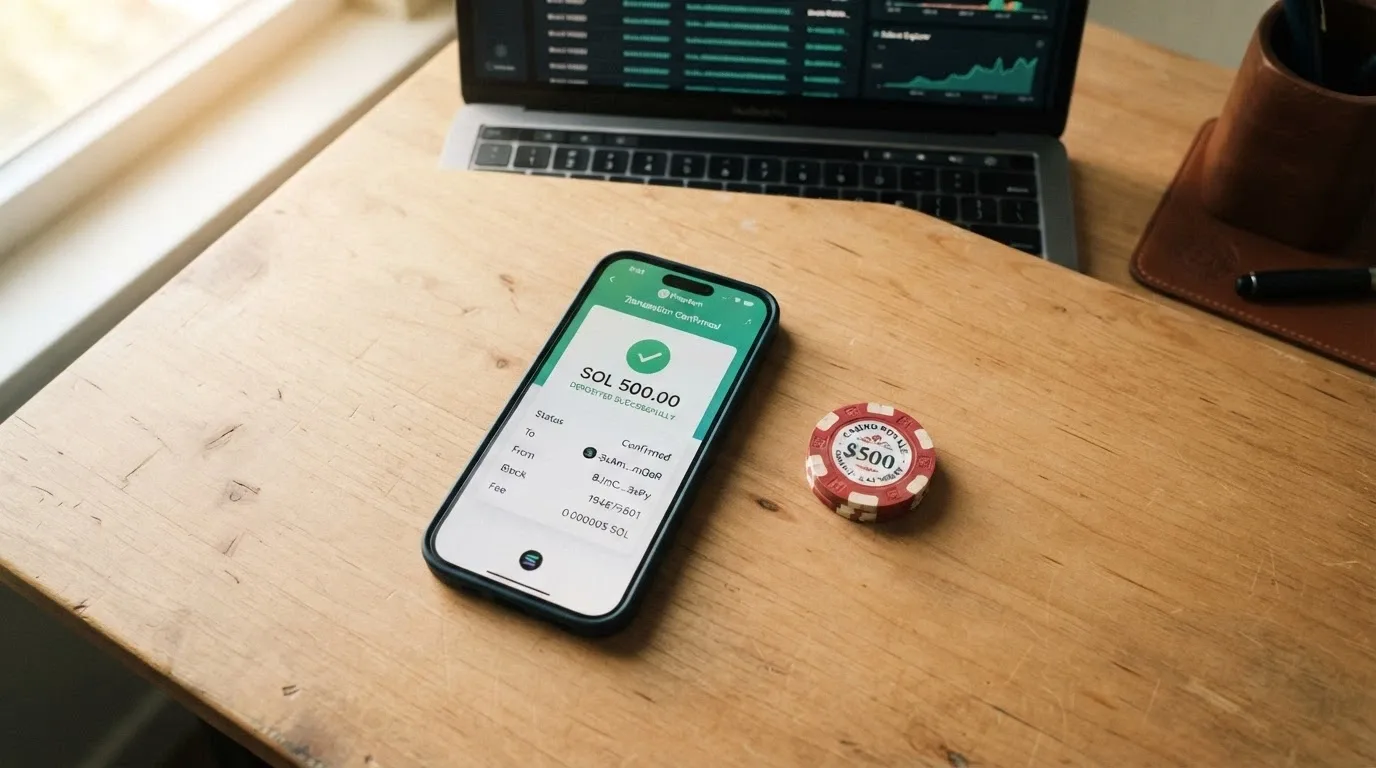
The casino still controls three things: the rail it uses to handle SOL once it arrives, the timing of its own processing queue, and the conditions under which it will hand the money back. None of those are visible on the landing page. All of them are visible on the cashier screen and the terms page.
How SOL Deposits and Withdrawals Work in Practice
A SOL deposit starts with the wallet. The player opens Phantom or Solflare, scans the casino’s QR code or copies its deposit address, signs the transaction, and waits for confirmation. The on-chain confirmation comes in seconds — independent testing across 14 Australian-facing casinos during peak evening hours recorded an average confirmation of 2.3 seconds. The casino’s credit to the player’s account is a separate step, and the time between on-chain confirmation and account credit is the casino’s own processing queue.
The rail the casino picks determines what the player receives. Native SOL credit means the balance is denominated in SOL and tracks the token’s dollar value through the session. Converted-at-cashier credit means the SOL is swapped into a stablecoin or house currency at the moment of deposit, and the conversion rate is the casino’s at that timestamp. USDT-SPL-only rails refuse SOL outright or refund it, because the cashier speaks USDT on Solana and SOL is a different token. Each rail has a different withdrawal expectation at the other end.
The three rails behave differently on price too. Native SOL holds the token’s volatility through the session, which is a feature for a player bullish on SOL and a risk for a player who treats the balance as AUD. Converted credit removes the volatility on credit but introduces it on conversion — the rate the casino applies at withdrawal may not match the rate it applied at deposit. USDT-SPL rails sit closest to a fiat experience because USDT tracks the dollar, and a player who wants their winnings in AUD will need an off-ramp anyway.
No-KYC Casinos — The Marketing Promise vs the Withdrawal Reality
“No KYC” is the headline most Solana casino marketing opens with. It is also, on most of these platforms, only true until it stops being true. The trigger is rarely signup — it is withdrawal, and the threshold varies.
SolCasino.io is the clearest example of a Solana-native operator that names its KYC provider (Sumsub) and announces the trigger up front. The active-deposit playthrough rule — deposits must be played through once before withdrawal — is a related but separate friction. Cloudbet triggers KYC at roughly USD $2,200 in cumulative withdrawals, which is generous in absolute terms but well below the threshold many Australian players will hit across a multi-session account lifecycle. BitStarz makes pre-withdrawal KYC mandatory across the board — the “no KYC” position is not the one this operator takes. Royal Reels, even on its AU$10 no-deposit bonus, requires phone verification at the front door.
The pattern is consistent. The wallets are permissionless. The cashout is not. A player who plans to withdraw more than a few hundred dollars at a time should expect a document request at the point they hit the threshold, and should expect that a failed or refused verification gives the casino contractual grounds to close the account and forfeit the balance. This is not the Australian regulator’s design. It is the offshore operator’s terms.
How Provably Fair Gaming Works on Solana
The provably fair model is the closest thing the crypto casino world has to an answer for trust. The mechanism is a commit-reveal scheme. Before play, the server commits a cryptographic hash of a seed on chain — the player can see that the hash existed before any bets were placed. After play, the seed is revealed, and the player can verify that the original hash matches the revealed seed. Because the hash was committed before the bets, the server could not have changed the seed after seeing the player’s actions.
Solana adds two things to that model. The first is speed — a commit-reveal cycle that would take minutes on a slower chain happens in seconds on Solana, which makes per-round verification practical rather than retrospective. The second is verifiability — outcomes that use Solana’s Verifiable Random Function (VRF) are recorded on chain and can be checked publicly on Solscan.io.
The game types that use this model are the originals — dice, crash, Plinko, blackjack and the rest of the in-house titles. Moonbet’s Plinko offers 8 to 16 rows, low/medium/high risk levels, a maximum multiplier of 1,000x, and an RTP above 99% across all configurations, with outcomes verifiable on Solscan. Solana Crash runs on Solana mainnet with a 7.77x jackpot. LootXX uses commit-reveal on Solana mainnet with no per-hand gas fees. Mainstream slots from Pragmatic Play, BGaming and the rest do not use this model — they run on the studio’s own certified RNG and are audited by the studio’s licensing jurisdiction, not on chain.
What Solana’s Speed Actually Means for Your Deposits and Withdrawals
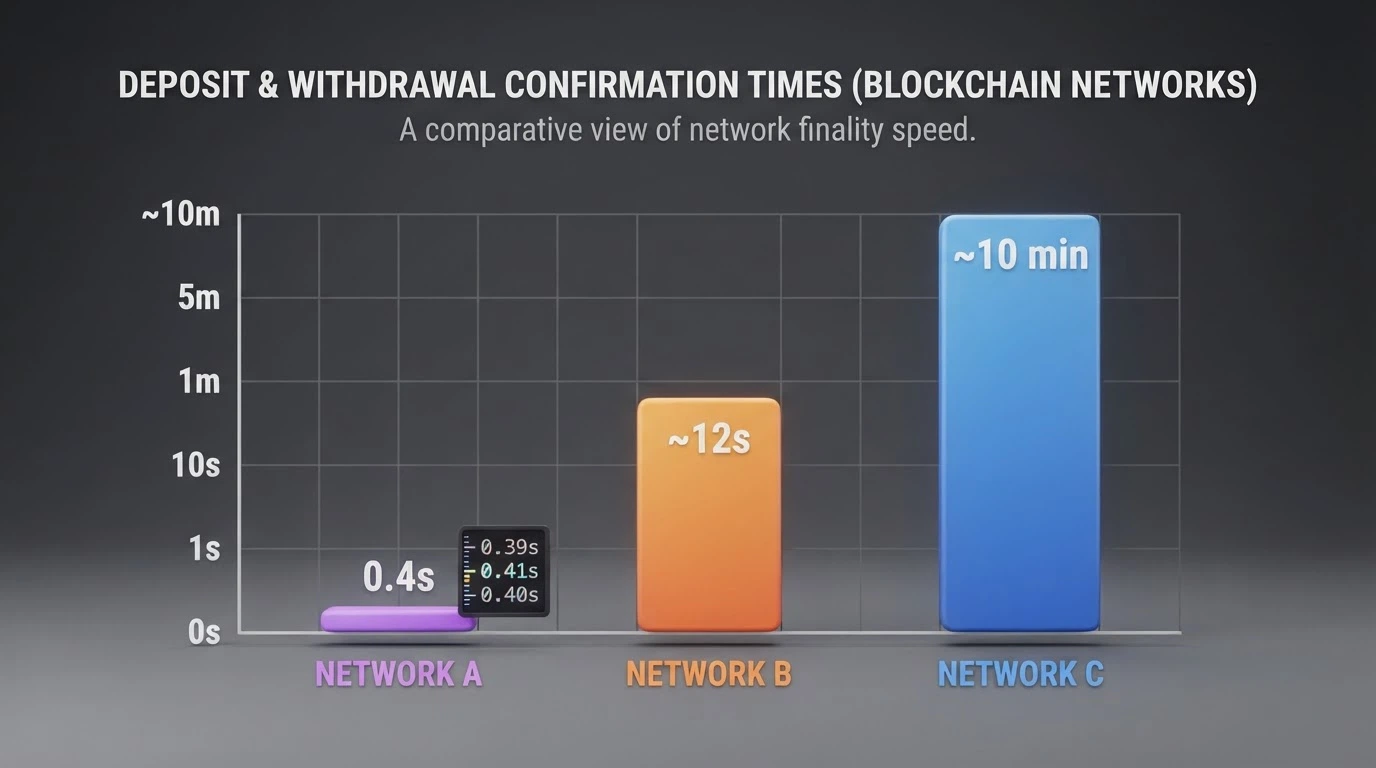
The number on Solana’s marketing page is 400 milliseconds per block. The number an Australian player actually feels is the time between pressing Withdraw and seeing the balance land in their wallet, which depends on the casino’s queue as much as on the network. The network is fast. The casino is the variable.
Deposit and Withdrawal Options Across Solana Casinos
The deposit floor across the Solana-accepting operators in this comparison is broadly similar — equivalent to roughly $5 to $20 in SOL or USDT-SPL, depending on the casino and the rail. Withdrawal minimums are typically the same range, though some operators set them higher for certain rails, and the maximum-bet rule during bonus wagering (where it applies) is a separate ceiling from the deposit or withdrawal minimum.
Beyond SOL, the rail spread varies widely. Bizzo takes AUD plus PayID alongside 22+ cryptocurrencies, which is the broadest fiat bridge in the comparison. BitStarz supports 11 cryptocurrencies and 10 fiat currencies, with mandatory pre-withdrawal KYC as the trade-off. Cloudbet accepts 30+ cryptocurrencies but no PayID or AUD — a player without an existing crypto balance has to acquire crypto elsewhere before depositing. Royal Reels and RocketPlay both accept AUD plus crypto, which suits the Australian player who wants to deposit in dollars and withdraw in dollars. WinSpirit’s offer page is denominated in CAD, which is a localised-pricing tell rather than a payment-rail tell. The pattern across the ranking is that payment flexibility and bonus generosity rarely sit on the same side of the trade-off.
How Fast Solana Withdrawals Really Are — The Numbers
The Solana network alone is fast. Blocks land in roughly 0.4 seconds. Typical SOL deposit speed is under 30 seconds; withdrawal speed is under 2 minutes on the network. On-chain confirmation for withdrawals can be recorded in under 5 seconds. These are network figures — what the network is capable of at the protocol level.
Casino-side testing during 2026 gives a more realistic picture. Across 14 Australian-facing casinos during peak evening hours (8–10 PM AEST), Casinozoid recorded an average deposit confirmation of 2.3 seconds. Casipto’s testing of Solana Hi-Lo across nine platforms in February 2026 put deposit confirmation at 0.3 to 0.5 seconds, bet confirmation at 0.4 seconds, and withdrawal processing at under 3 minutes to wallet. LootXX cites 400ms confirmation and under 5 seconds on-chain for blackjack.
The pattern is that Solana is faster than the casino. The deposit confirms on chain faster than the casino’s internal credit queue can post it. The withdrawal signs faster than the casino’s risk and KYC pipeline can release it. A player who values speed above all else is choosing between operators by their queue times, not by their blockchain. The network is a near-constant. The operator is the variable.
Transaction Fees and Hidden Costs You Should Know About
Solana’s network fee is around 0.000005 SOL — less than one cent in AUD terms. That is the headline number. It is also the only fee that is consistent across the operators in this ranking.
Beyond the network fee, three other costs can appear. The first is the operator’s own withdrawal fee. LootXX charges a 2% withdrawal fee on cashouts, which is a flat reduction on top of the network cost. The second is the rail-conversion cost. Casinos that accept SOL but convert at the cashier apply their own rate, and the spread between the deposit rate and the withdrawal rate is a hidden margin on top of the network fee. The third is the playthrough cost — SolCasino.io requires active deposits to be played through once before withdrawal, which is a turnover requirement at the cashout step rather than at the bonus step, and is a friction the player does not see until they try to withdraw.
The arithmetic still favours SOL over a fiat rail on raw fees, even with these costs added. A bank wire to an offshore casino can carry a flat fee on both ends and a multi-day processing window. A SOL transfer is sub-cent on the network. The trade-off is that “fast and cheap” assumes the casino does not add its own friction on top, and the only way to find out is to deposit, play and withdraw at that operator.
The Slots and Games Worth Your Bankroll at Solana Casinos
The slot library at a major Solana casino is, in practice, the same slot library that runs at a major fiat casino. Pragmatic Play, BGaming, Hacksaw Gaming, Betsoft, NetEnt and the rest distribute the same titles to both rails. The difference is in the originals — the in-house dice, crash and Plinko games that exist only on the crypto side because they rely on on-chain randomness to be verifiable.

| Slot Title | Provider | RTP | Volatility | Max Win |
|---|---|---|---|---|
| Gates of Olympus | Pragmatic Play | 96.50% | High | 5,000x |
| Sweet Bonanza | Pragmatic Play | 96.51% | High | 21,175x |
| Big Bass Bonanza | Pragmatic Play | 96.71% | High | 2,100x |
| Big Bass Splash | Pragmatic Play | 96.71% | High | 5,000x |
| Gates of Olympus 1000 | Pragmatic Play | 96.50% | Extreme | 25,000x |
| Mega Joker | NetEnt | 99% | — | — |
| Blood Suckers | NetEnt | 98% | — | — |
The em-dash cells mark the place where research did not carry the figure. Mega Joker and Blood Suckers are both NetEnt classics with published RTPs in the upper band — 99% and 98% respectively — but their volatility and maximum win were not in the sources consulted for this comparison. A player chasing these titles should confirm the spec on the casino’s paytable before staking real money.
The Best Slots at Solana Casinos — RTP, Volatility and Max Wins
RTP, volatility and max win are three different numbers and they answer three different questions. The RTP is what the slot returns to players across millions of spins. The volatility is how that return is distributed across sessions — a high-volatility slot can run cold for long stretches and pay out in concentrated bursts. The max win is the ceiling on a single spin’s payout, expressed as a multiple of the stake.
The Pragmatic Play cluster carries the highest max wins in the comparison. Gates of Olympus 1000 caps at 25,000x — five times the original Gates of Olympus. Sweet Bonanza reaches 21,175x. Big Bass Bonanza is the lower-volatility cluster at 2,100x, with Big Bass Splash sitting at 5,000x on the same math. All five are high- or extreme-volatility. A session on any of them is more likely to end on a small balance than on a max-win screenshot, and the RTP figures should be read as long-run averages, not session guarantees.
Mega Joker at 99% RTP is the outlier. It is a classic NetEnt title with a published RTP that sits two and a half percentage points above the Pragmatic Play cluster, and the gap compounds across thousands of spins. Blood Suckers at 98% is the other end of the high-RTP segment. Both are older titles and both are widely available across the Solana casino libraries in this comparison.
Dice, Crash and Provably Fair Originals
The originals are the reason a Solana casino exists as a distinct category rather than as a fiat casino with a crypto cashier. Dice, crash and Plinko all run on the same basic mechanic — the player picks a stake, the operator generates an outcome, and the result is settled instantly — but the difference is that the outcome can be verified.
Moonbet’s Plinko is provably fair through Solana’s Verifiable Random Function. Each round’s outcome is recorded on chain and any player can confirm it on Solscan.io. The game offers 8 to 16 rows and three risk levels (low, medium, high), with a maximum multiplier of 1,000x and an RTP above 99% across all configurations. Solana Crash runs on Solana mainnet with a 7.77x jackpot. The commit-reveal scheme — server commits a hash of the seed on chain before play, reveals the seed after — is the same model across the originals: the casino cannot change the outcome after seeing the player’s bet, because the seed was already committed on chain.
These games are not a substitute for slots. They are a category of their own, with shorter rounds, lower visual overhead, and a verification layer the slot world does not offer. A player who treats the originals as a small side bet alongside a slot session is using the crypto casino the way it is designed to be used.
Live Dealer vs RNG — What You Can Actually Play
Live dealer tables are scarcer at Solana-accepting casinos than they are at the established fiat operators. The infrastructure is heavier — a studio, a dealer rotation, a streaming pipeline — and the larger crypto casinos have invested less in it than the established fiat brands have. Pragmatic Play Live and Evolution are the names that appear most often, and even then the table count is typically lower than what a fiat casino of the same game-library size would carry.
RNG table games fill the gap. Blackjack, roulette, baccarat and the dice games all run as RNG products from BGaming, Pragmatic Play and others, with no live dealer and no streaming. Demo play is available at most of the operators in this comparison — BitStarz and BC.Game both offer demo mode across the library, and Betfury’s demo coverage is the broadest. A player who wants to try a slot before staking real SOL can do so without depositing at any of these.
The honest summary is that a player looking for a full live casino floor — multiple blackjack variants, several roulette wheels, baccarat squeeze, the game-show formats Evolution runs — will find more of that at a fiat casino than at most of the operators in this ranking. A player looking for slots, RNG tables and provably fair originals will find more of that at a Solana casino than at most fiat brands. The categories are different. Neither is the whole picture.
Staying Safe When the Australian Safety Net Cannot Reach You
The Australian help infrastructure for people experiencing gambling harm is well-resourced and world-class. The National Gambling Helpline (1800 858 858) is free, confidential and staffed 24 hours a day, every day. Gambling Help Online runs online chat and counselling through gamblinghelponline.org.au. BetStop, the National Self-Exclusion Register, excludes a person from every Australian-licensed online and phone wagering service in a single step. The 2026 reform will expand specialised financial counselling services for people experiencing gambling harm.

None of those services require the person to have been gambling at a licensed Australian operator. The helpline, the online chat, the counselling, and the financial counselling expansion are all available regardless of where the person has been playing. What changes between a licensed operator and an offshore casino is not the help available. It is the protective mechanism the help is built around.
Australian Help Resources You Can Still Use
The number to keep is 1800 858 858. Free, confidential, 24/7. It is the single most useful piece of information on this page, and the one that works regardless of which casino — licensed or offshore — the caller has been using. Gambling Help Online (gamblinghelponline.org.au) provides online chat and counselling for people who would rather type than call. The two together cover phone, web and chat.
The 2022 Australian Institute of Health and Welfare figure put high-risk gambling at 1.8% of the adult population. Broader surveys put problem gambling at 2.1% — roughly 430,000 Australian adults. Those numbers describe the population the help infrastructure was built for. The 2026 reform expands financial counselling services through the Department of Social Services to support people in financial harm from gambling. None of those expansions depend on where the gambling happened.
Why BetStop Cannot Protect You at an Offshore Casino
BetStop is the most powerful single tool in the Australian player-protection stack, and it has the clearest single limitation. Since going live in August 2023, BetStop has accumulated 67,480 registrations as at 31 July 2026, of which 41,290 exclusions were still active — more than 60% of everyone who ever signed up. 78% of registrants are under 40. 38% chose lifetime exclusion. Self-exclusion runs from a minimum of three months to lifetime; to be removed, a person cannot apply in the first three months and must include a statutory declaration confirming they have received counselling. BetStop binds approximately 150 licensed Australian wagering providers.
BetStop does not bind any operator in this ranking. None of the ten casinos listed above is connected to the register, because none of them is licensed in Australia. A person who has self-excluded through BetStop will continue to be able to sign up, deposit and play at any of the operators in this comparison. The 2027 inducement marketing rules — three months after BetStop deregistration, indefinitely for at-risk customers — apply to licensed Australian operators and do not reach offshore casinos. The offshore route is the one place where BetStop is silent.
This is the single most concrete harm of the offshore route, and the one a self-excluded person will encounter first. The licensed bookmaker will refuse the deposit. The offshore casino will not.
Practical Limits You Can Set Yourself at Any Casino
Australian-licensed wagering operators offer deposit limits, session timers, take-a-break tools and activity statements as a condition of their state or territory licence. The features differ by jurisdiction, but the structure is the same: the operator has to offer them and has to honour them.
Offshore casinos vary widely on the same tools. Some of the operators in this ranking publish deposit limits, session timeouts and self-exclusion options at the account level. Some publish none of them and rely on the player to email support to set a limit. None of them are bound by an Australian licence condition to offer any specific tool, and none of them are subject to ACMA enforcement if the tool is not honoured. A player who wants to use deposit limits, loss limits or session timers at an offshore casino should set them at signup, confirm them by email to support, and treat the confirmation as the only enforceable record.
The Australian licensed-wagering baseline is the contrast. A player moving from a licensed bookmaker to an offshore casino is moving from a system where the limits are licence-conditioned and regulator-enforced to a system where the limits are a feature the operator chose to offer. The first is a guarantee. The second is a setting.
How We Chose and Ranked These Solana Casinos
This comparison is built on three categories of source. The first is regulatory — the ACMA’s published register of blocked services and the ACMA’s published material on the Interactive Gambling Act 2001, plus the Curaçao Gaming Control Board’s public licensee search. The second is the operators themselves — each casino’s own bonus terms page, its own responsible-gambling policy, its own licence statement. The third is review aggregators — Casino.Guru’s Safety Index, AskGamblers’ Editor and Player scores — cross-referenced against operator-published data where possible.
The ranking weighs what each operator actually delivers: the licence claim and its verification status, the game count and provider breadth, the welcome bonus terms (where the operator publishes them in a form that can be verified), the wagering requirement and its cap mechanics, the SOL support model, and the review-aggregator standing. No weighting system is invented here. The order is the editorial call this comparison makes, and the reader who disagrees with it can re-rank on any single column above.
The key limitation is the same one that runs through every section of this page. Every operator here is offshore and unlicensed in Australia. The ranking weighs operator quality, not legal status — because legal status is the same for every row. A reader using this comparison is choosing between offshore options on their merits, with the legal context stated plainly in the section above. There is no way to rank inside this set without accepting that premise.
What Australian Players Should Actually Do With This Comparison
The single most important fact on this page is one no competitor’s comparison prints. There is no licensed online casino in Australia. Every operator in the ranking above — Skycrown, RocketPlay, Stake, Bizzo, Rainbet, Royal Reels, WinSpirit, SolCasino.io, Cloudbet, BitStarz — is unlicensed in this market. The licence they hold is from Curaçao, Costa Rica, Kahnawake or the Tobique Gaming Commission. None of those licences grants them permission to serve an Australian player. The IGA prohibits the supply of the product they offer. The ACMA enforces the prohibition and blocks the domains that breach it. The IGA does not prosecute the individual player, which is the reason these operators continue to find Australian customers — but it does not protect the player’s balance, the player’s bonus, or the player’s self-exclusion.
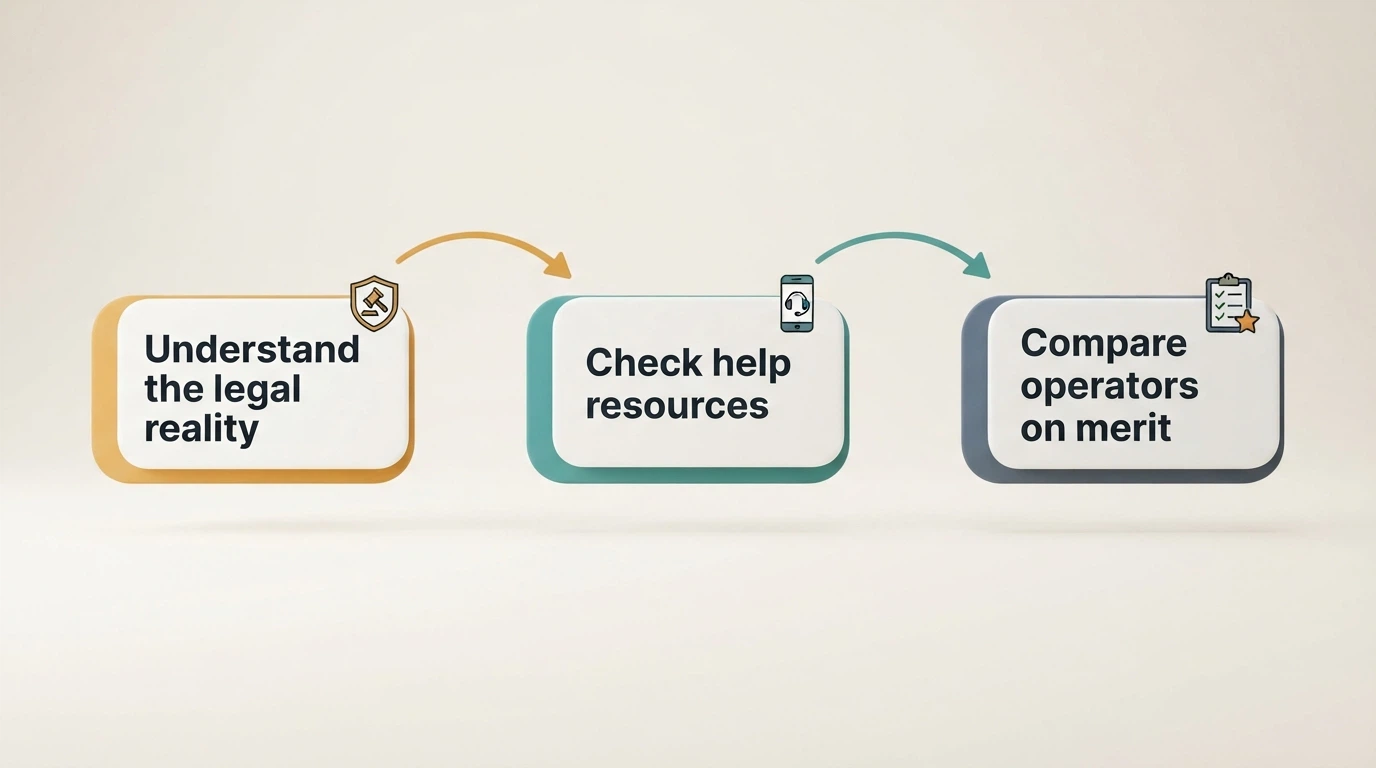
Three actions follow from that picture. First, read the legal section above before reading the rest of the comparison. The ranking only matters once the offshore premise is understood. Second, if a player chooses to proceed despite the offshore premise, the ranking above is built to help — it weighs what each operator actually delivers, with the limitations of the available data stated honestly. Third, the help resources listed in the safety section work regardless of where the gambling happens. The National Gambling Helpline (1800 858 858), Gambling Help Online, BetStop and the financial counselling services being expanded under the 2026 reform are all available to Australian players who have been playing at offshore casinos, and they are the part of the Australian system that does reach a player no matter where they have been.
This page does not recommend an operator. It compares ten of them on the merits research could verify, in a market where every one of them is operating outside Australian law. The reader’s call is the one that follows from those two facts together.
Frequently Asked Questions
Can I be prosecuted for playing at a Solana casino from Australia?
No. The Interactive Gambling Act 2001 targets the provider of online casino services, not the customer. There is no prosecution risk for the individual player who gambles at an offshore Solana casino. The legal exposure sits with the operator, who can face civil penalties, formal warnings, ISP blocking and referrals for criminal enforcement. That said, the absence of prosecution is not the same as protection — there is no Australian regulator to escalate to if the operator refuses a withdrawal or closes an account.
Is it safe to gamble with cryptocurrency in Australia?
Cryptocurrency itself is legal to own and trade in Australia, and is classified as property rather than legal tender. The risk attached to gambling with it is not the legal status of the token but the legal status of the platform. Every Solana casino in this comparison is offshore and unlicensed in Australia. The player gives up BetStop coverage, ACMA complaints recourse, and Australian consumer protection by playing at one. Crypto is the rail. The risk lives in the casino, not the coin.
Can Australian banks block crypto casino transactions?
Banks and payment providers gain express statutory authority to block transactions to illegal gambling operators from 1 January 2027 under the 2026 reform, which was passed in August 2026 but does not commence until that date. The credit-and-crypto payment ban in force since 11 June 2024 applies to licensed Australian operators, requiring them to refuse crypto deposits — but does not currently require banks to block transfers to offshore exchanges or casinos. The 2027 reform closes that gap.
How do Solana network fees compare to Bitcoin and Ethereum?
A typical Solana transaction costs around 0.000005 SOL, which is worth less than one Australian cent. Bitcoin and Ethereum fees vary with network congestion and can range from a few dollars during quiet periods to materially more during peak demand. On raw fee cost, Solana sits well below both. On settlement speed, Solana’s roughly 0.4-second block time also outpaces Bitcoin’s ~10-minute target block and Ethereum’s variable finality window. The advantage is network-level; the casino’s own processing queue still adds its own time on top.
Do offshore Solana casinos actually let you play without KYC?
Up to a point. Wallets are permissionless — a player can connect Phantom or Solflare and deposit without naming themselves. Most operators, however, trigger identity verification at withdrawal, with thresholds that vary: Cloudbet’s trigger sits around USD $2,200 cumulative, BitStarz requires verification before any withdrawal, SolCasino.io uses Sumsub and requires active deposits to be played through once. Royal Reels requires phone verification before releasing its no-deposit bonus. The “no KYC” headline ends the moment a withdrawal or a bonus claim triggers a check, and the casino’s own terms typically allow account closure with balance forfeiture if verification fails.