
Newest online casinos with no-deposit bonuses for Australian players
A fresh domain name does not make a casino safe. Every site in this ranking is AU-facing — built to attract Australian sign-ups — yet none of them holds an Australian licence. Online casino is prohibited under the Interactive Gambling Act 2001, and the offshore operators serving Australians do so from Curaçao, on their own terms. What follows is a ranked look at the ten newest AU-facing casinos offering no-deposit bonuses, the fine print behind those offers, and what the prohibition actually means for anyone who uses them.

Data current as of 16 October 2026 and verified against the ACMA register of blocked services.
Table of Contents
- Newest Australian online casinos in 2026: what “new” actually means
- The ten newest AU-facing casinos, ranked by what they actually offer
- Newest no-deposit bonuses: the fine print behind “free”
- Payments at the newest casinos: fast and low-cost
- Newest pokies and games: what the new libraries actually hold
- Free slots and demo play: the zero-cost way in
- Australian law on online casinos: the prohibition behind every “new” site
- Responsible gambling: the limits and the number to call
- How we selected and checked these operators
- Before you claim: what the fine print and the law mean for your bonus
- Frequently asked questions
Newest Australian online casinos in 2026: what “new” actually means
“Newest” is a marketing word, not a quality signal. A site that launched last month has no payout history, no reputation built up over years of complaints and responses, and no reason to trust it other than the licence it carries and the terms it publishes. In Australia, where no online casino can hold a licence at all, the word does extra duty — it has to stand in for both the brand and the regulator that never approved it.
That leaves a question every “new” casino wants a reader to skip: what are the things a brand can hide in its first six months online? Plenty. Terms written for the player who never reads them. Verification held until after a win. A bonus structure that ties withdrawals to impossible turnover. A licence that exists on paper only, in a jurisdiction whose regulator does not publish operator registers the way the UK or Malta do. None of that is visible on the homepage, and the casino’s birthday never tells you whether any of it is happening.
The harder fact sits behind the marketing. Australians lost $36.0 billion to gambling in the twelve months to March 2026, up from $34.3 billion the year before. Online participation has climbed from 8% of adults in 2017 to 33% in 2025 — a fourfold rise, in a market where the casino side of that participation is illegal. A “newest” badge in this context means a brand is entering a growing, lightly policed, mostly offshore market. Newness is what they sell because they have nothing else.
Newly launched operators to watch
The launch is the easy part. A Curaçao licence — the route every operator in this ranking takes — can be acquired in days. A library of games can be licensed from the same aggregator as the next twenty new brands. A welcome bonus can be copy-edited from a competitor’s terms. None of those are a track record.
A track record looks like this: withdrawals paid on time, at the published speed, in the published currency, without sudden verification demands. Terms that survive contact with a player who actually wins. Customer support that resolves complaints instead of closing accounts. A responsible-gambling regime that does something — limits that hold, self-exclusion that lasts, advertising that does not chase a self-excluded player back. None of those exist for a brand on day one. They are built, claim by claim, over years.
The thing a reader can check on day one is the licence itself. A Curaçao licence is real, and operators on the ranking below do hold one — Hollycorn N.V. for SkyCrown, for instance — but the regulator’s public register is harder to query than the UK Gambling Commission’s or the Malta Gaming Authority’s. A reader who wants confirmation of a specific licence number has to dig, and a brand that does not surface it transparently is one to be careful with. Fair Go, for example, publishes a Curaçao licence reference on its terms page that does not appear in the public register this article could verify; that is not the same as saying it is unlicensed, but it is the same as saying it cannot be confirmed.
There is also the question of what the brand is selling. The newest no-deposit offers arrive with the smallest cash amounts and the heaviest conditions — twenty free spins on a single game, a $15 free chip with sixty times the bonus in turnover. The headline is “free”; the actual product is a heavily-gated funnel toward the first deposit. That is worth knowing before signing up. It is also worth knowing that the prohibition itself does not change with the launch. Every casino in this ranking is operating illegally in Australia under the Interactive Gambling Act 2001 — there is no Australian licence for online casino, federally or in any state or territory, and there cannot be.
Real-money play for Australian punters
Real-money play is the default. A punter who walks past a pokie in a pub or club expects to drop a coin; the online version expects to drop a deposit. Real-money pokies are the core product at every operator in this ranking — the thing their bonus offers are designed to feed — and they behave much like the land-based originals on which they are modelled.
The deposit-or-no-deposit split is the first decision. A no-deposit offer gives a small slice of free play before any card or bank is touched. A deposit offer gives a bigger slice once a minimum amount has been paid in. Both routes lead to the same place: wagering requirements on the bonus, a maximum bet while the bonus is live, a cashout cap on what winnings can be taken out, and a clock on how long the player has to clear it all. The deposit route typically unlocks a larger welcome package; the no-deposit route lets a player test the cashier before committing a dollar.
The clearance mechanic matters more than the bonus amount. Pokies count 100% toward wagering at most of these sites — every dollar bet on a pokie reduces the bonus obligation by a dollar. Table games typically contribute 5% or 0%, which means a player who tries to clear a bonus at blackjack or roulette will spend twenty to a hundred times longer at it than a pokie player would. Live dealer, where it is bonus-eligible at all, sits in the same low-contribution category. That is why free chips — the third type of no-deposit offer — are usually the only ones that meaningfully work on table games.
Then there is the demo path. Most pokies run in a free-play mode that does not require an account, a deposit or a wager. It uses a virtual balance. It pays no real money. It is the only way to actually feel a game — its volatility, its hit rate, how its bonus rounds land — without any of it costing the player. A newcomer to a brand should always spend an hour in demo before committing a bonus to the same title.
Mobile-first casinos and apps
The phone is the casino. The newest operators in this ranking were built mobile-first — their sign-up flows, their cashier pages, their game lobbies all assume a 5.5-inch screen and a thumb. The brand that insists you download a desktop client is a brand that has not yet decided who its player is.
Mobile-browser play is the default. There is no download to install, no app store to vet the operator through, no update loop to manage. A punter opens Safari or Chrome, taps the casino URL, signs up, and plays — usually inside a couple of minutes. The newest operators offer their full library on mobile, not a stripped-down subset.
Native apps exist where the operator has bothered to ship one — Bitstarz and Stake are examples in this ranking — but they are not the load-bearing piece. A good mobile site loads in under three seconds, runs a pokie in landscape without stuttering, and lets the cashier talk to the bank app or to PayID without leaving the browser. An app that does less than that is decoration.
The thing mobile does that desktop does not is provide the deposit path. PayID, Apple Pay, and the open-banking rails most Australian players use to send money in real time all sit one tap away from the phone’s home screen. A punter who has to log into a desktop, copy a BSB and account number, and walk to the bank app is not a punter the newest operators are designing for. They have built for the punter who is on the couch, on the train, in the lunch break — and that is the punter who signs up.
The ten newest AU-facing casinos, ranked by what they actually offer
Ten operators sit in this ranking. Five of them publish a no-deposit bonus a new sign-up can claim without paying in first — SkyCrown, Fair Go, Royal Reels, Bizzo and Bitstarz. Two of the others run the occasional registration promotion that may or may not be live when a reader arrives. Three of them — Rocket Play, WinSpirit, Stake — direct the offer straight at the first deposit and have no sign-up bonus to claim. The split matters because the article is about no-deposit offers, and almost half the operators in it do not really have one.
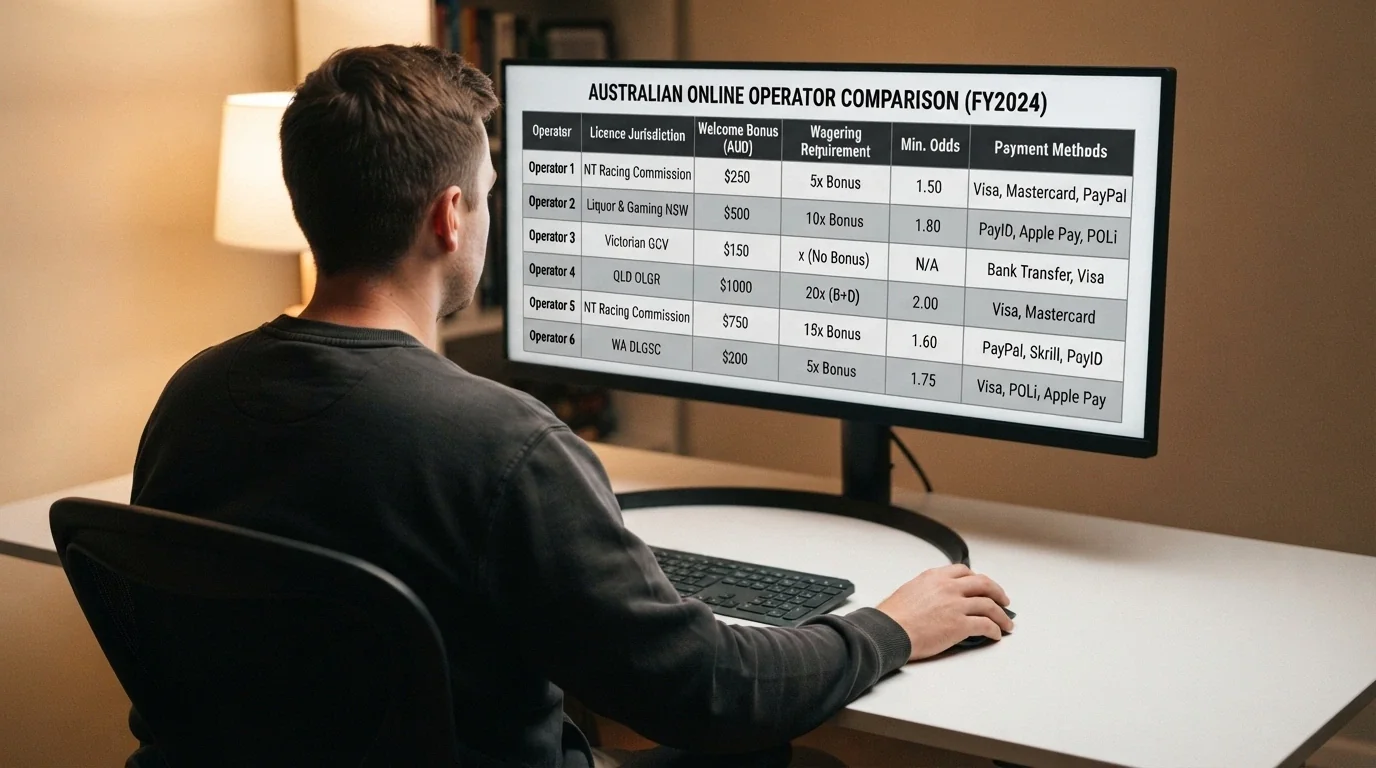
The other thing the split does not change is the licence. Every operator in the table holds a Curaçao licence; none holds an Australian one. The Australian-licensed products that exist are wagering — sports and racing — not casino, and no AU-licensed casino exists for any of these brands to anchor to. A reader choosing among them is choosing between ten offshore brands, and the column that decides the choice is the fine print.
| Operator | No-deposit bonus | Wagering | Max cashout | Welcome bonus |
|---|---|---|---|---|
| SkyCrown | 20 FS on Aztec Clusters (BGaming) | 25x on FS winnings | A$40 | Up to A$8,000 + 400 FS |
| Fair Go | $15 free chip | 60x | ~A$180 | 100% up to $200 (5 deposits, up to $1,000 total) |
| Rocket Play | — | — | — | 100% up to A$1,000 + 100 FS |
| Royal Reels | A$10 sign-up | 30–40x | — | 100% up to A$500 (min A$30) |
| WinSpirit | — | 40x | — | 200% + 25 FS |
| Bizzo Casino | 10–25 FS | 40x | — | Multi-deposit package |
| Stake | — | 40x | n/a | 200% up to $2,000 |
| Rainbet | Occasional FS | 40x | ~A$50 | 100% + 20 FS (1st), 50% + 20 FS (2nd), 100% + 20 FS (3rd) |
| Scream Casino | — | — | — | — |
| Bitstarz | 50 FS (no code) | — | — | Multi-deposit package |
SkyCrown
SkyCrown runs the cleanest no-deposit offer on this ranking — small enough that nobody reads the terms and gets angry. New sign-ups get 20 free spins on Aztec Clusters, a BGaming pokie, with 25x wagering on whatever those spins win. The winnings cap is A$40; the maximum bet while the bonus runs is A$3; activation is 7 days and validity 5. Profile completion and phone verification are required before the spins credit, which kills a few shortcuts.
The welcome behind it is larger: up to A$8,000 across four deposits plus 400 free spins, at 40x wagering, a 14-day window per stage, and a A$300 cap on free-spin winnings per stage. The provider mix is wide — BGaming, IGTech, Pragmatic Play, Evolution, Booongo, Booming — a multi-studio catalogue with hundreds of pokies plus a full live-dealer lobby.
The A$40 cashout ceiling is the whole story in a number: a player can win something, but never much, and the 25x wagering clears faster than the 40-60x market norm.
Fair Go
Fair Go turned ACMA’s enforcement into a case study. On 19 November 2019, Fair Go became the first illegal offshore gambling site ACMA ever ordered blocked by Australian ISPs — and it is still operating, just not from a URL Australian readers can reach without a workaround. A brand that survived its own blocking and kept serving international sign-ups has either rebuilt or rebranded several times over.
The offer is the heaviest on this ranking. New players get a $15 free chip with 60x wagering, meaning $900 in turnover before any winnings become withdrawable. The cashout cap sits around A$150–A$180. The chip is restricted to RTG pokies — Fair Go is a single-provider RTG casino, and the bonus works only on that library. The welcome behind it is a 100% match up to $200 across five deposits, at 30x.
The Curaçao licence Fair Go publishes does not appear in a public register this article could verify. Players who care about a verifiable licence number, or about playing on a brand ACMA has explicitly ordered blocked, have nine other names on this list.
Rocket Play
Rocket Play is the first operator on this ranking where the headline changes shape. There is no standard no-deposit sign-up bonus — Rocket Play does not hand out free chips or free spins to new accounts as a standing offer. The brand occasionally runs a promotional exception, but the regular product is the first-deposit match.
That match is generous by market standards: 100% up to A$1,000 plus 100 free spins on the first deposit, with 40x wagering on the bonus and a 5-day validity window. The library behind it is broad — Pragmatic Play, Evolution, BGaming, Yggdrasil, Hacksaw Gaming, and 30+ other providers. A player who deposits the minimum and works through the bonus gets a large catalogue to do it on.
The trade-off is the absence of the trial. A punter who wants to feel the cashier before committing money does not get that runway at Rocket Play. The welcome is one of the stronger ones here, for a player who already knows what they want from a multi-provider casino.
Royal Reels
Royal Reels is the only operator on this ranking that pairs a small no-deposit bonus with a deposit match — a combination that lets a player walk through the cashier before paying in and then double down once they do. The no-deposit sign-up bonus is A$10, with 30–40x wagering. The welcome match is 100% up to A$500, with a A$30 minimum deposit.
The library is the multi-provider standard: Pragmatic Play, Evolution, Yggdrasil, Hacksaw Gaming, 30+ others.
The wagering range is the part to read carefully — “30–40x” is a band, not a number, and the player sees whichever end applies to that specific promotion. Some weeks it is the lighter end; some weeks it is the heavier one. The only operator on this ranking that pairs a no-deposit bonus with a deposit match, with a wagering band that moves.
WinSpirit
WinSpirit publishes the most aggressive welcome headline in this ranking — a 200% bonus on the first deposit plus 25 free spins, with 40x wagering. A punter who deposits A$100 receives A$300 in bonus money, with a A$400 starting balance and 40 times the bonus in turnover to clear before any winnings are withdrawable.
The clean information stops there. WinSpirit does not publish no-deposit bonus terms anywhere accessible — a punter who reads the brand’s bonus page before signing up will not find a stand-alone no-deposit offer. The wagering is published; the rest — max cashout, eligible games, bonus duration — is not.
For a player who is happy to take the welcome headline at face value and find the small print after the deposit, WinSpirit delivers the largest headline number on this ranking. For a player who wants the bonus structure fully visible before signing up, three other operators publish more.
Bizzo Casino
Bizzo’s no-deposit offer is the small-burst kind: 10–25 free spins on registration, with 40x wagering on whatever the spins win. The headline is modest and the conditions are market-standard, which is itself the point — a player signing up to test the cashier does not lose hours clearing a 60x requirement for a 20-spin prize.
The welcome package is a multi-deposit construction. Specific terms were not published in a comparable way across every stage at the time of writing, but the headline structure is the standard multi-stage deposit match with free spins attached. Bizzo sits in the middle of this ranking: not the cleanest terms, not the largest headline, but a steady multi-provider casino with a free-spin no-deposit that does what the word promises.
The safe middle pick on this ranking. For players seeking a balanced choice, Bizzo offers a clearer path than the more aggressive alternatives listed here.
Stake
Stake is the brand where “newest” and “no-deposit” part company. There is no no-deposit bonus available — Stake does not hand out free chips or free spins to new accounts, and does not currently run a stand-alone registration promotion. The product is a deposit match, and the deposit match is crypto-native.
The welcome is 200% up to $2,000 on the first deposit, with 40x wagering on the combined deposit and bonus amount and a 24-hour window to enter the promotional code after funding. The catalogue is the multi-provider standard — Pragmatic Play, Evolution, Hacksaw, 15+ others — and the cashier is built around Bitcoin, Ethereum and the other coins that sit in a typical crypto wallet, not around PayID or cards.
The 24-hour code window is the small print worth knowing. A player who deposits and forgets to enter the code before the clock runs out forfeits the welcome. The 40x on deposit+bonus — not on the bonus alone — is the second: $2,000 in bonus requires $8,000 in total turnover, half of which is the player’s own deposit. This crypto-first product suits those already accustomed to digital-wallet transactions, though it remains a distinct shift for anyone used to AUD-based payment rails.
Rainbet
Rainbet’s no-deposit offer is the kind a punter hears about second-hand. The brand runs occasional registration free spins — promotional, not standing — and a player who arrives in the right week gets 20-or-so spins on a featured game. A punter who arrives the next week gets nothing.
The standing terms, when a bonus is live, are 40x wagering on the bonus credits, with games above 97.4% RTP restricted while a bonus is active. The restriction is the small print that matters — a high-RTP pokie is the most efficient way to clear a bonus, and Rainbet removes the most efficient options while the bonus runs. Promotional codes carry a ~A$50 cap.
The welcome package is a three-deposit construction: 100% + 20 free spins on the first, 50% + 20 free spins on the second, 100% + 20 free spins on the third. A small concession if the player knows about it in advance — and a meaningful one if they don’t.
Scream Casino
Scream is on this ranking for popularity, not for published bonus terms. The brand operates under a Curaçao licence, runs a multi-provider library, and signs up Australian players. The brand does not publish a no-deposit bonus, a welcome package, or a wagering multiple in a place a reader can find without an account.
A punter who arrives at Scream via a banner ad sees a casino homepage, a sign-up form, and a deposit page; the bonus structure sits behind the sign-up wall. The judgement is that an operator whose terms are not visible before sign-up is one to approach carefully — not because the brand is provably bad, but because the structure of the offer cannot be checked against the marketing.
For a player who has already decided they want a multi-provider Curaçao casino and is comfortable signing up before reading the bonus terms, Scream delivers the standard multi-provider product. Every other name on this ranking is more transparent.
Bitstarz
Bitstarz runs the largest no-deposit free-spins offer in this ranking: 50 spins on registration, no deposit, no bonus code. The wagering attached to those 50 spins is not published — the brand’s bonus page lists the spin count and the eligible games without a wagering multiple for the no-deposit specifically — which puts the headline 50 free spins in a slightly different light.
The catalogue is the largest on this ranking — 4,000+ games across the multi-provider standard, with a heavier weighting toward crypto-friendly titles than the AUD-focused brands above. The welcome package is a multi-deposit construction with 40x wagering on the bonus.
The headline is the highest, the small print is the thinnest. For a player who values the spin count over the published terms, Bitstarz delivers 50 free spins with no code and no deposit. For a player who needs to see the wagering multiple before claiming, the gap on this ranking sits with Bitstarz.
Newest no-deposit bonuses: the fine print behind “free”
The word “free” does a lot of work in the offer. A no-deposit bonus is free in the sense that the player does not pay in to receive it. It is not free in the sense that the player pays in something else — time, attention, and a chunk of turnover at the house edge — to convert the bonus into cash they can withdraw. The size of that second cost is what the fine print actually sells.
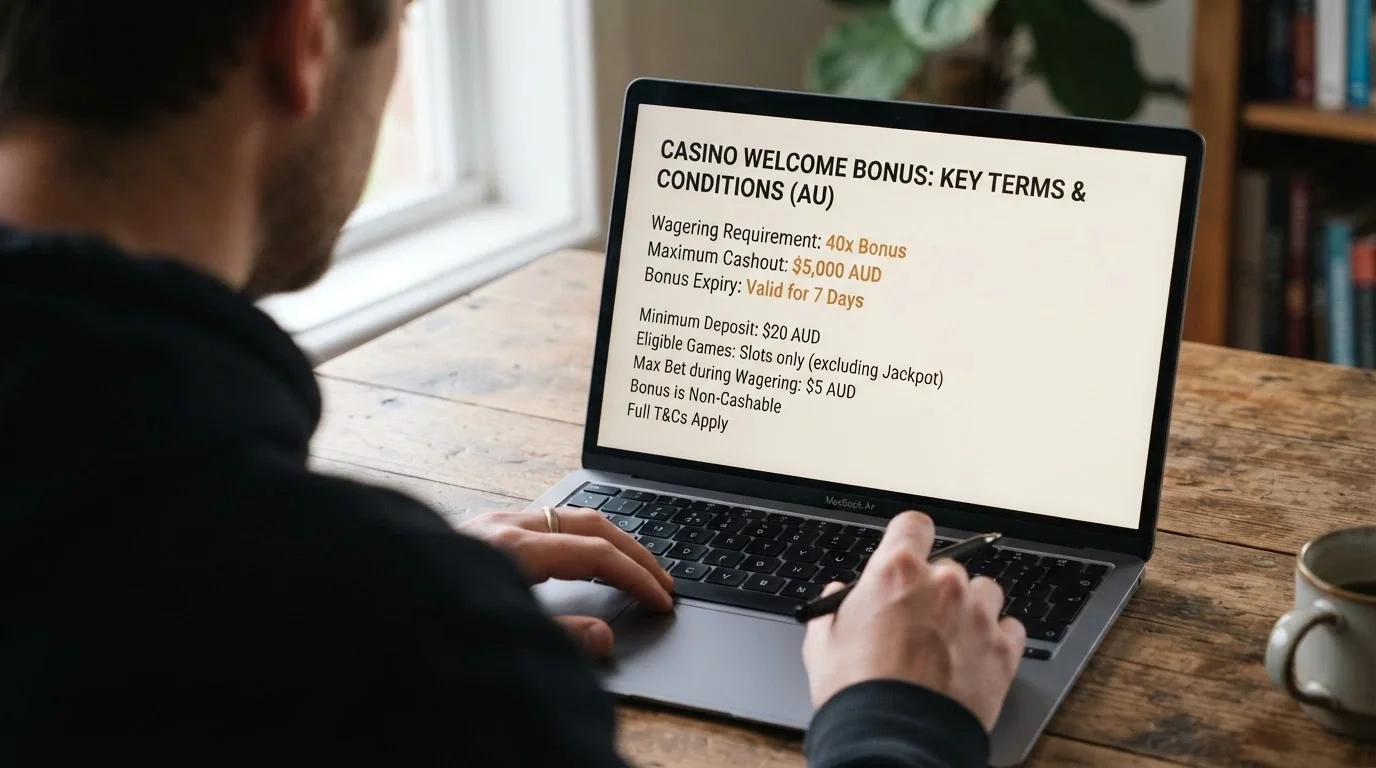
Take a typical market-norm no-deposit free-spins bonus. Twenty spins at A$0.25 per spin gives a player A$5 in nominal spin value. Wagering of 40x on the bonus means the player must turn over A$200 through the games before any winnings become withdrawable. At a 96% RTP — a standard figure for an NDB-eligible pokie — the house edge is 4% of turnover. On A$200 of required turnover, the expected loss is A$8 by the time the bonus is cleared.
So a player who claims a A$5 “free” bonus and clears it through to a withdrawal can expect to lose A$8 on the wagering alone — paying in nothing to receive the bonus, but absorbing A$8 of house edge to walk away with anything. That is the whole economics of a no-deposit offer in one line.
At the heavier end — a $15 free chip at 60x, like Fair Go’s — the same RTP produces a $36 expected loss on the $900 of required turnover, more than twice the nominal chip value. A player who hits the A$180 cashout cap and stops has come out ahead; a player who plays through without hitting a feature pays the full $36 on average. The cap is what saves the offer, and the cap is what makes it small.
The numbers also explain why operators publish them as “max cashout” rather than “expected loss”. A$40, A$100, A$180 — these are ceilings, not averages. They tell the player the most they can walk away with; they do not tell the player what the bonus costs on average. The cost is in the turnover and the house edge, and the marketing word “free” never quite covers it.
No-deposit bonus types and their wagering
The headline “no-deposit bonus” is really three offers in a trench coat. Industry-side breakdowns split the category into three: no-deposit free spins, no-deposit bonus cash, and free chips for live dealer or table games. Each clears through a different gate.
Free spins are the smallest and the most common. A player receives a fixed number of spins — typically 20 to 50 — on a single named pokie. The stake is set by the casino (often A$0.25 to A$1.00 per spin). Whatever the spins win becomes bonus funds subject to wagering. Time limits are tight: 1 to 7 days to use the spins, sometimes 24 hours. The cap is the smallest of the three categories — SkyCrown’s A$40 is typical.
Bonus cash is rarer and more flexible. A player receives a small cash amount (A$5 to A$20) that can be spent on a wider game selection — though usually still pokies-only. Wagering runs 40x to 60x on the cash itself, not on any winnings. The cashout cap is bigger than free spins but still tightly bounded.
Free chips are the live-dealer variant. A player receives a chip valued at A$5 to A$20 that can be spent at table games or live dealer. Wagering is heavy — 40x to 60x — because the house edge on those games is lower, and the operator needs more turnover to make the offer pay. The cap sits in the A$50 to A$180 range.
The wagering multiple is where the cost hides. A 40x requirement on a A$5 bonus is A$200 of forced play; a 60x requirement on a $15 chip is $900. The cap is the ceiling on what comes back; the wagering is the floor on what has to go through. Comparing these figures helps determine if a bonus is truly worth the commitment.
Where the newest no-deposit sites fit
The “newest” no-deposit sites are the same offshore operators wearing a fresh badge. A Curaçao licence that took weeks to acquire. A multi-provider library licensed from the same aggregators the next twenty brands use. A welcome bonus and a no-deposit offer copy-edited from a competitor’s terms. The newness is in the URL, the launch date and the marketing — not in the regulatory framework, which has not changed in years.
In Australia specifically, the “newest” framing does something else. It implies that the prohibition has shifted, or that a new brand has cracked a regulatory loophole that older operators could not. Neither is true. The Interactive Gambling Act 2001 still prohibits online casino, the 2017 amendment still gives ACMA enforcement powers, and the 2026 Gambling Reform Bill — passed in August 2026 and commencing 1 January 2027 — does not legalise anything new. It tightens advertising rules and lets banks block transactions to illegal operators. The casino prohibition is the constant.
A punter who treats a new brand’s launch as a signal that the regulatory environment has shifted will read the licence, the terms and the legality section in the wrong order. The order is: read the legality first (because the product is prohibited), then read the licence (because the licence is offshore), then read the terms (because the terms are the only thing the operator writes for the player). The launch date is the part that does not need reading at all.
General bonuses and promotions beyond the no-deposit
The welcome package is where the real wagering volume sits. A no-deposit offer is the thin end — a small amount of bonus cleared through a tight cap. The welcome is the wide end — a multi-deposit package with thousands of dollars of bonus money behind a longer wagering requirement.
SkyCrown’s welcome is the largest on this ranking: up to A$8,000 across four deposits plus 400 free spins, at 40x wagering, with a 14-day window per stage and a A$7.50 max bet while the bonus is live. The free-spin winnings are capped at A$300 per stage. Rocket Play’s welcome is tighter — 100% up to A$1,000 plus 100 free spins on the first deposit, at 40x wagering on the bonus alone, with a 5-day validity window that is much shorter than SkyCrown’s.
WinSpirit’s 200% multiplier is the most aggressive headline. A player who deposits A$100 receives A$300 in bonus money, with a A$400 starting balance to clear. The 200% headline outranks the typical 100% match, but the wagering cost scales with the bonus — 40x on A$300 is A$12,000 in turnover, against A$4,000 for a 100% match on the same deposit. The marketing word “200%” and the small-print number “40x” describe the same offer.
The general lesson holds across all of them: the larger the welcome bonus, the larger the wagering commitment behind it. A punter who chooses on the headline alone sees the biggest number and pays the longest clear. Always verify the wagering terms before deciding which offer aligns with your budget.
Bonus eligibility on the newest launches
The fine print that decides whether a player ever sees a bonus is the eligibility section, not the wagering one. Four gates sit at the door of every no-deposit offer on this ranking.
Profile completion and phone verification are the first. SkyCrown does not credit the 20 free spins until the player has filled in the profile fields and verified a phone number. Royal Reels and most others do the same. A player who skips these steps does not get the bonus — and a player who enters a wrong phone number finds out at withdrawal, not at sign-up.
New-sign-up-only is the second. A no-deposit bonus is a one-per-account offer. A player who already holds an account at a brand, or whose household holds one, or whose IP-address history suggests one, does not get a second one. The operator tracks all three.
One bonus per player or household is the third. A punter cannot register two email addresses and claim twice. The operators share enough data — IP addresses, device fingerprints, payment methods — to catch most attempts. The “household” wording extends the rule to partners and family members who share an address or a payment card.
The consecutive free bonus rule is the fourth, and it is the one most often missed. A player cannot redeem two non-deposit bonuses in a row without making a real-money deposit in between. Doing so triggers an automated “bonus abuser” flag at the operator’s fraud system. The flag can result in forfeited winnings, account closure, and exclusion from future bonuses at the same brand. The rule exists because no-deposit offers would be unprofitable if a player could chain them indefinitely; the cost of violating it is paid by the player who does not know the rule exists.
Payments at the newest casinos: fast and low-cost
Australian players expect to deposit in Australian dollars, in seconds, from a phone. The newest operators know this — every cashier on this ranking supports some form of instant deposit, and several of them support the methods Australian banks have spent the last five years building. The catch is that the payment methods Australian players expect, and the payment methods Australian law allows, are no longer the same list.
The headline change sits in 2024. From 11 June 2024, credit cards, credit-related products and digital currency (crypto) are banned as payment for online wagering in Australia under the Interactive Gambling Amendment (Credit and Other Measures) Act 2023. The penalty for a non-compliant Australian-licensed operator is up to $247,500. A punter who is asked for a credit card or a crypto deposit is being served by someone outside the Australian rules — and the payment method is itself a tell. The legality section below covers the enforcement side; this section covers the cashier.
PayID and Osko deposits
PayID is the instant-transfer option Australian players reach for first. A PayID links a bank account to a phone number, an email, or an ABN; Osko adds the real-time settlement layer on top of the New Payments Platform so the transfer arrives in seconds, not hours. For a punter who wants to deposit A$30 from a Commonwealth, ANZ, NAB or Westpac account and see it in the casino cashier before the next tap, PayID with Osko is the standard.
Whether each operator supports it is the part this article cannot confirm at the ranking level. The brands on this list are offshore and ship their cashier pages themselves; a player who wants to know whether the operator they have chosen takes PayID has to check that operator’s own cashier page. Some do — and the support is usually flagged in the deposit-method tiles. Some do not — and a punter who arrives without checking will fall back to cards (which are banned under the 2024 rules) or crypto (also banned). The deposit method is the first thing to confirm, before any bonus is claimed.
The minimum deposit at the AUD-friendly operators on this ranking is small. Royal Reels sets a A$30 minimum on its welcome match; most others sit at A$10 to A$20 for the deposit match to unlock. Testing the cashier with a small deposit is the most reliable way to confirm PayID support within the operator’s interface before committing larger amounts.
Pay n’ play and instant-play cashiers
Pay n’ play is the cashier flow that lets a player register, deposit and start playing in a single step, by linking a bank account at sign-up rather than after. The concept comes from the European open-banking market — Trustly, Brite and similar services verify the bank account and the player identity in one motion. The Australian offshore market has not adopted it at scale; a punter who looks for a pay n’ play button at an AU-facing casino will usually not find one.
What the newest operators do offer is instant-play in a lighter sense: registration-to-deposit in under a minute, no app to download, no software to install, with the cashier inside the same browser tab as the lobby. The friction is at verification, not at sign-up. Every operator on this ranking still has to verify identity and payment method before any withdrawal is processed; that verification usually means a copy of a photo ID, a proof of address, and — critically — a verification deposit of A$10 to A$20 to lock the payment method and complete the AML checks.
That verification deposit is the small print that surprises players most often. A punter who wins on a no-deposit bonus, requests a withdrawal, and discovers they have to deposit before the withdrawal clears is not being scammed — they are hitting the standard AML protocol. The deposit is not a fee; it is a payment-method confirmation. A punter who knows this in advance does not panic when the cashier asks for it.
Newest pokies and games: what the new libraries actually hold
The bonus only matters against the games. A free-spins no-deposit offer on a low-volatility pokie with frequent hits burns through its turnover faster than the same offer on a high-volatility pokie with rare features. A 100% welcome match on a multi-provider catalogue gives a player more room to find the right game than the same match on a single-provider library. The newest libraries on this ranking split cleanly along two lines — multi-provider versus single-provider — and the line decides what the bonus can do.

| Title | Provider | RTP | Volatility | Max win | Min bet |
|---|---|---|---|---|---|
| Wolf Treasure | IGTech | 96% | Medium | 2,000x | A$0.25 |
Wolf Treasure is the workhorse of the AU-facing no-deposit scene — the IGTech pokie that turns up as the free-spin-eligible title at multiple operators on this ranking. A 96% RTP, medium volatility, and a A$0.25 minimum bet let a small bonus clear without forcing high stakes. The 2,000x max win is the ceiling on a single spin, not the expected payout — a player who bets A$0.25 and hits the top end walks away with A$500, more than most cashout caps will allow.
Other no-deposit games on this ranking — Aztec Clusters at SkyCrown, the various RTG titles at Fair Go — do not have published specs available at the article level. Players interested in the RTP or volatility of a specific title should consult the operator’s built-in help menu or info panel, where these specifications are typically detailed.
Newest pokies and the RTG catalogue
Realtime Gaming — RTG — is the provider that dominates the AU-facing no-deposit scene at the single-provider end. Fair Go runs an RTG-only library; every chip, every free spin, every eligible game on Fair Go’s offer is an RTG title. The catalogue is narrower than what the multi-provider operators ship — fewer than 200 games in total — but the bonus terms are simpler for it. There is no ambiguity about which games count toward wagering, because no other providers are on the platform.
RTG pokies tend to share a feature set: high volatility, frequent free-spin rounds, progressive jackpots on the older titles. A punter who likes a particular RTG game — Achilles, Bubble Bubble, Cash Bandits — finds it across multiple AU-facing casinos, which means the favourite title travels with the punter. A punter who wants something outside the RTG catalogue has to move to a multi-provider operator.
Wolf Treasure is not an RTG title. It is the IGTech pokie that ships across multi-provider operators as the free-spin-eligible game on the SkyCrown-style no-deposit offer. Its specs — 96% RTP, medium volatility, 2,000x max win — are the ones to know when it appears as the no-deposit game at any AU-facing casino.
Slot games and their specs
Three numbers decide how a pokie plays: RTP, volatility, and hit frequency. A punter who knows them before claiming a bonus can match the offer to the game; a punter who doesn’t ends up clearing a 60x requirement on a high-volatility pokie with a 1-in-141 bonus frequency.
RTP is the long-run return to player, expressed as a percentage of every dollar wagered. A 96% RTP pokie returns 96 cents on the dollar over thousands of spins. The 4% gap is the house edge, and it is the engine behind the expected-loss calculation earlier in this article. Most NDB-eligible pokies sit in the 95% to 97% RTP band; high-RTP pokies (above 97.4% at Rainbet, for instance) are sometimes restricted while a bonus is active, because the operator cannot afford them.
Volatility is the spread of outcomes. A low-volatility pokie pays often and small; a high-volatility pokie pays rarely and big. A punter with a small bankroll on a 60x requirement wants low to medium volatility — the small wins keep the balance alive long enough to clear the turnover. A punter chasing the cashout cap wants high volatility — the rare big hit is the only way to reach the cap.
Hit frequency is the percentage of spins that produce any return. Wolf Treasure’s hit frequency is 27.6% — just over a quarter of spins return something. Bonus frequency is rarer: 1 in 141 spins triggers the bonus round. A punter who plays 200 spins of Wolf Treasure on a free-spins bonus will hit the bonus round about once on average. The cashout cap is what stops that one bonus round from paying out at the full 2,000x max win.
Providers that power the newest casinos
The provider mix tells a reader more about a casino than its marketing does. SkyCrown runs BGaming, IGTech, Pragmatic Play, Evolution, Booongo and Booming — a multi-studio roster with hundreds of pokies plus a full live-dealer lobby. Royal Reels, Rocket Play and Rainbet ship the same broad catalogue — Pragmatic Play, Evolution, Yggdrasil, Hacksaw — plus 30+ others between them. Bitstarz runs 4,000+ games from the largest aggregator stack on this ranking.
The multi-provider roster is the trust signal. A brand that ships Pragmatic Play, Evolution, BGaming and the other big names has paid for direct integration with each provider — a cost that discourages the fly-by-night operator. A brand that ships only RTG, or only a handful of unknown studios, has cut costs somewhere, and the cutting is usually visible elsewhere (limited cashier, slow withdrawals, thin terms).
The single-provider roster has its own argument. Fair Go’s RTG-only library is a deliberate choice — the brand caters to a player who knows and prefers RTG, and the operator ships a curated catalogue rather than a sprawling one. It’s an ideal setup for players who prefer a streamlined library over a vast, multi-provider stack.
Casino game catalogues and live dealer
Live dealer is the part of the catalogue the bonus terms most often ignore. Pokies count 100% toward wagering at most of these sites; table games and live dealer contribute 5% or 0%. A player who tries to clear a 40x bonus at the blackjack table will spend twenty times longer at it than a pokie player — every $20 bet at a 5% contribution rate reduces the bonus obligation by $1, against $1 reduction per $1 at a pokie.
That is why free chips — the third no-deposit offer type — exist. A free chip is the live-dealer and table-game variant of the no-deposit bonus, designed to be cleared at the games where pokies contribution would not work. The wagering is heavier (60x at Fair Go, for example) because the house edge on those games is lower; the operator needs more turnover to make the offer pay.
A punter who cares about live dealer and table games has two paths. The first is to play them without a bonus — for real money only, with no wagering obligation, and full access to the wins. The second is to take a free-chip bonus and accept the heavy wagering as the cost of bonus-funded live play. Mixing the two — playing live dealer while a pokie bonus is active — usually means 5% or 0% of the live-dealer bets count toward wagering, which extends the clearance time dramatically.
Free slots and demo play: the zero-cost way in
The only genuinely free way to play a pokie is to not deposit. Demo mode — sometimes called play-money or free-play — runs the game on a virtual balance, with the same RNG, the same RTP, the same volatility and the same features as the real-money version. The difference is what happens at the end of the session: nothing. The balance resets, no cash is paid out, and no wagering obligation exists.

That makes demo mode the only zero-cost entry point. A no-deposit bonus is free at the point of claim, but it carries wagering, a cap, and a clock — the cost shows up on the way through. A demo session is free in every sense: no deposit, no wagering, no cap, no clock.
Demonstration mode vs real-money pokies
Demo mode is the rehearsal before real money. A punter who has never played Wolf Treasure before claiming a SkyCrown-style free-spins bonus should spend thirty minutes in demo first — to feel the hit rate (27.6% of spins return something), the volatility (medium), and the bonus frequency (1 in 141 spins) — without any of it costing a cent. The same advice applies to every pokie on the AU-facing catalogue: try it in demo, get a feel for the rhythm, then decide whether to commit a bonus or a deposit.
The data is identical. The RNG that drives a demo session is the same RNG that drives the real-money session. The RTP, the volatility, the paytable, the bonus features — all of it is the same code. The only differences are the balance type (virtual vs real) and the outcome of any spin (paid out vs not paid out). A punter who decides to skip demo and go straight to real money is skipping the only free information available about the game.
The safe-first-step principle applies to newcomers especially. A punter who has never played an online pokie before, and who is drawn to a no-deposit bonus, should treat the bonus as the second step, not the first. The first step is the demo. The second step is the no-deposit bonus, where the player can feel the cashier, the wagering, the clock. The third step — if those two worked — is a real-money deposit, with the welcome match behind it. Each step costs the player less than the next, and the player who skips steps does not save time, they lose information.
Australian law on online casinos: the prohibition behind every “new” site
The law sits behind every other topic in this article. A punter who reads the offer and the games and the cashier first, and the legality second, has read them in the wrong order. Online casino is prohibited in Australia; the offshore operators serving Australians are doing so illegally; the prohibition does not depend on the operator, the offer, or the brand. It applies to the entire market.

The Interactive Gambling Act 2001 — the IGA — is the statute that closes the door. The 2017 amendment gave the regulator the keys. The 2026 Gambling Reform Bill, commencing 1 January 2027, adds new locks. None of it opens anything for online casino.
The Interactive Gambling Act and the 2017 amendment
The IGA was enacted in 2001. Its core prohibition is straightforward: it is an offence to provide an online casino, online pokies or in-play sports betting to a person in Australia. There is no licence for these products — not federally, not in any state or territory. The Australian market is structurally closed, the way the French market is, not the way the British market is.
The 2017 amendment closed the loopholes offshore operators had been using to reach Australian customers. Before 2017, a brand could argue it was not technically providing a service “to” Australians — it was simply providing a service globally, and Australians were finding it. The amendment redefined the prohibition around the customer, not the operator’s intent: if an Australian can place a bet on the platform, the platform is providing a service to that Australian. The amendment also gave the Australian Communications and Media Authority — ACMA — its enforcement powers, including the ability to direct Australian ISPs to block illegal sites.
The 2026 Gambling Reform Bill is the next step. It passed Parliament on 19 August 2026 and commences 1 January 2027. Its headline measures are bank-blocking authority for illegal-gambling transactions, advertising restrictions during live sport, and a ban on inducements directed at recent sign-ups and recent BetStop deregistrants. None of these legalise online casino. They tighten the existing prohibition.
Licensed wagering vs offshore casinos: the label that matters
The label “licensed” in Australia means licensed for wagering — sports and racing — not for casino games. Sportsbet, bet365, Ladbrokes and the other major brands hold Northern Territory Racing and Wagering Commission licences; they are licensed to take bets on races and on sports outcomes placed before the event begins. They are not licensed to take bets on pokies, blackjack, roulette or baccarat. No Australian brand is, because no Australian licence for those products exists.
The casino operators on this ranking are licensed in Curaçao — the operator of SkyCrown is Hollycorn N.V., the others hold similar Curaçao permits. A Curaçao licence is real, but it is not Australian. It does not connect the operator to BetStop, to ACMA enforcement, to Australian consumer protection, or to Australian banking rules. A punter who treats “Curaçao licensed” as a synonym for “safe” or “Australian-friendly” has misunderstood what the licence actually does.
The label that matters is “AU-facing”. An AU-facing casino is one that accepts Australian sign-ups, accepts Australian dollars (sometimes), and markets to Australian customers — all of which the offshore brands in this ranking do. The label that does not appear on any of these brands is “AU-licensed”, because the licence they hold is not an Australian one. Checking the ACMA’s register of blocked services reveals that every brand on this ranking either appears on the list or operates within the broader offshore market that the IGA strictly prohibits.
The credit-card and crypto ban as a tell
The payment method is itself a tell. From 11 June 2024, credit cards, credit-related products and digital currency are banned as payment for online wagering in Australia. The penalty for an Australian-licensed operator that accepts them is up to $247,500. The penalty for the player is harder to pin down — the IGA targets providers, not customers — but the practical consequence is straightforward.
A punter who is asked for a credit card or a crypto deposit at a gambling site is being served by someone outside the Australian rules. No Australian-licensed wagering operator can legally accept either method; an operator that does is operating from outside Australian jurisdiction, on its own terms. That is not in itself a sign of fraud — many offshore operators run clean businesses — but it is a sign that the consumer protections Australians expect (ACMA complaints, BetStop self-exclusion, Australian banking recourse) do not apply.
The honest framing for an Australian punter is this: the payment methods available at an offshore casino tell you the casino is offshore. The size of the no-deposit bonus, the number of free spins, the brand name on the homepage — none of those tell you where the operator is incorporated. The payment-method tile at the cashier is the simplest single check.
The 2026 Gambling Reform and what changes in 2027
The 2026 Gambling Reform Bill passed Parliament on 19 August 2026. Its measures commence 1 January 2027. The headline changes are these.
Banks and payment providers gain express authority to block transactions to illegal gambling operators. A punter whose deposit attempt is flagged as going to an illegal operator will see the transaction declined at the bank level. The change does not legalise the receiving casino — it makes it harder to pay one.
Direct marketing of inducements — bonus offers, free bets, sign-up deals — is prohibited for 14 days after a customer signs up and for three months after a person deregisters from BetStop. The change targets the chase, not the offer; an existing customer can still be marketed to after the cooling-off window.
Wagering advertising during live sport is phased out over three years. The first phase caps broadcast wagering ads at three per hour between 6:00 am and 8:30 pm. Athletes, celebrities and influencers are barred from promoting wagering. Odds broadcasting is restricted.
Online keno and foreign-matched lotteries are prohibited under Schedule 4 of the Bill.
None of these changes affect the casino prohibition. The IGA still bans online casino. The 2026 Bill tightens the enforcement, narrows the advertising, and gives banks a new tool — it does not open a regulated casino market in Australia.
Why unlicensed casinos are dangerous for Australians
The concrete harms are not abstract. An Australian punter at an offshore casino has no Australian consumer protection — no ACMA complaint that will recover funds, no Australian Financial Complaints Authority avenue, no local court that can enforce a withdrawal. The casino’s own terms govern, and the casino’s own interpretation of those terms is final.
BetStop does not reach offshore casinos. BetStop is the National Self-Exclusion Register; one registration excludes a person from every Australian-licensed wagering service in a single step. An offshore casino is not licensed here, is not connected to the register, and will keep taking a self-excluded person’s money. The punter who registers with BetStop and then plays at an offshore casino has done the right thing and achieved nothing on the casino side.
DNS blocking is the third risk. ACMA has had 1,564 illegal gambling and affiliate websites blocked by Australian ISPs since November 2019 — and Fair Go, on this ranking, was the first one. A punter who has a balance on a blocked site cannot reach the cashier to withdraw it without a workaround. The site’s terms usually require play-through before withdrawal; the block usually makes play-through impossible.
Refused withdrawals and voided wins are the fourth. The most common complaints against offshore casinos — and they are common, on every complaint forum that aggregates them — are withdrawal delays, sudden verification demands after a win, bonus terms reinterpreted to void a payout, and accounts closed with balances still on them. None of those complaints has an Australian remedy.
The individual player is not prosecuted under the IGA — the Act targets providers, not customers. That is real, and it is the one piece of comfort the law offers. But “not illegal for you” is not the same as “safe”. The prohibition exists because offshore casino play carries these harms; the prohibition is the regulator’s answer to them; the punter who uses these sites anyway is the punter who absorbs them.
Responsible gambling: the limits and the number to call
The most important number in this article is not on a bonus page. It is 1800 858 858 — the National Gambling Helpline, free, confidential, staffed 24 hours a day, seven days a week, with online chat and counselling through Gambling Help Online. A punter who needs help gets it by calling that number or by visiting gamblinghelponline.org.au. The rest of this section is about the tools that work before that call is necessary, and the tools that do not.

Self-exclusion and BetStop’s offshore blind spot
BetStop launched on 21 August 2023. One registration excludes a person from every Australian-licensed online and phone wagering service — Sportsbet, bet365, Ladbrokes, TAB, the lot. As of 31 March 2026, 59,830 people had registered with BetStop, with 37,247 exclusions currently active. The register works for the products it covers.
What it does not cover is every casino in this article. BetStop binds Australian-licensed wagering services; an offshore casino is not licensed here, is not connected to the register, and will keep taking a self-excluded person’s money. A punter who registers with BetStop and then plays at SkyCrown, Fair Go, Rocket Play, or any other brand on this ranking has done the right thing on the licensed side and achieved nothing on the offshore side.
The demographics behind the register tell their own story. 78% of BetStop registrants were under 40; 38% chose lifetime exclusion. The register is most used by the age group most exposed to offshore marketing — younger adults, often on their phones, often via the social channels that the offshore operators advertise through. The tool that the registered punter needs most is the tool that does not reach them.
The honest framing: BetStop is the strongest player-protection tool Australian-licensed gambling has, and it does not touch a single operator in this ranking. Self-exclusion from an offshore casino requires contacting the operator directly. Because these casinos are not licensed in Australia, they are under no obligation to comply with such requests, and they may keep accounts open until they decide otherwise.
The prevalence of gambling harm in Australia
The numbers explain why the tools exist. As of March 2026, 13.0% of the Australian adult population — an estimated 2,857,000 people — were experiencing some form of gambling harm from their own gambling behaviours; 15.1% of adults (3,320,000 people) including harm from others’ gambling. An estimated 1,970,000 Australian adults are classified as having at-risk or problem gambling. About 2.1% of adults — roughly 430,000 people — experience problem gambling specifically. The annual health loss associated with gambling harm in Australian adults exceeds 400,000 Years Lived with Disability.
The product mix explains most of the harm. Pokies are responsible for 52%–57% of gambling problems in Australia; sports and race betting together account for about 19%–20%; pokies, casino games and betting together account for about 90% of harm. The newest online casinos on this ranking are pokies-first, multi-provider operations, sitting squarely in the category that drives the largest share of harm. That is not an editorial opinion; it is the share that the research reports.
The economic numbers are heavier. Australians lost $36.0 billion to gambling in the twelve months to March 2026, up from $34.3 billion the year before. Online participation has climbed from 8% of adults in 2017 to 33% in 2025 — a fourfold rise in eight years, against a static prohibition. A$15.8 billion went on pokies in 2022–23 alone. State governments collected more than $9 billion in gambling taxes that year, of which $5.3 billion came from pokies. The harm is paid by individuals; the revenue is collected by governments; the offshore operators on this ranking sit outside both.
Concrete tools on any operator, licensed or not
Three tools work on every operator — licensed or not — because they are self-set. A punter who takes them before signing up for a bonus spends less, plays longer within budget, and exits faster when the budget runs out.
Deposit limits are the first. Every operator on this ranking lets a punter set a daily, weekly or monthly deposit cap in the responsible-gambling section of the account settings. The cap applies to every deposit, not just bonuses, and the operator enforces it. A punter who sets a A$50 weekly deposit cap and loses it on Monday cannot deposit again until the following Monday.
Time-outs and take-a-break are the second. A short break — 24 hours to a week — is a self-imposed cool-off. A longer exclusion — six months to five years — is a harder block. Both are available at every AU-facing casino on this ranking, though the offshore operators set their own rules and can refuse to apply them.
Session caps are the third. A punter who plays on a phone can set a phone-level reminder or use an external app to enforce a session time. The casino does not enforce session caps, because the operator benefits from long sessions; the punter has to bring the discipline themselves.
The wider truth is harder. In NSW, only 13.5% of moderate-to-high-risk gamblers reported seeking help. The tools exist. The number to call exists. The registration system exists. The gap between the tools and the people who need them is the gap this section is for, and the gap does not close by itself.
How we selected and checked these operators
Ten operators sit on this ranking because they meet three tests. The first is that they accept Australian sign-ups, ship an AUD or AUD-equivalent cashier, and offer a no-deposit bonus or a deposit-match welcome package of the kind this article covers. The second is that they hold a Curaçao licence or operate under a corporate entity that does. The third is that enough of their terms are publicly visible — wagering multiple, cashout cap, eligible games — that a reader can decide whether to claim before signing up.
The article did not invent terms. Where an operator does not publish a no-deposit bonus, a cashout cap, or a wagering multiple at the article’s check date, that cell in the ranking table is marked with an em dash rather than estimated. The Curaçao Gaming Authority register was not consulted on this run — specific permit dates for each operator are not confirmed here, and the ranking does not pretend otherwise.
This ranking prioritizes clarity and reader-focused analysis over standard bonus-code aggregation. The following table pairs wagering requirements with cashout caps and spin values, providing a direct view of the terms that determine real value. It also outlines the legal context for Australian players and the risks inherent in using offshore-licensed platforms.
What was not verified is also worth naming. The withdrawal speeds at each operator were not tested live. The complaint histories on independent forums were not aggregated. The current state of the ACMA block list was not re-checked for each brand beyond Fair Go, which is the one confirmed block on this ranking. A reader who wants confirmation of those specifics should check the operator’s own cashier and the ACMA’s published list at the time of reading.
Before you claim: what the fine print and the law mean for your bonus
A no-deposit bonus is real money gated by wagering, on sites the law does not protect. That is the sentence this article has been building toward.
The numbers behind it are not small. The market-norm no-deposit offer is 20 to 50 free spins or a $5 to $20 chip, with 40x to 60x wagering, a $50 to $180 cashout cap, and a 1-to-7-day clock on the spins. The expected cost of clearing a typical A$5 free-spins bonus at 40x is around A$8 in turnover losses at 96% RTP; at the heavier end, a $15 chip at 60x carries a $36 expected loss. The “free” word in “free spins” describes the deposit, not the cost.
The legality behind it is closed. Every operator on this ranking serves Australians from Curaçao, on their own terms, with no Australian licence available to hold. The Interactive Gambling Act 2001 prohibits the product. The 2017 amendment gave ACMA the power to block sites. The 2026 Gambling Reform Bill tightens the rules further from 1 January 2027. The credit-card and crypto ban that took effect on 11 June 2024 is a tell — a payment method at the cashier is a quick way to know whether a casino is offshore.
What to actually do before claiming is the question this article leaves the reader with. Three checks, in order. First, read the wagering multiple, the max cashout and the eligible games on the offer page — the numbers this article cites, against the offer the player is about to claim. Second, decide whether the offer is worth the cost — A$8 in expected losses for a A$5 bonus is a small cost to test a cashier, and a high one if the cashier turns out to be the wrong place to be. Third, set the deposit limit and the time-out before signing up, and call the National Gambling Helpline — 1800 858 858 — if any of this stops feeling like a choice.
The ten operators on this ranking are the newest AU-facing casinos with no-deposit offers at the time of writing. None of them alters the legal prohibition, nor do they offer the same level of player protection as an Australian-licensed wagering operator. Maintaining awareness of the fine print, utilizing self-set limits, and keeping the helpline number handy are essential steps for anyone choosing to use these platforms.
Frequently asked questions
What is a no-deposit bonus at an online casino and how does it work for Australian players?
A no-deposit bonus is a small offer — 20 to 50 free spins or a $5 to $20 chip — credited to a new account before any deposit. Clearing it requires 40x to 60x wagering, and winnings above the $50 to $180 cashout cap are voided. Every operator on this ranking is offshore.
Are online casinos with no-deposit bonuses legal in Australia?
No. The Interactive Gambling Act 2001 prohibits online casino in Australia — no licence exists federally or in any state. Every operator on this ranking serves Australians from Curaçao, on its own terms. The 2017 amendment gave ACMA blocking powers; 1,564 illegal sites have been blocked since November 2019.
What are the wagering requirements on no-deposit bonuses at the newest Australian casinos?
Wagering requirements at AU-facing no-deposit bonuses run 40x to 60x on the bonus or on the winnings from bonus spins. SkyCrown is the lighter end at 25x on free-spin winnings; Fair Go is the heavier at 60x on the chip. Wagering must be completed within the operator’s validity window — usually 1 to 14 days.
Can I win real money from a no-deposit bonus and actually withdraw it?
Yes — but with constraints. Real-money winnings are withdrawable once the wagering requirement is cleared, the cashout cap is respected, and the account has passed verification. Verification usually includes a photo ID, a proof of address, and a small deposit to lock the payment method. Winnings above the cap are voided.
What is the maximum I can cash out from a no-deposit bonus at an Australian online casino?
Cashout caps on no-deposit bonuses at AU-facing casinos typically run $50 to $180. SkyCrown caps free-spin winnings at A$40; Fair Go caps chip winnings at approximately A$180. Caps apply regardless of how much the player wins — the bonus terms cap the withdrawal, not the screen balance.
How do I claim free spins without making a deposit at a new casino?
Registration is the route. A new account at SkyCrown, Fair Go, Bizzo or Bitstarz triggers the no-deposit free-spins credit on completion of profile and phone verification. No deposit is required at claim. The spins must usually be used within 1 to 7 days, and any winnings clear through the operator’s wagering requirement.
Why do casinos require a verification deposit after I win with a no-deposit bonus?
The verification deposit — typically $10 to $20 — is a payment-method confirmation, not a fee. Offshore casinos are required to verify the player’s payment method and complete AML checks before processing a withdrawal. The deposit locks the card or account, satisfies the AML protocol, and lets the cashier release the winnings.
What happens if I try to claim two no-deposit bonuses in a row?
Casinos enforce a “consecutive free bonus” rule. Two non-deposit bonuses in a row — without a real-money deposit between them — triggers an automated “bonus abuser” flag at the operator’s fraud system. The penalty is forfeited winnings, account closure, or exclusion from future bonuses at the brand. The rule is in the terms.
Are offshore casinos connected to Australia’s BetStop self-exclusion register?
No. BetStop — the National Self-Exclusion Register — binds Australian-licensed wagering services only. Offshore casinos are not licensed here, are not connected to the register, and will keep taking a self-excluded person’s money. The strongest player-protection tool Australians have does not reach a single casino on this ranking.