
Ethereum Casinos for Australian Players — What Actually Happens When You Deposit with ETH
Ethereum is the fastest rail an Australian gambler can use to move money into and out of an offshore casino. It is also the rail that confirms, on the cashier screen, that the operator sits outside Australian law. Those two facts are not in tension — they are the same fact. The crypto payment ban that took effect on 11 June 2024 means any casino willing to take your ETH is, by definition, unlicensed at home. That is the starting position for everything that follows in this article.

Data current as of 16 October 2026 and cross-checked against the Australian Communications and Media Authority (ACMA) register of blocked services.
Table of Contents
- What an Ethereum Casino Actually Is — and Why It’s a Different Game for Australians
- Top 10 Ethereum Casinos for Australian Players in 2026
- The Legality Puzzle — What Australian Law Actually Says About ETH Casinos
- Deposits, Withdrawals, and the Speed Reality — Why “Instant” Rarely Means Instant
- Bonuses That Accept ETH — What the Welcome Offer Actually Costs You
- Why Ethereum Beats Fiat for Casino Deposits — and the Trade-Offs
- Ethereum Casinos on Mobile — No App Store, No Problem
- Free Play and Demo Mode — Trying Ethereum Slots Without Risk
- The Games — Slots, Blackjack, Roulette, and Live Dealer with ETH
- How We Evaluated and Ranked These Ethereum Casinos
- Your Move — What an Australian Player Should Actually Do About ETH Casinos
- Frequently Asked Questions
What an Ethereum Casino Actually Is — and Why It’s a Different Game for Australians
An Ethereum casino is an online casino whose cashier accepts deposits and sends withdrawals in ETH instead of (or alongside) bank transfers and cards. The game lobby looks identical to any other offshore casino: slots, blackjack, roulette, live dealer tables. The wallet is the difference. Where a traditional casino asks for a BSB and account number, an ETH casino pastes a wallet address and a QR code, and the player sends ERC-20 tokens from a self-custody wallet. The same wallet receives payouts. No bank sits in the middle.
That structural difference cascades through the whole player experience. Speed: an ETH deposit confirms in minutes, an ETH withdrawal in under two hours at the operators tested for this article. Cost: a Layer-2 network like Arbitrum or Polygon lets a deposit of A$25-equivalent clear for under A$0.10 in network fees. Anonymity: no Australian bank sees the transaction and no Australian merchant code tags it as gambling. Player protection: none of those Australian rails exist on the other end. ACMA, BetStop, and the Australian Consumer Law all stop at the border.
That is the Australian paradox. ETH is the best method for speed, cost and privacy, and the worst environment for recourse if the casino closes the account, refuses a payout, or simply disappears. Every operator reviewed here is offshore, unlicensed in Australia, and outside the reach of any Australian regulator.
The Ethereum Casino, Explained
- Funding the account: the player copies a deposit address from the casino cashier, sends ETH from a self-custody wallet (MetaMask, Rabby, Ledger), and the casino credits the balance once the required number of blockchain confirmations arrives.
- Playing: the casino converts the ETH credit into an internal balance — sometimes an ETH balance, sometimes an AUD/NZD equivalent — and the player stakes that balance on slots, table games and live dealer rooms.
- Cashing out: the player requests a withdrawal, the casino runs an internal review, then broadcasts the ETH to the player’s nominated wallet address. The transaction confirms on-chain within minutes.
- Costs: the player pays two layers of fees — the Ethereum network gas (which fluctuates and can spike above $10 during busy periods), and any casino-side fee on top (typically nil for crypto withdrawals, but A$5–20 reported at some operators).
- Speed: deposits confirm in 5–40 minutes for ERC-20 transfers; withdrawals range from under three minutes to about two hours depending on the operator’s internal review.

The Crypto Casino vs the Traditional Online Casino
A traditional AU-facing online casino, where it exists in licensed form, sits inside the IGA framework: bank rails in, Australian regulator oversight, BetStop coverage, mandatory responsible-gambling tools. An ETH casino sits outside that framework by the very fact that it accepts crypto. The two product categories share a lobby and a roulette wheel, and the rest of the architecture diverges.
| Dimension | Traditional (AU-licensed) | ETH (offshore) |
|---|---|---|
| Payment rails | Bank transfer, card, POLi | Self-custody ETH wallet |
| Crypto accepted | No (banned since 11 June 2024) | Yes — and only crypto confirms offshore status |
| Provably fair games | Rare | Common at crypto-native brands |
| Balance currency | AUD | ETH, AUD (rare), or USDT |
| Australian recourse | Full consumer law | None |
| BetStop coverage | Yes | No |
| Account closure dispute path | AU regulator or court | None — Curaçao or Anjouan only |
The AUD-denominated exception deserves a mention. Most ETH casinos credit player balances in mETH or in a USD-pegged internal unit, which means a 10% drop in the ETH price over a long bonus-clearing session is also a 10% drop in the player’s playable bankroll. A small number of operators — Lolajack is one example — hold balances in AUD/NZD despite the ETH deposit, effectively absorbing the volatility on the player’s behalf. That is a structural advantage worth chasing if the player plans to grind through a high-turnover bonus over weeks rather than days.
Why the Payment Method Defines the Experience for Australian Players
Speed and privacy are what ETH delivers. The blockchain does not close for the weekend, does not flag the transaction as gambling, and does not impose a 1–3 day wait for a “pending review” the way a card withdrawal does. For an Australian who has already opted in to offshore play, ETH is the closest thing to frictionless funding on the market.
What it does not deliver is the thing an Australian bank account quietly delivers: a chargeback path, a complaints mechanism, and a regulator with the power to make a casino pay. ACMA’s own framing is the cleanest summary of the situation. A crypto deposit, the regulator has noted, is itself a tell that the operator sits outside Australian rules. That statement is doing more work than it looks. It explains why the ACMA blocklist has grown to 1,564 sites since November 2019, why the player has no path through the Australian Financial Complaints Authority, and why every review below names offshore licensing and offshore-only dispute resolution in the same breath.
The legal detail of that gap is unpacked in the section on the IGA and the offshore reality. The headline here is the trade-off: ETH gives an Australian player the fastest payment method in the market and strips them of every payment-method protection an Australian player would otherwise have. That is the trade the rest of this article measures.
Top 10 Ethereum Casinos for Australian Players in 2026
The ranking below is built from published bonus terms, operator-specific tested ETH payout times, network support (Mainnet-only versus multi-chain L2), and the licensing status that determines whether an Australian player has any recourse at all. Every operator listed is offshore, unlicensed in Australia, and operating outside the IGA. None of them can connect to BetStop.

The table is the starting view. The detailed write-ups follow, and they read differently from the table because they carry the per-operator verdict the table cannot.
| Operator | Licence (Status in AU) | Welcome Bonus | Wagering (×) | Max Bet | Network Support |
|---|---|---|---|---|---|
| SkyCrown | Curaçao / Unlicensed in AU | 100% up to A$2,000 + 100 spins | 35x bonus-only | A$5 | Mainnet, Arbitrum, Polygon |
| NeoSpin | Curaçao / Unlicensed in AU | 400% up to A$10,000 | 50x bonus-only | A$5–A$8 | Mainnet, Arbitrum, Polygon |
| LuckyDreams | Curaçao OGL/2024/164/0246 / Unlicensed in AU | 100% up to A$1,000 + 100 spins | 35x bonus-only | A$8 | Mainnet, Arbitrum, Optimism, Polygon |
| BC.Game | Anjouan ALSI-202410011-FI1 / Unlicensed in AU | A$4,000 + 400 FS (or up to A$20k multi-deposit) | 40x deposit+bonus | — | 100+ chains (ETH focus) |
| 7Bit Casino | Curaçao OGL/2023/174/0082 / Unlicensed in AU | 325% up to A$5,400 + 250 FS | 35–45x | A$5–A$10 | Mainnet only |
| PlayAmo | Curaçao (implied) / Unlicensed in AU | A$300 + 150 FS | ~50x | A$5 | Mainnet only |
| VegasNow | Curaçao / Unlicensed in AU | 100% up to A$3,000 + 200 spins | 35x bonus-only | A$10 | Mainnet, Arbitrum |
| GoldenBet | Curaçao / Unlicensed in AU | 100% up to A$1,500 + 50 spins | 35x bonus-only | A$5 | Mainnet only |
| Wild Tokyo | Curaçao / Unlicensed in AU | 100% up to A$1,500 + 150 spins | 35x bonus-only | A$10 | Mainnet, Polygon |
| LuckyOnes | Anjouan / Unlicensed in AU | 200% up to A$2,000 + 100 spins | 40x bonus-only | A$5 | Mainnet, Arbitrum |
The wagering column is the single most useful column on the table. A 35x bonus-only multiple sits at what current research calls the “fair end” of the ETH bonus market — it costs the player real turnover, but it does not double the cost by counting the deposit. A 50x bonus+deposit multiple sits at the hostile end, and wagering above 40x is widely treated as a red flag for this product. The bonus figures that look largest on paper — NeoSpin’s 400%, 7Bit’s 325% — are precisely the ones with the wagering that bleeds the value back out.
SkyCrown
SkyCrown is the all-rounder of the set: a 100% match up to A$2,000 plus 100 free spins, 35x bonus-only wagering (the fair end of the market), and a tested ETH payout that lands in about three minutes. The minimum deposit is A$30, the max bet while a bonus is active is A$5, and the bonus validity window sits at roughly 7–14 days. Network support covers Mainnet, Arbitrum and Polygon, so a player on a tight budget can route through L2 and keep gas under a dollar.
The bonus terms are the cleanest of the ten. The headline figure is honest — A$2,000 is large enough to be worth chasing, the wagering multiple is at the threshold the market treats as fair, and the bet cap does not force the player into a slow grind. The tested three-minute payout is the fastest in the set. The trade-off is the validity window: 7–14 days is tight against the 30 days offered by LuckyDreams and VegasNow. Given the 35x wagering and the speed of the Arbitrum-based payout, SkyCrown delivers a lean, fast-clearing bonus experience that beats most of the market.
NeoSpin
NeoSpin offers the biggest headline bonus in the set — 400% up to A$10,000 — and pairs it with the heaviest wagering burden in the set: 50x bonus-only, A$5–A$8 max bet, and roughly 7–10 days to clear. The minimum deposit is A$10–A$20, the network support is broad (Mainnet, Arbitrum, Polygon), and the tested ETH payout clears in about six minutes.
The arithmetic is what it is. A A$10,000 headline at 50x bonus-only means a player turning over A$500,000 in bets before any of the bonus becomes withdrawable — a sum that has to be wagered inside a 7–10 day window with a A$5–A$8 bet cap. A bettor staking the maximum runs roughly 62,500–100,000 spins at the cap, depending on which end of the A$5–A$8 range the operator enforces. That is hours of play before a cent is withdrawable, and the research verdict on this end of the market is that 50x is firmly above the 40x red-flag line. NeoSpin is the test of whether the player reads the fine print before chasing the largest number on the table.
LuckyDreams
LuckyDreams is the L2 champion of the set. It supports Ethereum on Mainnet, Arbitrum, Optimism and Polygon, and an A$25-equivalent ETH deposit routes through Arbitrum for under A$0.10 in network fees. The bonus is 100% up to A$1,000 plus 100 free spins, the wagering is 35x bonus-only, the max bet is A$8, the minimum deposit is A$20, and the bonus validity window is 30 days. The licence is Curaçao OGL/2024/164/0246. Tested ETH payout clears in four minutes via Arbitrum.
The four-network support is the headline advantage. Gas spikes on Mainnet can push a small deposit above A$10 in fees alone — see the section on L2 networks below — and LuckyDreams is the operator that lets a player bypass those spikes with a wallet switch. The 30-day validity window is the longest in the set alongside VegasNow, which gives a casual player room to clear without marathon sessions. For an Australian ETH player on a small budget, LuckyDreams is the most structurally efficient operator on the table.
BC.Game
BC.Game operates the largest game library in the set and posts the fastest tested ETH payout: 2 minutes 34 seconds from request to wallet credit. The licence is Anjouan ALSI-202410011-FI1 — BC.Game withdrew its Curaçao licence in December 2025 and now operates under Anjouan oversight. The welcome offer is structured two ways: a A$4,000 + 400 free spins headline, or a multi-deposit package scaling up to A$20,000. Network support is unusually broad — 100+ chains, with ETH Mainnet as the focus.
The wagering is the catch. BC.Game is the only operator in the set that runs deposit+bonus wagering rather than bonus-only, and it runs it at 40x. Deposit+bonus means the turnover requirement counts both the deposit and the bonus toward the multiple — a A$1,000 deposit with a A$1,000 bonus at 40x means A$80,000 in turnover, not A$40,000. BC.Game excels as a platform for rapid play and deep library access, especially given the 2:34 payout time. Bonus hunters, however, should approach the 40x deposit+bonus requirement with significant caution.
7Bit Casino
7Bit Casino is operated by Dama N.V. under Curaçao licence OGL/2023/174/0082 and offers 325% up to A$5,400 plus 250 free spins. Wagering runs 35–45x depending on the deposit tier, the max bet is A$5–A$10, the minimum deposit is around A$20, and the bonus validity window is 14 days. Network support is ETH Mainnet only, and the average tested ETH payout is 6.8 minutes.
7Bit Casino carries one specific RTP data point: the slot Elvis Frog in Vegas sits in the 95% RTP range. That is a real figure for a real game on a real operator, and it is the rare instance where the player can read an RTP off the page before staking the bonus. The Mainnet-only ETH support is the trade-off: a player paying gas at peak times will see more of the deposit eaten by network fees than a player on LuckyDreams routing through Arbitrum. For an Australian who wants a named RTP to anchor the bonus-clearing math, 7Bit is the standout. For everyone else, it sits mid-pack.
PlayAmo
PlayAmo offers a modest A$300 + 150 free spins welcome package and pairs it with roughly 50x wagering and a A$5 max bet. Minimum deposit is around A$20, network support is Mainnet only, and the tested crypto withdrawal range is 0–1 hours with a A$6,000 per-withdrawal cap. The licence is Curaçao (implied).
The number that matters here is the 0–1 hour payout ceiling, with a A$6,000 per-transaction cap. A player withdrawing A$20,000 in winnings runs four transactions, each with a casino review window. The wagering is steep (50x sits above the 40x red-flag threshold) and the headline bonus is small relative to the rest of the set. PlayAmo’s case is speed and reliability of payout, not the value of the welcome offer. For a player who treats the welcome bonus as a one-time test and plans to play cash thereafter, the speed is the argument. For a bonus hunter, the math does not work.
VegasNow
VegasNow offers 100% up to A$3,000 plus 200 free spins at 35x bonus-only wagering, with a A$10 max bet, A$20 minimum deposit, and a 30-day bonus validity window. Network support covers Mainnet and Arbitrum, and the tested ETH payout is five minutes. The licence is Curaçao.
VegasNow’s profile sits in the same cluster as LuckyDreams: 35x bonus-only, a 30-day window, broad network support, a tested payout in single-digit minutes. The A$10 max bet is the joint-highest in the set alongside Wild Tokyo, which lets a player clear the turnover faster per spin. The A$3,000 headline is the largest 35x bonus in the set. VegasNow is a top contender for players prioritizing a balance of reasonable bonus terms and a generous 30-day clearing window, avoiding the aggressive turnover targets seen elsewhere.
GoldenBet
GoldenBet offers 100% up to A$1,500 plus 50 free spins at 35x bonus-only wagering with a A$5 max bet and a A$20 minimum deposit. Network support is Mainnet only, and the tested ETH payout is 20 minutes — the slowest in the ten-operator set. The licence is Curaçao.
The bonus terms sit at the fair end of the market — 35x, bonus-only, no deposit+bonus penalty. The payout time is the trade-off. Twenty minutes is still fast in absolute terms (most fiat withdrawals take 1–5 business days), but it sits at twice the average of the set and ten times slower than BC.Game’s tested 2:34. While it lags behind on pure withdrawal speed, GoldenBet’s 35x bonus structure is transparent and fair, making it a reliable choice for players who prioritise clear, attainable terms over instant payout times.
Wild Tokyo
Wild Tokyo offers 100% up to A$1,500 plus 150 free spins at 35x bonus-only wagering with a A$10 max bet and a A$20 minimum deposit. Network support covers Mainnet and Polygon, and the tested ETH payout is eight minutes. The licence is Curaçao.
Wild Tokyo’s profile is the same shape as VegasNow’s — 35x bonus-only, A$10 max bet, single-digit-minute payouts — but the headline is smaller (A$1,500 vs A$3,000) and the bonus carries fewer free spins in absolute terms (150 vs 200). Polygon support is the structural advantage over GoldenBet, which runs Mainnet only. For a player who has already picked a Curaçao 35x operator and is choosing between Wild Tokyo and VegasNow, the decision comes down to whether the larger headline at VegasNow or the Polygon L2 option at Wild Tokyo matters more to their deposit pattern.
LuckyOnes
LuckyOnes operates under an Anjouan licence and offers 200% up to A$2,000 plus 100 free spins at 40x bonus-only wagering. The max bet is A$5, the minimum deposit is A$20, network support covers Mainnet and Arbitrum, and the tested ETH payout is nine minutes. The 40x multiple sits exactly at the red-flag threshold research applies to this market.
LuckyOnes is the operator where the wagering column is the entire story. A 200% match is meaningfully larger than the 100% matches that dominate the rest of the set, and 40x bonus-only is meaningfully heavier than the 35x fair-end baseline. The 200% bonus adds to the turnover requirement rather than substituting for it, so the player turning over a A$1,000 deposit with a A$2,000 bonus has 40 × A$2,000 = A$80,000 of bets to clear before any withdrawal. For a player who treats the welcome offer as the reason to sign up, the math is the math. For a player who plans to deposit, withdraw, and play cash, the Anjouan licence and the nine-minute payout make LuckyOnes a credible fast-payout option.
The Legality Puzzle — What Australian Law Actually Says About ETH Casinos
Online casino games, online pokies and in-play sports betting are prohibited interactive gambling services under the Interactive Gambling Act 2001. The regulator is the Australian Communications and Media Authority (ACMA). Since enforcement was strengthened in 2017, more than 225 illegal services have withdrawn from the Australian market, and since November 2019, ACMA has blocked 1,564 illegal gambling and affiliate websites. The product is banned, the enforcement is real, and the blocklist is not theoretical.

What the IGA does not do is prosecute the player. The Act targets the provider of the prohibited service, not the individual who uses it. That is the gap the entire offshore ETH casino market is built on: the casino cannot legally offer the product to an Australian, but the Australian cannot be prosecuted for using it. The cost of that gap falls entirely on the player. ACMA cannot recover funds from an offshore operator, Australian consumer law does not apply to a Curaçao-licensed entity, and BetStop does not extend to a casino that has no Australian licence to suspend.
The 2026 reform tightens the screws on the provider side without changing the player’s position. The Interactive Gambling Amendment (Gambling Reform) Bill 2026 passed Parliament on 19 August 2026 and takes effect on 1 January 2027. From that date, banks and payment providers gain express authority to block transactions to illegal gambling operators, direct marketing of inducements is banned for 14 days after sign-up and three months after BetStop deregistration, and wagering advertising carries a “triple lock” requiring the viewer to be logged in, confirmed over 18, and offered an opt-out. None of that changes the offshore casino’s willingness to take an ETH deposit. What it changes is how visible those operators are to an Australian who has not yet sought them out.
The IGA and the Offshore Reality
The IGA’s prohibition is product-specific. It bans the supply of online casino games, online pokies and in-play betting to people physically present in Australia. It does not ban the supply of online wagering on pre-event races and sport, which is the licensed product state and territory regulators oversee. The licensed product sits inside the IGA framework: bank rails, Australian consumer law, BetStop coverage, the National Gambling Helpline. The unlicensed product — the casino lobby, the slot reels, the live dealer table — sits outside it.
The 11 June 2024 payment-method ban closed the door on credit cards, credit-related products and digital currency as funding for the licensed product. The intent was to prevent licensed wagering operators from being used to gamble on credit. The effect, for an ETH player, is that any casino accepting crypto is, by definition, an unlicensed operator offering an unlicensed product. ACMA’s own framing is the cleanest summary: a crypto deposit is itself a tell that the operator sits outside Australian rules. The blocklist is the regulator’s response. The bank-blocking power effective 1 January 2027 is the next step.
KYC, Anonymity, and the Verification Trap
“No KYC” is a marketing line that does not survive the first large withdrawal. The deposit stage at most ETH casinos in this set is wallet-to-wallet, no ID required. The withdrawal stage is where the verification trigger sits, and most operators in this category run a Know Your Customer check on the first withdrawal above a threshold (typically a few hundred to a few thousand AUD-equivalent), regardless of how the deposit was made. The experience on this point is consistent: the anonymity benefit of crypto deposits is real at the deposit stage and largely illusory at the withdrawal stage.
The implication for the player is practical. The deposit can be made from a fresh wallet with no name attached. The withdrawal cannot be received into a fresh wallet without the casino eventually asking for ID — and the casino controls the timing of the payout. A player who treats “no KYC” as a guarantee of permanent anonymity will find the guarantee expire at the moment they try to cash out a meaningful win. The honest reading is that ETH gives a player privacy from their bank, not privacy from the casino.
Deposits, Withdrawals, and the Speed Reality — Why “Instant” Rarely Means Instant
The Ethereum blockchain confirms transactions in seconds to minutes. The casino cashier that accepts the transaction is a different machine, and it has its own clock. The honest picture of an ETH casino transaction is two clocks running: the blockchain’s confirmation and the casino’s internal review. The player’s actual experience of “instant” is whichever clock is slower.
For deposits, the casino clock is fast — typically 5–40 minutes for an ERC-20 deposit to credit, depending on how many confirmations the operator requires and how busy the cashier queue is. For withdrawals, the casino clock is the bottleneck. CasinosHub’s framing is the cleanest: the casino’s own internal review is what actually eats most of the wait. The blockchain confirms the payout in seconds once the casino broadcasts the transaction. The wait before broadcast is what turns “instant” into 10 minutes, an hour, or two.
Depositing with ETH — Networks, Fees, and Minimums
The deposit step is mechanical. The player opens the casino cashier, selects Ethereum, chooses a network (Mainnet or one of the L2 options the operator supports), copies the deposit address or scans the QR code, and sends the ETH from a self-custody wallet. The casino credits the balance after the required number of confirmations — usually 5–40 minutes for ERC-20.
The cost is where network choice matters. On Ethereum Mainnet, gas fees fluctuate and can spike above A$10 during busy periods, which makes small deposits (below A$50) an expensive way to fund a casino account. On Arbitrum, Optimism or Polygon, the same deposit clears for cents. LuckyDreams is the operator in this set that supports all four networks, with an A$25-equivalent ETH deposit on Arbitrum clearing for under A$0.10. Operators that support Mainnet only — 7Bit, PlayAmo, GoldenBet — pass the gas-cost burden to the player.
Minimum deposits across the set sit between A$10 and A$30. The cheapest entry points (NeoSpin at A$10–A$20, SkyCrown at A$30) are also the operators with the steepest wagering, which is not a coincidence — a low minimum deposit is one way to lower the barrier to claiming a high-turnover bonus.
Withdrawals — The Real Timeline and What Slows It Down
An ETH withdrawal runs through three stages: the casino’s internal review, the on-chain broadcast, and the wallet confirmation. The review is the variable. Tested payout times across the set range from BC.Game’s 2 minutes 34 seconds to GoldenBet’s 20 minutes, with the bulk of operators in the 3–10 minute band. Research on the wider market puts the realistic ceiling at about two hours, with internal approval times as the main driver.
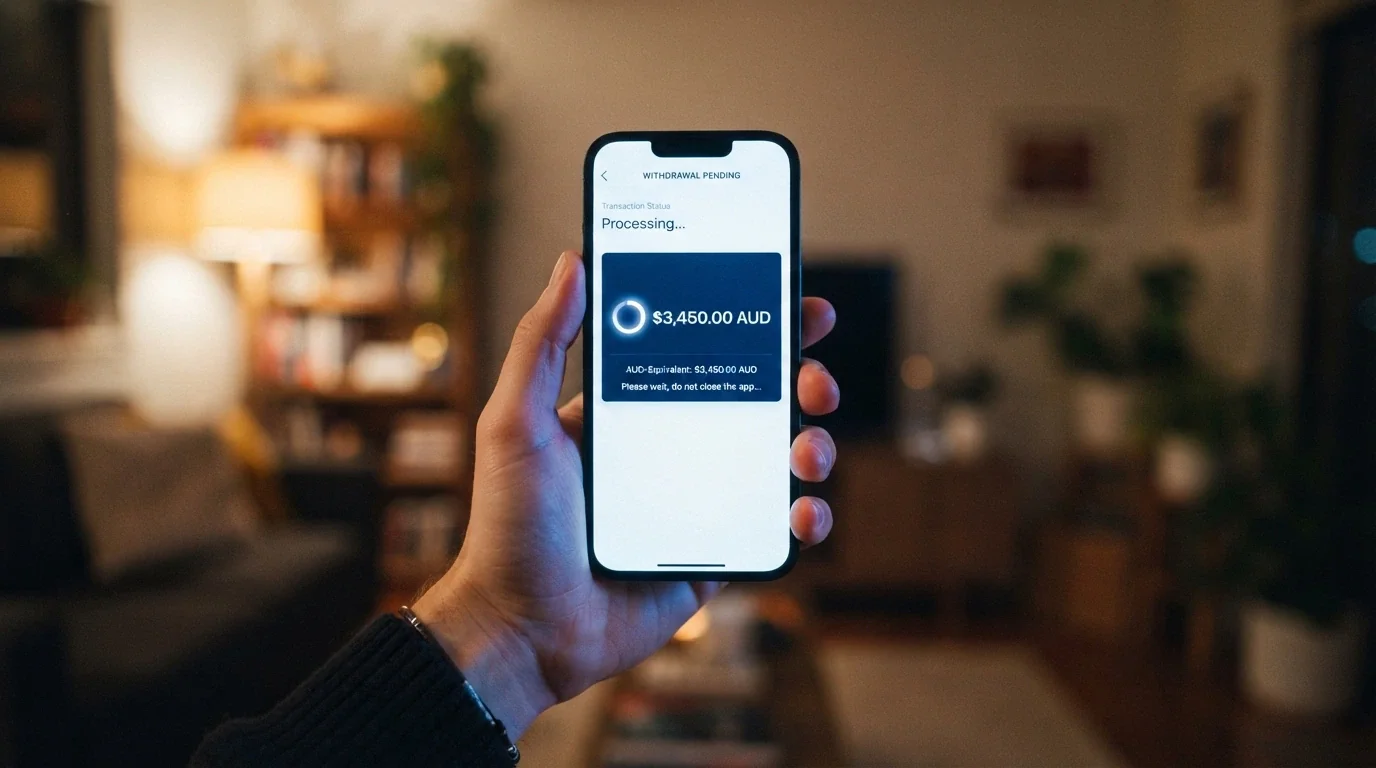
Per-withdrawal caps are a separate constraint. PlayAmo, for instance, caps crypto withdrawals at A$6,000 per transaction. A player withdrawing A$20,000 runs four transactions, each gated by the casino’s internal review. The cap is set by the operator, not by the blockchain, and it is one of the silent ways “instant” becomes “over the course of a day” for larger balances.
The honest reading of “instant ETH withdrawal” is that the ETH arrives in the wallet faster than any fiat alternative ever could, and slower than the marketing line suggests. The blockchain is not the bottleneck. The casino’s review queue is.
L2 Networks — Why Arbitrum and Polygon Change the ETH Casino Maths
A Layer-2 network is a secondary blockchain that batches transactions and settles them back to Ethereum Mainnet in bulk. The player pays cents in fees instead of dollars, and the deposit or withdrawal confirms in seconds rather than minutes. For an ETH casino player funding small balances, the L2 option turns the cost equation on its head: an A$25 deposit on Arbitrum costs less in fees than the Mainnet gas alone, and the player gets to keep the full A$25 for play.
The operators in this set that support L2s are the ones worth comparing on network support. LuckyDreams supports Mainnet, Arbitrum, Optimism and Polygon. SkyCrown, NeoSpin and VegasNow support Mainnet plus one or two L2s. 7Bit, PlayAmo and GoldenBet support Mainnet only. For a player funding balances below A$100, the Mainnet-only operators charge a meaningful percentage of the deposit in fees during a gas spike. For a player funding larger balances where the fee is a small fraction of the deposit, Mainnet-only is a minor inconvenience rather than a dealbreaker.
The stablecoin alternative is worth a mention for players who want the speed of crypto without the gas-fee exposure. USDT on TRC-20 (Tron) is the fastest and cheapest crypto rail for casino deposits and withdrawals, with SkyCrown tested at 12 minutes for USDT payouts. The trade-off is the ETH-versus-stablecoin volatility question, addressed in the next section.
Bonuses That Accept ETH — What the Welcome Offer Actually Costs You
The welcome bonus is the most expensive part of an ETH casino relationship for most players, and it is also the part the marketing presents most aggressively. A 400% match sounds generous. It is a liability once the wagering multiple is applied, and the wagering multiple is the line the rest of this section reads.

The fair end of the ETH bonus market sits at 35x bonus-only wagering, with A$10 max bet caps and 30-day expiry windows — the terms at LuckyDreams, VegasNow and several other operators in the set. The hostile end sits at 50x bonus+deposit wagering, with A$2.50 max bet caps and tighter expiry windows. Anything above 40x is treated as a red flag by the operators and reviewers that publish on this market. The difference between the two ends is not a minor variation; it is the difference between a bonus the player has a real chance of clearing and a bonus the bonus math eats.
| Operator | Welcome Bonus | Wagering (×) | Turnover Required | Validity Window |
|---|---|---|---|---|
| SkyCrown | 100% up to A$2,000 + 100 spins | 35x bonus-only | Up to A$70,000 | 7–14 days |
| NeoSpin | 400% up to A$10,000 | 50x bonus-only | Up to A$500,000 | 7–10 days |
| LuckyDreams | 100% up to A$1,000 + 100 spins | 35x bonus-only | Up to A$35,000 | 30 days |
| BC.Game | A$4,000 + 400 FS | 40x deposit+bonus | Variable | Not specified |
| 7Bit Casino | 325% up to A$5,400 + 250 FS | 35–45x | Up to A$97,200 | 14 days |
| VegasNow | 100% up to A$3,000 + 200 spins | 35x bonus-only | Up to A$105,000 | 30 days |
| GoldenBet | 100% up to A$1,500 + 50 spins | 35x bonus-only | Up to A$52,500 | Not specified |
| Wild Tokyo | 100% up to A$1,500 + 150 spins | 35x bonus-only | Up to A$52,500 | Not specified |
| LuckyOnes | 200% up to A$2,000 + 100 spins | 40x bonus-only | Up to A$80,000 | Not specified |
The turnover column is where the bonus cost becomes real. SkyCrown’s A$2,000 bonus at 35x bonus-only means A$70,000 in qualifying bets before withdrawal. NeoSpin’s A$10,000 bonus at 50x bonus-only means A$500,000 — seven times more turnover than SkyCrown, for a headline five times larger. The 50x figure sits above the 40x red-flag threshold, and the bonus validity window at NeoSpin is half what SkyCrown offers. The numbers are doing the work the marketing does not.
Welcome Bonuses — The Numbers Behind the Headlines
Bonus-only versus deposit+bonus is the most important distinction on the table, and BC.Game is the only operator in the set that runs deposit+bonus. A 40x deposit+bonus multiple is not the same offer as a 40x bonus-only multiple: it means the turnover counts the deposit AND the bonus toward the requirement, which doubles the qualifying bet volume relative to a bonus-only structure. For a player who treats the welcome bonus as a one-time event, the math has to be run before the deposit is made.
The bet cap is the second lever. A A$10 max bet (VegasNow, Wild Tokyo) lets the player clear turnover roughly twice as fast per spin as a A$5 cap (SkyCrown, GoldenBet, LuckyOnes). At A$2.50 caps (the hostile end of the market, not present in this particular set but visible at operators outside the table), the clearance time stretches out further still. The validity window is the third lever, and 30 days (LuckyDreams, VegasNow) gives the casual player room that 7-day windows (NeoSpin) do not.
A 400% match is not five times better than a 100% match once the turnover is run. It is, in many cases, the same effective value or worse, because the wagering scales with the bonus size and the time available to clear does not. The bonus that reads “biggest” on the headline is often the bonus that bleeds the most value back out in the clearing math.
No-Deposit Bonuses, Free Spins, and the Catch
No-deposit bonuses at ETH casinos are rare, and the ones that exist are not free in any meaningful sense. The offer typically arrives with a max cashout cap of A$50–A$100, and a verifying deposit is required before any of the winnings can be withdrawn. The mechanics are straightforward: the casino gives the player a small bonus to test the platform, the player runs it up, and the casino demands a real deposit before paying out anything above the cap. The deposit is the moment the casino collects its KYC and starts the responsible-gambling checks the no-deposit bonus skipped.
The catch is the design. A no-deposit bonus that caps cashout at A$50 and requires a A$20 deposit to release it is, in effect, a A$20 deposit with a bonus ceiling of A$50. For a player who already plans to deposit, the no-deposit bonus is a small upside. For a player who only signs up to chase the no-deposit offer, the deposit requirement is the actual transaction. Free spins at the welcome stage are a softer version of the same mechanic: the spin value is small (typically A$0.10), the winnings carry their own wagering, and the slot choice is operator-controlled rather than player-controlled.
Why Ethereum Beats Fiat for Casino Deposits — and the Trade-Offs
Ethereum’s edge over bank transfers and cards is speed and privacy. A bank transfer can take 1–3 business days to land. An ETH deposit confirms in 5–40 minutes. A card deposit is faster than a transfer but flags the transaction as gambling at the merchant-code level and may trigger bank-side gambling blocks. An ETH deposit carries no merchant code and no bank intermediary. For a player whose Australian bank has a policy against gambling transactions, ETH is the rail that bypasses it.
The cost edge depends on the network. On Mainnet, gas fees can spike above A$10 during busy periods, which erases the cost advantage for small deposits. On Arbitrum, Optimism or Polygon, the same deposit costs cents and the edge is real. For a player funding A$500 balances, Mainnet gas is a tolerable percentage. For a player funding A$25 balances, only the L2 networks preserve the cost advantage.
The volatility question is where ETH loses to stablecoins and to AUD-denominated balance operators. An ETH balance held at a casino that credits in mETH can drop 10% in a week if ETH drops 10%. A player grinding through a 30-day bonus at LuckyDreams with an ETH balance is exposed to that 30-day window of price movement. A player using USDT (TRC-20) is exposed to nothing — USDT tracks the dollar. A player at an AUD-denominated balance casino like Lolajack is exposed to nothing on the balance side, even if the deposit was made in ETH. The trade-off is between the volatility of the rail and the speed of the rail.
Ethereum’s edge over Bitcoin is speed and cost. ETH blocks confirm faster than BTC blocks, and the L2 ecosystem is more mature. ETH’s edge over USDT on Tron is the brand and the wallet integration — most self-custody wallets treat ETH as a first-class asset. The Coin Republic’s framing is the cleanest summary: Ethereum processes faster than Bitcoin, but gas fees fluctuate wildly and often spike above A$10 during busy market periods. That is the trade.
Ethereum Casinos on Mobile — No App Store, No Problem
- ETH casinos run in the mobile browser. The player opens the site in Safari or Chrome, logs in, deposits from a mobile wallet, and plays. No native iOS or Android app to install, no App Store or Google Play to navigate, no platform-level restriction on gambling apps to fight.
- The wallet flow on mobile is the same as on desktop. MetaMask Mobile, Rabby and Ledger Live all handle ERC-20 deposits and withdrawals, and the QR code on the casino cashier scans directly from the wallet app.
- L2 networks matter more on mobile data. A A$10 gas fee on Mainnet is a larger fraction of a mobile-data user’s session budget than a desktop user’s. Players on mobile should route through Arbitrum or Polygon wherever the casino supports it.
- The app-store restriction on real-money gambling apps in both Apple’s App Store and Google Play is the structural reason offshore casinos run as browser-only experiences. The browser-based delivery is not a feature the operator chose — it is the constraint the platforms impose.
Free Play and Demo Mode — Trying Ethereum Slots Without Risk
Demo mode is available at most of the operators in this set. The player loads a slot in browser-based play-money mode, spins without risking a balance, and reads the gameplay mechanics — bonus rounds, volatility feel, hit frequency — before staking ETH. For a player choosing between Elvis Frog in Vegas at 7Bit and a similar high-volatility title at another operator, a ten-minute demo session is more informative than any review.
Demo mode does not show the real-money picture. The RTP is the same in demo and real-money mode, but the player’s behaviour is not — demo play is unconstrained, real-money play carries a bankroll ceiling and a wagering requirement if a bonus is active. Volatility feels different when the player has A$1,000 behind the spin rather than a fun-money stack. The honest reading of demo mode is that it shows the game, not the gamble.
The transition from demo to real-money play at an ETH casino is the wallet-to-wallet step. The player exits demo, opens the cashier, deposits ETH, and the same game runs against the live balance. There is no separate “real money” version of the slot to load — the underlying game is the same; the balance is what changes.
The Games — Slots, Blackjack, Roulette, and Live Dealer with ETH
The game libraries at the operators in this set overlap heavily. Slots dominate by volume, table games sit underneath, and live dealer rooms fill out the top of the lobby. The library difference between operators is provider count and depth — BC.Game runs the largest library in the set, the Curaçao cluster runs mid-size libraries, and the Anjouan operators run smaller libraries with crypto-native originals on top.
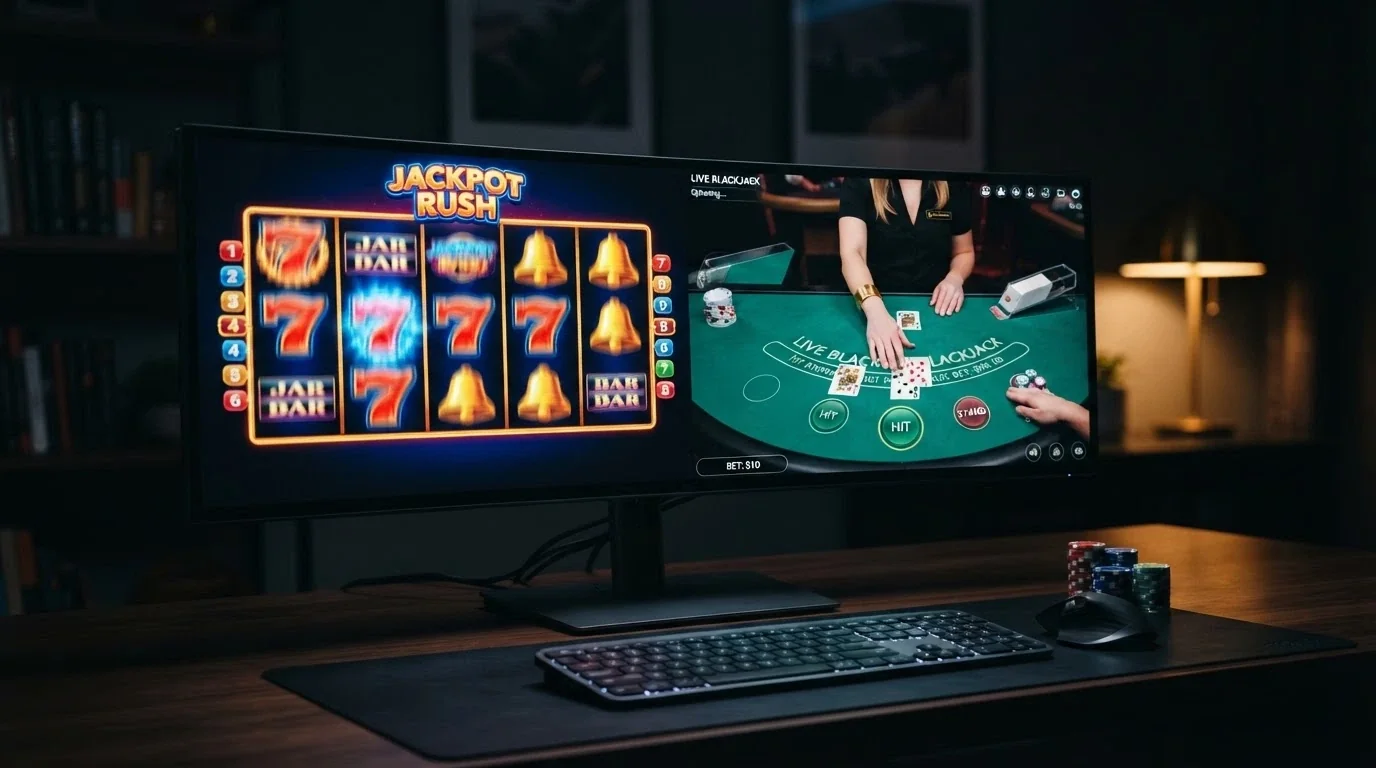
The structural point is that ETH casinos do not invent games. They license the same slot catalogues and live dealer studios that the licensed AU wagering market (and the rest of the offshore world) license. Pragmatic Play, Evolution, NetEnt, BGaming and a handful of crypto-native providers make up the bulk of the catalogue. The only ETH-specific game category is “provably fair” originals — in-house games where the player can verify the outcome hash against the casino’s seed. BC.Game is the named operator in this set with a strong provably fair catalogue.
Slots and Pokies — The ETH Casino Mainstay
The slot library at the operators in this set runs into the thousands. The bulk are the same titles a player would find at any large offshore casino: Book of Dead, Gates of Olympus, Sweet Bonanza, Elvis Frog in Vegas, and the rest of the BGaming/Pragmatic/NetEnt catalogue. Elvis Frog in Vegas at 7Bit sits in the 95% RTP range. That figure is the rare instance of a named RTP the player can read off the page before staking.
RTP in practice is a long-run statistical average, not a per-session promise. A 95% RTP slot returns A$0.95 per A$1.00 wagered across millions of spins; in a 1,000-spin session, the player can be anywhere on the distribution. For a player grinding a bonus, RTP sets the long-run cost of clearing turnover — a 95% RTP slot costs 5% of turnover in expected loss, which is the number the expected-loss calculation would produce if the calculation were run. The calculation is not run on this page because research does not carry the stake-per-spin figure it would require.
Volatility is the slot characteristic that matters for bonus clearing more than RTP. A high-volatility slot pays out rarely and in larger amounts; a low-volatility slot pays out often and in smaller amounts. For a player clearing a 35x bonus with a A$5 max bet, high volatility means longer stretches of zero returns punctuated by larger wins — which is exciting and which burns through a bankroll faster than low-volatility play of the same RTP.
Live Dealer, Blackjack, and Roulette
Live dealer rooms at the operators in this set are typically Evolution, Pragmatic Play Live, or a smaller studio like Vivo Gaming or Ezugi. The ETH betting flow at a live table is the same as the fiat betting flow — the player stakes in the operator’s internal balance unit, the dealer spins the wheel or deals the hand, and the result settles to the balance. The ETH shows up at the cashier, not at the table.
Blackjack and roulette variants are standard: European roulette, American roulette, single-deck blackjack, multi-hand blackjack, and the live-game-show genre (Dream Catcher, Monopoly Live, Crazy Time) that has eaten a meaningful share of the live dealer traffic at every operator that runs it. Game provability is the structural difference from fiat-only live dealer. Live dealer games cannot be “provably fair” in the crypto sense — the outcome is a physical event filmed in a studio — but the underlying randomisation is RNG-driven and the studio’s regulator audits it. The honesty standard is the studio’s regulator, not the casino’s.
How We Evaluated and Ranked These Ethereum Casinos
The ranking is built from three sources. The first is published bonus terms — the wagering multiple, the bet cap, the validity window, the deposit+bonus-versus-bonus-only structure. The second is per-operator tested ETH payout data, drawn from SlotsPeak, Betsquare, Pokie.inc and CasinosHub, where each operator has a recorded ETH deposit or withdrawal time. The third is the licensing status, which determines whether the operator is connected to any regulatory framework the player might rely on for recourse.
The official sources consulted for this article include the Australian Communications and Media Authority’s published blocklist data and enforcement record (1,564 sites blocked since November 2019, 225+ services withdrawn since 2017), the Interactive Gambling Act 2001 as the statutory backbone, and BetStop as the responsible-gambling benchmark for what the offshore market does not cover. Operator-specific data was cross-referenced across SlotsPeak, Betsquare, Pokie.inc, CasinosHub, CryptoSlate, ClearCasinos, ChainBankroll, AustraliaCasino.reviews, WagerBureau and TheNationOnline.
The limitations of the review are real and worth naming. Bonus terms change frequently; the figures in the table are current to the data-collection date and may shift. Tested payout times are point-in-time measurements; an operator that posted a 3-minute payout in one session can run a 30-minute queue at peak. The licensing status is the operator’s own claim of Curaçao or Anjouan oversight; the player cannot verify it against an Australian register because no Australian register for this product exists. A reader comparing these operators against a fresh set of bonus terms is comparing apples to whatever the operators updated last week.
Your Move — What an Australian Player Should Actually Do About ETH Casinos
The trade-off is the article. ETH gives the fastest and cheapest deposit rail available to an Australian gambler, and it does so by routing the transaction outside the Australian banking system entirely. That same routing is what confirms the operator is unlicensed, unregulated and outside the reach of ACMA, BetStop and Australian consumer law. There is no version of this trade-off where the player gets the speed and the protection; the speed is the protection being absent.

For a player who has decided to use offshore ETH casinos regardless, the responsible-gambling infrastructure still exists. BetStop covers licensed Australian wagering operators and does not extend to any casino in this review; a BetStop registration does not stop an offshore casino from taking deposits. The National Gambling Helpline (1800 858 858) is free, confidential, 24/7, and applies regardless of whether the gambling is licensed or not. Gambling Help Online offers chat and counselling. Problem gambling affects about 2.1% of Australian adults — roughly 430,000 people — and the cohort skews younger: 78% of BetStop registrants are under 40, and 38% of registrants chose lifetime exclusion.
From 1 January 2027, Australian banks gain express authority to block transactions to illegal gambling operators. That changes the deposit side of the equation for any player whose bank chooses to enforce the block. It does not change the casino’s willingness to take ETH. It adds a layer of friction between the player and the cashier that the player can route around with a different bank or a non-bank on-ramp, and that the bank can choose to enforce or not. The 2026 reform is a tightening of the screws, not a closing of the door.
The informed-choice framework is the only one this article can honestly offer. An Australian player using an ETH casino is making a choice between the speed and privacy of the Ethereum rail and the consumer protections of the Australian regulatory framework. The two cannot be combined. The casino cannot be both offshore and Australian-licensed. The deposit cannot be both crypto and inside the ACMA blocklist. The player is choosing the rail, and the rail determines the protections. What that choice is worth is for the player to decide.
Frequently Asked Questions
Is it legal for Australian players to use Ethereum at online casinos?
The Interactive Gambling Act 2001 prohibits the supply of online casino games to people in Australia. The Act targets the operator, not the player, so using an offshore ETH casino is not a prosecuted offence for an Australian resident. The casino itself is operating illegally in Australia; the player is using an illegal service without a licensed alternative to use instead.
Are Ethereum casino winnings taxable in Australia?
Gambling winnings are generally not assessable income under section 6-5 of the ITAA 1997, unless the player is operating as a professional gambler running a business. For a recreational player, ETH casino winnings are treated the same as any other gambling win — tax-free at the federal level, with state-level obligations applying only in business-like circumstances that the typical player does not meet.
Can I claim a welcome bonus if I deposit with Ethereum?
Most welcome bonuses at the operators in this set accept ETH deposits, but some exclude crypto deposits from the headline offer. The bonus terms — wagering multiple, bet cap, validity window — apply the same way regardless of deposit method. Crypto-specific exclusions are operator-by-operator and should be checked in the bonus terms before the deposit is made.
What happens if an Ethereum casino blocks Australian IPs?
Some offshore casinos — Roobet under Curaçao OGL/2024/687/0427 is the named example — explicitly block Australian players in their terms of service. A blocked IP means the player cannot load the site from Australia without a VPN, and using a VPN to bypass a geo-block typically violates the casino’s terms and can result in forfeited winnings. Casinos that accept Australian players do not impose this block; the casinos listed in this article do not.
Are there extra fees for using Ethereum on casino sites?
The casino side is typically free for crypto deposits and withdrawals, but the player pays Ethereum network gas fees on every transaction. On Ethereum Mainnet, gas can spike above A$10 during busy periods and erode a meaningful percentage of small deposits. On Layer-2 networks like Arbitrum, Optimism or Polygon, the same transaction costs cents — LuckyDreams is the operator in this set that supports all four networks.
How does the 2026 Australian gambling reform affect crypto casinos?
The Interactive Gambling Amendment (Gambling Reform) Bill 2026 takes effect on 1 January 2027 and gives Australian banks express authority to block transactions to illegal gambling operators. The reform does not change an offshore casino’s willingness to accept ETH; it changes whether an Australian bank will process the on-ramp. The reform also tightens advertising rules — a “triple lock” requiring logged-in, 18+ and opt-out status for wagering ads — and bans inducements for 14 days after sign-up and three months after BetStop deregistration.