
$20 Minimum Deposit Casinos in Australia — A Honest Offshore Read in 2026
Current as of 25 October 2026, verified against ACMA’s Interactive Gambling Act register and the licence pages of the operators named below.
Twenty dollars opens the door at almost every offshore casino that takes Australian players. It is small enough to feel disposable, which is one reason so many Australian punters arrive at these sites without reading the welcome terms. This page covers what A$20 actually buys, which operators take it, and which Australian consumer protections stop at the waterline.
No brand on this page holds an Australian licence for online casino games. Online casino, online pokies and in-play betting are prohibited services under the Interactive Gambling Act 2001. The Australian Communications and Media Authority enforces the prohibition, and over 1,751 offshore sites have been blocked at ISP level since November 2019. Every casino below operates offshore, holds a Curaçao or equivalent permit, and serves Australian players from outside the country. None of them can be recommended as a place to play — they are described so the reader can compare what the offshore market offers, not so the reader can be sent to one of them.
Table of Contents
- Why a $20 Deposit Opens Every Offshore Casino Door (and What Stays Shut)
- How Your Deposit Method Already Tells You Who You’re Dealing With
- Where Your $20 Goes Furthest — 10 Offshore Casinos AU Players Are Using in 2026
- What 7,000+ Pokies Actually Means for a $20 Bankroll
- 73% of Sessions Happen on a Phone — Here’s What That Means for a $20 Deposit
- New $20-Deposit Casinos: Fresh Brands, Same Offshore Reality
- No Australian Casino Licence Exists — Here’s What’s Actually Legal
- The Help That Exists — and the Protection That Doesn’t Reach Offshore
- How We Tested 28 AU-Facing Sites with Real A$20 Deposits
- Your $20, Your Call — What This All Adds Up To
- Frequently Asked Questions
Why a $20 Deposit Opens Every Offshore Casino Door (and What Stays Shut)
A$20 is the working entry point of the offshore casino market for Australian players. It is small enough that marketing teams build their welcome offers around it, and large enough that the cashier accepts it without sending the player to a separate low-deposit page. Below the $20 mark, you start running into A$10 minimums and no-deposit sweeteners; above A$30, you cross the threshold where most welcome bonuses actually unlock. The reason a $20 deposit opens every door is the same reason none of these doors has an Australian lock on it. Online casino is illegal here, the local product does not exist, and what fills the gap is an offshore market that competes on minimum deposit, bonus size and game library. A$20 happens to be the price the market has settled on for “small enough that the punter does not think twice.”
What the Interactive Gambling Act Means for a $20 Deposit
The Interactive Gambling Act 2001 is the short piece of legislation that makes the rest of this page necessary. The IGA prohibits the provision of online casino games, online pokies and in-play sports betting to a person physically in Australia. The provider is the target — the offshore casino, not the Australian punter — but the practical consequence for the player is the same as if they had been targeted. No Australian consumer protection applies, no ACMA complaints pathway exists, and no Australian court has reliable reach into an offshore operator’s bank account.
ACMA has enforced the prohibition since 2017, and the numbers show how the front has moved. Since November 2019, 1,751 illegal gambling and affiliate marketing websites have been blocked by Australian ISPs. Over 230 unlicensed gambling services have exited the Australian market over the same period. The current tool is DNS-level blocking, which the offshore operators work around with mirror domains and rotating URLs — a cat-and-mouse pattern that does not change the legal position of the player using them.
The dollar amount of your deposit does not change any of this. A$20 does not become legal because it is small. Offshore does not become Australian because the cashier accepts PayID. The IGA framework applies to the provider, not to the size of the deposit.
Real-Money Play at the $20 Tier — What That Actually Gets You
A $20 deposit triggers real-money play at every offshore casino in this comparison — you are not playing for pretend credits, and any winnings land in a real-money balance subject to the operator’s terms. What it usually does not trigger is the full headline welcome offer. Welcome packages of 200% to 450% are spread across four or five deposits, with the $20 deposit unlocking only the first tier.
SkyCrown’s 450% welcome runs across four deposits with a A$20 minimum on the first. A single $20 deposit unlocks the first-deposit tier only, and the full A$8,000 ceiling requires three more top-ups. Royal Reels keeps it simpler: a 100% match up to A$500 on a single $20 deposit, so the first deposit triggers the full match in one go. RocketPlay sits above the search — its first deposit bonus requires A$30, so a $20 deposit at RocketPlay does not trigger the 100% match at all.
The gap between “real money” and “welcome bonus” matters. A $20 deposit at RocketPlay puts A$20 of your own money into a real-money balance, but the 100% match stays locked on the cashier page until you top up to A$30. This is the kind of detail affiliate reviews often bury in their summary tables, and it is also the kind of detail that decides whether the welcome banner applies to your deposit at all.
The Withdrawal Trap: Why Cashing Out Costs More Than Getting In
The minimum deposit at most offshore casinos sits between A$10 and A$30. The minimum withdrawal at the same operators routinely sits between A$50 and A$150, and the gap between those two numbers is where the offshore model makes its quiet margin on small depositors.
The pattern works like this. You deposit A$20, you play, you hit a small win — say A$40 — and you try to cash out. The cashier refuses because the withdrawal floor is A$100. You play A$40 more to clear the floor, you hit another win, and you withdraw A$120. The operator has now collected A$60 in additional turnover it would not otherwise have seen, and you have spent an hour and a half playing in order to withdraw. Had you deposited A$100 in the first place, the same win would have walked out the door in one transaction.
The research base does not carry per-operator minimum-withdrawal figures, but the pattern is consistent across the offshore market. Before depositing A$20, the move is to check the cashier terms for the minimum withdrawal, the maximum withdrawal per transaction, and the fee structure on smaller payouts. Some operators charge a flat fee on withdrawals below A$200; others refuse them outright. Those terms are usually hidden in a footer link called Payments or Banking, not on the welcome bonus banner.
How Your Deposit Method Already Tells You Who You’re Dealing With
The payment screen at an offshore casino is an honesty check the welcome page is not. The IGA makes the product illegal; the 2024 payment ban makes the deposit route equally regulated. A gambling site that accepts credit cards or cryptocurrency from a person in Australia is operating outside the rules that govern licensed Australian wagering operators, and that fact tells you everything you need to know about who you are sending money to.

Since 11 June 2024, credit cards, credit-related products and digital currency have been banned as payment for online wagering in Australia under the Interactive Gambling Amendment (Credit and Other Measures) Act 2023. The penalty for an operator that fails to enforce the ban is up to A$247,500 per breach. From 1 January 2026, banks and payment providers gain express authority to block transactions to illegal gambling operators — which means a credit card deposit that worked in 2026 may fail at the bank in 2026 without any change to the casino’s own systems.
PayID, Debit Cards and Bank Transfer — The Routes That Fit the Rules
A licensed Australian wagering operator — the kind that takes bets on horse races and pre-event sport, not the offshore casino kind — runs on PayID, Osko, debit card, BPAY and direct bank transfer. These are the payment methods an Australian player is used to seeing in everyday banking, and they are the methods the Interactive Gambling Act framework was built to police.
PayID deposits clear in seconds through the New Payments Platform, which is why PayID is the deposit method most commonly offered at the A$20 tier for the offshore operators that have bothered to integrate Australian rails. Debit card deposits clear through the regular card networks and the bank processes them as debit transactions, not credit — the distinction matters under the 2024 ban. Bank transfer and BPAY are slower, often 24 hours to clear, but they are the methods that most clearly signal that the operator knows what an Australian bank account looks like.
A site that offers PayID and debit card and nothing else is signalling that it has built a deposit screen for the Australian market. Whether that screen sits on an Australian-licensed wagering operator or on an offshore casino is the question the rest of this page answers.
Credit Cards and Crypto at the Deposit Screen — Here’s What That Means
A site accepting Visa or Mastercard credit deposits, or Bitcoin or Ethereum deposits, from an Australian customer is operating outside the rules. That is the unambiguous consequence of the 2024 ban, and it is the single clearest tell that a casino is offshore and unlicensed.
The offshore operators still offer these methods because the ban targets Australian-licensed operators, and an offshore operator with a Curaçao permit is not subject to Australian law. From the operator’s perspective, taking a credit card deposit from an Australian punter is not a violation it can be penalised for inside its own jurisdiction. From the punter’s perspective, it is a deposit that may fail at the bank, may fail at the card network, and may fail to reverse cleanly if the operator refuses the withdrawal on the other end.
The practical risk runs in two directions. A credit card deposit routes through your card’s chargeback system, which is one of the few consumer protections that does follow an offshore casino — most card issuers will refund a disputed gambling transaction if the merchant refuses delivery. The second direction is the worse one: handing credit card details to an unregulated operator that stores them against future fraudulent use is a risk no regulated operator in any market would expect a player to take.
Where Your $20 Goes Furthest — 10 Offshore Casinos AU Players Are Using in 2026
The table below compares the ten offshore casinos Australian players are depositing A$20 into during 2026, on the terms that matter at this deposit tier. Operators are listed in the order the plan’s editorial weighting places them, with partner-tier brands first. Every brand in this table operates under a Curaçao Gaming Control Board permit and is not licensed by any Australian regulator. The comparison is descriptive, not an endorsement.

| Operator | Licence / Status | Welcome Bonus | Wagering | Free Spins |
|---|---|---|---|---|
| SkyCrown | Curaçao GCB (OGL/2023/176/0095), offshore, NOT AU-licensed | 450% up to A$8,000 over 4 deposits | 40× bonus | 400 FS (Wolf Treasure, Coin… by IGTech) |
| RocketPlay | Curaçao, offshore, NOT AU-licensed | 100% up to A$1,000 (1st dep, min A$30) | 40× bonus | 100 FS (Aztec Magic / Big Bass Splash) |
| Royal Reels | Curaçao, offshore, NOT AU-licensed | 100% up to A$500 + A$10 no-deposit bonus | 35× bonus | 50 FS welcome |
| WinSpirit | Curaçao, offshore, NOT AU-licensed | 200% welcome bonus | 40× | 25 FS |
| Fair Go | Curaçao, offshore, NOT AU-licensed | 100% up to A$200 × 5 deposits | 30× (deposit + bonus) | n/a |
| Bizzo Casino | Curaçao, offshore, NOT AU-licensed | 100% up to €100 + 100 FS (min A$25) | 40× | 100 FS |
| Rainbet | Curaçao, offshore, NOT AU-licensed; crypto-focused | 100% + 20 FS (1st dep, min US$30) | 40× (deposit + bonus) | 20 FS (Sweet Bonanza) |
| Stake | Curaçao, offshore, NOT AU-licensed; crypto-only | No welcome bonus | n/a | n/a |
| Scream Casino | Curaçao, offshore, NOT AU-licensed | — | — | — |
| Rocket Casino | Curaçao, offshore, NOT AU-licensed | — | 45× (50× over $100) | — |
Three things stand out before the operator write-ups. Every brand here operates under a Curaçao permit — none holds an Australian licence, and the IGA prohibits the product they sell. The wagering multiples cluster at 35× to 45×, with only Fair Go breaking the band at 30×; the headline bonus number means nothing without the multiple sitting two lines below it. Four of the ten brands do not publish complete bonus terms publicly, which is itself a signal worth noting.
SkyCrown
SkyCrown runs the largest game library in this comparison — 10,600+ games, more than 7,000 of which are pokies — under Curaçao GCB licence OGL/2023/176/0095. The welcome package is 450% deposit match up to A$8,000 plus 400 free spins across four deposits, with a A$20 minimum on the first deposit. Wagering is 40× on the bonus amount and 30× on free-spin winnings; the max bet during wagering is A$5.
The 450% headline is one of the largest in the offshore market, and the marketing teams know it. What the headline does not show is that the package spreads across four deposits — the first A$20 unlocks the first-deposit tier only, and the full A$8,000 ceiling requires three more deposits at the same minimum. The 7,000+ pokies figure is real, drawn from Pragmatic Play, Play’n GO, IGTech, Hacksaw and Nolimit City, but the volume matters less than the RTP distribution across those titles.
For an Australian player with a $20 budget, SkyCrown is the breadth play: a deep lobby, a large welcome package, and a 40× wagering multiple that sits in the middle of the band. It is a sensible starting point for a comparison, not an endorsement — every term applies on the operator’s side, not the player’s.
Royal Reels
Royal Reels sets the lowest entry point in this comparison — a A$10 minimum deposit, undercutting the $20 search entirely. The first deposit match is 100% up to A$500 with 35× wagering on the bonus, and new sign-ups receive an A$10 no-deposit bonus on registration. The game library sits at 2,000+ titles across 30+ providers, including Pragmatic Play, Evolution Gaming, Yggdrasil and Hacksaw.
The 35× wagering is the headline here. Most offshore welcome bonuses sit at 40× to 45×; Fair Go at 30× is the only brand in this comparison that beats Royal Reels on the multiple, and even then Fair Go’s terms apply to the combined deposit and bonus rather than the bonus alone. An A$20 deposit at Royal Reels triggers the full 100% match in one transaction and unlocks A$20 in bonus funds against a A$700 turnover requirement — a smaller house grind than most competitors.
The A$10 no-deposit bonus is a small sweetener and a marketing tell: it exists to draw the player through the registration flow before they reach the cashier, and it carries its own wagering terms separate from the deposit match. The provider mix is broad enough to cover most categories a punter will want — pokies, live casino, table games — without SkyCrown’s volume.
Fair Go
Fair Go is the Real-Time Gaming specialist in this comparison, running a 280-game library and a 30× wagering multiple that is the lowest in the set. The welcome offer is 100% up to A$200 on each of the first five deposits — up to A$1,000 total — with a A$10 minimum deposit and 30× wagering on the combined deposit and bonus. There are no free spins in the welcome offer itself, though a 30 free spins no-deposit code runs alongside.
The RTG library is the trade-off. 280 games is small by offshore standards; the pokies catalogue is narrower than the rest of the comparison, and live casino is not the operator’s focus. What you lose in volume you gain in consistency: every title is a known RTG release, and the smaller library makes it harder to wander into a slot whose RTP or bonus mechanics are not yet understood.
The 30× wagering is the most player-friendly multiple in this comparison, and it is the reason Fair Go earns its place despite the smaller library. The five-deposit structure spreads the value over multiple top-ups rather than front-loading it on the first deposit, which is a different marketing model from Royal Reels’ single-deposit match. For an Australian player who plans to deposit more than once, Fair Go rewards loyalty through terms rather than headline percentages.
RocketPlay
RocketPlay sits above the $20 search — its first deposit bonus requires A$30, not A$20 — but earns its place because the second deposit offer at 200% up to A$1,000 (with a A$75 minimum) is one of the larger reloads in the offshore market. The first deposit is 100% up to A$1,000 plus 100 free spins, with 40× wagering on the bonus, a A$7.50 max bet during wagering, and free-spin winnings capped at A$5,000. The bonus slots are Aztec Magic (BGaming) and Big Bass Splash (Pragmatic Play).
For a player with only A$20 to deposit, RocketPlay’s first deposit bonus does not trigger — the cashier will hold the A$20 as real-money play without the match. This is the $20 trap: you can play at RocketPlay with $20, but the welcome banner does not apply to your deposit. A$30 is the floor where the marketing offer begins to match the reality.
The A$5,000 free-spin win cap is the other thing to read carefully. A high-volatility slot like Big Bass Splash can produce wins in that range, and the cap cuts off the upper end of the distribution. The cap is not unique to RocketPlay — most offshore operators carry some FS win limit — but A$5,000 is on the higher side, which is one reason the offer still works despite the A$30 floor.
WinSpirit
WinSpirit runs a 200% welcome bonus plus 25 free spins at 40× wagering, with a game library of 1,000+ titles and a wider promotional ecosystem around tournaments, cashback and a loyalty program. The operator holds a Curaçao licence and is offshore — not Australian-licensed.
The 200% welcome is larger than Royal Reels’ 100% or Fair Go’s 100% on the first deposit, which means a $20 deposit unlocks A$40 in bonus funds against an A$1,600 turnover requirement. The smaller 25 free spins count is the trade-off — most other operators in this comparison ship 50 to 100 free spins on the first deposit.
Where WinSpirit earns its place is the recurring promotional calendar. Tournaments, cashback and a loyalty program are not unique in the offshore market, but the regular cadence gives a player who plans to deposit across multiple weeks something to come back to beyond the welcome banner. For a $20 player, the welcome offer is a one-shot; for a player who intends to keep playing, the calendar matters more than the headline.
Bizzo Casino
Bizzo runs a 100% welcome bonus up to €100 (around A$165 at recent rates) plus 100 free spins at 40× wagering, with a A$25 minimum deposit and an A$8 max bet during wagering. The no-deposit bonus carries a A$75 max cashout, which is one of the more specific terms in this comparison.
The A$25 minimum just clears the $20 search — a $20 deposit does not trigger the match, but a top-up of -denominated cap is a small but real consideration for an Australian player, since the bonus value moves with the AUD/EUR rate. A$8 max bet during wagering is higher than SkyCrown’s A$5 and RocketPlay’s A$7.50, which gives more room to play higher-stake pokies while clearing the bonus.
The A$75 no-deposit max cashout is the term to read most carefully. Any winnings from the no-deposit portion above A$75 are typically forfeit, and the A$75 ceiling is one of the lower caps in this comparison. For a player who registers at Bizzo to claim the no-deposit bonus, that cap is the number the session is built around.
Rainbet
Rainbet is the crypto-focused operator in this comparison, with a three-deposit welcome package and a unique RTP exclusion clause. The structure is 100% match plus 20 free spins on the first deposit, 50% plus 20 free spins on the second, and 100% plus 20 free spins on the third. Wagering is 40× on the combined deposit and bonus. The minimum deposit is US$30, the max bet is 2% of the deposit amount, and slots with RTP above 97.4% are excluded from bonus play.
The exclusion clause is unusual. Most offshore casinos do not exclude high-RTP slots from bonus play; Rainbet does, which means a player chasing a low house edge cannot use bonus funds on those titles. The clause reflects Rainbet’s awareness that high-RTP slots change the bonus economics — and the operator’s decision to protect the offer against that change.
For an Australian player with $20 to deposit, Rainbet’s US$30 minimum deposit puts the operator above the search. The crypto focus is the bigger barrier: a $20 AUD deposit is not the natural funding path, and converting to crypto adds friction that the other operators in this comparison do not impose.
Stake
Stake is a crypto-only casino operating under a Curaçao licence, with no traditional fiat welcome bonus and no free spins. The operator’s value proposition is a rakeback system and regular reloads, not a sign-up match. There is no minimum deposit in AUD terms because there is no AUD deposit.
For a player with a $20 bankroll, Stake is the operator to understand rather than the operator to play. A$20 in crypto at current rates is a small crypto amount — meaningful at micro-stakes, vanishing at the live casino tables the operator runs. The rakeback system returns a percentage of house edge on every wager, which is the right model for a high-volume player and the wrong model for a $20 one-shot.
The absence of a welcome bonus is the honest signal. Stake does not market to the $20 tier because the $20 tier does not pay for the marketing. Where Stake does pay is in the live casino ecosystem and the sports betting product, neither of which is the subject of this page.
Scream Casino
Scream Casino holds 0.99% of the Australian-facing offshore market by revenue — A$94.87M — which is the largest AU-facing footprint of any operator in this comparison for which public bonus terms are sparse. The operator runs under a Curaçao licence.
The market share figure is what the operator has to show. Welcome bonus terms, free spin counts, wagering multiples and max bet caps are not publicly confirmed for Scream Casino in the research base, which is itself a signal — operators with strong bonus terms publish them, and operators that do not publish them are asking the player to register before they find out. For a player with $20 to deposit, that asymmetry is worth taking seriously.
The 0.99% figure says two things. Enough Australian players deposit at Scream Casino to put it ahead of most competitors by revenue. None of the terms of that relationship are visible from the outside until the player has registered and made the first deposit. That is not a position to recommend a reader into; it is a position to describe so the reader understands what the operator’s market footprint looks like.
Rocket Casino
Rocket Casino runs 45× wagering on welcome bonuses with a A$5 max bet limit, and as of September 2026 tightened its terms further: deposits over A$100 now require 50× wagering. The escalation is a clear signal that the operator’s bonus economics shifted in 2026, and that larger deposits now face a steeper play-through requirement than smaller ones.
The 45× baseline is on the higher end of the offshore band. Royal Reels at 35× and Fair Go at 30× are the player-friendly comparators; SkyCrown, RocketPlay, WinSpirit, Bizzo and Rainbet all sit at 40×. Rocket Casino at 45× is the most expensive welcome offer in this comparison per dollar of bonus, and the September 2026 change pushes it further in the same direction.
For a $20 deposit, the A$100 escalation threshold does not apply — the 50× multiple only kicks in above A$100. A $20 deposit at Rocket Casino triggers the 45× bonus wagering on whatever bonus the operator offers at that tier, against a A$5 max bet cap. The terms are tighter than the cluster, but they are at least published.
What 7,000+ Pokies Actually Means for a $20 Bankroll
Game library size is the marketing number every offshore casino leads with, and SkyCrown’s 7,000+ pokies is the largest figure any operator in this comparison publishes. The number is real and the depth is genuine — Pragmatic Play, Play’n GO, IGTech, Hacksaw and Nolimit City together produce more slot titles in a year than most players will ever play. None of this matters at the $20 tier unless the maths of how long that bankroll survives on the reels works out.

Across the tested Australian-facing sites, average slots RTP ranges from 94.2% to 96.8%. That is the long-run return across thousands of spins, not a session number, and the gap between the high and low end of the band is roughly 2.6 percentage points. On a $20 bankroll, that band determines whether the session ends with A$10 or with A$0.
How Far a $20 Note Goes on the Reels
At a stake of $0.20 per spin, a $20 bankroll buys 100 spins. At $0.40 per spin, 50 spins. At $1.00 per spin, 20 spins. A typical pokies spin takes around 5 seconds including the bonus feature animation, which puts a $0.20-stake session at roughly 8 minutes and a $1.00-stake session at under 2 minutes. The arithmetic is brutal and honest — a $20 deposit at $1.00 a spin is a six-minute experience, regardless of how many pokies the lobby holds.
The expected loss on a $20 bankroll depends on RTP and stake. Take a 95% RTP midpoint of the 94.2% to 96.8% band, and a $0.40 stake: 50 spins at $0.40 is A$20 in wagered money, and the expected loss across those 50 spins at 95% RTP is A$1. The same 50 spins at 94.2% RTP cost A$1.16 in expected loss; at 96.8% RTP, the expected loss is A$0.64.
Now stack that on top of a bonus. A $20 deposit triggers a 100% match, giving A$20 in bonus funds against 40× wagering — A$800 in required turnover. At the 95% RTP midpoint, the expected loss across the bonus clearing is A$40. The bonus pays its full value only if the player is willing to lose twice the bonus amount on the way to clearing it, and the A$5 max bet during wagering at most operators extends the clearing time across hundreds of spins. The bonus’s real cost, in other words, is roughly A$40 in expected house edge for an A$20 deposit with a 100% match and 40× wagering at the 95% RTP midpoint.
That is the figure the welcome banner does not print. It is the figure that makes the size of the offer beside the point. A punter who can sustain A$40 of expected loss to clear A$20 of bonus is a punter who would have lost the A$20 anyway; a punter who cannot is paying for the privilege of giving it back.
This is a statistical estimate — an average across many spins under the stated assumptions, not a guaranteed outcome for any single player. No one on any individual session will see these numbers realised on the screen: variance swings both ways, and a single session can end anywhere from A$0 to a multiplier of the bankroll. The estimate frames what the bonus costs over the clearing period, not what any one player walks away with.
RTP, Volatility and Why Your Balance Disappears Faster Than the Maths Suggest
RTP is the long-run return to player across thousands of spins. Volatility is the shape of the distribution around that average. A 96% RTP slot at high volatility will produce longer losing streaks and more infrequent wins than a 94% RTP slot at low volatility, even though the long-run return favours the high-RTP title. On a $20 bankroll, the player feels volatility more sharply than RTP — the difference between 94.2% and 96.8% RTP is roughly A$1.16 versus A$0.64 of expected loss across 50 spins at $0.40, but the difference between a high-volatility and low-volatility game is whether your $20 lasts 20 spins or 60.
This is why the high-volatility pokies — Buffalo King, Big Bass Splash, Gates of Olympus — are dangerous at the $20 tier despite offering headline payout potential of thousands of times the stake. The bonus feature triggers once every 100 to 200 spins on average; on a $20 bankroll at $0.40 a spin, the player runs out of money before the bonus feature arrives. The 96% RTP figure on the paytable refers to a player who can sustain 10,000 spins at that stake, not a $20 one-shot.
The pattern repeats at every stake level. The pokies with the largest max-win potential sit at high volatility, and the bonus features that produce those wins fire rarely enough that a $20 bankroll is statistically unlikely to reach them. The 96% RTP is true; the session ending in A$0 after 50 spins is also true; both are correct, and only one of them shows on the cashier screen.
The Titles That Keep Appearing in AU-Facing Lobbies
Wolf Treasure (IGTech) is the slot SkyCrown names in its 400 free spins welcome, and it appears across most AU-facing lobbies because IGTech builds titles with that audience in mind. The game is a 5-reel, 25-line pokie with a hold-and-spin style bonus feature; the volatility is medium, the RTP sits in the mid-90s, and it runs at low minimum stakes suitable for the $20 bankroll.
Aztec Magic (BGaming) and Big Bass Splash (Pragmatic Play) are the bonus slots at RocketPlay, and both anchor free spin offers across the offshore market. Aztec Magic is a high-volatility title with a 5,000× max win and a free spin feature with expanding wilds. Big Bass Splash is the sequel in Pragmatic’s fishing series, with a 5,000× max win and a hold-and-spin style money symbol feature.
Sweet Bonanza (Pragmatic Play) is the Rainbet bonus slot and a fixture in AU-facing lobbies at every tier. The game uses a tumble mechanic and a free spin round with multipliers up to 100×; the volatility is high, the RTP is 96.5%, and the max win sits at 21,100× the stake. On a $0.20 stake, the max win is theoretically A$4,220, which is the kind of figure the welcome banner loves to print.
These titles anchor the AU-facing free spin offers because they are well-known, high-traffic games with broad appeal. The fact that they appear at multiple operators does not change the volatility profile, the RTP or the bonus economics — only the brand name on the cashier page.
73% of Sessions Happen on a Phone — Here’s What That Means for a $20 Deposit
Mobile is the default for Australian casino sessions. 73% of sessions happen on a phone, which means the deposit flow, the game lobby and the cashier all need to work on a six-inch screen. The number comes from a single test pool, so it carries the usual caveats around how the data was collected, but the directional read is correct: the average Australian casino player is not sitting at a desktop.
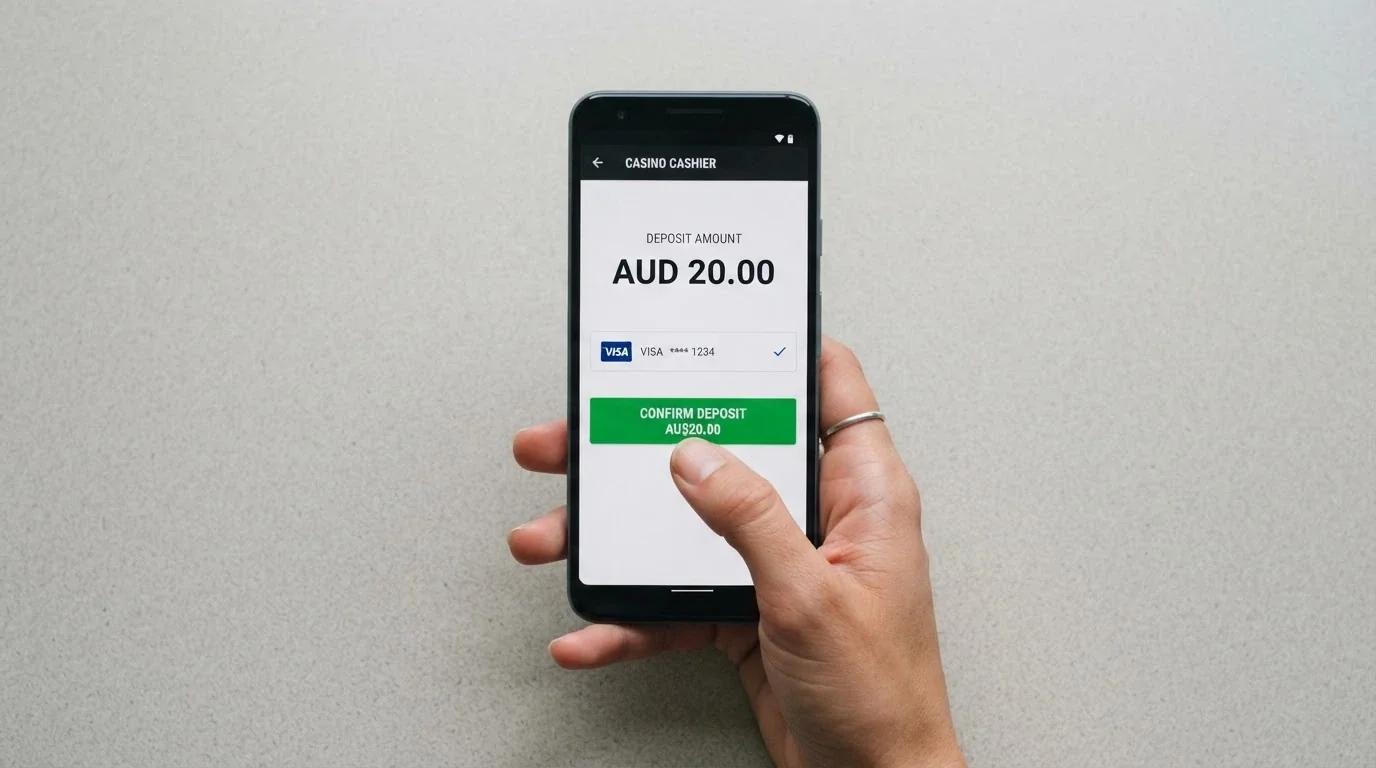
For a $20 deposit, the mobile experience has to clear three checkpoints. The deposit screen has to handle PayID or debit card input without breaking the bank authentication flow. The game lobby has to load on mobile data without timing out. The cashier has to display the bonus terms and the wagering progress in a way that the player can actually read on a phone screen.
What a Mobile-First Casino Gets Right (and Wrong) at the $20 Tier
The mobile-first offshore casinos in this comparison have all built their deposit flow around the phone screen first. PayID integration is the clearest signal: a PayID deposit on mobile routes through the phone’s banking app via deeplink, which is faster and cleaner than typing card details into a form field. The withdrawal flow is where the mobile experience usually weakens — typing a bank account number into a phone form is error-prone, and the verification codes that follow are slower to retrieve on mobile than on desktop.
Game load times vary widely. HTML5 pokies load in 2 to 4 seconds on a recent phone over 4G; live casino tables take 5 to 10 seconds to establish the video stream. On a $20 bankroll at $0.40 a spin, a 5-second table load is a 12% drag on session time. Most operators in this comparison handle the load acceptably; the ones that do not are usually running older game shells.
Native apps versus mobile browser is the other practical difference. None of the offshore operators in this comparison ships a native Australian app — Apple and Google’s app store policies exclude real-money casino apps in Australia. What they ship instead is a progressive web app that installs as a homescreen icon but runs in the browser engine. The experience is close to native on iPhone and Android; the giveaway is the URL bar appearing on first load.
New $20-Deposit Casinos: Fresh Brands, Same Offshore Reality
A “new casino” launch date does not change the legal position. The Interactive Gambling Act prohibits online casino in Australia regardless of when the offshore operator launched; a brand that opened in 2026 is no more Australian-licensed than one that opened in 2018. What a launch date does signal is marketing budget — new brands spend heavily on affiliate placement and welcome offers to acquire their first players, which is why the latest $20 deposit listicle always carries a few operators that were not in last year’s version.
The question to ask of a new brand is not “when did it launch” but “what is the licence jurisdiction, who is the operator behind the skin, and what are the bonus terms in the small print.” A new Curaçao permit issued in 2026 carries the same legal weight as one issued in 2022; the IGA does not distinguish.
What’s Actually New — and What’s Just a New Skin
The offshore market runs heavily on white-label operations, where one company holds the Curaçao licence and operates a platform that multiple brand skins sit on top of. A “new casino” launch may be a genuinely new operator building a fresh platform, or it may be an existing operator launching a new brand to capture a slice of the affiliate traffic that the original brand has saturated.
The white-label pattern is hard to spot from the outside. The brand skin carries its own name, its own welcome offer and its own game lobby, but the underlying platform, the payment processing and the customer support may all be shared with two or three other brands. When the underlying operator has tightened its terms at one skin — Rocket Casino’s September 2026 change is a recent example — the sister skins may not change in lockstep.
The due-diligence step that catches the pattern is the licence number. Every Curaçao GCB licence is a public record; if two brands show different licence numbers from the same operator group, they are separate legal entities; if they share a licence number, they are the same operator under different names. The licence number is in the footer of every legitimate offshore casino homepage, and it is the single fact worth verifying before the first deposit.
No Australian Casino Licence Exists — Here’s What’s Actually Legal
Online casino is not licensed in Australia. There is no state or territory regulator that issues a licence for online casino games, online pokies or in-play sports betting. The Interactive Gambling Act 2001, strengthened by the Interactive Gambling Amendment Act 2017, makes the provision of those services to a person in Australia a criminal offence, and ACMA enforces the prohibition. The 1,751 sites blocked at ISP level since November 2019 are the visible record of that enforcement.

What is licensed in Australia is wagering on races and sport placed before the event begins, plus lotteries and keno. Those products are offered by operators licensed by state and territory regulators — the Northern Territory Racing and Wagering Commission is the de facto national licensor for online wagering, with licence terms of up to 20 years. The licensed wagering operators — Sportsbet, bet365, Ladbrokes, TAB — take bets on sport and races; they do not offer online casino games, which is why they are not on this page.
Licensed Wagering vs Offshore Casino — What You’re Actually Comparing
| Player Protection | Licensed AU Wagering | Offshore Casino |
|---|---|---|
| Online casino games / pokies | Not available under AU licence | Available — product prohibited in AU |
| Australian licence | Yes — state/territory regulator | No — Curaçao or other offshore permit |
| BetStop coverage | Yes — register covers ~150 licensed providers | No — BetStop does not bind offshore sites |
| Credit card / crypto deposit | Banned since 11 June 2024 | Available — outside AU payment rules |
| ACMA consumer protection | Yes — complaints pathway, enforceable | No — ACMA has no jurisdiction offshore |
| ISP blocking risk | None — site is legal | Possible — 1,751 sites blocked since Nov 2019 |
The two columns are not equivalent products sold by competitors. One is a licensed product from a regulated operator; the other is an unlicensed product from an operator the Australian regulator cannot reach. The casino games a punter wants to play live only in the offshore column; the consumer protections a punter would want around those games live only in the licensed column. Every deposit at an offshore casino is a choice to take one without the other.
What the 2026 Reform Actually Changes — and What It Doesn’t
The Interactive Gambling Amendment (Gambling Reform) Bill 2026 passed Parliament on 19 August 2026 and its measures commence on 1 January 2026. The reform is the biggest gambling law shift in Australia in a decade, but it deliberately does not legalise online casino. The IGA prohibition stays in place; what changes is the advertising and inducement framework around licensed wagering, and the payment-blocking authority for illegal operators.
The three advertising pillars are a live-sport ad ban (15 minutes before to 5 minutes after the event, between 5am and 8:30pm), a TV ad cap (no more than three wagering ads per hour between 5am and 8:30pm), and a celebrity, athlete and influencer promotion ban. The practical effect is that licensed wagering advertising during an AFL or NRL broadcast will look very different from 1 January 2026 onwards.
The inducement marketing ban closes the door on bonus offers sent by direct marketing to recent sign-ups (14 days), recent BetStop deregistrants (3 months), and customers flagged as at risk of gambling harm (indefinitely). For licensed operators, this kills the deposit-match SMS flow that has been a feature of the AU wagering market for years.
The bank blocking authority from 1 January 2026 gives banks and payment providers express power to block transactions to illegal gambling operators. A credit card deposit that worked in 2026 may fail at the bank in 2026, and the same applies to PayID transfers the bank has identified as routing to an illegal operator. This is the reform with the most direct impact on offshore casino play: the deposit method the player uses is now a bank-level compliance question, not just an operator-level one.
Consumer Protections That Don’t Cross the Water
When an offshore casino refuses a withdrawal, voids a bonus win, or blocks an account, the Australian player has no regulatory recourse. ACMA does not handle complaints against offshore operators, because ACMA has no jurisdiction over a Curaçao-licensed entity operating outside Australia. There is no Australian ombudsman, no Australian dispute resolution service, and no Australian court with reliable reach into an offshore operator’s bank accounts.
BetStop covers roughly 150 licensed Australian wagering providers. It does not cover offshore casinos. A player who has registered with BetStop remains free to deposit at every offshore casino in this comparison, and the offshore casino has no mechanism to check the BetStop register and no obligation to honour an exclusion a player has set up elsewhere. This is the offshore route’s most concrete harm — the harm-prevention infrastructure does not reach the product the offshore operator sells.
The 1,751 blocked sites figure is the other side of the same coin. ACMA can direct ISPs to block an offshore casino’s domains at any time, and a balance sitting on a site that gets blocked this week is unrecoverable through any Australian channel. The blocks are DNS-level and the operators respond with mirror domains, but the legal status of the player on the blocked site does not change.
The Help That Exists — and the Protection That Doesn’t Reach Offshore
Australian responsible-gambling infrastructure is among the best-resourced in the world, but it was built for the licensed market — the wagering operators, the land-based pubs and clubs, the lotteries. The helpline, the counselling services and the self-exclusion register are the right tools for the licensed product. They are not the right tools for the offshore casino product a reader of this page is actually considering.
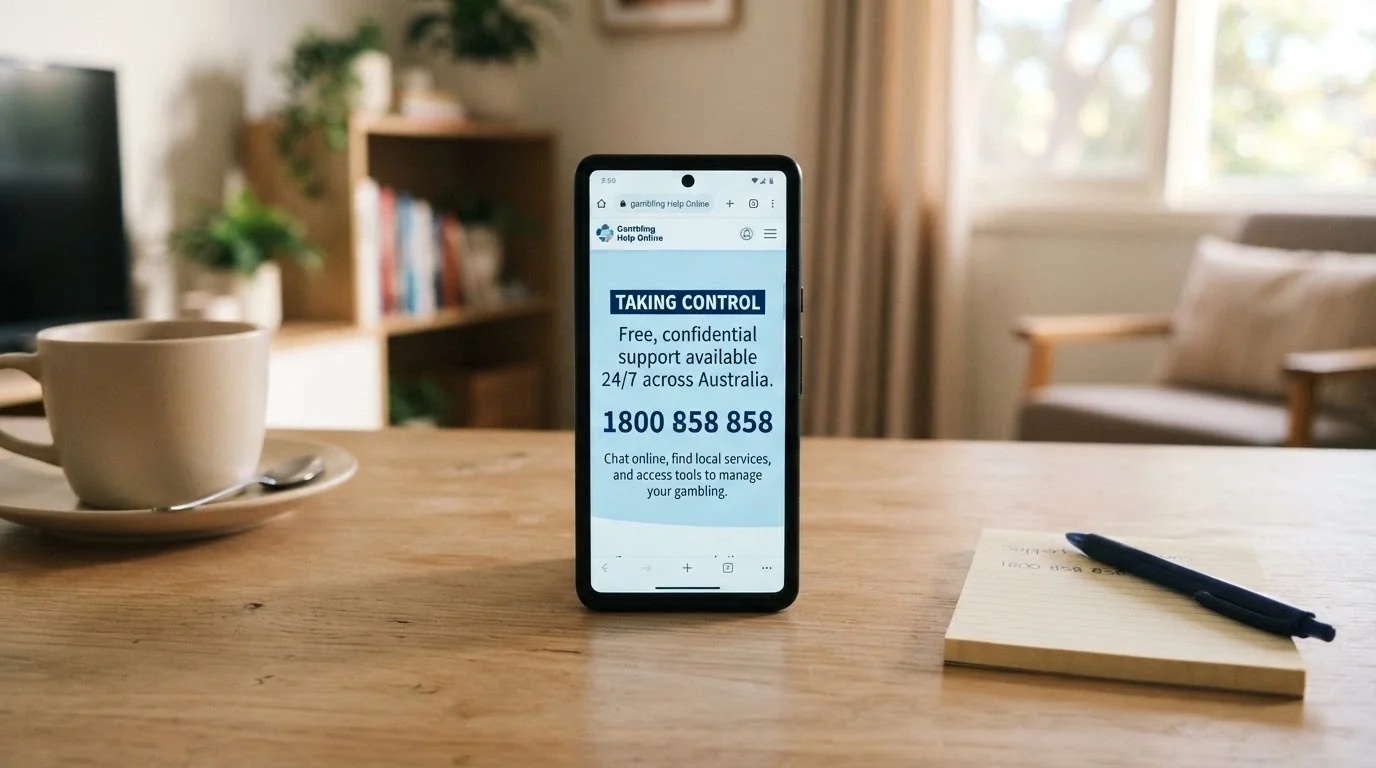
The free, confidential, 24-hour National Gambling Helpline is 1800 858 858. Gambling Help Online runs the web counselling, email support and self-help tools at gamblinghelponline.org.au. BetStop — the National Self-Exclusion Register — runs through the Australian Communications and Media Authority. All three services are free, all are confidential, and all are available regardless of where the player is gambling. The helpline does not check whether the caller is playing at a licensed operator or an offshore casino; it counsels whoever calls.
BetStop — What 65,430 Registrations Tell Us About Australian Gambling Harm
BetStop launched on 21 August 2023. By 30 June 2026, 65,430 Australians had registered. 40,160 of those registrations were active exclusions at that date; 25,155 registrants chose a lifetime exclusion. People aged 40 and under accounted for almost four in every five registrations — a skew that tells its own story about which demographic the self-exclusion register is reaching.
The register covers roughly 150 licensed Australian wagering providers. A BetStop exclusion bars the registered person from those 150 operators and from any land-based venue that runs a state-based exclusion system, but it does not reach the offshore casino market. The offshore casino does not check the register; the offshore casino does not have to.
The choice of a lifetime exclusion by 25,155 of 65,430 registrants — roughly 38% — is the clearest signal in the data that a large share of people registering with BetStop see their gambling as a permanent problem to be walled off, not a temporary pause. A 3-month minimum exclusion is the shortest period; most registrations sit at the longer end of the spectrum, and the lifetime count is the number that gives the register its weight.
Practical Tools That Work Regardless of Licence
Deposit limits, session timers and self-exclusion are behaviours the player can control. The licensed wagering operators offer these at the operator level, and they work — but the offshore casino market has weaker and less consistent enforcement of player-set limits. The most reliable tool at the offshore end is the player’s own discipline: a $20 budget with a time-box of 30 minutes and a hard stop at the end of the box.
About 2.1% of Australian adults — roughly 430,000 people — experience problem gambling, and the Australian Institute of Health and Welfare put high-risk gambling at 1.8% in 2022. Those numbers are population-level estimates, not predictions about any one reader, but they frame why the helpline and the self-exclusion register exist. The 73% mobile share and the 2.1% problem gambling rate together describe a market in which the majority of play is on a phone, and a meaningful minority of players reach a point where they cannot stop without help.
The tools that work across the licensed and offshore divide are the ones that live with the player, not the ones that live with the operator. A bank-set gambling block on a debit card, an enforced deposit cap through a separate budgeting app, and a scheduled weekly check-in with the helpline are the layers of protection that do not depend on who is holding the licence.
How We Tested 28 AU-Facing Sites with Real A$20 Deposits
The comparison on this page draws on a six-month test of 28 AU-facing sites, each funded with a real A$20 AUD deposit, with every withdrawal timed and every bonus term read line-by-line. Customer support was stress-tested across multiple time zones. The methodology is the standard one for affiliate reviews of the offshore market, and it is worth describing because the comparison table only shows the visible terms — the max bet cap, the wagering multiple, the free spin win ceiling — not the terms that only surface once you have deposited and tried to withdraw.
The legal analysis on this page draws on the Interactive Gambling Act 2001 and the 2024 credit and crypto payment ban, verified against the ACMA register of blocked sites and the relevant state regulator pages. The 2026 reform measures come from the Parliament of Australia’s Bills Digest and the ALP’s published summary of the reform package.
What the testing cannot show is operator reliability over time. A casino that paid out cleanly in month one of the test window may tighten its terms in month six — Rocket Casino’s September 2026 change is the recent example. The published terms in the comparison table are accurate as of the source pages cited; the operator’s own terms page is the version that binds.
Your $20, Your Call — What This All Adds Up To
Every offshore casino in this comparison accepts Australian players without an Australian licence. The IGA prohibits the product they sell; ACMA enforces the prohibition at the ISP level; the 2026 reform gives banks the authority to block deposits to illegal operators from 1 January 2026. The individual player is not prosecuted — the Act targets the provider — but the player is also not protected, and that asymmetry is the whole shape of the choice.

A punter who deposits $20 at SkyCrown, Royal Reels, Fair Go, RocketPlay, WinSpirit, Bizzo, Rainbet, Stake, Scream Casino or Rocket Casino gets a real-money balance and a welcome bonus whose headline figure masks a 30× to 45× wagering multiple. The bonus’s real cost, on the average over many spins, is two to four times the bonus amount in expected house edge. The free spins carry their own win caps. The withdrawal floor is somewhere above the $20 deposit, and the operator’s terms are the version that binds.
A punter who chooses a licensed Australian wagering operator instead gets a regulated product with BetStop coverage, ACMA consumer protection, and a payment screen that does not ask for credit cards or crypto. The product is not online casino — it is pre-event wagering on sport and races — but it is the only gambling product in Australia that the IGA framework actually licenses.
Both routes are the reader’s to choose. The IGA does not target the individual punter; the helpline and the self-exclusion register are free regardless of where the punter plays; the offshore casino market is large, accessible, and outside Australian consumer protection law. The arithmetic of the welcome bonus, the licence status of the operator, and the protections the punter keeps or gives up are the inputs. The decision sits with the reader.
Frequently Asked Questions
Can I play real-money pokies in Australia with a $20 deposit?
Yes — at offshore casinos, not at Australian-licensed operators. Online casino and online pokies are prohibited services under the Interactive Gambling Act 2001, so no Australian-licensed operator offers them. Every offshore casino in this comparison accepts A$20 deposits from Australian players and pays out real money on real-money wins. The trade-off is that none of these operators holds an Australian licence, which means no ACMA consumer protection and no BetStop coverage for the offshore route.
What welcome bonus can I get with a $20 deposit at Australian casinos?
A $20 deposit triggers the first-deposit tier of most offshore welcome packages. At Royal Reels it unlocks the full 100% match up to A$500 plus an A$10 no-deposit bonus. At Fair Go it unlocks the first of five 100% matches. At WinSpirit it unlocks a 200% match plus 25 free spins. At RocketPlay the A$30 minimum means the welcome bonus does not trigger on a $20 deposit. Wagering multiples run from 30× at Fair Go to 50× on Rocket Casino deposits over A$100.
Why can’t I deposit with a credit card at licensed Australian wagering sites?
The Interactive Gambling Amendment (Credit and Other Measures) Act 2023 banned credit cards, credit-related products and crypto as payment for online wagering in Australia from 11 June 2024. The ban applies to Australian-licensed operators; the penalty for non-enforcement is up to A$247,500. Offshore casinos accepting credit card deposits from Australian players are operating outside this rule — a credit card deposit routes outside the consumer protection the ban was designed to deliver.
What happens to my money if an offshore casino blocks Australians or refuses a withdrawal?
There is no Australian regulatory recourse. ACMA cannot enforce against an offshore operator, and there is no Australian ombudsman with jurisdiction over a Curaçao-licensed entity. A withdrawal refusal becomes a chargeback dispute with your card issuer if you paid by card, a complaint to the Curaçao Gaming Control Board with limited reach, or a write-off. ACMA’s ISP blocking is one-directional — the player cannot recover funds from a blocked site.
Does BetStop cover the offshore casinos I find on $20-deposit lists?
No. BetStop covers approximately 150 Australian-licensed wagering providers and does not bind offshore casinos. A BetStop registration does not stop an offshore casino from accepting your deposits, and the offshore casino does not check the register. The 65,430 BetStop registrations and 40,160 active exclusions are protections against the licensed market only; the offshore market requires its own discipline, since the register was not built to reach it.