
The $5 Minimum Deposit Pokies Search Promise, and the 2026 Reality
If you came here looking for a site where you can wire A$5 and pull the lever on a real-money pokie, the headline answer is blunt: that product does not exist. The A$5 deposit figure is a search-engine artefact, a number copied between affiliate pages until it hardened into a market promise, but no Australian-facing casino accepts a genuine A$5 fiat deposit. The closest entries are roughly A$10 via Neosurf vouchers, A$20 via PayID, or sub-A$1 deposits at crypto-only operators, and every one of those sites sits offshore, outside Australian law, and outside the consumer protections Australians take for granted when they place a bet.

Current as of 24 October 2026 · verified against the ACMA public register, operator terms pages, and the PayoutVerdict, AussiePokies96, Betsquare and PokiesAustralia.com minimum-deposit and payment-method data.
Table of Contents
- Why Your $5 Pokies Deposit Isn’t What the Search Results Promise
- The Real Deposit Floor for Australian Pokies Players in 2026
- Not Really $5: What Every Offshore Operator Actually Charges Australian Players in 2026
- New Low-Deposit Pokies Sites: What 2026 Launches Mean for Minimum Deposits
- Your Phone Won’t Lower the Deposit: Mobile Pokies and the Same Old Minimums in 2026
- The Legal Reality: Why Every $5 Pokies Site Is Offshore in 2026
- The Safety Net That Misses Offshore Players: Responsible Gambling for Australian Pokies Fans
- How We Evaluated These Low-Deposit Pokies Operators
- Is a $5 Pokies Deposit Worth the Trouble? What the Deposit Maths Actually Tells You
- Frequently Asked Questions About $5 Minimum Deposit Pokies in Australia
Why Your $5 Pokies Deposit Isn’t What the Search Results Promise
The $5 Deposit That Search Engines Invented
Type “$5 deposit pokies Australia” into a search engine and the results page fills with affiliate listicles, ranked operator tables, and payment-method breakdowns that all carry the A$5 figure as if it were a known quantity. The deeper pages run to three or four thousand words, complete with welcome-bonus comparisons and licence disclaimers. Yet the figure is a search artefact: a number the affiliate pages copied from each other until it became self-confirming, and one PayoutVerdict’s review of the segment called out directly: there is no honest A$5 fiat-deposit casino for Australian players in 2026.
The real deposit floor, if you want to play a real-money pokie from Australia, is A$10 via Neosurf, A$20 via PayID, or a fraction of an Australian dollar in crypto at the operators that accept it. The search-results landscape papers over the gap with marketing language and bonus-eligibility footnotes. The deeper pages from PayoutVerdict, SlotsPeak and PokiesAustralia.com do flag the withdrawal-floor asymmetry, where you can deposit A$5 but cannot cash out until you reach A$20–A$50, and some of them warn that 8 of 15 AU-facing brands quietly enforce a higher minimum for welcome-bonus eligibility than for plain play. Still, none of the competitor pages leads with the Australian Communications and Media Authority (ACMA) prohibition, the 2026 reform, or the BetStop statistics, which are the three pieces of context that turn a comparison page into a usable guide.
Pokies vs Casino Slots: What the Australian Player Is Actually Searching For
Australian searchers type “pokies”. International casino sites label the same product “slots”. The two words describe the same machine, a spinning-reel game with a random number generator and a return-to-player (RTP) percentage, but the terminological split has practical consequences for deposit thresholds. Offshore sites built for a global market build their cashier pages around the word “slots” and their minimum-deposit tables around USD or EUR. The Australian searcher who lands on those pages is reading a price tag in the wrong currency and a product name in the wrong language, and the deposit floor they see has already been converted up.
Neosurf’s Australian voucher denominations start at A$10 because the A$5 voucher is an EU-only product. PayID, the AU-native instant-transfer rail operated through NPP Australia, has a casino-side A$20 minimum because the payment service providers (PSPs) flag inbound micro-deposits as test transactions or layering activity. The terminology gap is a deposit-floor gap: the searcher asking for “pokies” pays in Australian cents, while the site serving them prices its entry in euros or dollars.
Online vs the Pub: Why the $5 Threshold Matters More on a Screen
A fiver in a pub or club pokie machine is real money that buys a few minutes of play. A A$5 deposit at an offshore casino is a number on a screen that the cashier floor, the PSP, and the bonus terms all push back against before it reaches a spin. The structural difference is that a land-based venue has a coin hopper and a printed ticket; an offshore casino has a payment processor, an anti-fraud team, and a terms-of-service page that takes the deposit in but sets a higher bar for the withdrawal and the bonus.
The A$5 threshold matters to an Australian player because it is the cost of a trial: the deposit you make to see whether a site is worth a larger commitment. The offshore sites know this, and their marketing budgets are aimed squarely at the trial-deposit figure even when their cashier pages set a higher minimum. The gap between the marketing promise and the cashier reality is the entire shape of this page.
Getting Started: What You Actually Need to Play Real-Money Pokies From Australia
The minimum toolkit is a payment method that the offshore casino accepts, a verified account, and a realistic picture of what the first session looks like. Age verification sits at the front door: the minimum gambling age across Australia is 18, and every legitimate operator enforces it, including the offshore sites that target Australian customers. Account creation takes a name, an email, and a password, and a phone number for some brands.
The deposit rail is where the trial runs into the floor. PayID is the fastest AU-native method: deposits land in under 60 seconds, with zero transfer fees from the casino side, a speed AussiePokies96 confirmed across 12 platforms in Q2 2026. The trade-off is the A$20 casino-side minimum, which exists because PSP anti-fraud monitoring flags micro-deposits as test transactions. Neosurf works at A$10 but is a one-way voucher, so withdrawals must route through a separate method, typically PayID, bank transfer, e-wallet, or crypto. Crypto bypasses the fiat floor entirely, with deposits from approximately A$0.10 BTC-equivalent at Stake, around A$1 in USDT at BC.Game, and near-zero at Bitcasino, but the crypto route is the clearest signal that a site is operating outside Australian law, since credit cards and cryptocurrency have been banned as payment for online wagering in Australia since 11 June 2024.
KYC lands at the first withdrawal, not the first deposit, and most offshore casinos ask for a photo ID, a proof of address, and sometimes a payment-method screenshot before releasing funds. Withdrawal minimums sit at A$20–A$50 via bank transfer, which means a A$5 deposit session with modest winnings needs to accumulate or top up before cashout is possible. The first session, in other words, often plays through to zero before it plays through to a withdrawal.
The Real Deposit Floor for Australian Pokies Players in 2026
Why No Australian-Facing Casino Accepts a A$5 Fiat Deposit
The genuine fiat floor sits at A$10, and the reason is structural rather than marketing. PSPs monitor inbound deposits for signs of fraud: a card tested for validity, a layering pattern across multiple small transfers, a bot probing a cashier. The threshold below which a transaction is treated as a test rather than a real deposit is, at most Australian-facing operators, A$20 for PayID and A$10 for Neosurf. Below those figures, the PSP rejects the transaction or the operator’s risk team holds it. The A$5 deposit is not a product that the casinos decided not to offer; it is a transaction the payment layer will not clear at scale.
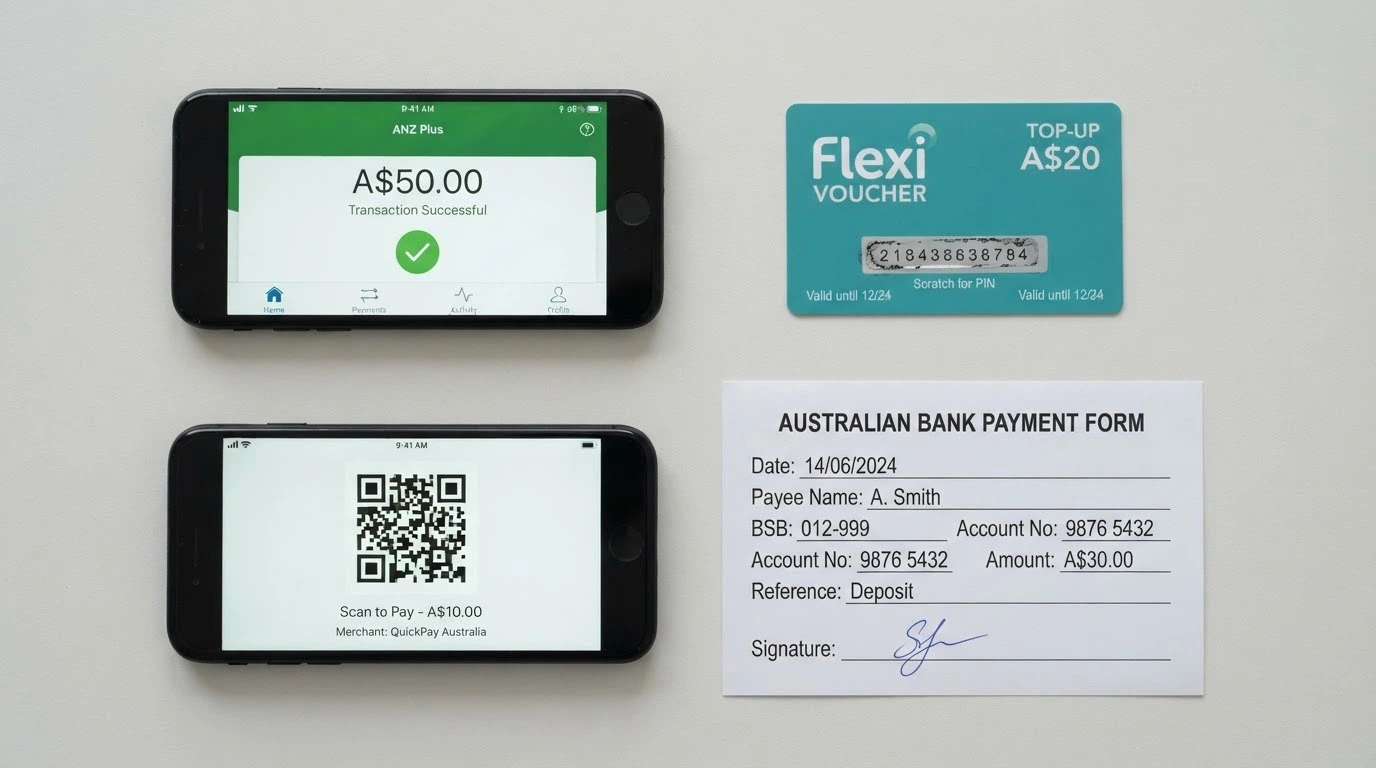
A A$5 deposit also fails the processing-cost arithmetic. PSP fees are a fixed component plus a percentage, and a A$5 deposit carries a fee-to-amount ratio that no operator can absorb at the volumes the marketing pages promise. The Neosurf A$10 floor exists because the voucher is prepaid, the PSP fee is already covered by the voucher purchase, and the operator takes no fraud risk on the inbound leg. PayID’s A$20 floor is the anti-fraud line. Crypto’s sub-A$1 floor is the only one with no PSP in the middle, which is also why accepting crypto from an Australian player is the clearest tell that the site is operating outside Australian law.
PayID: Fast Deposits, But the Casino Sets the Bar at A$20
PayID is the AU-native instant-transfer rail, operated through NPP Australia, that links a deposit to a bank account by a mobile number, email, or ABN. For an Australian player the speed is the draw: deposits arrive in under 60 seconds, and the casino side charges no transfer fee. AussiePokies96 tested 12 platforms in Q2 2026 and found consistent sub-minute arrival times across the set. Withdrawal turnaround is the second advantage: PokiesAustralia.com measured PayID withdrawals at 2–4 hours at most casinos in its review.
The A$20 floor is the catch, and it sits on the casino side, not the rail. PayID itself will move any amount; the operator’s cashier rejects anything below A$20 because the PSP’s anti-fraud monitoring flags inbound micro-deposits as test transactions or layering activity. For a player who came looking for a A$5 entry point, PayID is the right rail and the wrong floor, and the gap is the reason the A$5 search promise does not survive contact with the cashier.
Neosurf, Bank Transfer, Credit Cards and Crypto: What Each Method Costs at the Low End
The method-by-method picture is the clearest map of what a low-deposit Australian player can actually use, and it lays bare the constraint behind the A$5 promise. Every method has a different floor, a different withdrawal story, and a different regulatory status. The table below uses research figures only; the gap on a cell means research did not cover it.
| Method | Lowest AU Deposit | Withdrawals Supported | Key Constraint |
|---|---|---|---|
| Neosurf (voucher) | A$10 | No — deposit only | A$5 voucher is EU-only; AU vouchers start at A$10; withdrawals route through a separate method |
| PayID | A$20 (casino-side floor) | Yes | PSP anti-fraud flags micro-deposits; casino sets the minimum at A$20 |
| Bank Transfer (direct) | Typically A$20–A$30 | Yes | Slower than PayID (often 1–3 days); higher minimums at most operators |
| Credit / Debit Card | A$20 typical | Yes (at offshore sites) | Banned for licensed AU wagering since 11 June 2024; a site accepting cards from Australians is offshore |
| Cryptocurrency (BTC, USDT, ETH, etc.) | A$0.10–A$5 depending on coin and operator | Yes (at the same operator) | Banned for licensed AU wagering since 11 June 2024; exchange-spread and volatility risk; no AU consumer recourse |
The credit-card and crypto entries carry the same regulatory message. A site that accepts either from an Australian customer is operating outside the Interactive Gambling Act 2001 (IGA) framework, because the Interactive Gambling Amendment (Credit and Other Measures) Act 2023 banned both as payment for online wagering in Australia from 11 June 2024. The player is not prosecuted under the IGA, which targets the provider, not the individual, but the offshore status of the site is the consequence of the payment it accepts.
AUD vs Crypto: The Deposit-Currency Split That Defines the Low End
The choice that defines the low end is not operator-by-operator, it is currency-by-currency. Fiat deposits denominated in AUD bottom out at A$10 via Neosurf, A$20 via PayID, and roughly A$20–A$30 via direct bank transfer. Crypto deposits denominated in BTC, USDT, or ETH go below A$1 at the operators that accept them: roughly A$0.10 BTC-equivalent at Stake, around A$1 in USDT at BC.Game, and near-zero at Bitcasino. The gap is real, and so is the trade-off.
Crypto deposits carry exchange-spread risk: the deposit is converted from AUD to crypto and back again at two points, and the player absorbs the spread. Volatility adds a second layer, since a A$0.10 BTC deposit today may be worth a different number in AUD by withdrawal. The regulatory tell is the clearest part of the trade-off: credit cards and crypto are banned for licensed AU wagering, so any site accepting crypto from an Australian player is offshore. That status means no ACMA complaint resolution, no Australian Consumer Law protection, and no BetStop coverage, points the section on responsible gambling returns to in detail.
Real-Money Pokies You Can Reach From the Lowest Genuine Deposit
A A$5 deposit at A$0.10 per spin buys roughly 50 spins, about five minutes of play. A A$5 deposit at A$0.20 per spin buys 25 spins, closer to two and a half minutes. The session length is short regardless of the title. Most welcome bonuses require A$10–A$20 to activate, so a A$5 deposit usually plays without a bonus attached, which is a quiet cost the marketing pages rarely surface.
The titles that dominate the low-stakes end are the ones with low minimum bet sizes, broad availability across offshore operators, and the high-volatility profile that suits a short session. Big Bass Bonanza, from Pragmatic Play, runs a 96.71% RTP with high volatility and a 2,100x max win, the kind of swing that fits a player chasing a single hit from a small bankroll. Starburst, from NetEnt, runs a 96.10% RTP with low volatility and a 250x max win, the steadier profile for a player who wants the A$5 to last longer than five minutes. Book of Dead, from Play’n GO, runs a 96.21% RTP with high volatility and a 5,000x max win, the long-odds title for a player willing to burn the deposit on a single bonus round. Each of those RTP figures is a long-run average, not a guarantee, and a A$5 deposit session will not come close to the mathematical RTP — it is too short a sample.
The expected cost of clearing SkyCrown’s first-deposit bonus (100% up to A$500, 40x wagering on the bonus) on Big Bass Bonanza at A$0.20 per spin works out to roughly A$100 in expected house edge across the A$20,000 in required turnover, the kind of figure that puts the bonus in perspective. The required turnover is A$500 multiplied by 40, which is A$20,000. The expected loss is the turnover multiplied by one minus the RTP, which gives A$20,000 × (1 − 0.9671) = approximately A$658. The bonus pays up to A$500, and the expected cost of clearing it sits above the bonus value. That is the math behind the bonus headline, and it is the figure a player should weigh before chasing the welcome offer.
Not Really $5: What Every Offshore Operator Actually Charges Australian Players in 2026
How We Ranked These Operators — And Why the Deposit Figure Is Not the Whole Story
The deposit minimum is the criterion the search brought the reader for, but it is not the criterion that decides whether a site is worth using. The ranking behind the table below weighs four other variables alongside the deposit floor: bonus fairness, measured by the wagering multiple, the cashout cap, and the validity window; licence status, which in this segment means offshore licence jurisdiction and whether the licence was confirmed against a regulator’s register; payment-method breadth, specifically whether the operator accepts an AU-friendly rail at the low end; and the bonus-eligibility minimum, which is often higher than the play minimum and is the figure a player needs to deposit to actually trigger the headline bonus.

The verification state for this segment is worth stating up front: no operator’s licence was confirmed against a regulator’s live register in this review. The competitor pages cite “Curacao” as a blanket label without confirmation numbers, and one Curacao Antillephone N.V. licence is named specifically (at WinSpirit). The rest are described as Curacao-licensed without a registered licence number, which is the same status the affiliate pages carry. Where a licence was not confirmed, the table cell carries that status rather than a licence type.
| Operator | Licence Jurisdiction | Min. Deposit Bonus-Eligible | Welcome Offer | Wagering Multiple | Free Spins |
|---|---|---|---|---|---|
| Fair Go | Curacao (not confirmed) | A$20 | 100% up to A$200 × 5 deposits (A$1,000 total) | 30x (deposit + bonus) | — |
| Bizzo Casino | Curacao | A$30 | Up to A$7,250 + 175 FS across 4 deposits | 40x (bonus) | 175 |
| Rocket Play | Curacao (not confirmed) | — | 300% up to A$6,000 + 300 FS | 30x (bonus) | 300 |
| SkyCrown | Curacao (not confirmed) | A$20 | A$8,000 + 400 FS across 4 deposits | 40x (bonus) / 30x (FS winnings) | 400 |
| Royal Reels | Curacao (not confirmed) | A$30 (deposit match) | No-deposit A$10 chip + 100% up to A$500 + 50 FS | 30x (bonus) | 50 (A$0.20 each) |
| WinSpirit | Curacao Antillephone N.V. | — | — | 40x (bonus) | — |
| Rainbet | Anjouan | $700 cap per deposit | 250% up to $2,100 + 60 FS across 3 deposits | 40x or No Wager Lock | 60 |
| PlayAmo | Curacao | A$5 (crypto) / A$10 (Neosurf) | Deposit match + FS (terms not confirmed) | — | — |
| Ignition Casino | Not confirmed | A$5 (crypto only) | Welcome bonus (terms not confirmed) | — | — |
| Stake | Not confirmed | ~A$0.10 BTC-equivalent | — | — | — |
The table’s gaps are deliberate: where research did not carry a figure, the cell is empty rather than filled with a number from outside the input. The “—” entries are the honest version of “we did not confirm this” and the gaps in the bonus, wagering, and free-spin columns reflect what was actually verifiable from operator terms pages and the review sites that test them.
The Crypto-Only Operators: Sub-$1 Deposits, Zero Australian Protections
Stake, BC.Game, and Bitcasino are the crypto-only tier, and they set the floor of the entire market. Deposits start at approximately A$0.10 BTC-equivalent at Stake, around A$1 in USDT at BC.Game, and near-zero at Bitcasino. There is no fiat rail and no AU consumer protection behind any of them. The licence status of this tier is the loosest in the segment: research did not confirm Stake’s jurisdiction, BC.Game and Bitcasino are not in the featured set but are referenced for the deposit floor they set, and the broader crypto-only category tends toward Anjouan or Curacao without registered confirmation numbers.
The trade-off is plain: the lowest barrier in the market, with the thinnest safety net. Crypto deposits bypass the PSP anti-fraud layer, which is why they can go below A$1, and the same bypass is why they are banned for licensed AU wagering. A player using crypto at one of these operators is, by definition, at an offshore site, and every protection the ACMA enforces, including ISP blocking of 1,564 illegal gambling and affiliate sites since November 2019, applies to that site as the target.
The Fiat-Ready Operators: Who Takes AUD and What They Really Want You to Deposit
Fair Go, Bizzo, Rocket Play, SkyCrown, Royal Reels, and WinSpirit are the fiat-ready tier: operators that accept AUD through a fiat rail (PayID, Neosurf, bank transfer, or card) and convert at the cashier rather than at the crypto exchange. The marketing headlines run to A$7,250, A$8,000, even A$6,000 in bonus value, and the deposit minimums are quieter. Fair Go’s welcome package is 100% up to A$200 across five deposits, totalling A$1,000, with a A$20 minimum per stage. Bizzo’s package reaches up to A$7,250 + 175 free spins, with 40x wagering on all bonus parts and a A$30 minimum qualifying deposit, despite A$20 in the marketing copy. SkyCrown provides A$8,000 + 400 free spins, with 40x wagering on the bonus and 30x on free-spin winnings, a A$20 minimum qualifying deposit, and 14-day validity per tier.
The pattern across the fiat-ready set is the bonus-eligibility gap. Eight of fifteen AU-facing brands surveyed enforce a higher minimum for welcome-bonus eligibility than for play, the kind of detail a player discovers only after depositing A$10 and watching the bonus not arrive. The marketing page shows A$20, the cashier floor sits at A$20, and the bonus terms sit at A$30. The arithmetic of low-deposit play is built out of these gaps, and the table above shows them where research confirmed them.
Fair Go Casino
Fair Go’s welcome structure is a 100% match up to A$200 across five deposits, totaling A$1,000, with 30x wagering on the combined deposit and bonus amount and a A$20 minimum per stage. The standout term is the absence of a maximum cashout cap on the deposit bonus, which is unusual in this segment. The A$20 minimum per stage is the gate: a player who wants the full A$1,000 needs to commit A$100 across the five deposits, not a A$5 entry.
The Curacao licence was not confirmed against a regulator’s register in this review, which is the same status the wider segment carries. The bonus structure is the strongest in the set for a player who plans to deposit in stages and stick with one operator, since the no-cashout-cap term gives the welcome package a longer tail than the headline figures at the other operators. A player with a modest bankroll will find the reward of commitment here, though the A$20 entry floor remains well above the A$5 search promise.
Bizzo Casino
Bizzo carries the largest headline figure in the featured set: up to A$7,250 + 175 free spins across four deposits, with 40x wagering on all bonus parts. The catch sits in the deposit minimum. The marketing page states A$20, the bonus terms state A$30, and the gap is the bonus-eligibility problem at its clearest. A player who deposits A$20 expecting the match will not trigger it; a player who deposits A$30 will. The 40x wagering multiple is on the steeper end, and the A$7,250 figure is the total ceiling across all deposits.
The Curacao licence is the jurisdiction cited in the review, though the registered licence number was not confirmed against the regulator’s register. Bizzo offers the largest headline bonus, but the high A$30 qualifying deposit and the steep 40x wagering make it best suited to a player who plans to commit to the full sequence and has the bankroll for a 40x playthrough.
Rocket Play
Rocket Play’s 300% bonus up to AU$6,000 + 300 free spins is the highest match percentage in the featured set, and the 5-day bonus validity is the tightest clock among the operators with confirmed terms. Wagering sits at 30x on the bonus amount, the AUD 7.50 max bet during wagering is the practical ceiling on a clearing strategy, and the A$5,000 max cashout from bonus terms is the ceiling on what the bonus can pay out.
The licence status is Curacao, not confirmed against a register. The 5-day validity window is the defining term: a player who clears a 30x wagering requirement in five days is committing to a session length that a casual deposit may not sustain. Rocket Play is an option for the player who wants the largest match percentage and is prepared to clear the aggressive 5-day clock, though they must work within the A$5,000 cashout cap on bonus returns.
SkyCrown
SkyCrown is the only operator in the featured set tested at a genuine A$5 deposit. Betsquare’s review found A$5 deposits accepted for play, although free spins required a higher deposit; withdrawal tested at 1 hour 44 minutes, and KYC triggered at the first payout. The welcome package runs to A$8,000 + 400 free spins, with 40x wagering on the bonus, 30x on free-spin winnings, a A$20 minimum qualifying deposit, a A$5 max bet per spin, and 14-day validity. Book of Dead free spins attach to the first deposit.
The Curacao licence was not confirmed against a regulator’s register. The A$5 play-only deposit is the closest the segment comes to the search promise, and the gap between the play floor and the bonus-eligibility floor is the textbook example of the bonus-eligibility problem. SkyCrown is the rare operator that accommodates the A$5 play-only entrant, provided they accept that the welcome offer requires a A$20 qualifying deposit.
Royal Reels
Royal Reels is the only no-deposit offer in the featured set: a A$10 free chip with 30x wagering and a cashout cap shown on activation. The deposit-match side is 100% up to A$500 + 50 free spins at A$0.20 each (A$10 value), with 30x wagering on the bonus and a A$30 minimum deposit. The A$10 free chip is the only path to a real-money session without depositing at all, which is a category of its own in this segment.
The Curacao licence was not confirmed against a register. The A$10 chip is the headline, and the cap is the cost: a player who wins on the chip and tries to cash out above the cap loses the difference. Royal Reels is the no-deposit entry, though the A$30 deposit-match floor is notably higher than the segment average for fiat operators.
WinSpirit
WinSpirit is operated by Complete Technologies N.V. and holds a Curacao Antillephone N.V. licence, one of the few operators in the set with a named licence subtype. The review carried the licence but not the welcome-offer specifics: the bonus amount, free-spin count, and qualifying deposit were not confirmed in this run. The wagering multiple on the bonus is 40x, and the payment methods on the cashier are cards, Neosurf, and crypto.
WinSpirit is operated by Complete Technologies N.V. and holds a Curacao Antillephone N.V. licence. The review carried the licence but not the welcome-offer specifics: the bonus amount, free-spin count, and qualifying deposit were not confirmed in this run. With 40x wagering, WinSpirit is better for the player prioritising licence clarity over a large, complex bonus structure.
Rainbet
Rainbet runs on an Anjouan licence, with a 250% welcome package up to $2,100 + 60 free spins across three deposits. The defining term is the choice: 40x Wager Lock or No Wager Lock, the only operator in the set offering the option. The No Wager Lock path means bonus winnings are withdrawable without a playthrough, which is rare in the segment. The $700 cap per deposit is the practical ceiling on each of the three deposit stages, and 25+ crypto coins are accepted.
Rainbet runs on an Anjouan licence, with a 250% welcome package up to $2,100 + 60 free spins across three deposits. The defining term is the choice: 40x Wager Lock or No Wager Lock, the only operator in the set offering the option. Rainbet is the recommended pick for the player who values a no-wager option over the massive headline bonuses found elsewhere, as the flexibility here is unique in the featured set.
PlayAmo
PlayAmo is one of the few operators in the set advertising a genuine A$5 entry point, available via cryptocurrency, with a A$10 Neosurf alternative for fiat players. The Curacao licence is the jurisdiction cited. The welcome-offer specifics, including bonus amount, wagering multiple, and free-spin count, were not confirmed in this review, so the offer is described qualitatively: a deposit match plus free spins, with the low entry point as the standout feature.
PlayAmo is one of the few operators in the set advertising a genuine A$5 entry point, available via cryptocurrency, with a A$10 Neosurf alternative for fiat players. The Curacao licence is the jurisdiction cited. The welcome-offer specifics, including bonus amount, wagering multiple, and free-spin count, were not confirmed in this review, so the offer is described qualitatively: a deposit match plus free spins, with the low entry point as the standout feature. This is a viable option for a player who prioritises the lowest possible entry point over verifiable bonus terms.
Ignition Casino
Ignition runs separate welcome-bonus tracks for cryptocurrency and card deposits, with a A$5 minimum deposit via crypto (Bitcoin, Bitcoin Cash, Litecoin, or Ethereum). The licence jurisdiction was not confirmed in this run, which is the same status several operators in the segment carry. The bonus structure, wagering multiple, and free-spin specifics were not confirmed, so the offer is described qualitatively: a split-track welcome with the crypto entry as the low end.
Ignition runs separate welcome-bonus tracks for cryptocurrency and card deposits, with a A$5 minimum deposit via crypto. The licence jurisdiction was not confirmed in this run. With a A$5 crypto entry point, Ignition is an alternative to PlayAmo for crypto players, though the lack of a verified licence and clear bonus terms makes it a high-risk choice.
Stake
Stake sets the floor of the entire segment at approximately A$0.10 BTC-equivalent, crypto-only, with no fiat rails. The licence jurisdiction and bonus terms were not confirmed in this review. The product is the crypto-only model at scale: every deposit, every bet, every withdrawal routes through Bitcoin, Ethereum, Litecoin, or one of the other accepted coins, and the AUD price is a conversion at the cashier.
Stake sets the floor of the entire segment at approximately A$0.10 BTC-equivalent, crypto-only, with no fiat rails. The licence jurisdiction and bonus terms were not confirmed in this review. Stake is the ultimate choice for the player seeking the lowest possible market barrier, provided they are prepared to absorb the regulatory risk associated with unverified licence status and the offshore nature of the operation.
New Low-Deposit Pokies Sites: What 2026 Launches Mean for Minimum Deposits
The Newest Offshore Operators Targeting Australian Players in 2026
New offshore casinos targeting Australian players launch on a regular cycle, and the comparison pages refresh their top-10 lists to match. The pattern across recent launches is the same as the pattern across established operators: the marketing pages compete on welcome-bonus size, the cashier pages sit at the same A$10–A$30 floor the segment has carried for years, and the bonus-eligibility gap is the same gap. A new operator does not invent a new deposit floor, because the floor is set by the payment layer rather than by the marketing team.

The way to read a fresh launch is to weigh the entry cost, the bonus size, and the licence status, and to expect the entry cost to be the same as the established set. The new-entrant advantage is usually a larger welcome package, a longer free-spin tail, or a crypto-only angle that the established brands do not emphasise. The new-entrant disadvantage is the absence of player-feedback history: a brand with six months of operation carries no record at the forums where players report slow withdrawals, voided wins, and bonus-terms disputes.
What a Fresh Launch Means for Deposit Minimums — And What It Does Not
A new casino does not change the deposit floor, because the floor is set by the payment processor rather than by the operator. PayID’s A$20 minimum is a PSP anti-fraud line, and a new operator that wants to accept PayID inherits the same line. Neosurf’s A$10 voucher is the same voucher whether the operator launched this month or three years ago. Crypto’s sub-A$1 floor is a network property, not an operator choice. The deposit floor is a structural figure, and no marketing budget changes it.
What a fresh launch can change is the bonus structure, the game library, and the crypto-rail emphasis. A new operator competing for the same player as an established brand will usually offer a larger welcome package, a more aggressive free-spin count, or a no-wager alternative. The trade-off is the verification record: a brand with a registered licence number, a tested withdrawal time, and a player-feedback history is worth a known quantity in a way a fresh launch is not.
Your Phone Won’t Lower the Deposit: Mobile Pokies and the Same Old Minimums in 2026
Mobile Pokies at the Minimum Deposit: Browser Play and Instant Access
Mobile play does not change the deposit floor, because the payment rail is the same rail. PayID deposits on a mobile browser arrive in under 60 seconds, the same as on desktop, because the speed is a property of the rail rather than the device. Neosurf voucher entry on a phone is a 16-digit code typed into the cashier, which is the same code typed into a desktop cashier. Crypto wallets connect to the casino’s cashier the same way on a phone as on a laptop.

The mobile experience is browser-based rather than app-based for most AU-facing offshore operators, and the absence of an App Store or Google Play listing is a regulatory tell rather than a service gap. The Interactive Gambling Act and the app-store policies that enforce it make native casino apps a rarity in the Australian market, and the browser-based product is the workaround. Game performance on a phone screen is comparable to a laptop for the major providers, and the pokies library at the established operators is the same library on either device.
Mobile-Focused Payment Setups: What Works and What Does Not
No payment method lowers its minimum for a mobile user, because the casino-side floors are device-agnostic. The A$20 PayID floor at the casino cashier is the same on a phone browser as on a desktop browser. The A$10 Neosurf voucher is the same voucher. Crypto minimums are network-level, not device-level. The friction on a mobile session is specific rather than structural: a voucher entry needs the 16 digits at hand, a crypto wallet needs the QR code or address visible on the phone, and a PayID deposit needs the bank app open in a second window.
The A$20 PayID floor is the constraint that holds on mobile, and the A$10 Neosurf voucher is the alternative that works at a lower entry. Crypto is the path below A$1, and the offshore status that comes with it is the trade-off. The page on payments covers the per-method detail; on mobile, the rule is that the device does not move the floor.
The Legal Reality: Why Every $5 Pokies Site Is Offshore in 2026
The IGA Prohibition: No Online Pokies Licence Exists in Australia and Never Has
The Interactive Gambling Act 2001 makes it an offence to provide online casino games, online pokies, and in-play sports betting to a person physically in Australia. There is no licence for these products anywhere in the country, not federally, not in any state or territory, and the prohibition has been the position since the Act was strengthened by the Interactive Gambling Amendment Act 2017. The IGA targets the provider, not the individual player: an Australian who accesses an offshore pokies site does not commit an offence, but the site itself is operating illegally in the Australian market.
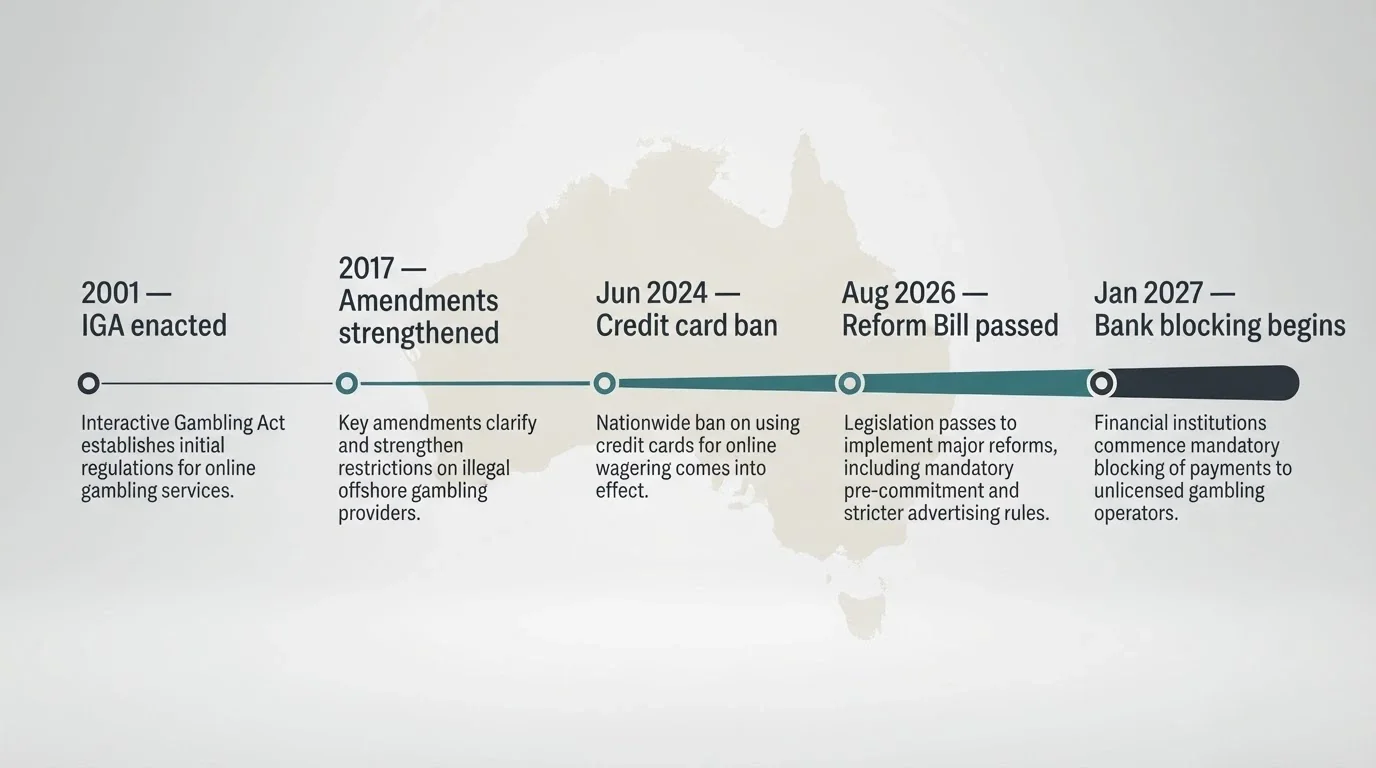
Enforcement runs through the Australian Communications and Media Authority (ACMA), and the scale of the action illustrates how seriously the prohibition is taken. Since November 2019, ACMA has had 1,564 illegal gambling and affiliate websites blocked by Australian ISPs, and more than 225 illegal services have withdrawn from the Australian market since enforcement strengthened in 2017. The blocking power is the practical expression of the prohibition: a site can be reached technically, but the ISP-level block means most Australian users will not reach it without a workaround.
What is licensed, in the Australian market, is wagering on races and sport placed before the event begins, lotteries, and keno, through operators licensed by a state or territory. The Northern Territory Racing and Wagering Commission (NTRWC), administered through Licensing NT, is the de facto national licensor for online wagering. Licensed wagering pays a 5% NT wagering tax plus a 0.05% racing levy, and each state sets its own point-of-consumption tax, typically 10–15% of net wagering revenue. None of this licensing covers online pokies, because none of it can.
The 2026 Gambling Reform Bill: What Changes on 1 January 2027
The Interactive Gambling Amendment (Gambling Reform) Bill 2026 passed Parliament on 19 August 2026, and its measures commence on 1 January 2027. The reform does not legalise online pokies and does not give players consumer recourse against offshore operators, but it tightens the framework around the licensed wagering market and the offshore illegal market in several specific ways.
Wagering advertising on broadcast television will be capped at three ads per hour between 6:00 am and 8:30 pm, with a complete blackout during live sport within those hours. Radio ads will be banned during school drop-off and pick-up times. Online wagering ads will be restricted to logged-in, over-18 users with an opt-out. Athletes, celebrities, and influencers are barred from promoting wagering products, and gambling ads are banned inside sports venues and on player uniforms. The direct marketing of inducements will be prohibited for 14 days after a customer signs up, for three months after a person deregisters from BetStop, and indefinitely for customers identified as at risk.
The most concrete change for a player at an offshore casino is the bank-blocking provision. From 1 January 2027, banks and payment providers gain express authority to block transactions to illegal gambling operators, which means a deposit or withdrawal routed through an Australian bank may be declined, held, or returned. The practical risk of a blocked transaction with a balance on it at an offshore site increases, and the player carries the cost of any funds the bank holds during a review. The Northern Territory wagering licence regime was reformed in 2026 after criticism of the regulator’s structure, and the NT reform sits alongside the federal Bill as part of the same regulatory reset.
The reform is the tightening of an existing prohibition rather than the legalisation of online pokies, and the offshore sites Australians reach today remain outside the framework on 1 January 2027. The credit-card and crypto ban in force since 11 June 2024 is the existing tell: a site that accepts either from an Australian customer is already operating outside AU law, and the 2027 changes add bank-level transaction blocking to the enforcement tools.
The Safety Net That Misses Offshore Players: Responsible Gambling for Australian Pokies Fans
Deposit Limits and Self-Exclusion: What BetStop Does — And the Offshore Gap It Cannot Close
BetStop is the National Self-Exclusion Register, launched on 21 August 2023, and it is the strongest self-exclusion tool Australia has. A single registration excludes a person from every Australian-licensed online and phone wagering service, across every licensed operator, in one step. As of 31 March 2026, 59,830 people had registered with BetStop, and 37,247 had active exclusions. The demographic skew is young: 78% of registrants were under 40, and 38% chose lifetime exclusion.
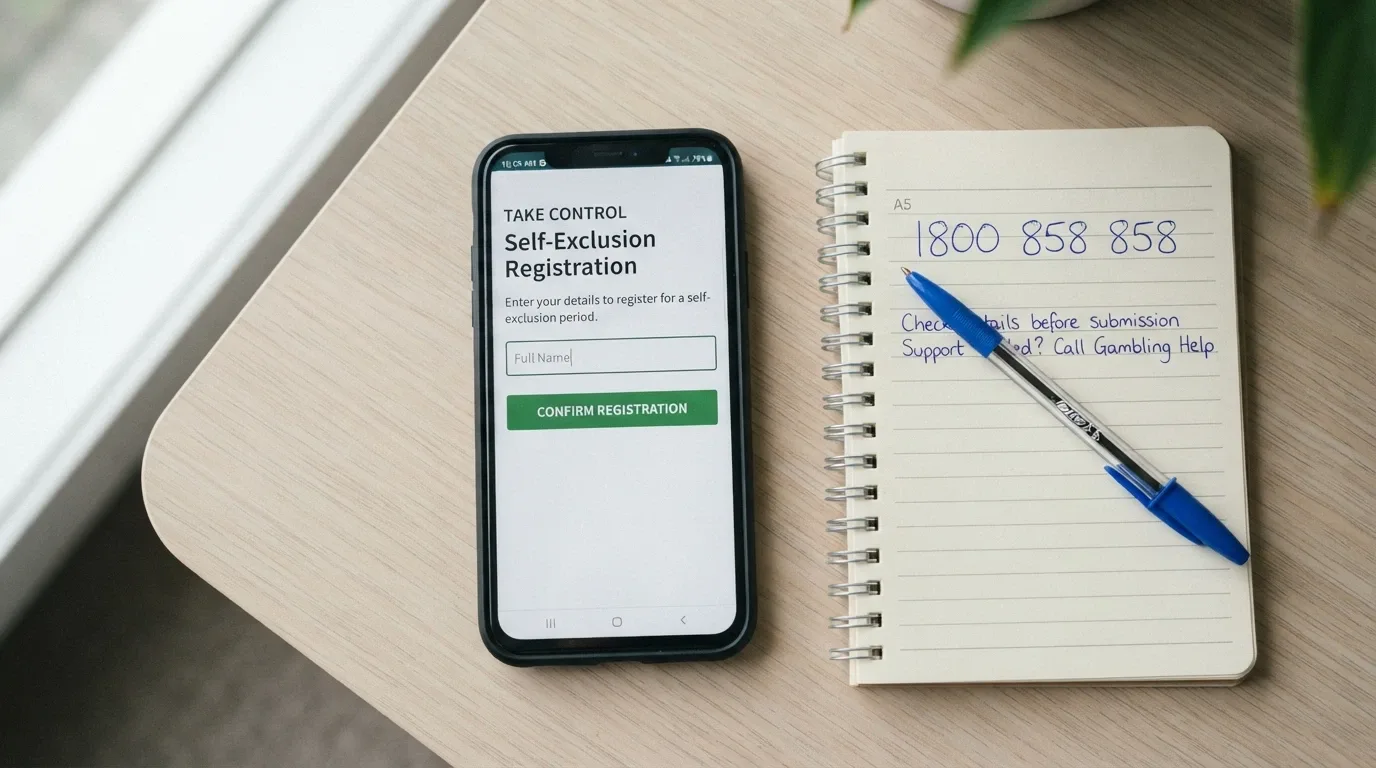
The offshore gap is the part of BetStop that the register cannot close. BetStop binds Australian-licensed wagering services only, which means an offshore casino is not connected to the register and will continue accepting a self-excluded person’s money. A player who has registered with BetStop to block themselves from licensed Australian wagering has not blocked themselves from the offshore pokies sites, and the protection they have signed up for does not reach the product the search term points them toward. The same protection also does not cover land-based venues, and a self-excluded person can still enter a pub or club, which is a separate gap.
The honest framing for a player considering offshore play is this: every responsible-gambling tool the Australian framework offers, including BetStop, deposit limits at the operator level, time and loss controls, and the ACMA complaint pathway, applies to licensed operators only. An offshore site is outside the framework, and a player at an offshore site is, in this respect, on their own.
Time and Loss Controls That Work Across Borders
The practical harm-minimisation tools an Australian player can set themselves fall into two groups: tools the operator offers, and tools the player sets outside the operator. Operator-level tools include deposit limits, loss limits, session-time reminders, and self-exclusion at the account level, and they are available at most offshore sites, though the depth of the offering varies. The limits of these tools at an offshore site are the same as the limits of BetStop: they are voluntary, they are enforced by the operator, and they depend on the operator honouring them.
Tools the player sets outside the operator are the backstop. A bank-side transaction limit, set with the player’s own bank, is the most reliable, because it is enforced by the institution that holds the funds. A separate bank account used only for gambling, with a hard cap on the balance, is the simplest version. A session-time tracker, set on the phone, is the softest of the three, but it is the one the player is most likely to use. The limits of self-imposed controls when the operator is offshore and unregulated are the limits of self-control itself, and that is the gap a player should weigh before they deposit.
Where to Get Help: The National Gambling Helpline and Support Services
Help exists, it is free, and a player does not need to be in crisis to use it. The National Gambling Helpline is 1800 858 858, free, confidential, and staffed 24 hours a day, seven days a week, nationwide. Gambling Help Online, at gamblinghelonline.org.au, offers free chat and email counselling, also 24/7. State-based services, including Gambler’s Help in Victoria and Gambling Help in New South Wales, run their own counselling lines and face-to-face support.
The harm figures behind the help lines are the reason the help lines exist. As of March 2026, 15.1% of the Australian adult population, approximately 3.32 million people, are experiencing some level of harm from their own or others’ gambling, per the Roy Morgan Gambling Harm Index. About 2.1% of Australian adults, roughly 430,000 people, experience problem gambling, with high-risk gambling at 1.8% per the Australian Institute of Health and Welfare in 2022. The minimum age for all commercial gambling in Australia is 18, and every legitimate operator, including the offshore sites, enforces it.
How We Evaluated These Low-Deposit Pokies Operators
The operators in this comparison were drawn from research across operator terms pages, the ACMA public register, and a set of affiliate test-data sources: AussiePokies96, PayoutVerdict, Betsquare, PokiesAustralia.com, and player-forum reports. The evaluation criteria were deposit floor, bonus fairness (measured by wagering multiple, cashout cap, and validity window), licence verification status, payment-method breadth for Australian players, and player-feedback signals from the forums.
The verification state is worth stating again. No operator’s licence was confirmed against a regulator’s live register in this review. The search results cite “Curacao” as a blanket label without confirmation numbers, and one Curacao Antillephone N.V. licence is named specifically at WinSpirit. The remaining operators are described as Curacao-licensed without a registered licence number, which is the same status the affiliate pages carry. A later phase should re-verify the licence details against the Curacao Gaming Control Board and the Anjouan Offshore Finance Authority registers, and the table in the operator section shows the licence status as it stands.
What was deliberately excluded from the evaluation: any operator that did not accept Australian customers, any operator that required a deposit above A$30 for play, and any operator whose terms page was unreachable at the time of the review. The featured set is the offshore sites Australians actually reach, ranked by deposit floor and bonus terms, and the gaps in the table are the limits of what was verifiable from this run.
Is a $5 Pokies Deposit Worth the Trouble? What the Deposit Maths Actually Tells You
The $5 fiat deposit does not exist. The closest entries are A$10 via Neosurf, A$20 via PayID, and sub-A$1 at the crypto-only tier, and every one of those routes is an offshore route. The marketing pages promise A$5, the cashier floor sits at A$10 or A$20, the bonus-eligibility minimum sits higher again, and the withdrawal minimum sits above the deposit minimum, so a A$5 deposit session that wins modestly cannot cash out until the balance reaches A$20–A$50.

The bonus-eligibility trap is the quiet cost. Eight of fifteen AU-facing brands surveyed enforce a higher minimum for welcome-bonus eligibility than for play, which means a player who deposits A$10 expecting a match discovers the bonus required A$20, and the deposit plays through without the headline offer attached. The expected-cost calculation on the SkyCrown first-deposit bonus (100% up to A$500, 40x wagering) gives an expected loss of approximately A$658 in turnover on Big Bass Bonanza at A$0.20 per spin, above the A$500 bonus ceiling, which is the kind of figure that puts a welcome package in perspective before the player chases it.
The withdrawal-floor economics are the trap the marketing pages do not surface. A A$5 deposit that wins modestly is stuck below the A$20–A$50 cashout floor, and the player either tops up to clear it, plays through to zero, or accumulates winnings across multiple sessions before the withdrawal is possible. The session length at the lowest entry is short regardless of the title: 50 spins at A$0.10, roughly five minutes of play, is the entire budget the A$5 buys.
The offshore risk calculus is the part a comparison page should weigh but rarely does. An offshore casino carries no ACMA complaint resolution, no Australian Consumer Law protection, no BetStop coverage, and no recourse if the operator refuses a withdrawal or voids a win. From 1 January 2027, banks gain authority to block transactions to illegal gambling operators, which means a deposit or withdrawal may be declined, held, or returned at the bank level, and the player carries the cost of any funds the bank holds during a review. The offshore status is the trade for the low entry, and the trade is heavier than the entry looks.
The honest reading of the $5 search term: the player it suits is the one who wants to test a site with the lowest possible commitment, accepts that the bonus will not attach at the minimum, accepts that the withdrawal will not clear until the balance grows, and accepts that the site is offshore and outside the Australian safety net. For that player, A$5 to A$10 via crypto or A$10 via Neosurf is the entry, the session is five to fifteen minutes long, and the only outcome that matters is whether the site is worth returning to with a larger bankroll. For every other player, the better entry is A$20 via PayID at a fiat-ready operator, the bonus terms attached, and the withdrawal floor reachable from a single session.
The kind of player a $5 deposit is wrong for is the one chasing the welcome bonus headline. The bonus-eligibility gap, the wagering multiple, and the cashout cap combine to make the welcome package more expensive than the bonus value across most of the featured set, and the calculation on the SkyCrown first-deposit bonus shows the expected cost above the bonus ceiling. A player who reads the bonus terms before they deposit, weighs the expected cost against the headline value, and chooses the operator with the smallest gap is the player who gets the most out of the segment, and that player is rare.
The check every player should make before depositing is the same check regardless of the deposit size. Verify the licence status against a regulator’s register, and treat “Curacao” without a registered number as unverified. Read the bonus terms for the wagering multiple, the cashout cap, and the validity window, and treat any bonus that does not name these as a bonus not worth claiming. Check the withdrawal minimum against the deposit minimum, and treat any gap above A$20 as a barrier. Confirm that the payment method is one the Australian bank will process after 1 January 2027, and treat any bank-blocked transaction as a risk the player carries. The $5 deposit is possible, and the cost of getting it wrong is paid by the player, not by the operator.
Frequently Asked Questions About $5 Minimum Deposit Pokies in Australia
Can I claim a welcome bonus if I only deposit $5?
No Australian-facing operator offers a welcome bonus at the A$5 deposit level. The bonus-eligible minimum at the fiat-ready tier runs from A$20 (Fair Go, SkyCrown) to A$30 (Bizzo, Royal Reels), and a A$5 deposit plays through without the bonus attached. Eight of fifteen AU-facing brands surveyed enforce a higher bonus-eligibility minimum than the play minimum, and the A$5 deposit falls below both.
What is the minimum withdrawal amount if I deposit $5 at a pokies site?
The minimum withdrawal at most AU-facing offshore casinos is A$20–A$50 via bank transfer, which means a A$5 deposit that wins modestly cannot cash out until the balance reaches the floor. The player either tops up to clear the minimum, plays through to zero, or accumulates winnings across multiple sessions. The withdrawal-floor asymmetry is a consumer trap that the marketing pages rarely surface.
Which pokies can I play with a $5 deposit?
At A$0.10 per spin, a A$5 deposit buys roughly 50 spins, which is enough to play any pokie in the operator’s library at the minimum stake. Big Bass Bonanza (Pragmatic Play, 96.71% RTP), Starburst (NetEnt, 96.10% RTP), and Book of Dead (Play’n GO, 96.21% RTP) are common low-stakes titles, though most operators do not restrict their library by deposit size. The constraint is spins, not game access.
Is a $5 deposit enough to have a meaningful session at online pokies?
A A$5 deposit at A$0.10 per spin buys roughly 50 spins, about five minutes of play. At A$0.20 per spin, the same deposit buys 25 spins, closer to two and a half minutes. The session is short regardless of the title, and a player who wants a longer session needs a higher deposit. The $5 entry is a trial, not a session.
What happens to my money if an offshore casino blocks my account or refuses a withdrawal?
An offshore casino sits outside Australian jurisdiction, and a player has no ACMA complaint pathway, no Australian Consumer Law protection, and no BetStop coverage. A blocked account or a refused withdrawal has to be pursued through the operator’s own dispute process, which is the only process available. From 1 January 2027, banks gain authority to block transactions to illegal gambling operators, which adds the risk of a declined or held transaction at the bank level on top of the operator-level risk.