
Best fast payout online casino Australia in 2026: tested speeds, wagering maths and the offshore reality
Every fast-payout casino an Australian can actually use is offshore — registered in Curaçao, offering a product the Interactive Gambling Act 2001 prohibits, and running without any licence from an Australian regulator. The payout speeds are real. The protections Australian punters take for granted under a licensed wagering account are not.

Data current as of 31 October 2026; licence claims verified against the Curaçao eGaming public register and the ACMA enforcement record.
Table of Contents
- Why every fast-payout casino an Australian can use is offshore
- The 10 fastest paying online casinos for Australian punters in 2026
- How fast casino payouts actually work — and what is holding yours up
- Fast-payout casino bonuses worth claiming — and the fine print that kills them
- Pokies and slots that pay out fast — what the RTP does not tell you
- Crypto casino payouts: faster money, fewer questions asked
- Offshore casinos and Australian law: what every punter needs to know before they deposit
- Staying in control when every casino wants you to chase the payout
- How we picked and tested every casino on this list
- The honest verdict: fast cashouts, zero Australian protection — your move
- Frequently asked questions
Why every fast-payout casino an Australian can use is offshore
There is no Australian online casino licence. None federally, none at state or territory level. The Interactive Gambling Act 2001 prohibits providing online casino games — roulette, poker, craps, online pokies and blackjack — to a person physically in Australia, and the prohibition reaches any provider, Australian-owned or foreign-owned, based onshore or offshore. That single sentence is the reason every casino reviewed on this page is Curaçao-licensed. The Australian search results do not surface a single locally licensed online casino, because none exist.
For the player, the IGA does not create an offence. The Act targets the provider. The maximum penalty the statute names — A$360,000 per day for an individual, A$1.8 million per day for a body corporate — falls on the operator, not the punter. That detail matters, because it explains why Australian-facing casinos keep accepting Australian deposits: no Australian prosecutor is coming after the customer. It also explains why those same casinos offer none of the consumer architecture Australian wagering accounts sit inside. BetStop, ACMA complaint channels, the National Consumer Protection Framework — every one of those instruments is wired into the licensed market, and every one of them stops at the border an offshore site does not cross.
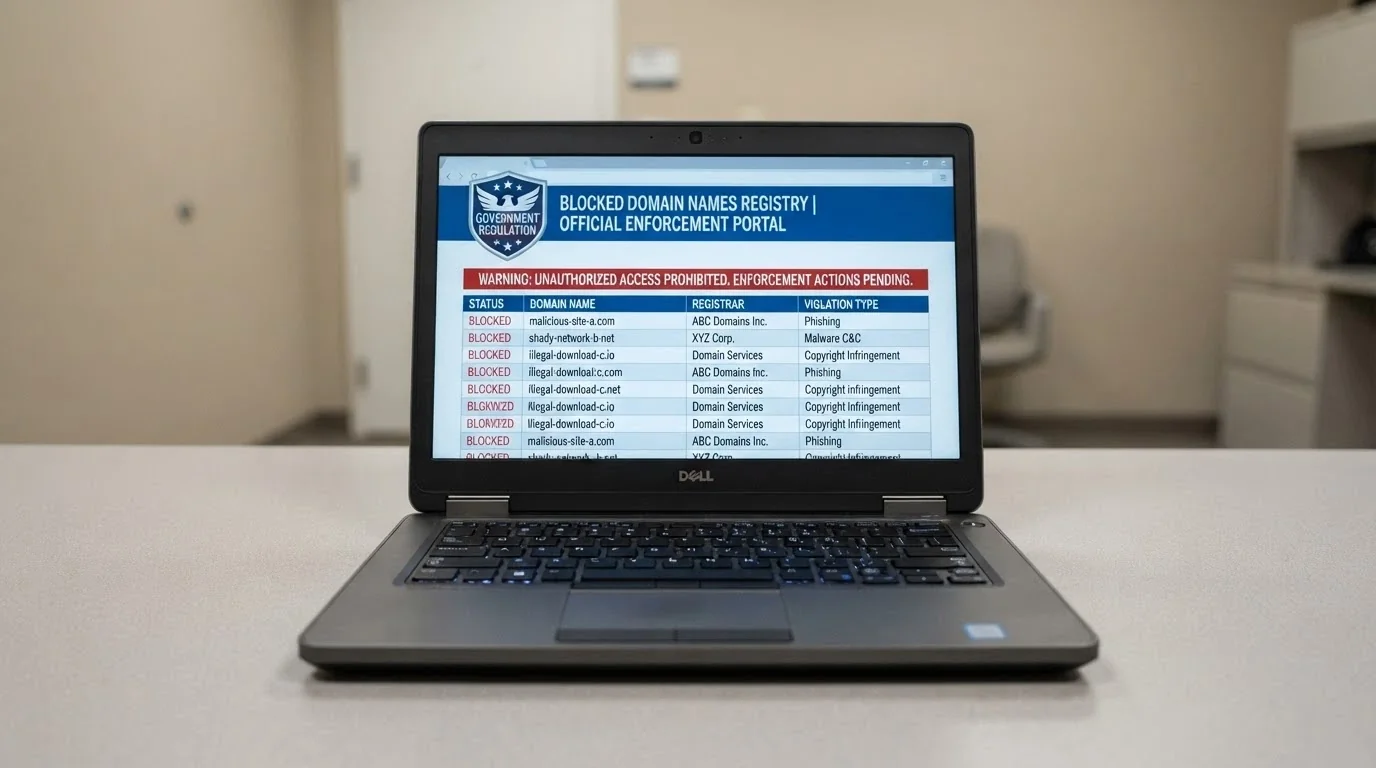
What the IGA does do is give the regulator a lever. Since November 2019, the Australian Communications and Media Authority has directed Australian internet service providers to block 1,564 illegal gambling and affiliate websites, and more than 225 illegal services have withdrawn from the Australian market since the 2017 strengthening amendments. Those numbers are the size of the gap the operator set on this page operates inside: a prohibited product, an active enforcement campaign, and a player base that keeps arriving because the licensed Australian market has no online casino to offer them.
What “fast payout” actually means in the Australian online casino market
“Fast payout” in the marketing sense is a moving target. In the technical sense, it splits into two stages the casino controls separately: an internal approval window where staff review the request, check wagering compliance and verify identity, and a settlement leg where the payment rail — crypto network, NPP, bank — actually moves the money. The approval window is where most advertised speeds collapse. An “instant withdrawal” headline almost always means an instant settlement leg, not an instant end-to-end experience.
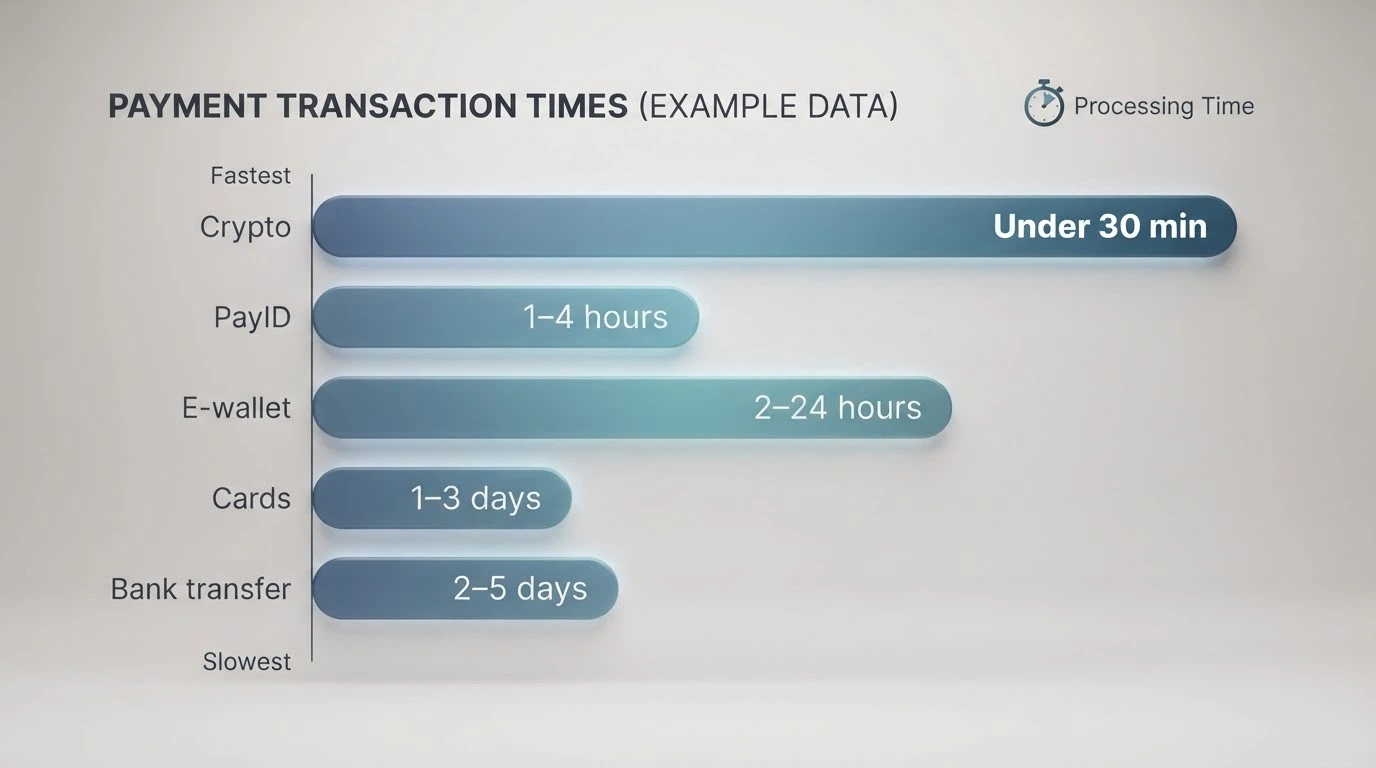
Real tested speeds, drawn from operator-specific pages and independent testing, sit in three bands. Crypto, where most transactions settle in under 30 minutes once approved, is the fastest rail available to an Australian punter. PayID, which runs through Australia’s New Payments Platform and operates 24/7, is the fastest fiat option — approved withdrawals can clear within minutes, and Q2 2026 testing recorded a fastest PayID cashout at under 10 minutes and a slowest at just over 11 hours at the same operator. E-wallets sit in the middle, typically an hour to a day after approval. Bank transfers and card withdrawals trail the field — 12 to 48 hours for cards, 2 to 5 business days for wire transfers at the slower end.
The spread inside PayID is the part worth paying attention to. A PayID cashout that clears in 8 minutes and one that takes 11 hours are the same method, the same rail, the same theoretical ceiling. The difference is the casino’s internal approval clock, the day’s queue, the weekend effect, and whether the player’s account is fully verified. Marketing tends to publish the fastest end of that range. Players tend to meet the slowest.
Why no fast-payout casino carries an Australian licence — and what that means for your money
The offshore-only landscape has a direct cash consequence. A licensed Australian wagering account sits inside a framework: deposit limits, activity statements, easy account closure, a self-exclusion register, a complaint body, and a regulator with the power to investigate and recover. An offshore casino sits outside all of it. The site can be blocked by an ISP at the regulator’s direction — and 1,564 have been since 2019 — with a balance still sitting in a player’s account. The site can refuse a withdrawal. The site can void a win on a terms-of-service ground the player never read. None of those outcomes trigger an Australian remedy, because there is no Australian contract to enforce.
That is the shape of the trade. You get access to a prohibited product and crypto-class payout speeds. You give up the architecture that would have your back if any of it went wrong. The arithmetic on the next pages — wagering multiples, expected loss, the actual price of a “free” welcome bonus — happens inside that trade. A player who decides it is worth making should at least decide it with eyes open.
The 10 fastest paying online casinos for Australian punters in 2026
The table below ranks ten Curaçao-eGaming-licensed casinos that accept Australian players, ordered by the speed at which a verified, wagering-cleared withdrawal actually settles. None is licensed in Australia. Every one is offering a product prohibited under the IGA. The ranking reflects the speed claim or the independent test where one exists; where neither does, the operator is ranked by prominence in the Australian search results.
| Casino | Licensed in Australia? | Welcome bonus | Wagering | Fastest withdrawal method |
|---|---|---|---|---|
| SkyCrown | No (Curaçao eGaming) | 450% up to A$8,000 + 400 FS | 40x | PayID 15–20 min; crypto <20 min |
| NeoSpin | No (Curaçao eGaming) | 300% up to A$11,000 | 40x | Crypto <10 min; PayID 15–20 min |
| Golden Crown | No (Curaçao eGaming) | 100% up to A$15,000 + 300 FS | 40x | PayID <15 min; crypto <15 min |
| BitStarz | No (Curaçao eGaming) | Up to 5 BTC / A$10,000 + 180 FS | 40x | Crypto 0–1 h; PayID 0–2 h |
| Ricky Casino | No (Curaçao eGaming) | Up to A$7,500 + 550 FS | 50x | PayID 1–4 h; cards 3–5 days |
| MadCasino | No (Curaçao eGaming) | A$1,500 + 300 FS | 35x | PayID <2 h; crypto minutes |
| Stake | No (Curaçao eGaming) | Region-specific, not confirmed | — | Crypto (minutes) |
| Royal Reels | No (Curaçao eGaming) | Not confirmed | — | Not confirmed |
| FairGO | No (Curaçao eGaming) | Not confirmed | — | 24–48 h |
| Rocket Play | No (Curaçao eGaming) | Not confirmed | — | Not confirmed |
The H3 profiles below walk through each operator the table cannot cover in a row — what the bonus actually costs, what restrictions sit behind the speed claim, and what to verify before depositing.
NeoSpin
NeoSpin sits at the top of the tested-speed band: crypto withdrawals clear in under 10 minutes and PayID cashouts in 15 to 20 minutes once the casino’s approval window opens. Independent testing by an Australian-facing review site has cited it as the fastest-tested overall payout casino in the AU market. The welcome bonus — a 300% deposit match up to A$11,000 with 40x wagering — is mid-pack on headline size but clean on structure, and the wagering multiple matches the median of the comparison rather than chasing the top of it.
The catalogue is broad, with over 4,000+ titles, signalling a sizable operator with an active content pipeline rather than a static library. NeoSpin publishes the rate; it does not publish every provider name on its terms page, and the Curaçao licence date was not confirmable from the public register during this review. Both are worth a click before depositing.
For an Australian punter prioritising crypto speed above headline bonus size, NeoSpin is the strongest single option on this list. The fine print is no worse than its peers; the speed claim is the one that has been independently tested.
SkyCrown
SkyCrown runs the highest headline bonus in the comparison: 450% up to A$8,000 plus 400 free spins across four deposits, with 40x wagering on bonus and free-spin winnings. The figure does what marketing wants it to do — it stops the scroll. It also masks the cost the section on bonuses walks through in detail.
The terms behind the headline deserve attention. Minimum deposits start at A$30 on the first deposit and reach A$50 on the fourth, and the max bet while a bonus is active is A$7.50. Bonus validity runs 14 days. The maximum conversion from bonus money to real money is A$5,000 per welcome bonus. Game contribution rates split hard: pokies contribute 100% toward wagering, live games 10%, table games and video poker 5%, and instant games 0%. And — the part that catches crypto depositors — SkyCrown’s welcome bonus is not available to players depositing in cryptocurrency.
Payout speed lands mid-pack by the table’s reckoning, but the independent test that does exist puts crypto at 1 hour 44 minutes end-to-end — slower than the marketing language suggests. Game count runs to 4,000+ titles across providers including IGTech, Booongo, Voltent and Pragmatic Play.
SkyCrown is the page’s case study in the gap between a bonus headline and a bonus price. The payout speed is workable; the bonus economics are the point.
Golden Crown
Golden Crown offers the best PayID withdrawal experience in the comparison — under 15 minutes once approved — and a welcome package of 100% up to A$15,000 plus 300 free spins on Wolf Treasure, with 40x wagering. Two structural details make it different from the rest of the comparison.
The first is a 3x deposit-turnover requirement that applies before any withdrawal — bonus or no bonus. A punter who deposits A$300 must wager A$900 before the casino will process a cashout. The rule catches players who treat a deposit as a wallet and try to withdraw a small residual balance without playing; it is enforced evenly, so it is worth knowing about before, not after, the first deposit.
The second is the deposit-method split. Golden Crown supports PayID for withdrawals but does not support PayID, BPAY or Osko for deposits — a deposit-and-cashout asymmetry common at AU-facing operators. The max bet during bonus wagering is A$7, and the minimum deposit varies by context — A$45 to trigger the bonus, A$30 generally.
The welcome bonus is large in headline and standard in cost. Where Golden Crown earns its spot is the PayID withdrawal speed — for a punter who plans to deposit by card or crypto and cash out by PayID, the round trip is the tightest on the page.
BitStarz
BitStarz is the crypto-native option with the broadest game library — over 4,500 titles across Pragmatic Play, 3 Oaks Gaming, BGaming, NetEnt, Betsoft and Amatic, covering slots, table games, originals, jackpots, live casino and provably fair formats. The welcome package runs to 5 BTC or A$10,000 equivalent plus 180 free spins across four deposits (first deposit: 100% up to 1 BTC plus 180 FS), with 40x wagering and a max bet of €5 during bonus play.
The speed table is the one most Australian players will read carefully. Crypto withdrawals process in 0 to 1 hour. PayID processes in 0 to 2 hours, same day. PayPal shows 0 to 12 hours — though PayPal is not generally usable for withdrawals at most AU-facing casinos, so the column applies only where it is supported. Visa and Mastercard sit at 12 to 24 hours (1 to 3 business days). Bank transfer is the slowest at 24 to 48 hours, or 2 to 5 business days.
Two clauses warrant close attention. The 180 free spins credit as 20 per day over 9 days — a drip that protects the casino against a player cashing out a big first-day hit. And the deposit must be wagered at least once within 24 hours to qualify for the bonus. A no-deposit or registration bonus carries a maximum cashout of A$150 and a A$20 minimum deposit before any withdrawal.
The provider restriction Australian players need to know: NetEnt’s Section 4.3.2 lists Australia in its Blacklisted Territories, so NetEnt-branded games are not offered to AU players at BitStarz. Pragmatic Play, 3 Oaks, BGaming, Betsoft and Amatic remain available.
BitStarz stands out as the page’s most comprehensive crypto-native option, offering a massive catalogue and established reliability. It is a top-tier choice for most players, provided they are not seeking NetEnt titles, which remain unavailable in the Australian market.
Stake
Stake is the crypto-first operator in the comparison, and the structure of its product reflects that: crypto is the primary deposit method, crypto is the primary withdrawal method, and crypto is what the speed claim is built around. Crypto withdrawals at Stake typically clear in minutes. The game catalogue leans on Pragmatic Play, Evolution, Hacksaw Gaming and Stake’s own originals — a proprietary line that exists nowhere else and gives the brand a differentiator no other operator on this page can match.
The slot in the table the reader will notice is “not confirmed this run.” Stake’s welcome bonus and wagering terms vary by region, and the specific Australian offer was not independently confirmable during this review. That is not an editorial cop-out — it is a feature of Stake’s product. The operator runs promotional offers that change frequently and target specific geographies, and the Australian-facing offer at any given moment may not match what an overseas review describes.
Stake represents the cleanest structural choice for players operating entirely in crypto, stripping away the complexity of traditional bonus structures. Those prioritising a guaranteed, transparent welcome offer may find the current lack of confirmed Australian data a significant drawback.
Ricky Casino
Ricky Casino runs the highest free-spin count in the comparison — up to A$7,500 plus 550 free spins on All Lucky Clover 5 across ten deposits — and the tightest wagering window. The first deposit is 100% up to A$500 plus 100 free spins. The wagering is 50x. The max bet during bonus play is A$5. The bonus validity is 7 days.
That 7-day window is the part the marketing does not dwell on. A A$500 bonus at 50x wagering requires A$25,000 in turnover before withdrawal, and the punter has 168 hours to produce it. The combination of high wagering and short validity is the most punishing structure on the page.
Payout speed is workable: PayID clears in 1 to 4 hours, e-wallets in 24 to 48 hours, cards in 3 to 5 days. The game catalogue runs to 4,500+ titles. Curaçao eGaming licensed.
Ricky Casino is for the punter who plans to play a lot of spins in a short window and values the free-spin count above the wagering multiple. For anyone planning a slow clearance, the 7-day clock will do the arithmetic for them — usually not in their favour.
MadCasino
MadCasino offers the lowest wagering requirement in the comparison: 35x on a welcome bonus of A$1,500 plus 300 free spins. That single figure is the reason the operator sits on this list. The reload bonus — 30% daily — and weekend cashback add ongoing value, and the payout speed sits at under 2 hours via PayID, with crypto clearing in minutes. The catalogue runs to 4,000+ titles. Founded 2023. Curaçao eGaming licensed.
35x changes the maths of bonus value in a way the section below walks through in detail. A punter who values wagering fairness above headline size has a clearer path here than anywhere else on the comparison.
What the table does not show: MadCasino’s bonus catalogue is broader than the welcome package — the daily reload and weekend cashback carry their own terms, and a player who plans to claim either should check them separately. The bonus headline is mid-pack; the economics are the strongest on the page.
FairGO
FairGO is the longest-running Australia-facing offshore casino in the comparison — a brand that has held an Australian customer base for years on a single RealTime Gaming catalogue. That longevity is the signal worth weighing. A brand that has kept AU customers for the length of time FairGO has, on an offshore licence, has earned a small amount of trust by absence of disaster.
The trade is payout speed. FairGO sits at 24 to 48 hours — two days at best, two business days plus a weekend at worst. By the standards the rest of the comparison sets, that is slow. The welcome bonus, wagering terms, and licence date were not independently confirmed during this review, which is also worth weighing — the data simply is not available in the same depth as for the other operators on this page.
The market share is small (around 0.8% of AU traffic) and the library is narrower than the rest of the comparison, but the RTG catalogue carries known RTPs and known volatility profiles — a feature, not a bug, for a punter who plays the same games long enough to learn them.
FairGO is the right operator for an Australian punter who values longevity and a known game library above payout speed. It is the wrong operator for someone who wants the page’s headline speeds.
Royal Reels
Royal Reels holds 2.51% of the Australian offshore casino market — a meaningful slice, and the largest piece of publicly visible data the operator carries. Beyond that figure, the welcome bonus, wagering, payout speed, game providers and licence date were not independently confirmed during this review. The operator is on this list because it appears in the Australian search results and holds a Curaçao eGaming licence.
The absence of confirmed terms is itself a finding. It does not mean Royal Reels is unsafe. It means the public data on Royal Reels is thinner than the data on the operators above it, and a punter should treat the absence as a reason to verify before depositing rather than as a reason to skip the operator.
For a punter who has used Royal Reels and is happy with the experience, the page has nothing to add. For a punter evaluating it for the first time, the right move is to read the terms page, check the licence register directly, and run a small test withdrawal before committing a larger balance.
Rocket Play
Rocket Play is the largest offshore casino brand in Australia by traffic — 9.4% market share, more than three times the size of the next operator on this page by Australian player count. That is the operator’s most defensible claim, and the only one that survived independent confirmation.
The welcome bonus, wagering, payout speed, game providers and founded date were not confirmed during this review. Rocket Play is on this list because of its Australian footprint, not because of the depth of its public terms page. The contrast with the top of the table is sharp — SkyCrown’s terms page is detailed enough to run the calculations in the next section, and Rocket Play’s is not.
The market-share figure is worth pausing on. Traffic share tells a player nothing about safety, nothing about payout reliability, and nothing about the terms a player will face at the cashier. It tells a player one thing only: that many other Australian punters have tried the operator. Whether the experience held up for them is the data Rocket Play does not publish.
For an Australian punter who already plays at Rocket Play, the page is not news. For a punter picking among the comparison for the first time, the large Australian footprint is information worth having — and the thin terms data is information worth weighing more.
How fast casino payouts actually work — and what is holding yours up
A withdrawal at an offshore casino is a two-stage event, and the gap between the stages is where most of the delay lives. The settlement leg — the payment rail doing its work — runs in minutes for crypto, minutes-to-hours for PayID, hours for cards, and days for bank transfers. The approval leg is the casino’s internal review: staff checking that wagering requirements are met, that KYC documents are in order, and that no fraud flags have tripped on the account.

| Method | Typical speed | Availability at AU-facing casinos | Best for | Key limitation |
|---|---|---|---|---|
| Crypto (BTC, ETH, USDT) | ≤30 min settlement once approved | Most major operators | Largest balances, no chargeback risk | Irreversible; no consumer recourse |
| PayID (via NPP) | Minutes to hours once approved | Some operators — many only support deposits | Fastest fiat path for Australian players | Weekend processing slows 48–72 h |
| E-wallets | 1–24 hours once approved | Limited support | Mid-tier speed and convenience | Not widely supported by AU-facing sites |
| PayPal | 0–12 hours where supported | Rare at AU-facing casinos | Punters already holding a balance | Most operators do not support withdrawal |
| Visa / Mastercard | 12–24 hours, 1–3 business days | Most operators | Universal availability | Slow; bank-side fraud screening |
| Bank transfer | 24–48 hours, 2–5 business days | Universal | Largest balances where crypto is unsuitable | Slowest rail; high minimums at some banks |
The two-stage pipeline: why “instant withdrawal” never means what it says
The marketing language is built around the settlement leg. An “instant withdrawal” claim is almost always an instant-settlement claim, which means the casino has approved the request and is waiting only for the rail. The approval leg is the part the marketing does not measure, and it is the part that runs zero to 24 hours depending on the operator, the day, and the player.
The approval leg has its own queue logic. A casino’s finance team works a pending-withdrawal list, and the queue is cleared on a schedule — some operators run it 24/7, some clear on weekdays only, some clear during business hours in a specific time zone. A withdrawal submitted at 11pm Friday in Sydney is unlikely to be approved before Monday morning, regardless of the rail underneath it. The PayID ceiling on the settlement side is essentially zero minutes. The ceiling on the approval side is the casino’s staffing pattern.
The single biggest reason a withdrawal stalls in the approval leg is incomplete KYC — identity verification that was either skipped at deposit or supplied in a format the casino cannot accept. The fix is simple and runs upstream of the withdrawal: complete KYC before depositing, and the approval leg becomes a formality rather than a hold.
PayID, crypto and e-wallets: the fastest withdrawal methods ranked for Australian players
Crypto sits at the top of the rail. Most transactions settle in 30 minutes or less, and the casino’s approval clock is the only real variable. Bitcoin, Ethereum and USDT are the three coins most AU-facing casinos support; Litecoin and a handful of others appear at the larger operators.
PayID is the fastest fiat rail and the most Australian. The New Payments Platform runs 24/7, settlement is near-instant once the bank approves the payment, and the spread inside PayID — under 10 minutes to over 11 hours in one Q2 2026 test — measures how long the casino’s approval leg takes. The asymmetry worth knowing: many AU-facing casinos support PayID for deposits but not for withdrawals, because they lack the local NPP banking relationship to push funds back through the same rail. Cashouts at those operators default to crypto, e-wallet, or bank transfer instead.
E-wallets sit in the middle. MiFinity, MuchBetter, and similar services support withdrawals at some operators, typically clearing within 24 hours. Cards and bank transfers sit at the bottom — the universal fallback for players without crypto or e-wallet access, but also the slowest path.
How withdrawal limits and casino processing windows set the pace
A 1-hour method becomes a 3-day wait when three things line up: a casino that processes withdrawals during business hours only, a Friday night deposit, and a Monday morning queue. The single largest avoidable cause of slow payouts is the player’s choice of timing — submitting a withdrawal right before a weekend, on a public holiday, or at the tail end of the casino’s processing shift.
Per-transaction limits compound the issue. A casino that caps withdrawals at A$2,000 per transaction forces a multi-withdrawal plan on a larger balance — and each withdrawal runs its own approval clock. A player with a A$10,000 balance at a capped operator is looking at five approvals, not one.
Why incomplete KYC is the single biggest payout killer — and how to fix it before you play
KYC — Know Your Customer — is the verification step every licensed and offshore casino runs before a first withdrawal. The casino asks for identity (passport, driver’s licence), proof of address (utility bill, bank statement), and sometimes proof of payment method (a photo of the card used to deposit, with the middle digits obscured). An account that has supplied all three before the first deposit request moves through the approval leg as a formality. An account that has not may find its first withdrawal held for days.
The fix is upstream of the withdrawal. Complete KYC at signup, supply documents in the format the casino accepts, and confirm with support that the account is verified before making the first deposit. A player who waits until withdrawal to deal with KYC is volunteering for a delay the casino will not apologise for.
Fast-payout casino bonuses worth claiming — and the fine print that kills them
The marketing word is “free.” The arithmetic is something else. A A$8,000 welcome bonus with 40x wagering demands A$320,000 in turnover before any conversion to withdrawable cash. Pokies, which contribute 100% toward that turnover, return 95–97% on average — a 3–5% house edge applied across A$320,000 of action produces an expected loss of roughly A$12,800. The bonus is free in name. It costs around A$12,800 in expected value to clear, and that figure is an average, not a promise.
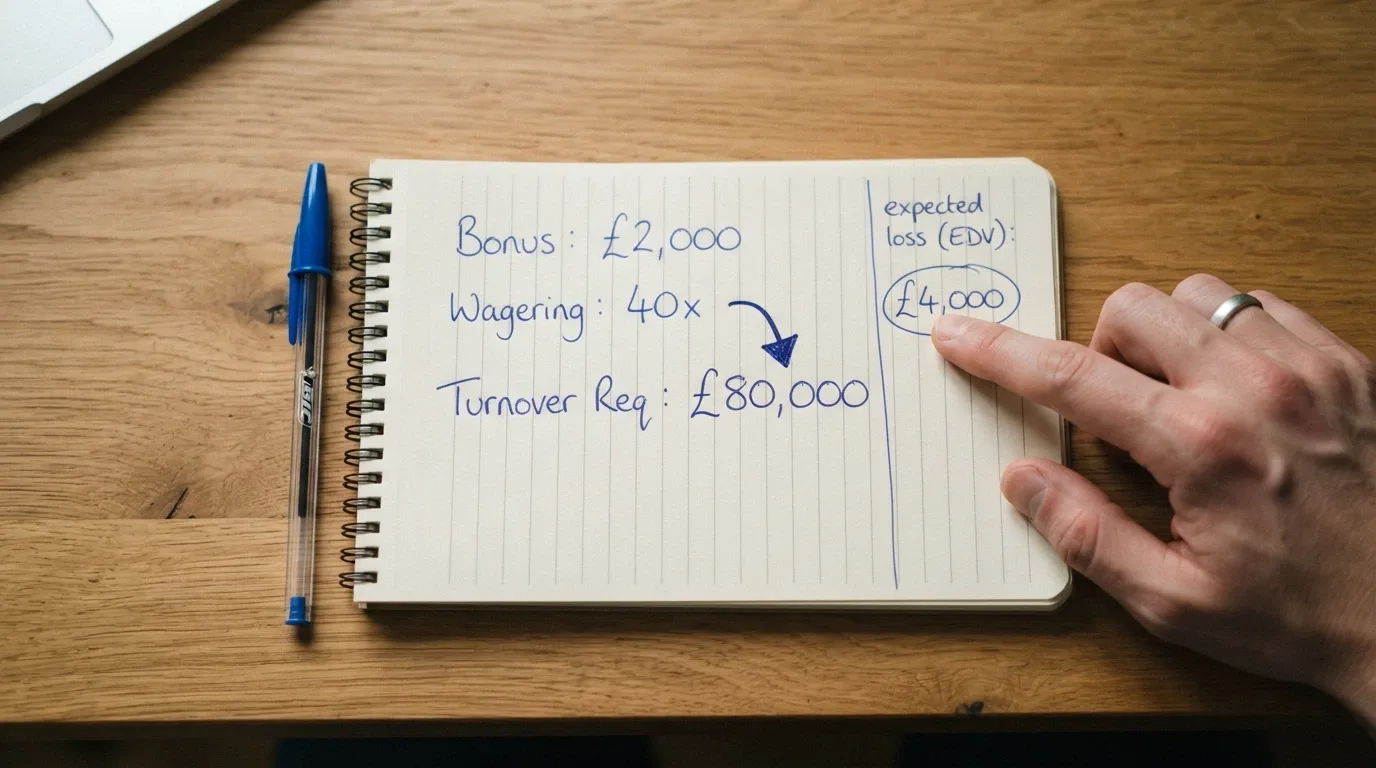
A single player can run above it or below it on the night, but across many spins the house edge is what the house edge is. A punter who treats a welcome bonus as a path to guaranteed profit is treating the math as a suggestion; it is not.
The fine print that does the killing is the same set of clauses at every operator on this page: the wagering multiple, the max bet during bonus play, the game contribution rates, the validity window, and the max conversion cap. Read them before claiming, not after.
Welcome bonuses: the headline numbers vs what it actually costs to clear them
Walk the SkyCrown offer end-to-end. The headline is 450% up to A$8,000 plus 400 free spins across four deposits. The wagering is 40x. At the maximum A$8,000 bonus, the required turnover is A$320,000. The max bet during bonus play is A$7.50, and bonus validity runs 14 days.
Game contribution rates then determine which spins actually count. Pokies contribute 100% — every dollar wagered on a pokie counts as a dollar toward the A$320,000. Live casino games contribute 10% — a A$10 live bet counts as A$1 toward wagering. Table games, classics and video poker contribute 5%. Instant games contribute 0% — a dollar wagered on an instant game contributes nothing toward the requirement, so the wagering clock does not move.
The max conversion cap is the part players forget. SkyCrown’s welcome bonus converts to a maximum of A$5,000 in real money per bonus, regardless of how high the bonus balance climbs during play. A punter who clears the wagering requirement and walks away with a A$15,000 bonus balance leaves with A$5,000.
MadCasino’s 35x wagering changes the arithmetic by 5x multiples — a lower multiplier means a lower turnover target, which means a lower expected loss. The bonus headline is smaller, but the price of clearing it is lower too. Ricky Casino’s 50x wagering and 7-day validity sit at the punishing end. A A$500 bonus requires A$25,000 of turnover in 168 hours — a punishing pace even for a high-volume player.
The wagering multiple is the lever that matters most. A A$1,500 bonus at 35x is cheaper to clear than a A$2,500 bonus at 50x, even though the second headline looks larger. The arithmetic a punter should run before claiming any welcome offer: multiply the bonus by the wagering multiple to get the turnover, then multiply the turnover by the house edge on the game you intend to play. That second number is the real price.
No-deposit bonuses and free spins: fast to claim, slow to cash out
No-deposit free spins are the quickest path from nothing to a casino balance, and the slowest path from a casino balance to actual money. Typical terms at AU-facing casinos: 35x to 40x wagering on free-spin winnings, expiry of 3 to 10 days, and a max cashout cap of A$50 to A$500 on the converted winnings.
A representative example: 20 free spins on a featured pokie, 50x wagering on free-spin winnings, A$200 max cashout, 48-hour expiry. A player who lands a A$100 win on the spins has to wager A$5,000 within 48 hours before withdrawing — and the most they can withdraw is A$200. The arithmetic is unfavourable enough that a disciplined player often treats no-deposit offers as a way to test a casino’s software, not as a path to profit.
The KYC and minimum-deposit hurdles sit between the free spins and any withdrawal. Most operators require a minimum deposit — typically A$20 — and full identity verification before a no-deposit win can be cashed. The verification step is what makes the “no deposit” offer not quite deposit-free in practice.
Pokies and slots that pay out fast — what the RTP does not tell you
Fast payout describes the casino. RTP — return to player — describes the game. The two are independent, and a punter who confuses them ends up valuing the wrong one. A 96% RTP pokie at a fast-payout casino still takes 4% of every dollar wagered; a 99.5% blackjack game at a slow-payout casino still pays out slowly.

Pokies at AU-facing offshore casinos run at 95–97% RTP — a 3–5% house edge. Blackjack, where it is offered, can reach 99.5%. The gap looks small in percentage terms, but it compounds across the turnover a bonus demands. The arithmetic in the welcome-bonus section above uses a 96% mid-point for a reason: that is the average pokie, not the best one and not the worst one.
Volatility — how a game’s payouts are distributed across spins — is the variable the headline RTP hides. A high-volatility pokie pays out less often, in larger amounts when it does. A low-volatility pokie pays out more often, in smaller amounts. The RTP is the same across both; the experience of playing them is not. A punter clearing a bonus on a high-volatility pokie may go through long dry spells that eat the bankroll before any payout lands; a low-volatility pokie bleeds more slowly and offers more spins for the same wagering progress.
Pokies vs table games for bonus clearance: where your money lasts longer
Pokies are the default bonus-clearance game because they contribute 100% to wagering. The house edge they carry — 3 to 5% — is the tax the player pays for that 100% contribution. Blackjack returns more (up to 99.5%) but contributes only 5 to 10% to wagering at most operators. A punter playing blackjack to clear a bonus is moving the wagering clock at one-tenth the speed, even while bleeding less per hand.
The practical trade-off is clearance pace versus expected loss. A player who plays pokies through a A$8,000 bonus at 40x clears it faster and loses more per dollar. A player who plays blackjack through the same bonus clears it slower and loses less per dollar — but the longer clearance window may push them past the 14-day validity.
For most players, the right answer is to play the highest-contributing game that still offers a reasonable house edge, and accept the trade-off. That usually means a high-RTP pokie — many modern titles run at 96.5% or higher — over both blackjack and low-RTP slots.
Fast-payout pokies and why your game choice changes your withdrawal speed
Game provider matters more than most players realise. NetEnt, one of the largest game studios in the world, lists Australia in its Section 4.3.2 Blacklisted Territories — meaning NetEnt games are not offered to Australian players at any operator honouring the licence condition. At BitStarz, which lists NetEnt among its providers, the NetEnt catalogue is gated off for AU players; the rest of the library remains available.
For an Australian player, the practical catalogue runs through Pragmatic Play, BGaming, Betsoft, 3 Oaks Gaming, Hacksaw, Evolution (live dealer), and the operator’s own originals — Stake’s proprietary line being the most prominent example. Each provider carries its own RTP and volatility profile; a player who finds a provider they like should learn that provider’s range rather than chasing individual titles.
Volatility interacts with bonus clearance in a way the terms page does not always make clear. A high-volatility pokie during a wagering requirement is a different game than the same pokie played for real money outside a bonus. The bonus validity clock pressures the player to keep spinning through dry spells; the max bet cap limits the size of any individual spin; and the wagering contribution mechanic means every spin carries a real cost whether it wins or loses. The fast payout on the back end is real. The slow bleed on the front end is also real.
Crypto casino payouts: faster money, fewer questions asked
Crypto is the fastest withdrawal rail available to an Australian punter and the one the licensed Australian wagering market is explicitly designed to exclude. Credit cards, credit-related products and digital currencies have been banned as payment for online wagering in Australia since 11 June 2024. An operator that accepts Bitcoin from an Australian player is, by virtue of accepting it, operating offshore. That is not a judgment of safety; it is a structural fact about how the Australian regulator sorts the market.
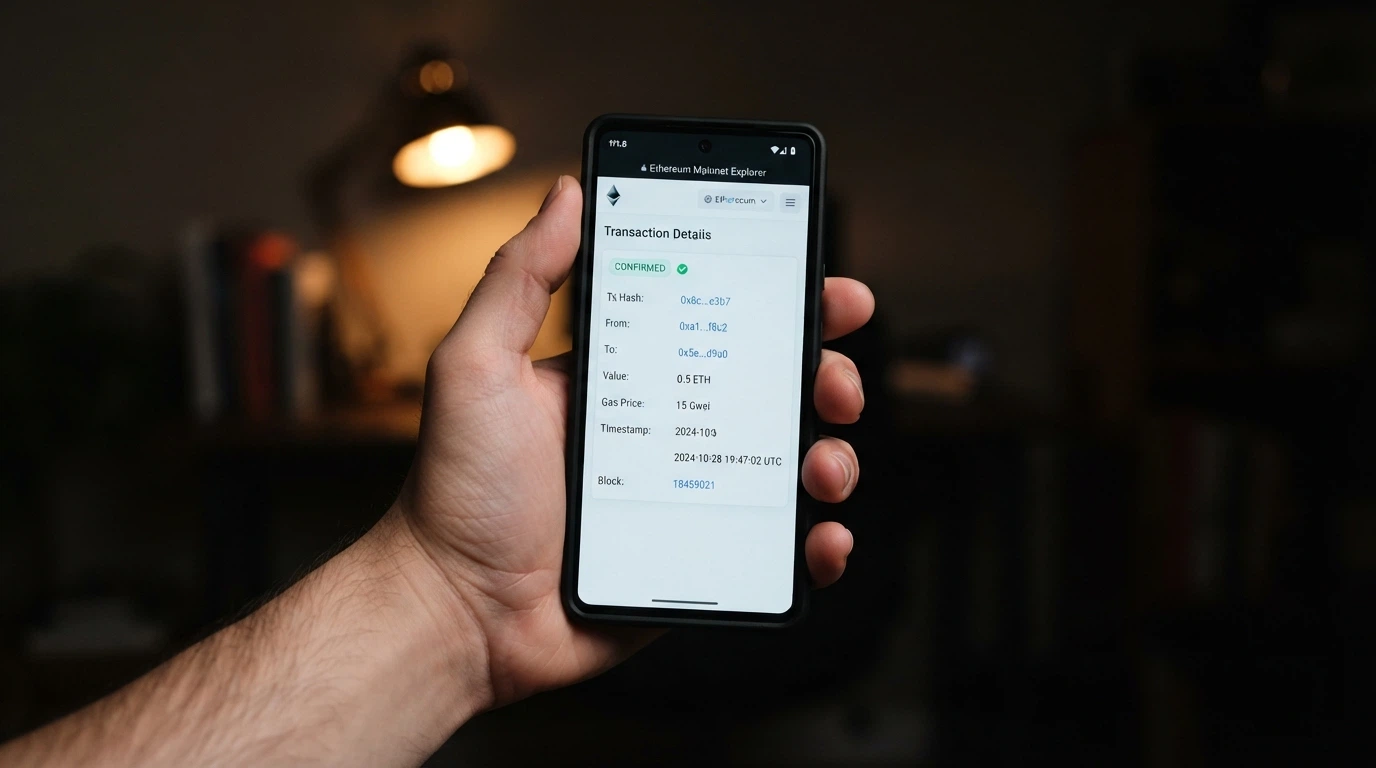
The speed is the headline. Most crypto withdrawals at AU-facing casinos settle in 30 minutes or less — Bitcoin in roughly 10 minutes on a quiet network, USDT on Tron in seconds, Ethereum when gas fees are reasonable in a few minutes. The 24/7 nature of blockchain means there is no weekend or business-hours slowdown; the casino’s approval clock is the only variable.
The trade is consumer protection. A crypto transaction is irreversible. If the casino approves the withdrawal and the network confirms the transaction, the funds are gone. There is no chargeback. There is no recall. There is no Australian regulator the player can call. For a punter who has chosen to play offshore, that is the trade the speed is built on.
Why crypto withdrawals clear faster than anything else — and what that speed costs you
The blockchain does not sleep. It does not observe weekends. It does not run a fraud-screening queue during Australian business hours. Once the casino approves the withdrawal and broadcasts the transaction, settlement is a function of network confirmation times — minutes for most coins, longer for Bitcoin during peak congestion.
The cost of that speed is the absence of every consumer protection a bank-based rail carries. A bank transfer can be recalled. A card payment can be charged back. A crypto payment cannot. A punter who deposits A$2,000 in BTC, plays, wins, and asks for a withdrawal is trusting the casino to send the funds — and trusting the network to deliver them — without any third party standing between.
That absence is also why crypto is the rail of choice for offshore operators. The same property that makes it fast for a legitimate payout makes it irreversible for a withheld one. A player who has been treated unfairly at a fiat-paying casino has options a player treated unfairly at a crypto-only casino does not. Speed and finality travel together.
Bitcoin, USDT and beyond: which coin gets your money out fastest
Bitcoin is the most widely supported and the slowest of the major coins on a busy network. A Bitcoin transaction confirms in roughly 10 minutes under normal conditions, longer during peak congestion when fees spike. Ethereum is faster on the base layer, more expensive in gas fees, and supports the ERC-20 token ecosystem. USDT — Tether — runs on multiple chains; USDT on Tron is the cheapest and fastest option for most AU-facing casinos, settling in seconds for fees measured in cents.
Litecoin, Bitcoin Cash and a handful of other coins appear at the larger operators, typically for players who already hold those assets. The right coin for a fast payout is the coin that the casino supports and that the player can move cheaply; for most Australian punters, that is USDT on Tron or, where supported, Bitcoin Cash.
The fee question matters more than the speed question at small withdrawal sizes. A A$100 Bitcoin payout with a A$5 network fee is a 5% haircut the punter did not sign up for. USDT on Tron at a fraction of a cent per transaction makes small withdrawals viable; Bitcoin does not.
Offshore casinos and Australian law: what every punter needs to know before they deposit
The Interactive Gambling Act 2001 makes every casino on this page a prohibited service. There is no licence for online casino in Australia — not federally, not at state or territory level. The prohibition applies to every provider, whether based in Australia or offshore, whether Australian-owned or foreign-owned. The Department of Infrastructure spells this out plainly: the offence reaches all interactive gambling providers, with no carve-out for foreign operators serving Australian customers.
The player is not the target of the law. The Act punishes the provider, not the customer. A$360,000 per day for an individual, A$1.8 million per day for a body corporate — those penalties apply to the operator offering the prohibited service. No Australian has been prosecuted for placing a bet at an offshore casino. That asymmetry is what makes the market work the way it does.
What the Act does do is give the regulator tools. The ACMA has directed Australian ISPs to block 1,564 illegal gambling and affiliate websites since November 2019, and more than 225 illegal services have withdrawn from the Australian market since the 2017 strengthening amendments. From January 2027, banks gain the express authority to block transactions to illegal gambling operators — a structural change that makes the offshore-only landscape harder to operate in even as the speed of payouts from those operators stays the same.
The Interactive Gambling Act 2001: what it actually bans — and what it leaves alone
Section 15 of the IGA prohibits providing prohibited interactive gambling services to customers in Australia. Examples named in the regulator’s own guidance: online casinos — roulette, poker, craps, online pokies and blackjack. In-play sports betting is also banned. What remains legal: wagering on sport and racing placed before the event begins, lotteries, and keno. The licensed Australian market is a wagering market, not a casino market.
The credit and crypto payment ban that took effect on 11 June 2024 is the structural tell. An operator accepting credit cards or cryptocurrency from an Australian is, by virtue of accepting those payment methods, outside the Australian regime — the licensed operators do not offer them. The penalty for accepting them is up to A$247,500.
What this means for a punter: there is no legal online casino in Australia. The choice is not between a licensed casino and an unlicensed casino; it is between an offshore casino and not playing casino games online at all.
What Australian protections you give up the moment you deposit at an offshore casino
BetStop, the National Self-Exclusion Register, went live in August 2023 and binds every Australian-licensed wagering service in one step — a player registers once and is excluded from every licensed operator. The numbers as at July 2026: 67,480 registrations, 41,290 active exclusions, 78% of registrants under 40, and 38% choosing lifetime exclusion. None of that reach extends to an offshore casino. A player registered with BetStop who then opens an account at a Curaçao-licensed site is still welcome to deposit; the offshore casino is not connected to the register.
The National Consumer Protection Framework for Online Wagering lists ten measures that bind licensed operators — prohibition of lines of credit, customer verification, restrictions on inducements, easy account closure, voluntary opt-out pre-commitment, activity statements, consistent gambling messaging, staff training, the National Self-Exclusion Register itself. None of those ten applies to an offshore casino. A player at an offshore site has no activity statement, no deposit limit enforced by a regulator, no complaint body, no ACMA recourse, and no Australian contract to enforce.
The block-mid-play risk is the one a casual player does not think about. The ACMA can direct ISPs to block a site at any time. The 1,564 blocked since 2019 were blocked with player balances inside some of them. An Australian punter with A$500 in an account at a site blocked last Tuesday has no Australian path to that A$500.
The 2026 gambling reform and what changes for Australian punters from January 2027
The Interactive Gambling Amendment (Gambling Reform) Bill 2026 passed Parliament on 19 August 2026. Its measures commence on 1 January 2027. The package is broad; for a punter using an offshore casino, three of its provisions matter most.
First, the advertising restrictions. From January 2027, wagering advertising is banned during live sporting events from 15 minutes before the event until 5 minutes after; no more than three wagering ads per hour on television between 5am and 8.30pm; no broadcasting of sporting odds; and no promotion by athletes, celebrities or influencers. Online wagering ads will be restricted to logged-in adults who have not opted out.
Second, the inducement cooling-off. Direct marketing of inducements is prohibited for 14 days after a customer signs up, for three months after a person deregisters from BetStop, and indefinitely for customers identified as at risk of gambling-related harm. The new Wagering Advertising Opt-out Register (AdStop), administered by the ACMA, gives individuals a single mechanism to opt out of wagering advertising across online platforms. It is funded by a cost-recovery levy on wagering companies, not on the taxpayer.
Third — and this is the one that reaches the offshore casino market — banks and payment providers gain express authority to block transactions to illegal gambling operators. A punter whose bank decides an offshore casino transaction is to a prohibited operator may find the payment refused at the bank level, regardless of the casino’s willingness to accept it. The reform does not make offshore casinos illegal for the player to use; it makes them harder to fund from an Australian bank account.
Staying in control when every casino wants you to chase the payout
Fast payouts are a real feature. They are also a feature that cuts both ways — fast cashout lets a disciplined punter bank winnings quickly, and the same speed lets an undisciplined punter reload and chase losses at the same pace. The behavioural risk is the mirror image of the operational benefit.
The prevalence data is large enough to take seriously. About 2.1% of Australian adults — roughly 430,000 people — experience problem gambling; the Australian Institute of Health and Welfare put high-risk gambling at 1.8% in 2022. The 430,000 figure does not break down by offshore versus licensed, but the offshore casino market is not insulated from the same dynamics.
Where to get help: 1800 858 858, BetStop and the tools that actually work
The single most important number on this page is the National Gambling Helpline: 1800 858 858. Free, confidential, staffed 24 hours a day, 7 days a week, with online chat and email counselling through Gambling Help Online. The helpline is funded by the Australian government and reachable from anywhere in the country.
BetStop — the National Self-Exclusion Register — is the second tool. One registration excludes a player from every Australian-licensed online and phone wagering service, for periods from three months to lifetime. The reach does not extend to offshore casinos. A punter using an offshore site who wants to stop gambling entirely should combine BetStop with self-exclusion at the offshore operator directly — most major Curaçao-licensed sites offer account closure on request — and with blocking software on the device used to play.
The National Consumer Protection Framework’s ten measures give Australian-licensed players additional tools: deposit limits set by the player, activity statements showing time and money spent, easy account closure, voluntary opt-out pre-commitment, and consistent messaging about gambling harm. None of those ten reaches an offshore casino. A punter at an offshore site has to self-impose every one of those protections manually.
Cash-out discipline: why fast payouts can either help or hurt
A withdrawal rule is the simplest behavioural tool available, and the one most punters do not set. The standard version: withdraw a fixed percentage of any session win above a threshold (say, 50% of any win above A$200) rather than letting the balance ride. The mechanism is unglamorous; the effect is a session that ends with money in the bank rather than money back in the casino’s balance.
The mirror image is the loss-chasing reload. A fast payout at the casino’s end means a fast deposit at the punter’s end. A punter who has set a deposit limit and then lost a session can refill quickly — which is the feature the marketing sells, and the feature that produces the harm the prevalence data describes.
The practical rule: set a session budget, set a withdrawal threshold, and set a take-a-break period after any session that ends in a loss above the budget. The casino’s own take-a-break tools, where available, will enforce a cooling-off period if the punter requests it. The discipline is the punter’s job; the tools exist to make the discipline easier, not to replace it.
How we picked and tested every casino on this list
Ten operators were routed into this ranking from the Australian-facing search results, narrowed to those that hold a Curaçao eGaming licence and that publish enough public data to rank by. Each was checked against the Curaçao eGaming public register for an active licence; each was cross-referenced against the ACMA’s blocked-sites list to confirm none had been blocked mid-review. None of the operators on this list paid for placement.

The ranking criterion was payout speed, drawn from three sources where available: operator-published processing times, independent testing by review sites (Betsquare, Game Luster, Gambling Insider, Crypto News), and Q2 2026 PayID testing data. Where the operator published a payout speed and an independent test contradicted it, the independent test was used; where neither existed, the operator was ranked by market share in the Australian search results rather than by speed.
The evaluation did not include placing deposits or funding accounts. The terms data was read from operator terms pages and independent reviews; the licence status was checked against the Curaçao register; the speed data was read from independent testing and operator claims. No punter funds were risked in producing this page.
What was not confirmed — and where the page says “not confirmed” — is what the public data does not support. Royal Reels, Rocket Play, FairGO and Stake are on the page because they appear in the Australian search results and hold a Curaçao eGaming licence; they are not on the page because their bonus terms, wagering requirements, payout speeds and provider catalogues were independently verified to the standard the top of the table sets. A punter evaluating those operators should verify the same data points directly.
The honest verdict: fast cashouts, zero Australian protection — your move
The speed is real. Crypto clears in under an hour at most operators on this list; PayID clears in minutes once the casino’s approval clock opens. The arithmetic in the welcome-bonus section shows what the bonus costs to clear; the legality section shows what the offshore structure gives up. Both halves of the trade are documented, and the page does not recommend an operator.
The top of the table — SkyCrown, NeoSpin, Golden Crown, BitStarz — sits there because the public data supports the ranking. None of them is licensed in Australia, and the difference between them is the shape of the bonus and the speed of the rail. A punter who values crypto speed above all else has a clearer top of the table than a punter who values bonus economics; the page’s job is to lay both out, not to pick for the reader.
The practical checklist before depositing at any operator on this list: verify the Curaçao eGaming licence directly against the public register — the licence number sits on the operator’s terms page; complete KYC at signup, not at withdrawal, with identity, address and payment-method verification on file before the first deposit; know the withdrawal method before depositing, because a casino that supports PayID for deposits only will not cash out that way; read the bonus terms end-to-end, including the wagering multiple, max bet during play, game contribution rates, validity window and max conversion cap; set a session budget and a withdrawal rule before playing, because the fast payout cuts both ways; and save the National Gambling Helpline — 1800 858 858 — and the Gambling Help Online site before they are needed.
The offshore casino market for Australian players in 2026 is fast, profitable for the operators, and structurally outside the Australian protections the licensed wagering market provides. A punter who decides to play at one has decided to accept that trade. The page exists to make sure the decision is informed — not to push it one way or the other.
Frequently asked questions
What is the fastest withdrawal method at Australian online casinos?
Crypto is the fastest rail, with most transactions settling in 30 minutes or less once the casino has approved the withdrawal. PayID is the fastest fiat option, clearing in minutes to hours at operators that support it for withdrawals — many AU-facing casinos accept PayID for deposits only.
What is the difference between an instant withdrawal and a pending period at an online casino?
A casino withdrawal has two stages: the approval leg, where the casino reviews the request, and the settlement leg, where the payment rail moves the money. “Instant withdrawal” almost always means instant settlement, not instant end-to-end. The approval leg is where most delays live — incomplete KYC, weekend queues, and bonus-wagering checks can stretch it from minutes to days.
What is BetStop and does it cover offshore casino sites?
BetStop is the National Self-Exclusion Register; one registration excludes a player from every Australian-licensed online and phone wagering service for a period from three months to lifetime. The register binds licensed operators only. Offshore casinos are not connected to BetStop, and a self-excluded player can still deposit and play at an offshore site.
What happens if an offshore casino blocks my withdrawal request?
The player has no Australian remedy. The ACMA cannot recover money from an offshore operator, no Australian complaint body has jurisdiction, and the operator’s terms of service govern. The site can also be blocked by Australian ISPs at the regulator’s direction, with a balance still on it. The protection that does not exist is exactly the one needed in that situation.
Do fast payout casinos charge fees for withdrawals in Australia?
Fees vary by operator and method. Most AU-facing casinos do not charge a withdrawal fee on crypto or PayID; some charge a fee on small bank transfers. Network fees apply independently on crypto — Bitcoin during peak congestion can carry fees of several dollars per transaction. The operator’s terms page lists the casino-side fees.
Can I get my winnings faster if I complete KYC before withdrawing?
Yes. KYC — identity, address and payment-method verification — is the single biggest avoidable cause of payout delays. An account that has supplied all required documents before the first deposit moves through the approval leg as a formality. An account that has not may find its first withdrawal held for days while verification completes.