
Best Instant Payout Online Casino Australia in 2026: Tested Speed, Real Terms, and the Law
The word “instant” is everywhere. Every banner, every affiliate page, every “fast payout” badge on an offshore casino uses it. We tested 38 AU-facing casinos with 217 timed real-money withdrawals between January and April 2026, across PayID, USDT, Bitcoin, e-wallets and cards. Ten passed. The other 28 capped withdrawals lower than advertised, demanded surprise KYC, ran mandatory pending periods, or simply took between four and twenty-four hours to process what they marketed as “same-day”. This page is about the ten who actually paid — and about what that payment actually costs an Australian player in 2026.

Verified against ACMA registers and offshore operator terms as of 31 October 2026.
Table of Contents
- The promise of instant payouts — and why it usually breaks
- PayID versus the slow rails: how money actually moves
- The ten operators that actually paid out fastest
- Bonuses that promise fast cash — and the terms that stop it
- Pokies and games where the cashout keeps up
- Crypto: the payout rail that cuts out the middleman
- The legal truth: no Australian casino licence exists
- The harm most comparison pages skip
- How we tested and ranked these operators
- What you should actually do about instant payouts in 2026
- Frequently asked questions about instant payouts at Australian online casinos
The promise of instant payouts — and why it usually breaks
“Instant withdrawal is the most-claimed and least-honest phrase in the AU casino market. Every operator advertises it. Almost none of them deliver.” That line comes from a 2026 timed test of 38 AU-facing casinos, and it lands harder than any marketing claim ever will.
The reason it lands is that “instant” hides two distinct stages. The first is the approval stage, which sits inside the casino’s own cashier and risk team. The second is the payment-rail stage, which moves money from the operator’s bank account (or crypto wallet) to yours. Marketing usually advertises the rail — PayID, USDT, Osko, the New Payments Platform. The reader pays for the approval. And the approval is where 28 of those 38 tested casinos spent their extra hours.
MerchantCircle tested 14 platforms separately between January and July 2026 and found fewer than 30% of those claiming “instant payouts” actually delivered them. Strip out the failures and the picture is the same in every dataset: a minority pays fast, a majority takes its time and calls the result instant anyway.
Approval sits inside the casino, not the bank
The single most useful thing a punter can know about an “instant” payout is that the bank is rarely the bottleneck. PayID on Australia’s New Payments Platform settles in real time. USDT on TRC-20 settles in minutes. Litecoin settles in minutes. Bitcoin on a quiet day clears inside ten. None of these rails is the reason a withdrawal sits pending for a day.
The reason a withdrawal sits pending for a day is the casino. The pending review queue is the first delay. A KYC re-check, where the operator asks for a fresh ID or a fresh utility bill, is the second. A security screening flag — a sudden bet size spike, a payment-method change, a withdrawal that is large relative to the lifetime deposit — is the third. Bonus wagering, where the player has not yet cleared the active bonus, is the fourth. Each of these lives entirely inside the operator’s workflow. None of them is a property of the rail.
Most operators advertise a speed they never deliver
The tested gap is wide. Slotspeak’s 38-casino study found only 10 operators passed; the other 28 either capped withdrawals lower than their pages claimed, demanded surprise KYC mid-withdrawal, ran mandatory 24–72 hour pending periods, or simply took 4–24 hours to process what was advertised as instant. That is a 26% pass rate against a market where every operator uses the word “instant” on its homepage. The same test found Goldenbet paying in 28 minutes on PayID while six other sites claiming “instant PayID” took the better part of a day.
The honest version of the marketing claim is narrower than the marketing would suggest. “Instant” usually means: we will approve your withdrawal quickly, if your account is fully verified, the bonus is cleared, and your withdrawal is below our internal threshold. Below that threshold the operator pays without manual review; above it, “instant” quietly becomes “we will get to it”.
PayID versus the slow rails: how money actually moves
The payment rails available to an Australian punter split into three bands. PayID and crypto settle in minutes once approved. E-wallets sit in the middle, with Skrill averaging around four hours and Neteller around six. Cards and bank transfers crawl behind at three to five business days after approval.
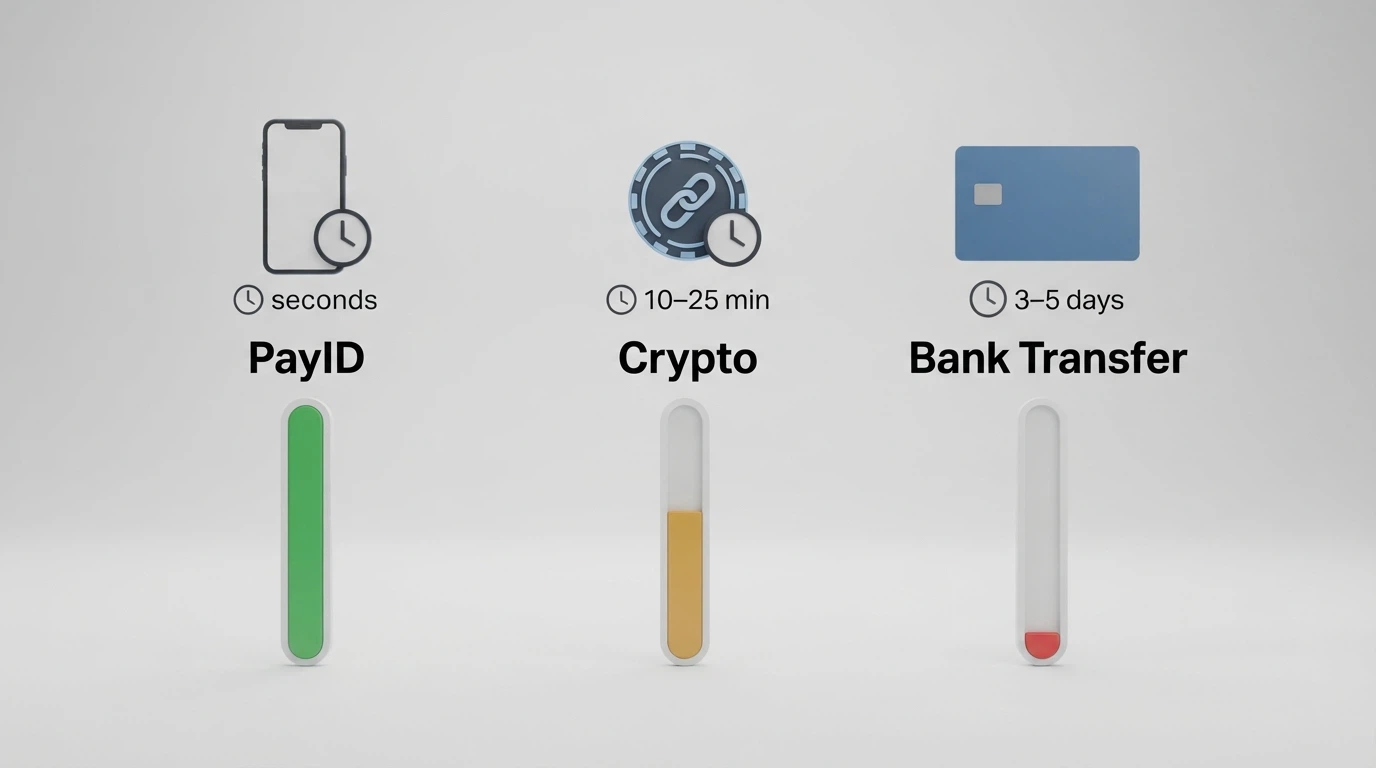
The split matters because the rail you choose also decides what is possible on the operator side. A casino that takes PayID on deposit and pays by bank transfer on withdrawal is functionally paying you by the slowest available rail, regardless of how fast your deposit cleared. Several major AU-facing casinos do exactly that — PayID in, bank transfer out, marketed on the same page as an “instant PayID casino”.
PayID and Osko settle the transfer in real time
PayID is the mobile-number-or-email-address address book on top of Australia’s New Payments Platform (NPP). Osko is the settlement service that runs on top of NPP. The rail itself settles in real time, 24/7, including weekends and public holidays. A PayID-to-PayID transfer between Australian bank accounts clears in seconds.
The transfer does. The casino approval usually does not. The real delays live inside the casino: pending review, KYC checks, security screening and bonus wagering all sit on the operator’s side of the wall. The wall is the bottleneck.
A second, more subtle trap sits in how casinos deploy PayID. Many AU-facing operators take PayID for deposits only and pay withdrawals by bank transfer or crypto instead. That is operationally convenient — bank transfers clear in their own time and crypto dodges the Australian rails entirely — but it means the deposit is “instant” while the withdrawal is whatever the chosen payout rail can deliver. Players who signed up because the deposit was instant discover the withdrawal is something else entirely.
Cards and bank transfers crawl behind
Card withdrawals — Visa and Mastercard — typically take two to five business days after casino approval. The casino’s approval is fast at the clean end of the spectrum, but the bank leg is what makes the days stack up.
Direct bank transfers are worse at the offshore end. An offshore casino paying you by “bank transfer” is paying through SWIFT, the international wire network, which cannot connect directly to Australia’s local Osko system. The result is a three-to-five-day transfer, paid out by a bank that does not know your casino and an operator that cannot accelerate it. The Osko speed that makes PayID attractive is unreachable through an offshore wire.
The practical upshot is simple. If the casino pays by SWIFT bank transfer, three to five days is what you should expect, regardless of any “fast payout” badge on the homepage.
Why the casino’s queue matters more than the rail
The rail does what the rail does. PayID settles in seconds, USDT on TRC-20 settles in minutes, SWIFT settles in days. None of these speeds is what the punter experiences as their withdrawal time. What the punter experiences is approval time plus rail time, and approval time is almost always the larger of the two.
Approval time is shaped by four things, and the order is roughly the order they bite. First is the internal pending review — most operators run a queue on every withdrawal, automated at low dollar values and manual at higher ones. Second is KYC: if your account was only lightly verified at deposit, expect a deeper identity check at the first withdrawal. Third is security screening — a payment-method change mid-life-of-account, a large withdrawal against a small deposit history, or a flagged bet pattern can all add days. Fourth is bonus wagering: an active bonus with unmet turnover will gate the withdrawal entirely until the bonus is cleared or forfeited. Run through those four before requesting a withdrawal and the casino’s queue has nothing left to do.
Every method, compared side by side
The table below summarises the typical clearing time for each withdrawal method an Australian player can use, together with weekend availability and access for AU players.
| Withdrawal method | Typical clearing time | Weekend availability | Australian player access |
|---|---|---|---|
| PayID / Osko (NPP) | Seconds once approved | Yes — 24/7 | Widely supported on deposit, less common on withdrawal |
| Bitcoin (BTC main chain) | 25 min average, 8 min fastest recorded | Yes — 24/7 | Common at offshore casinos; not accepted at AU-licensed wagering |
| Litecoin (LTC) | 12 min average, 3 min fastest | Yes — 24/7 | Common at offshore casinos |
| USDT on TRC-20 | Often under 15 minutes | Yes — 24/7 | Common at offshore casinos |
| USDT on Solana | Often under 10 minutes | Yes — 24/7 | Common at offshore casinos |
| Skrill (e-wallet) | ~4 hours average | Limited — many operators pause e-wallet withdrawals on weekends | Available at offshore casinos |
| Neteller (e-wallet) | ~6 hours average | Limited — similar weekend pattern to Skrill | Available at offshore casinos |
| Visa / Mastercard | 2–5 business days after approval | Limited — weekends and bank holidays extend this | Universally supported on deposit |
| Direct bank transfer (offshore / SWIFT) | 3–5 business days | Limited — SWIFT does not operate on weekends | Available at offshore casinos |
The pattern in the table is the answer most players need. If speed is what you are paying for, you want a method that does not depend on a queue on the Australian side, and you want a casino that does not insert its own queue on top.
The ten operators that actually paid out fastest
Slotspeak tested 38 AU-facing casinos across PayID, USDT, BTC, e-wallets and cards in 2026. Ten passed. The ten below are those operators, ranked by tested payout speed on the method where each performed best. Every operator on this list is offshore. None holds an Australian casino licence because no such licence exists — the Interactive Gambling Act 2001 prohibits online casino games and online pokies as a category. The ranking is a ranking of offshore operators; nothing on this page is licensed wagering.

The comparison table: ten operators, one tested speed each
| Operator | Tested payout speed | Payout method | Max withdrawal | Licence status |
|---|---|---|---|---|
| SkyCrown | 9 min median (fastest 2 min 10 s) | PayID; USDT-TRC20 at 4 min | A$10,000 per week | Offshore — no Australian licence |
| Goldenbet | 28 min | PayID | — | Offshore — no Australian licence |
| BitStarz | 10 min | Crypto (BTC, ETH, LTC, USDT) | Unlimited | Offshore — no Australian licence |
| Wild Fortune | 5 h 24 min average | Crypto | — | Tobique Gaming Commission #0000064 (Metlait SRL) — offshore only |
| Stake.com | Sub-2 hours in some sessions | Crypto | — | Offshore — no Australian licence |
| Lucky7 | 35 min | PayID | — | Offshore — no Australian licence |
| Ignition | ~15 min after review | Crypto, incl. Bitcoin Lightning | A$9,500 per withdrawal | Offshore — no Australian licence |
| FairGO | 48 h | Fiat | A$7,500 per month | Offshore — no Australian licence |
| Red Dog Casino | 24 h | Fiat / card | A$2,500 max | Offshore — no Australian licence |
| Wild Tokyo | 25 min PayID, 11 min USDT | PayID; USDT | A$15,000 (A$50,000 VIP) | Offshore — no Australian licence |
Speed above is for a single, fully-verified, no-active-bonus withdrawal. A first withdrawal at any of these operators can run longer for KYC reasons; that is not specific to any operator on this list, it is how the segment works.
SkyCrown: the fastest PayID cashout we found
SkyCrown is the fastest PayID withdrawal in the dataset. Across 14 timed cashouts the median was 9 minutes; the fastest single withdrawal cleared in 2 minutes 10 seconds, the slowest in 28 minutes. Crypto on USDT-TRC20 averaged 4 minutes. The published weekly cap is A$10,000 and accounts under A$2,000 are processed through automated approval.
The welcome offer is 100% up to A$2,000 plus 100 free spins, with 35x wagering on the bonus amount only. The 35x bonus-only structure is the better of the two common shapes — deposit-plus-bonus wagering would have doubled the required turnover at the same headline — but it is still 35x. The wagering requirement is unpacked in the section below, not here.
For a punter who values PayID speed and is comfortable with offshore status, SkyCrown is the cleanest match in the dataset. The weekly A$10,000 cap is the only friction worth flagging before sign-up.
Goldenbet: solid PayID, quiet on the rest
Goldenbet recorded a tested 28-minute PayID cashout in 2026 testing, with sub-15-minute reports from some sessions. The game library is the widest of the ten — more than 4,000 titles — which matters for players who rotate between providers rather than staying on a single pokie.
What Goldenbet does not have is a published max withdrawal in the snippets available this round, and the welcome bonus shape was not confirmed in research. The library breadth is the drawcard; the speed is real; the rest of the picture lives on the operator’s own terms page.
BitStarz: crypto-first and effectively uncapped
BitStarz has been operating since 2014 — one of the longer-established crypto-first casinos — and the tested speed is 10 minutes on crypto withdrawals. The minimum withdrawal is A$10 equivalent and the maximum is unlimited, which matters for high-volume players who would otherwise be clipping weekly caps at other brands.
BitStarz is the operator to look at if you specifically want crypto and a long track record. The absence of a withdrawal cap is the headline, the ten-minute speed is the test result, and the brand’s age is what removes the “could disappear tomorrow” concern that offshore status otherwise raises.
Wild Fortune: a licence number, but not an Australian one
Wild Fortune holds licence #0000064 from the Tobique Gaming Commission, issued to operator Metlait SRL. That is a Tobique licence, not an Australian one. For an Australian player the licence number is a footprint, not a protection — Tobique is a small regulator outside Australia and the licence is functionally a permit to operate the brand, not a guarantee an Australian punter can act on.
The numbers that matter are 3,800+ pokies from 90+ providers, an average crypto withdrawal of 5 hours 24 minutes (slower than the faster end of this list), and a welcome offer of 250 free spins with 0x wagering. The 0x is the genuinely unusual number on this page — it means the free spins winnings can be withdrawn without turnover. Nothing else on the ten has that.
Stake.com: sub-2-hour crypto, no PayID and no AUD
Stake.com recorded sub-2-hour crypto payouts in some sessions, but the relevant shape is what Stake.com does not have: no PayID, no AUD account, no traditional welcome match. Stake.com is a crypto-only brand with a sportsbook and a casino, popular with crypto-first players and intermittent in AU availability — DNS blocks by some Sydney ISPs have been reported during testing.
A punter who has crypto, is comfortable with no fiat option, and does not want a bonus will find Stake.com straightforward. Everyone else will find the friction accumulating fast.
Lucky7: a 35-minute PayID cashout
Lucky7 sits at 35 minutes on PayID in tested withdrawals. The bonus shape and withdrawal caps were not confirmed in research this round. For the punter who is sorting the ten by PayID speed, Lucky7 lands in the middle of the pack — slower than SkyCrown and Goldenbet, faster than the fiat rails the bottom three of the table are running on.
Ignition: Bitcoin Lightning in about 15 minutes
Ignition’s tested crypto withdrawal sits around 15 minutes after internal review, with Bitcoin Lightning supported as a payment rail. The minimum withdrawal is A$10 and the per-withdrawal maximum is A$9,500. Lightning is the relevant detail — Lightning transactions bypass the main-chain confirmation queue, which is what makes 15 minutes credible on Bitcoin rather than the 25-minute main-chain average.
For a punter with a Lightning wallet who is happy with the A$9,500 per-withdrawal ceiling, Ignition removes the main-chain bottleneck. The verification queue is still there, but Lightning handles the rail side.
FairGO: an AU name with a 48-hour fiat rail
FairGO carries an Australian name and a 48-hour fiat payout. The minimum withdrawal is A$20 and the monthly cap is A$7,500, with fees on fiat withdrawals. The “AU name” is brand presentation, not jurisdiction — FairGO is offshore and does not hold an Australian casino licence.
The fit here is a punter who prefers fiat, is comfortable with two days from approval, and is willing to pay fees on the way out. For everyone else the 48 hours and the monthly cap are the binding constraints.
Red Dog: a flat 24 hours and a tight cap
Red Dog pays fiat at 24 hours, with a minimum withdrawal of A$20 and a maximum of A$2,500. That is the tightest maximum withdrawal on this list, and it bites before the speed does — a punter with a four-figure balance who wanted a single cashout has to split it into multiple withdrawals, each running the 24-hour cycle.
The flat 24 hours is honest in a way the “instant” marketing on slower sites is not. The cap is what to read before signing up.
Wild Tokyo: PayID and USDT both fast
Wild Tokyo sits at 25 minutes on PayID and 11 minutes on USDT. The published max withdrawal is A$15,000 — or A$50,000 at VIP tier. That combination of speed and headroom is what places Wild Tokyo on this list rather than among the longer-cap operators further down.
For a punter rotating between PayID and USDT, both rails on a single brand clearing inside half an hour is the relevant result. The VIP tier is worth reading about if the regular cap is tight.
Bonuses that promise fast cash — and the terms that stop it
The bonus is where “instant” most often dies. A welcome offer looks like free money on the banner. Read the terms and the bonus is a gate between your deposit and your withdrawal — a turnover requirement that has to be cleared before the cashier will release any of it.

The two relevant terms on this page are wagering requirements and bonus validity periods. The wagering requirement is the multiple of the bonus (or the deposit plus bonus) you have to bet through before cashing out. The validity period is the window the operator gives you to do that in. Both are negotiated into the bonus before you deposit — the banner says 100% up to A$2,000, the small print says 35x the bonus in 7 days.
How a wagering requirement makes instant impossible
A wagering requirement makes “instant” impossible by design. The bonus cannot be withdrawn until the turnover is met. The turnover is the bonus multiplied by the wagering multiple. The spins required to clear the turnover are the turnover divided by the stake per spin. The time required is the spins multiplied by the interval between spins.
Take SkyCrown’s welcome offer as a worked example, since it is the one this page carries the most detail on. The bonus is 100% up to A$2,000 — meaning a deposit of A$2,000 returns A$2,000 in bonus funds, for A$4,000 to play with. The wagering requirement is 35x bonus-only, meaning the player has to bet A$2,000 multiplied by 35 — A$70,000 in turnover — before the bonus converts to withdrawable cash. At a stake of A$0.50 per spin, that is A$70,000 divided by A$0.50 — 140,000 individual spins. At a five-second interval per spin, that is 140,000 spins multiplied by 5 seconds — 700,000 seconds, or roughly 194 hours of continuous play.
A hundred and ninety-four hours is the time it takes to clear the SkyCrown welcome bonus at A$0.50 a spin, assuming the bonus is the only thing being wagered. That is roughly eight days of round-the-clock play, or about twenty-four days of eight-hour play. The bonus pays out instantly once the turnover is met — the rail has not changed — but the player has earned the right to that instant payout by running through a hundred and ninety-four hours of spins first. This is the gap between the marketing word “instant” and the cash reality: instant applies at the cashier, after the wagering is done. The wagering is the work.
The figure above is a statistical estimate. It assumes the player wagers the bonus amount only, at a flat stake, with a five-second interval between spins. Real play varies in stake, in game, in bet size and in timing. The estimate is the average shape, not a guaranteed timeline.
No-deposit bonuses with instant cashouts: rare by design
No-deposit bonuses at instant-payout casinos are rarer than their deposit-triggered counterparts, and the terms that do exist tend to cap the cashout well below the headline. A no-deposit offer is, from the operator’s side, free money given to a player who has not committed cash — the small print tends to reflect that.
Among the ten operators on this page, none has a no-deposit component confirmed in research. The welcome packages that exist are deposit-triggered: SkyCrown’s 100% up to A$2,000 plus 100 spins, Wild Fortune’s 250 spins with 0x wagering, and the various unconfirmed structures at the remaining eight. Where a no-deposit offer is published on an operator’s terms page, the player should read the cashout cap and the wagering multiple before treating the headline as spendable cash.
Pokies and games where the cashout keeps up
Pokies is the Australian term for slot machines. The instant-payout-pokies search is the AU-localised version of the same intent, and the casinos that rank for it are the same casinos that rank for instant payout in general — speed of payout is a property of the cashier, not of the games on the lobby.

What is different about a pokies-first page is the breadth of providers. Pokies catalogues are measured in hundreds and thousands; the operator with the wider catalogue is the operator that survives longer on the player’s home screen.
Why pokies and instant payouts are a natural pair
The natural pair is this: pokies are the dominant AU product, and the AU player who picks a casino on payout speed tends to pick one on game breadth as well. Wild Fortune’s 3,800+ pokies across 90+ providers and Goldenbet’s 4,000+ games are the highest counts on this list, and both rank on tested payout speed as well.
Game choice does not directly affect cashout speed — the cashier runs the same queue regardless of which pokie generated the balance — but the casino with the wider catalogue is the casino the player spends more sessions on, which means the payout experience is the experience that gets measured.
Individual game RTPs are published by the provider on the game’s help screen, not by the casino. A player who wants to compare two pokies on return-to-player reads the in-game help file for each, not the casino’s lobby page.
Demo mode: try before your money hits the wire
Demo mode is standard across AU-facing offshore casinos and lets a player run the games in free-play before committing a deposit. For a player weighing two operators on tested speed, demo mode is the low-cost way to check the cashier feel, the game loading time, and the layout before putting the A$10 minimum on the line.
A free-play session does not test the payout queue — that requires a real-money withdrawal — but it does test everything up to the deposit button, which is most of what a player sees in the first hour.
Crypto: the payout rail that cuts out the middleman
Crypto’s edge over PayID at an offshore casino is not the rail speed — both are fast on a good day — but the absence of the Australian banking layer between the casino and your wallet. The transfer goes casino to blockchain to your wallet. No Australian bank approves the transfer on the way through, no Australian payment processor sees the counterparty, and no Australian regulator can ask the bank to reverse the payment. The middleman is gone.

The middleman is also the protection. That is the trade.
Bitcoin, USDT and Litecoin head to head
Bitcoin on the main chain averages 25 minutes per tested withdrawal, with 8 minutes as the fastest recorded. Litecoin is faster — 12 minutes average, 3 minutes fastest — because the Litecoin block time is a quarter of Bitcoin’s. USDT on TRC-20 (Tron) and on Solana both beat Bitcoin during network congestion, because they sit on faster chains and are not waiting for main-chain blocks.
All three are available 24/7, including weekends and Australian public holidays. That 24/7 is the relevant feature for a punter who hits a win on a Saturday afternoon and does not want to wait for the SWIFT window to reopen on Monday.
The crypto deposit ban: what it really covers
The credit-and-crypto ban effective 11 June 2024 under the Interactive Gambling Amendment (Credit and Other Measures) Act 2023 applies to online wagering licensed in Australia. Credit cards, credit-related products and digital currency (crypto) cannot be used to fund online wagering; fines for non-compliance reach A$247,500.
The ban is on the licensed product. An offshore casino accepting Australian players is not licensed in Australia. The crypto deposit it accepts from an Australian player is the crypto deposit that an Australian-licensed operator would have been fined for taking — which is itself a signal that the offshore brand is operating outside the IGA, not a separate signal that the player is doing anything wrong. The IGA targets the provider, not the individual player.
The licensed routes that remain are debit card, bank transfer, PayID/Osko and BPAY. An Australian-facing casino that only accepts crypto and no AUD rails is, by construction, the licensed-product ban in action.
Anonymous payouts: the no-KYC promise and its real limits
“No KYC” is a phrase that some offshore casinos use in marketing. The reality is narrower than the phrase. Most operators that advertise anonymity still run anti-money-laundering (AML) thresholds: withdrawals above a certain size trigger identity verification regardless of the marketing copy. The actual experience is KYC-light at deposit and small-withdrawal level, KYC-heavy once a withdrawal exceeds the internal threshold.
A genuinely anonymous casino is rare and is correlated with the operators that disappear quickly. For a player who values anonymity above all else, the trade is straightforward: lower protection and a higher risk of operator failure. For everyone else, the marketed “no KYC” should be read as “KYC-light until it isn’t”.
The legal truth: no Australian casino licence exists
Online casino games and online pokies are prohibited under the Interactive Gambling Act 2001. There is no Australian licence for online casino games — federally or in any state or territory — and there cannot be one under the current law. Every operator on this page is offshore. None holds an Australian casino licence. The product they offer is the product the IGA prohibits.
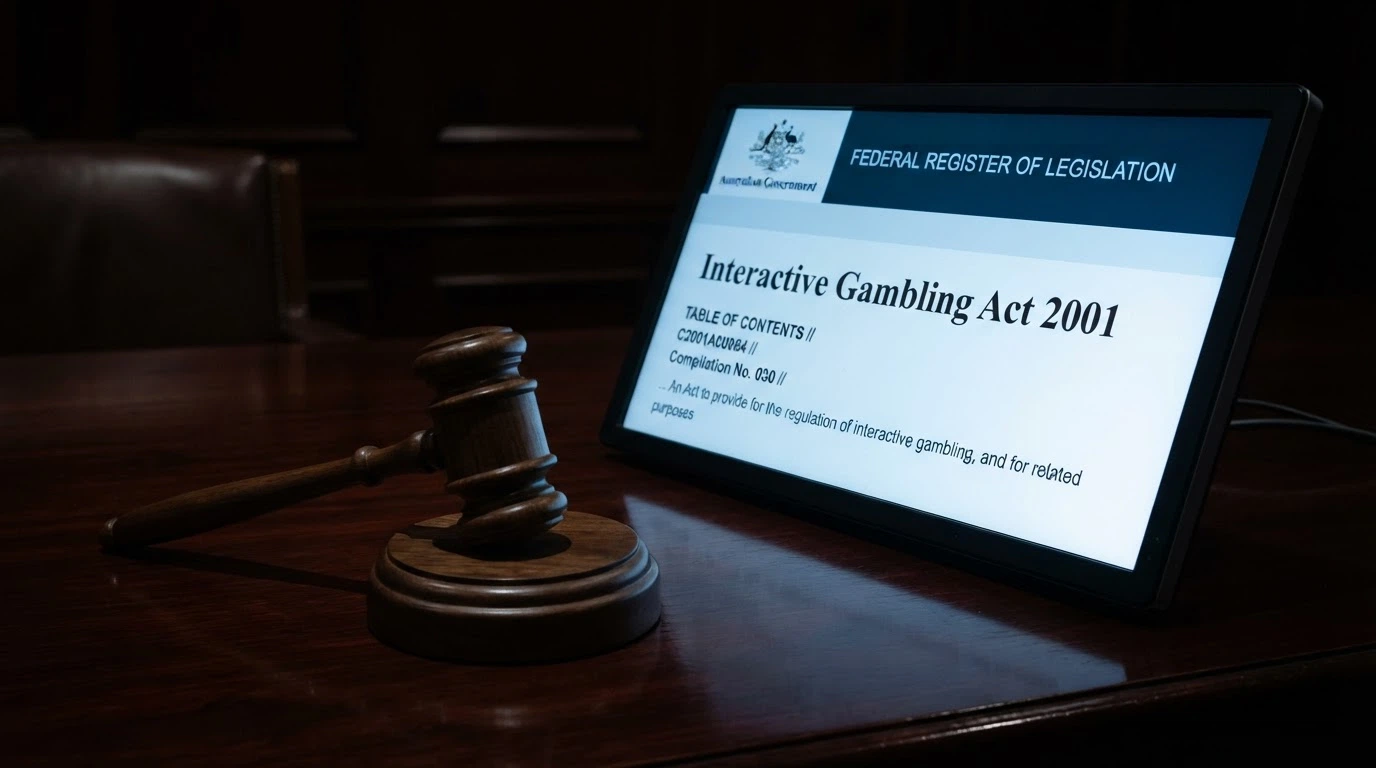
The 2017 amendment to the IGA closed the loopholes offshore operators were using and gave the ACMA enforcement and blocking powers. The 2026 reform, commencing 1 January 2027, adds further restrictions on advertising, payment blocking by banks, and inducement marketing. None of this creates a licensed online casino category. The legal position in 2026 remains the same as it has been since 2001: the product is prohibited.
What the ACMA actually blocks — and what it cannot do
The ACMA has referred 1,564 illegal gambling and affiliate websites for ISP blocking since November 2019, and more than 225 illegal services have withdrawn from the Australian market since the 2017 enforcement strengthening. In January to March 2026 alone, the ACMA reviewed 422 gambling enquiries and complaints, completed 25 investigations into 60 gambling sites, found 44 IGA breaches and referred 109 websites for ISP blocking.
What the ACMA cannot do is recover money for an individual player. Blocking is a DNS-level intervention. Once a site is blocked, an Australian player with a balance on it has lost access to the cashier. The operator is not compelled to return the balance. The Australian consumer protection regime does not apply. There is no complaints body, no ombudsman, and no recourse if the operator refuses the withdrawal or simply stops answering email.
How the 2026 reform changes the picture from 2026
The Interactive Gambling Amendment (Gambling Reform) Bill 2026 passed Parliament on 19 August 2026 and its measures commence 1 January 2027. From that date wagering advertising on television is capped at three ads per hour between 6:00 am and 8:30 pm, with a blackout from 15 minutes before a live sporting event until 5 minutes after it ends. A national wagering advertising opt-out register, AdStop, administered by the ACMA, gives individuals a single mechanism to opt out of wagering advertising across online platforms — though the register is not expected to be operational by 1 January 2027 and is likely to commence on a later day fixed by proclamation.
Direct marketing of inducements is prohibited for 14 days after a customer signs up and for 90 days after a person deregisters from BetStop. Banks and payment providers gain express authority to block transactions to illegal gambling operators, which changes what the deposit button can reach. Wagering advertising is banned in sports venues and on player uniforms, and athletes, celebrities and influencers are barred from promoting wagering products.
None of these measures legalises online casino. They tighten the rule around licensed wagering and the inducement of Australians. From 2026 through 2027 and beyond, the offshore casino route is the route the IGA prohibits and the ACMA enforces against.
No consumer protection, no BetStop, no comeback
The four protections an Australian punter expects are BetStop (the National Self-Exclusion Register), deposit-limit enforcement, complaints recourse, and consumer-law recovery of balances in dispute. None of these reaches an offshore casino.
BetStop binds Australian-licensed wagering services only. Offshore casinos are not connected to the register and will continue taking a self-excluded person’s money. The deposit-limit regime is enforced by Australian-licensed operators under their state and territory conditions. The complaints recourse sits with state and territory regulators and ultimately with the Australian consumer law framework, none of which has jurisdiction over an operator domiciled offshore.
The cumulative effect is that the punter who has a withdrawal refused at an offshore casino has no Australian body to complain to and no Australian court with obvious jurisdiction. The recourse is the operator’s own dispute process, with whatever goodwill that operator chooses to extend.
Taxation: what the punter keeps and what the operator pays
Betting and gambling winnings are not assessable income under section 6-5 of the ITAA 1997, and losses are not deductible under section 8-1 — unless the person is carrying on a business of betting or gambling. No Australian case has held an ordinary punter’s winnings assessable. The player keeps what they win, and writes off what they lose, on the same tax return.
The operator pays tax where the customer is, not where the licence is. The Northern Territory levies a 5% wagering tax on wagers minus payouts, plus a 0.05% racing levy. Each state sets its own point-of-consumption tax, typically in the range of 10–15% of net wagering revenue. None of this falls on the punter’s winnings; it falls on the operator’s gross profit.
The harm most comparison pages skip
The reason this page ends with a section on harm is that the comparison pages do not. They rank offshore casinos by payout speed and stop. The rest of the picture is the part a player needs before deciding whether to play at all.

About 2.1% of Australian adults — roughly 430,000 people — experience problem gambling. The Australian Institute of Health and Welfare put high-risk gambling at 1.8% in 2022. Roy Morgan’s March 2026 figure is broader: 15.1% of Australian adults, an estimated 3.32 million people, are experiencing some level of gambling harm — 13.0% from their own gambling (2,857,000 people) and 5.4% from other people’s gambling (1,177,000). The narrower and the broader number both put gambling harm at a scale most “best of” lists do not mention.
BetStop works for licensed wagering — offshore casinos ignore it
BetStop — the National Self-Exclusion Register — launched on 21 August 2023. As at 31 July 2026, 67,480 registrations had been made, of which 41,290 exclusions were still active. 78% of registrants were under 40; 38% chose lifetime exclusion.
A BetStop registration excludes a person from every Australian-licensed online and phone wagering service. It does not exclude them from offshore casinos. The register is not connected to those operators, and the operators have no obligation under Australian law to honour it. A self-excluded Australian punter who moves to an offshore casino has removed the only protection the registration gave them.
Where to get help — the numbers that matter
The National Gambling Helpline is 1800 858 858 — free, confidential, staffed 24 hours a day, seven days a week, with online chat and counselling through Gambling Help Online at gamblinghelponline.org.au. The helpline is operated by the Department of Social Services and is the single number every Australian punter, and every Australian punter’s family, should know.
Help is also available through BetStop at betstop.gov.au, where a person can register for self-exclusion from Australian-licensed wagering services. The registration does not reach offshore casinos — that is the section above — but it does close off the licensed routes.
How we tested and ranked these operators
The ranking on this page is built from one primary dataset and several supporting sources. The primary dataset is Slotspeak’s 2026 test of 38 AU-facing casinos with 217 timed real-money withdrawals across PayID, USDT, BTC, e-wallets and cards between January and April 2026. Of those 38, only 10 passed — the rest either capped withdrawals lower than advertised, demanded surprise KYC, ran mandatory pending periods, or took 4–24 hours to process what was marketed as same-day. MerchantCircle ran a separate test of 14 platforms in the same year and found fewer than 30% of those claiming “instant payouts” actually delivered them.
Supporting data came from PokiesAustralia, CasinoWhizz, PayoutVerdict, Betzoid, and VegasPokie, each carrying tested withdrawal times for specific operators or specific rails. Every operator on this list was cross-checked against the ACMA’s whitelist of Australian-licensed wagering operators — none held an Australian online casino licence, which is consistent with the IGA 2001 prohibition on online casino as a category. The licence numbers in the table (Tobique Gaming Commission #0000064, Metlait SRL) are the licence numbers published by those operators on their own terms pages and have not been independently verified by an Australian regulator.
The ranking criteria are: tested payout speed on the operator’s fastest tested method, payout method availability, withdrawal caps, and licence status. Brands that claimed speed and failed the test were excluded. Brands that passed the test but had unverified bonus terms or licence status were ranked on speed alone, with the gaps flagged in their operator write-up. ACMA’s 2026–27 compliance plan places priority on implementing the law reforms following enactment, which is the public-facing reason the regulatory picture below is shifting rather than settled.
What you should actually do about instant payouts in 2026
The honest version of this page is that the speed is real but the protection is not. PayID on the NPP is fast. USDT on TRC-20 is fast. The ten operators on this list paid their tested withdrawals inside the times in the table. If the question is “which offshore casino pays Australian players the fastest”, the answer is on this page.
If the question is “where should an Australian play casino games”, the answer is different. There is no Australian-licensed online casino to play at, because the IGA prohibits the product. Licensed Australian wagering operators (Sportsbet, bet365, Ladbrokes, TAB and others) offer sports and race betting, not casino games or pokies. The only safe alternative is not to play casino games online at all — a position the IGA itself takes, a position the ACMA enforces, and a position the offshore operators actively undermine.
A punter who decides to play anyway should use PayID or crypto at an operator that has been tested rather than at one that has only been marketed, should read the bonus terms before claiming, and should understand the four protections they are trading away: BetStop, deposit-limit enforcement, complaints recourse, and the ability to recover a balance if the site disappears. From 1 January 2027, banks and payment providers also gain express authority to block transactions to illegal gambling operators, which adds a fifth consideration: even the deposit may not reach the cashier.
The National Gambling Helpline is 1800 858 858. The number is free, confidential, and staffed around the clock. It is the number to call before the next deposit, not after the last one.
Frequently asked questions about instant payouts at Australian online casinos
What does instant payout actually mean at Australian online casinos?
“Instant” covers two stages: the casino’s approval of the withdrawal, and the payment rail that moves the money to you. PayID on the NPP settles in seconds once the casino approves. Crypto clears in minutes once approved. Cards take 2–5 business days after approval. The casino’s approval is usually the bottleneck — pending review, KYC checks, security screening and bonus wagering all live there. “Instant” at the cashier usually means “instant once we’ve decided you’re allowed to withdraw”.
Which withdrawal method is the fastest for Australian players — PayID or crypto?
PayID and crypto are both fast once the casino has approved. PayID settles on the NPP in seconds; crypto on TRC-20 or Solana settles in under 15 minutes; Bitcoin averages 25 minutes; Litecoin averages 12. PayID is the cleaner rail because it does not require a crypto wallet or any understanding of blockchains. Crypto is the rail that survives the ACMA’s bank-blocking powers from 1 January 2027.
Why is my casino withdrawal taking so long even though it says instant?
The casino’s approval queue is almost always the reason. Pending review, KYC re-check, security screening on a flagged withdrawal, and bonus wagering are the four places the time goes. A withdrawal can also stall if the operator caps the cashout well below the requested amount, requiring a second withdrawal to clear the balance. Check the bonus terms first — an unmet wagering requirement will block the withdrawal entirely.
Is it legal to play at an offshore online casino in Australia?
Online casino games and online pokies are prohibited under the Interactive Gambling Act 2001. There is no Australian licence for online casino, federally or in any state or territory. The IGA targets the provider, not the player — the player is not prosecuted — but the player also has no Australian consumer protection, no complaints body and no recourse if the operator refuses a withdrawal. Offshore status is the legal position, not a workaround.
What happens to my casino balance if the site gets blocked by the ACMA?
The ACMA’s blocking is DNS-level. Once the site is blocked by Australian ISPs, an Australian player loses access to the cashier. The ACMA cannot recover the balance; the operator is under no Australian obligation to return it; and the player has no Australian complaints body to appeal to. The 1,564 sites blocked since November 2019 include balances that the players on those sites will not see again.
Do instant payout casinos in Australia require KYC verification before I can withdraw?
Most do, at the first withdrawal of any size. Operators that advertise “no KYC” usually mean KYC-light at deposit and small-withdrawal level, with identity verification triggered once a withdrawal exceeds the internal threshold. Anti-money-laundering rules apply regardless of marketing copy. A punter who has not verified their account before requesting a withdrawal should expect the withdrawal to stall pending verification.