
How the “highest payout” promise reads, and what an Australian punter is actually choosing between
Data current as of 3 November 2026 — verified against the Australian Communications and Media Authority register and Curaçao Gaming Control Board records.

Every operator in this guide is offshore. None holds an Australian licence, because none can. Online casino is prohibited here under the Interactive Gambling Act 2001, and the most the phrase “highest payout online casino Australia” can honestly do is name that prohibition, then walk through what sits on the other side of it. The pokies with the strongest published return-to-player percentages are real, and they sit in offshore lobbies alongside games that quietly run reduced-RTP variants. The wagering multiples that eat those percentages are real too, and the welcome-offer headlines that pretend otherwise are the marketing word the rest of this page keeps deflating. The choice for a punter is between access to the strongest numbers the global market offers and every Australian protection the IGA would otherwise apply. This page is built to read both sides of that choice at once.
Table of Contents
- The “highest payout” promise, decoded
- The pokies that actually pay the most
- Ten offshore casinos Australian punters actually play, ranked
- Online casino is illegal in Australia: the IGA reality
- Staying safe while playing high-variance pokies
- How we chose and ranked these casinos
- What to actually do with this information
- Frequently asked questions
The “highest payout” promise, decoded
The marketing word “payout” does two jobs. It names the return-to-player percentage the studio publishes for a pokie, which is a long-run number over millions of spins. It also names the speed at which a casino sends money back to the punter, in days or minutes. They are not the same metric, and conflating them is how an operator ends up sounding safer than it is.
RTP is a long-run average, not a per-session promise
Return to player is the slice of every dollar wagered that a pokie is programmed to return to players across its lifetime. A 96.5% pokie keeps 3.5 cents of every dollar on average. The phrase on average carries the load. Across enough spins the figure lands close to what the studio published. Across one session it can land anywhere, because each spin is independent and short-term variance is enormous. A high-RTP title can streak downward for hours. A low-RTP title can pay out early and often and still net the house a profit over the long run.
Volatility is the shape of those swings. A low-volatility pokie returns small wins regularly, and the bankroll bumps along. A high-volatility title returns little for long stretches and then pays in lumps. Sugar Rush 1000 runs at high volatility (5/5) with a default 96.53% RTP — the long-run number is solid, the ride is not. Ugga Bugga sits at the other end, low volatility at 99.07% — among the highest published RTPs in the segment and one of the gentlest. Two titles, two RTP brackets, two completely different session textures. A 99% RTP on a low-volatility pokie still means the house keeps 0.93% over millions of spins; a session is a sample of dozens or hundreds of pulls, not millions.
Payout percentage and payout rate are the same number
Casino marketing calls it payout percentage. Operator terms call it payout rate. Both name return to player — the long-run share of wagers the title returns. There is no second, distinct metric hiding behind either phrase. If a site quotes a payout percentage and a payout rate as two separate numbers, ask for the methodology. One of them is being used loosely.
The house edge: what even a 99% pokie keeps
Every published RTP carries an implied house edge. A 99.00% pokie still keeps 1.00% over the long run. Mega Joker sits at 99.00% and is the highest-payout real-money pokie research found available to Australian players in 2026. Even there, the house is taking a cut. Drop to Ugga Bugga at 99.07% and the cut is 0.93%. Drop again to Goblin’s Cave at 99.32% — the highest published figure on the books — and the house still pockets 0.68% per dollar, indefinitely, across millions of spins.
Average published RTPs across operator lobbies cluster in the 96%–98% band. Fastpay quotes 98% across 4,000-plus games. BruceBet quotes 97.60% across 5,000-plus. Royal Reels sits at 96.4% on its top-50 pokies. The gap between 99% and 96% looks small in writing. Compounded across thousands of spins, it is the difference between the studio keeping 1 cent and 4 cents on every dollar, and that gap is what pays for the welcome offer, the licensing fee, and the affiliate commission an offshore operator runs on.
What “highest paying” really means for an Australian punter
In the Australian market the phrase “highest paying online casino” is a marketing label without a regulated backing. No Australian-licensed online casino exists to be the highest-paying or the lowest-paying one, because no online casino licence is issued in any state or territory. The Interactive Gambling Act 2001, strengthened by the 2017 amendment, prohibits online casino games and online pokies to persons in Australia; the providers sit in Curaçao, Anjouan and elsewhere, licensed outside the regime the Act sets. The phrase therefore resolves, on the ground, to offshore sites whose RTPs, wagering and withdrawal terms a punter can compare but cannot appeal to any Australian regulator about. The rest of this page weighs those three things — RTP, wagering, withdrawal terms — against each other, because that is the only honest weighing the phrase supports.
The pokies that actually pay the most
The researched high-RTP list is entirely pokies and slots. Published RTP is per title, set by the studio, not by the casino. Some operators run reduced-RTP versions of the same title at 94% or 92% and never say so in the lobby. A “surprisingly large chunk” of the segment, in one audit’s wording, runs those variants without disclosing them.
The 99% club: the three pokies that pay back nearly everything
Three pokies clear the 99% mark. Goblin’s Cave, a Playtech title, carries the highest published figure at 99.32%. Ugga Bugga, also Playtech, sits at 99.07% with low volatility and a multi-spin card layout with a maximum multiplier of x1,000. Mega Joker, a NetEnt pokie played in Supermeter mode, sits at 99.00% — and the only source that explicitly says so frames it as “the single highest-RTP real-money pokie available to Australian players in 2026”. Between the three, the difference is a fraction of a percentage point and a long discussion about session volatility.

Ugga Bugga is the gentlest of the three on a session basis; the lower volatility means the bankroll drifts rather than gets eaten in streaks. Mega Joker’s Supermeter mode is its high-RTP configuration and requires deliberate play. Goblin’s Cave runs the highest published return of any pokie in the segment. The four-tenths of a percentage point between them compounds across thousands of spins into something measurable, but a punter playing one of them on any given evening is unlikely to feel the difference; what they will feel is the volatility underneath.
Slots or pokies: the Australian name changes nothing in the maths
Pokies is the Australian word for slot machines, and the two are interchangeable. RTP works identically under either name. Where a source says “highest RTP slots Australia” it is naming the same titles the local press calls “highest paying pokies”. The rest of this page uses “pokies” primarily because that is what an Australian punter calls them; “slots” appears where a quoted source uses it.
Pokies beat table games on published RTP, with a catch
The researched high-RTP numbers are pokies-led. Stake Originals — Stake’s in-house provably-fair games — run a verified 1.00% house edge, the lowest figure research surfaced, which translates to a 99.00% RTP for the titles that sit underneath it. Stake also lists over twenty enhanced-RTP titles at 98%, including Sweet Fiesta and Gates of Heaven, available exclusively on its platform. The table-game side carries no per-game published RTP in research, and that silence is itself a data point: blackjack and roulette tables are quoted with theoretical edges (often sub-1% for blackjack, around 2.7% for European roulette, higher on the American double-zero wheel) rather than the studio-published long-run RTP a pokie help screen shows. Both are calculable. Only one is stamped on the game, and only one is what an operator’s “average payout” claim is averaging over.
Real-money versus demo play: why free play is not the proof
Demo mode is standard at these offshore sites. Spinning in demo tells a punter the reels, the bonus frequency, the look and feel. It does not prove the punter is being served the published-RTP version. Some operators quietly serve a 94.5% build of a 96.5% pokie, and the demo session runs on whatever version the lobby is configured to send. A punter who plays 200 demo spins and feels confident about the game has learned about the game, not about the build the operator is serving.
The RTP version a punter is actually being served lives in the in-game help menu — the small “i” or “?” icon, usually inside the game screen — and the figure there is the one to trust, not the studio’s marketing page. For any pokie that matters to the decision, opening that screen takes ten seconds and settles the question before any real money goes down.
Reduced-RTP variants: how the same pokie pays less elsewhere
Spotting a reduced-RTP version takes one move. Open the in-game help screen on the pokie, read the listed RTP, and compare it against the studio’s published figure. If the figure on the screen is lower than what the studio quotes, the operator is running a reduced version. Three concrete examples research surfaced:
- Book of Dead runs at a typical 96.21%, but operator versions of 94% and 92% exist.
- Big Bass Bonanza can drop to roughly 95.48% or less at some operators.
- Bizzo, in particular, has been noted to run providers at 94.5% versus the 96.5% baseline on some titles.
None of this is disclosed in the lobby. A punter who never opens the help screen never sees it, and a punter who only compares titles by name across two operators may believe they are getting the same game when the maths underneath is two percentage points apart. On a 96% versus a 94% title, the difference is the house keeping 4 cents on the dollar instead of 6. Across a few thousand spins that compounds into the difference between a session that ends flat and one that ends visibly underwater, and no marketing banner tells the punter which build the lobby is serving.
The highest-RTP pokies for Australian players, ranked
Fourteen pokies carry a published per-title RTP in research. They sit below, ranked high to low. Volatility is filled only where a source states it; the rest carries the no-data marker.
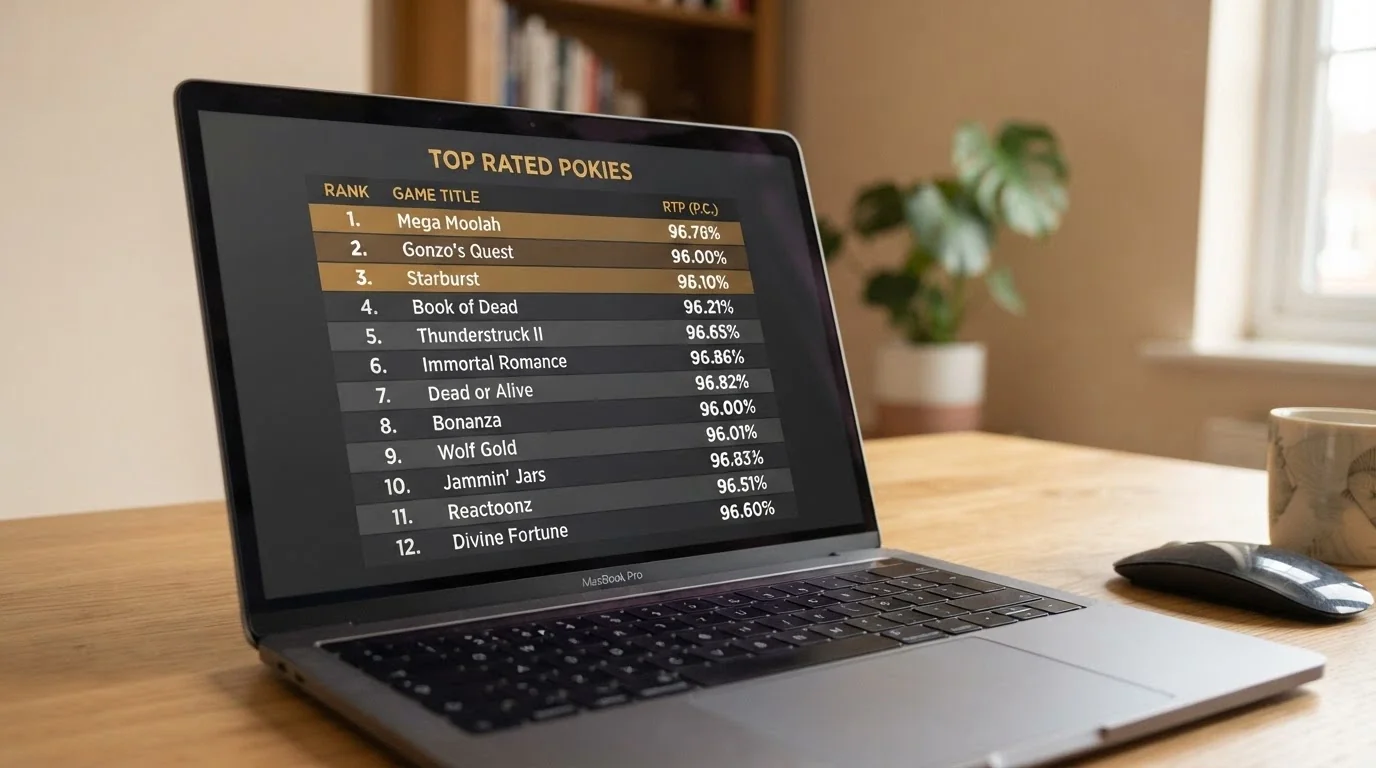
| Pokie | RTP | Provider | Volatility |
|---|---|---|---|
| Goblin’s Cave | 99.32% | Playtech | — |
| Ugga Bugga | 99.07% | Playtech | Low |
| Mega Joker | 99.00% | NetEnt | — |
| Book of 99 | 99.00% | Relax Gaming | Medium |
| Jackpot 6000 | 98.86% | NetEnt | Medium |
| 1429 Uncharted Seas | 98.60% | Thunderkick | — |
| Marching Legions | 98.12% | Relax Gaming | High |
| The Catfather | 98.10% | Pragmatic Play | — |
| Blood Suckers | 98.00% | NetEnt | Medium |
| Starmania | 97.87% | NextGen | — |
| White Rabbit Megaways | 97.72% | Big Time Gaming | — |
| Sugar Rush 1000 | 96.53% | Pragmatic Play | High (5/5) |
| Gates of Olympus | 96.50% | Pragmatic Play | — |
| Book of Dead | 96.21% | Play’n GO | High |
The cluster at the top is tight. Everything from Goblin’s Cave through Blood Suckers — eight titles, every one above 98% — is where a payout-conscious punter earns the most back, all else equal. The bottom half of the list, from Sugar Rush 1000 down, is the ordinary offshore-casino norm: solid pokies, ordinary returns, a 3.5%–4% house take on each spin. A punter who picks by name from the top half of this table and then checks the in-game help screen has done the only two things a careful reader can do.
Ten offshore casinos Australian punters actually play, ranked
None of the operators below holds an Australian licence, because none can. All ten are offshore, licensed in Curaçao or Anjouan, accessible from Australia only because the IGA prohibits the activity rather than the access. The ranking below orders them by researched RTP evidence first, then by bonus terms and library size, then by withdrawal speed. There is no safety column, because offshore status is the safety column — read the section on the IGA reality before choosing any of them.

| Casino | Licence | Welcome offer | Wagering | Game count | Demo mode |
|---|---|---|---|---|---|
| Fastpay | Curaçao OGL/2023/174/0082 | n/a | n/a | 4,000+ | Yes |
| BruceBet | Curaçao OGL/2024/1056/0702 | 500% up to A$2,000 | n/a | 5,000+ | Yes |
| Royal Reels | Curaçao (offshore) | A$2,500 + 50 spins at A$0.20 | 35x bonus only | 1,800 (~1,400 pokies) | Yes |
| Stake | Curaçao, on ACMA’s blocklist | 200% up to USD 2,000 | 40x (deposit + bonus) | 4,500+ | No |
| SkyCrown | Curaçao (Hollycorn N.V.) | Up to A$8,000 + 400 free spins | 40x (bonus + free spins) | 7,000+ | Yes |
| RocketPlay | Curaçao (Dama N.V.) | Up to A$2,000 + 100 free spins | 40x | 3,000+ | Yes |
| Fair Go | Curaçao (Deckmedia N.V.) | Up to A$1,000 across five deposits | 30x (bonus + deposit) | RTG-focused library | Yes |
| WinSpirit | Curaçao (offshore) | 100% up to A$300 + 100 free spins | 40x | n/a | Yes |
| Bizzo | Curaçao Antillephone 8048/JAZ2017-067 | n/a | n/a | n/a | Yes |
| Rainbet | Anjouan ALSI-152406029-FI2 | n/a | 40x on some promos | n/a | n/a |
The table is the comparison. The prose below it is the judgment.
Fastpay Casino’s 98% average RTP, examined
Fastpay quotes the highest average RTP in the surveyed set, 98% across 4,000-plus games, and a withdrawal window of 0 to 5 days. The licence is Curaçao (OGL/2023/174/0082). The welcome offer was not detailed in surfaced sources, which is itself a tell: a casino whose marketing leans on payout rather than bonus has often made a deliberate choice about what to lead with. For a punter whose priority is return per spin rather than headline credit, Fastpay is the strongest match on the data research carried — with the same caveat the table’s existence implies, which is that “98% average” is an operator-wide claim across the lobby, not a per-title guarantee, and reduced-RTP variants can sit underneath it on individual games.
BruceBet’s 97.60% RTP across 5,000-plus games
BruceBet runs at a 97.60% average RTP across more than 5,000 games, under a Curaçao licence (OGL/2024/1056/0702) operated by Inextro B.V. The welcome offer is a 500% match up to A$2,000 — a heavy headline by any measure, and the kind of percentage that almost always arrives with a steep multiplier attached. The wagering multiple was not detailed in surfaced results, which means a punter would need to check the bonus terms page before depositing anything; a 500% match on its own is not a bargain if the multiplier is 60x or 70x. Treat the average-RTP figure as the strongest argument for BruceBet; treat the welcome offer as a question to answer before claiming it.
Royal Reels: 96.4% on its top-50 pokies, with a 35x catch
Royal Reels is the operator where the full bonus picture lines up against the average-RTP figure, so it is the one this page runs the calculation against. Around 1,400 pokies sit inside a 1,800-title library, and the average RTP across the top-50 most-played pokies is 96.4%. The welcome package is A$2,500 across three deposits plus 50 free spins at A$0.20 stake, with 35x wagering on bonus only and an A$5 per-spin cap during clear-down. The 35x is on the bonus amount, not the bonus plus deposit, which makes it softer than Fair Go’s 30x-on-bonus-plus-deposit despite the lower headline figure.
What does that A$2,500 bonus actually cost? Cleared at 35x wagering, the required turnover sits at A$87,500 across the bonus balance, and across that turnover the 3.6% house edge averages out to A$3,150 of expected loss before the punter sees a withdrawal. The bonus pays up to A$2,500 in credited cash. Statistically, the punter gives back more than the bonus is worth, assuming only the bonus amount is wagered — a long-run average over millions of spins, not a forecast for any single session, and a number that lands whether or not the punter wins anything on a free spin. Royal Reels is the operator to model against because every input to the calculation is on the page; most of the others in the table leave one or more figures out.
Stake: crypto-only, 1% house edge, already on ACMA’s blocklist
Stake is the outlier of the set. The welcome offer is 200% up to USD 2,000 with 40x wagering on deposit plus bonus, the crypto-only stance means there is no fiat support, and the platform is on ACMA’s confirmed blocklist — the regulator has had it blocked at the DNS level for Australian ISPs. Stake.com.au is a separate, unrelated stock trading platform; punter confusion on that point has been a regular search.
What Stake offers that no other operator in this set does is verified mathematics. The in-house Stake Originals run a 1.00% house edge under provably-fair mechanics, and over twenty exclusive titles sit at 98% RTP, including Sweet Fiesta and Gates of Heaven. Crypto withdrawals clear fast during testing — Bitcoin 8–15 minutes, Litecoin under 5, Ethereum 3–8. The 4,500-game library covers slots, Stake Originals, live casino and table games. None of that changes the blocklist, which means access is fragile at best and a click away from disappearing, with a balance on the site still possible when the block lands. Stake earns its place in the ranking on RTP evidence, not on access.
SkyCrown’s A$8,000 welcome, and the 40x that shrinks it
The biggest headline figure in the set is SkyCrown’s A$8,000-plus-400-free-spins welcome, spread across four tiers with 120% up to A$1,200 on the first deposit. The 40x wagering requirement applies to bonus money and free spins, the minimum qualifying deposit runs from A$30 on the first deposit to A$50 on the fourth, and the maximum win limit on free spins is A$300 per bonus part — a cap that quietly empties most of what a 400-spin package might otherwise look like. Bank transfer withdrawals clear within three days starting from A$100. The licence is Curaçao, held by Hollycorn N.V., and the library is 7,000-plus games. The welcome number looks generous on a banner; on the wagering maths, the 40x takes back roughly what every 40x package takes back, and the A$300 free-spin cap turns 400 spins into a marketing figure rather than a payout.
RocketPlay’s A$2,000 and 100 spins, at the usual 40x
RocketPlay sits in the middle of the set: up to A$2,000 plus 100 free spins, with a 100% match plus 100 free spins on the first deposit and a 200% boost on the second. The 40x wagering is standard, the minimum deposits are A$20 and A$75, and the library is 3,000-plus games under a Curaçao licence (Dama N.V.). The shape of the offer is familiar enough that the page does not need to dwell on it. For a punter who wants a known operator in the standard offshore bracket, RocketPlay is the unremarkable choice, which in this market is closer to a compliment than a criticism.
Fair Go’s A$1,000 across five deposits, at a softer 30x
Fair Go’s headline multiplier is the lowest in the set: 30x, applied to bonus plus deposit. The package is A$1,000 across five deposits, 100% up to A$200 each, with a A$20 minimum deposit and a A$10 maximum bet. The wagering sits on (bonus + deposit), so the effective multiple is higher than the 30x reads at first glance — a A$200 bonus on a A$200 deposit means turnover is A$400 multiplied by 30, which is A$12,000 to clear. The library is RTG-focused and small by comparison to Pragmatic-led lobbies, and the weekly withdrawal limit of A$7,500 is a real ceiling for a high-volume punter. Fair Go’s pitch is the multiplier; the trade-off is the size of the library and the basis the multiplier applies to.
WinSpirit’s A$300 and 100 spins, with a 7-day expiry
WinSpirit’s welcome package is 100% up to A$300 plus 100 free spins on the first deposit (minimum A$30) with 40x wagering and a A$5 maximum bet during bonus play. The unusual part is the validity: 7 days after reception, with 31 days from registration to activate. Free spins arrive 20 a day across five titles — Lady Wolf Moon, Pearl Diver, Boom! Boom! Gold!, Green Chilli, Dragon Wealth — and the maximum payout on free spins is A$300; the deposit bonus carries an A$3,000 win cap. The A$300 ceiling on free spins means a 100-spin package paid at maximum payout is roughly the deposit-bonus ceiling. Tightest validity window in the set, sharpest caps, a package designed for a punter who spins the day it lands.
Bizzo’s licence, and its lower-RTP pokie versions
Bizzo operates under TechSolutions Group N.V. on a Curaçao Antillephone licence (8048/JAZ2017-067). The detail that puts it in this guide is the RTP-variant note: some providers run reduced builds — 94.5% versus the 96.5% baseline — at Bizzo specifically. The welcome terms for Australian accounts were not fully confirmed in surfaced results, which means a punter checking the offer needs to log in and verify the multiplier and game eligibility before depositing anything. Bizzo is the entry in this ranking that an RTP-conscious punter should treat with caution specifically because of the variant issue, not because of the licence.
Rainbet’s Anjouan licence and 5-to-15-minute withdrawals
Rainbet sits outside the Curaçao cohort. The licence is Anjouan (ALSI-152406029-FI2), the operator RBGAMING N.V. with company registration 16077. The withdrawal window is 5 to 15 minutes typically, with a minimum withdrawal around A$15 equivalent. Some promotions carry 40x wagering; welcome terms vary and were not fully detailed in surfaced sources. The licence is a step outside the Curaçao cluster rather than a step up in regulatory weight — Anjouan’s regime is light by comparison — but the payout speed is the fastest in the set, which is why Rainbet earns its place here. For a punter whose priority is the cash-out clock, it is the operator to check.
Online casino is illegal in Australia: the IGA reality
The product the rest of this page describes is, in Australia, a prohibited interactive gambling service. No licence for online casino exists federally or in any state or territory. The licensed wagering market covers pre-event sport, racing, lotteries and keno; online casino games and online pokies are not on that list. Every operator named above is offshore, accessed from Australia in spite of the prohibition rather than under any licence issued by an Australian regulator.

The IGA prohibition, in plain terms
The Interactive Gambling Act 2001 prohibits online casino games, online pokies and in-play sports betting to persons in Australia. The Interactive Gambling Amendment Act 2017 strengthened enforcement. Providing a prohibited interactive gambling service to a person in Australia is a criminal offence; the Act targets the provider, not the individual player, which is why a punter is not at risk of prosecution for using an offshore site but is at risk of losing every cent on it with no recourse. The licensed market is state and territory business — the Northern Territory Racing and Wagering Commission, administered through Licensing NT, is the de facto national licensor for the largest online bookmakers — and it does not extend to casino games. The minimum gambling age in Australia is 18.
The reform that passed in 2026, and what it changes
The Interactive Gambling Amendment (Gambling Reform) Bill 2026 passed both Houses of Parliament on 19 August 2026 and commences on 1 January 2027. It inserts new Parts 7C, 7D and 7E into the IGA. Part 7C caps wagering advertising at no more than three ads per hour between 6 am and 8:30 pm, and bans wagering ads from 15 minutes before a live sporting event until 5 minutes after it ends. Part 7D restricts inducements: direct marketing of bonus offers is banned for 14 days after a customer signs up, for three months after a person deregisters from BetStop, and indefinitely for customers identified as at risk of gambling-related harm. Part 7E creates AdStop, the national wagering advertising opt-out register, administered by ACMA. Foreign matched lotteries and online keno become prohibited. Most consequentially for offshore operators, banks and payment providers gain express authority to block transactions to illegal gambling operators from 1 January 2027 — the practical effect of which is that money in and out of an offshore casino becomes harder to move without leaving a paper trail a bank can read.
Licensed wagering versus offshore: what you actually get
The licensed wagering market carries protections an offshore casino does not. Licensed operators pay point-of-consumption tax, which runs at 5% wagering tax plus a 0.05% racing levy in the Northern Territory, with each state setting its own point-of-consumption tax, typically 10% to 15% of net wagering revenue. The Northern Territory is the de facto national licensor for the big online bookmakers because of historical accident and a competitive tax rate, with state and territory licences layered on top. What an offshore casino does not carry: Australian consumer protection, BetStop coverage, recourse if a withdrawal is refused or a win is voided, or any guarantee that a regulator will treat the punter’s complaint as something to act on. The licensed bookmaker pays tax and accepts the framework. The offshore casino sits outside it, with the new bank-blocking power taking a step toward closing that gap from 1 January 2027.
ACMA enforcement: 1,564 sites blocked and counting
The Australian Communications and Media Authority has had 1,564 illegal gambling and affiliate websites blocked by Australian ISPs since its first blocking request in November 2019, as at March 2026. More than 225 illegal services have withdrawn from the Australian market since enforcement was strengthened in 2017. Blocks happen at the DNS level, which means they affect lookups rather than traffic and are not unbeatable in the technical sense. The page does not describe how to circumvent them, because the framing of this section is what a punter stands to lose, not what an end-run looks like. The headline is the count and the direction of travel: more blocks, more withdrawals, less reliable access, with a balance on the site still possible when the block lands.
The payment tell: credit cards and crypto are banned here
Since 11 June 2024, credit cards, credit-related products and digital currency (crypto) are banned as payment for online wagering in Australia, under the Interactive Gambling Amendment (Credit and Other Measures) Act 2023. An operator that fails to enforce the ban faces penalties of up to A$247,500. Legal routes for licensed wagering are debit card, bank transfer, PayID/Osko and BPAY. POLi was decommissioned on 30 September 2023. A punter being asked for a credit card number or a crypto wallet address by a gambling site is being served by someone outside the Australian rules — the payment method is itself a tell that the operator is offshore. Several of the operators in the ranking above, including Stake, are crypto-only by design. The reason that matters in an Australian context is the one spelled out above: the rules the operator follows are not Australian rules.

Staying safe while playing high-variance pokies
High-variance pokies lengthen losing streaks. The RTP number is honest, the session reality is not. A punter playing Sugar Rush 1000 or Marching Legions needs to plan for the possibility that several hundred spins pass without a meaningful return, because that is what high volatility means in practice. The Australian responsible-gambling infrastructure is built around the licensed market and does not reach offshore casinos in the way it reaches licensed wagering operators.
BetStop’s numbers: 67,480 self-excluded and counting
BetStop, the National Self-Exclusion Register, went live in August 2023. As at 31 July 2026, the register held 67,480 registrations, of which 41,290 exclusions were still active — more than 60% of all who ever signed up. Seventy-eight percent of registrants were under 40, and 38% chose lifetime exclusion. The register binds approximately 150 Australian-licensed wagering providers. It does not bind an offshore casino, which is the operator class this page is about. A self-excluded Australian can still register, deposit and lose money at any of the ten operators in the ranking above. BetStop is the strongest tool available in the licensed market and is not a tool at all in the offshore one.

The help that exists: 1800 858 858 and Gambling Help Online
The National Gambling Helpline is 1800 858 858, free, confidential and staffed 24 hours a day, seven days a week. Gambling Help Online, at gamblinghelponline.org.au, provides online chat and counselling. Both services are free, both are Australian, and neither requires the punter to be in the licensed market to use them. They are the right number to call whether the gambling that is causing harm is happening at a licensed bookmaker or at an offshore casino.
2.1% of Australian adults: the problem-gambling beat
About 2.1% of Australian adults — roughly 430,000 people — experience problem gambling. The Australian Institute of Health and Welfare put high-risk gambling at 1.8% in 2022. High-variance pokies amplify the experience of harm for the punter already in that slice, because the long losing streaks that are part of the design are precisely the patterns that drive chasing behaviour. A pokie at 99.32% RTP still gives the house 0.68% over the long run, and a long run is what a punter chasing losses is unintentionally signing up for.
How we chose and ranked these casinos
The ten featured operators were checked against the ACMA blocklist and against the absence of any Australian online casino licence — every entry is offshore, and the ranking reflects that fact in the language used to describe each one. Sources were the Australian Communications and Media Authority, Parliament of Australia for the 2026 reform, Curaçao and Anjouan licence registers for operator status, and operator terms pages and affiliate audits for bonus and RTP figures. Ranking was ordered by researched RTP evidence first — Fastpay’s 98% average, BruceBet’s 97.60%, Royal Reels’ 96.4% — and then by bonus terms and library size for operators whose average RTP was not published. No invented weightings or percentage scores were applied; the only quantitative inputs are the figures in the table above and the bonus terms in the operator write-ups. Stake is included despite being on ACMA’s blocklist, because the verified 1% house edge on Stake Originals and the 98% enhanced-RTP cluster are the strongest RTP data points in the set, and the page’s subject is payout evidence rather than access advice. A punter who reads the IGA section above will already know what the blocklist entry means.
What to actually do with this information
Three conclusions, in order of weight.
The phrase “highest payout online casino Australia” resolves to offshore operators with no Australian licence. The choice is access versus protection, and access wins on RTP evidence and loses on recourse. A punter who plays any of the ten operators above cannot escalate a complaint to an Australian regulator and cannot register for BetStop coverage that includes them.
The wagering multiple is the real cost, not the bonus headline. Royal Reels’ 35x on bonus only, at a 96.4% average RTP, costs an expected A$3,150 of house-edge loss across the A$87,500 turnover required to clear a A$2,500 bonus — more, on average, than the bonus pays out. SkyCrown’s A$8,000 headline at 40x on bonus and free spins costs a comparable fraction of the credited amount, before the A$300 free-spin cap is applied. The free-spin cap is the line that turns 400 free spins into a marketing number rather than a payout, and it is present in different shapes on nearly every welcome package in the table.
Gambling winnings are not taxable income for an Australian punter (ITAA 1997 section 6-5), and losses are not deductible (section 8-1) unless the punter is carrying on a business of betting. None of which changes the underlying edge or the fact that BetStop will not cover the account.
The decision is whether the best-RTP pokies in the offshore market are worth the absence of every Australian protection that would otherwise apply, and that decision is one only the reader can make. Play within limits, on the highest-RTP titles the operator actually serves at the published figure, and check the in-game help screen before assuming the studio’s number is what is on the reels.
Frequently asked questions
What does “highest payout” mean at an online casino — is it the same as RTP?
Yes. “Highest payout”, “payout percentage” and “payout rate” name the same underlying metric — return to player, the share of every dollar wagered that a pokie returns across millions of spins. A casino quoting both a payout percentage and a payout rate as two separate figures is using one of them loosely, because there is no second, distinct metric behind either phrase.
Do offshore casinos actually pay out winnings to Australian players, and how long does it take?
Most do, eventually, with timing depending on operator and method. Rainbet quotes 5 to 15 minutes for crypto withdrawals; Fastpay quotes 0 to 5 days; Royal Reels’ bank transfer clears within 3 days. No Australian regulator handles complaints about offshore withdrawals — that gap is what the offshore route leaves open when something goes wrong.
Can I use PayID or crypto to deposit and withdraw at online casinos from Australia?
PayID and bank transfer are the legal deposit routes at licensed Australian wagering operators. At offshore casinos the deposit method is whatever the operator accepts — card, e-wallet, frequently crypto. Credit cards and crypto have been banned for online wagering in Australia since 11 June 2024, so using either at an offshore site uses a method your own jurisdiction prohibits.
Does BetStop cover offshore casino sites, or only licensed wagering operators?
Only licensed wagering operators. BetStop binds approximately 150 Australian-licensed providers. An offshore casino is not connected to the register, and a self-excluded Australian can still register, deposit and lose money at any of the ten operators in this guide. The section on BetStop’s numbers has the figures.
Are casino winnings taxable in Australia?
No, not for an ordinary punter. Betting and gambling winnings are not assessable income under section 6-5 of the ITAA 1997, and losses are not deductible under section 8-1, unless the person is carrying on a business of betting. The tax answer does not change the underlying house edge or what an offshore welcome offer actually costs to clear.
What happens if an offshore casino refuses to pay out — do I have any recourse in Australia?
Effectively no. The operator is licensed in Curaçao or Anjouan, not Australia, and ACMA does not handle complaints about individual offshore transactions. The complaint goes to the operator’s customer service and, at best, the offshore licence issuer — neither under Australian jurisdiction. The practical meaning of “no Australian consumer protection” is spelled out in the IGA section.