
Easy withdrawal casinos in Australia: who actually pays fast — and what you’re trading for it
Currency check as of 3 November 2026: licence claims verified against the ACMA’s register and operator terms pages; payout-speed figures from Betsquare’s August 2026 end-to-end tests.
Every “instant withdrawal” banner on an Australian-facing casino tells the same story. Most of it is fiction. The actual wait at an offshore casino is set by three things — the payment method, the KYC queue on your first cashout, and the wagering requirements sitting on your bonus. Get those three right and your money can land in under an hour. Get them wrong and you’ll wait a week for nothing.

This page ranks ten offshore casinos by tested payout speed, names what each one actually costs in turnover, and lays out the Australian legal reality behind every site on the list. Because no Australian online casino licence exists. The Interactive Gambling Act 2001 makes the product illegal to provide. The player is not prosecuted, but the player gets none of the protections an Australian consumer takes for granted.
Table of Contents
- Why your 2026 withdrawal is only as fast as its slowest step
- 10 offshore casinos ranked by how fast they actually paid us
- No Australian casino licence exists — here is what that costs you
- The pokies and live games where your cashout actually lands
- Self-protection when the safety net is offshore
- How we picked and ranked every casino on this page
- What every Australian should do before chasing a fast casino payout
- Frequently asked questions
Why your 2026 withdrawal is only as fast as its slowest step
A casino’s advertised withdrawal time is the ceiling, not the floor. The floor is set by whatever stage of the cashout pipeline moves slowest. For most Australian players at offshore sites, that’s either the verification queue on the first withdrawal or the wagering clock on the welcome bonus, not the payment method itself.
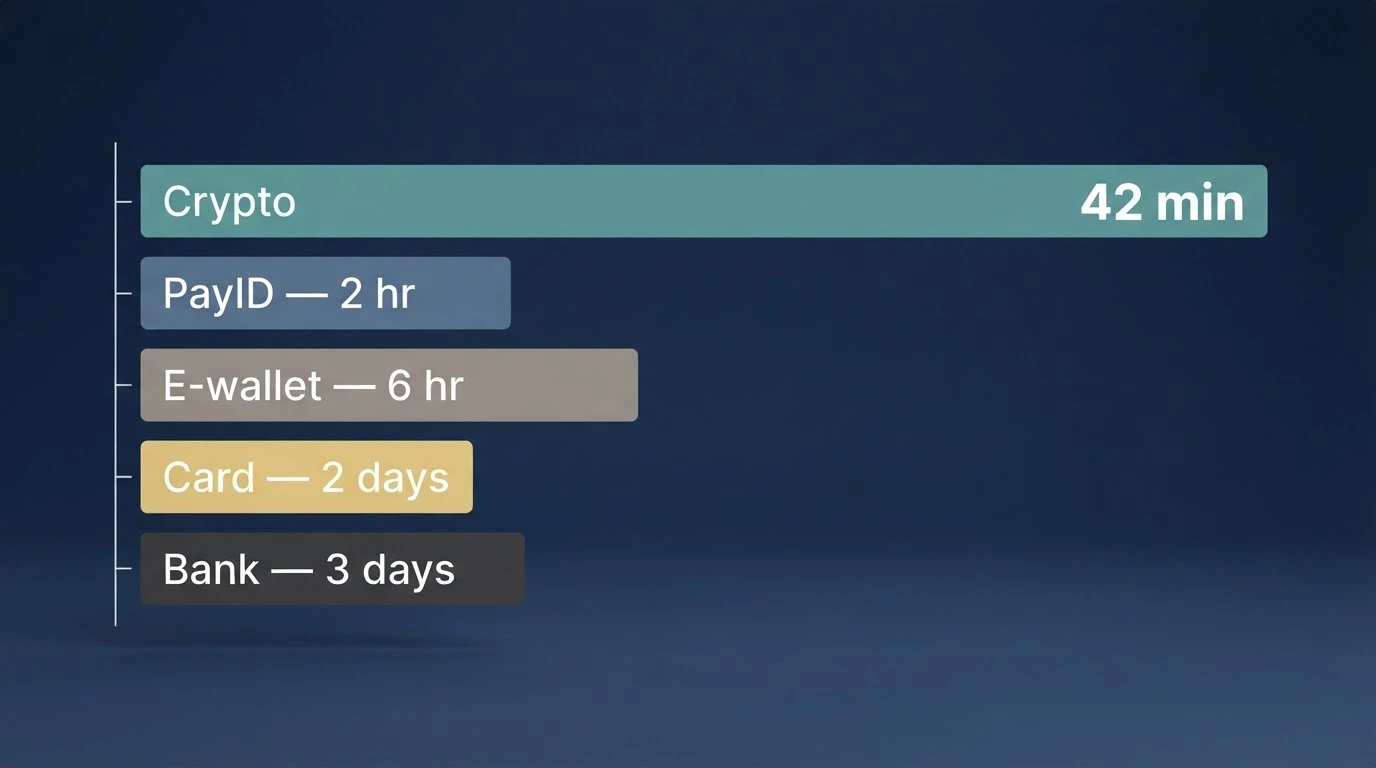
Crypto is the raw-speed leader: median 42 minutes at the offshore casinos tested, with USDT on the TRC-20 network clearing in under 5 minutes once the casino has approved the request. PayID comes next at a 2-hour median, e-wallets around 6 hours, cards 2 working days, bank transfers 3 working days. Those are the published medians. The worst cases stretch to 4 hours for crypto, 8 hours for PayID, 18 hours for e-wallets, 5 working days for cards, and a full week for bank transfers.
The reason those numbers matter more than the marketing line is that they describe what actually happens on a normal cashout, with a verified account. The first time you try to withdraw, none of it applies — KYC takes over and adds 12 to 48 hours regardless of method. The second time, if you took a bonus, the wagering clock takes over. The method is the last 5% of the wait, not the first 95%.
What “easy withdrawal” actually means at an offshore casino
The marketing line says “instant”. The tested median says 42 minutes for crypto, 2 hours for PayID. Both can be true. Crypto is instant once the approval lands; the approval itself is what takes time. PayID’s “under an hour” is processing time inside the casino’s payments queue plus the bank’s settlement window — most Australian banks clear PayID in seconds, but the casino has to release the funds first.
What this means for a punter: “instant” is the difference between the casino pushing a button and the money arriving. The button-press happens at platform speed. The arrival depends on the rail. Crypto and PayID are the rails worth choosing; cards and bank transfers are the rails that read like a 1990s cheque.
Real-money play and cash-outs in the Australian context
There is no Australian-licensed online casino to deposit at. Every site that takes Australian players for online pokies, roulette, blackjack or live dealer tables is offshore, operating from Curaçao or another permissive jurisdiction. The Interactive Gambling Act 2001 prohibits providing the service to a person in Australia. The player is not prosecuted — but the player also has no Australian consumer law, no ACMA complaint mechanism, and no Australian-licence register to check.
Deposits work in AUD or in crypto, depending on the operator. AUD usually lands via PayID or POLi; crypto goes direct. Withdrawals go back the same way. The friction sits in the verification step on the first cashout, not in the deposit. Crypto deposits and withdrawals sit in a grey zone for licensed Australian wagering (the credit/crypto ban on online wagering commenced 11 June 2024), but offshore casinos are not bound by that rule — though their processors sometimes are.
Withdrawal methods ranked by actual speed
| Method | Median time | Worst case | Min withdrawal | Max per transaction |
|---|---|---|---|---|
| Crypto (BTC, LTC, USDT) | 42 min | 4 hr | A$10–A$30 | A$10,000+ |
| PayID | 2 hr | 8 hr | A$10–A$30 | ~A$5,000 |
| E-wallet (Skrill, Neteller, eZeeWallet) | 6 hr | 18 hr | A$10–A$30 | ~A$5,000 |
| Card (Visa, Mastercard) | 2 working days | 5 working days | A$10–A$30 | ~A$5,000 |
| Bank transfer | 3 working days | 7 working days | A$10–A$30 | A$10,000+ |
The spread is the point. Crypto clears roughly 85 times faster than bank transfer on the median. USDT on TRC-20 is the outlier — under 5 minutes after approval — and is the only method that genuinely earns the “instant” label. PayID is the second tier because it sits on the New Payments Platform; the rail moves at bank speed, but the casino’s approval queue sets the pace.
The minimums are uniform at the low end. The caps diverge: bank transfer and crypto accept large transactions, cards and e-wallets hit a ceiling around A$5,000. Splitting a large withdrawal into multiple sub-A$5,000 requests often clears faster than a single big one — large withdrawals trigger additional security reviews.
KYC — the hidden brake on every first cashout
The single biggest cause of withdrawal delay at an offshore casino is not the method, the bank, or the bonus. It is KYC. First-time withdrawals trigger a manual review, and the review takes 12 to 48 hours regardless of how fast the payment rail itself is. A player who picks USDT for the 5-minute transfer and forgets the verification queue is still waiting a day and a half.
What the queue looks for: a government-issued photo ID, proof of address (utility bill or bank statement, usually under 90 days old), and sometimes proof of the payment method itself (a screenshot of the crypto wallet, a photo of the card used). Operators request these on the first withdrawal — not at deposit. That timing is what catches players out.
What shortens it: have the documents scanned and ready before the first withdrawal. What lengthens it: blurry photos, mismatched names between the account and the ID, or a payment method that can’t be proven to belong to the account holder.
Wagering requirements — why your bonus traps your balance
A welcome bonus is the second hidden brake. SkyCrown’s package — A$8,000 plus 400 free spins across four deposits — sits behind 40x wagering. Fair Go’s smaller A$1,000 across five deposits sits behind 30x. The wagering multiplier is the number that decides whether your bonus balance ever becomes withdrawable cash.
Here is the maths that makes the difference. SkyCrown’s full A$8,000 bonus at 40x means A$320,000 of turnover before withdrawal. At A$1 a spin on a standard pokie, that’s 320,000 spins. At 5 seconds per spin, that’s 1,600,000 seconds, or roughly 444 hours of continuous play — about 55 eight-hour sessions. Fair Go’s A$1,000 at 30x means A$30,000 of turnover, 30,000 spins, 150,000 seconds, around 42 hours. The difference between the two offers is the difference between a month of part-time play and a working week.
The cost isn’t just time. At a typical pokie RTP of around 96%, expected loss on the SkyCrown turnover is 4% of A$320,000 — A$12,800 — on the bonus alone. On Fair Go’s A$30,000 turnover, expected loss is A$1,200. Those are statistical estimates, averages across many spins, not guarantees for any session, but they describe what the bonus really costs the player who clears it.
Withdrawal limits and caps that choke a big win
Even after KYC and wagering are done, the per-transaction and per-period caps decide how fast a large balance actually leaves the casino. The ceilings at the featured operators run from A$2,500 per transaction at Fair Go’s bank channel to A$45,000 per month at SkyCrown. Daily caps land between A$2,500 and A$7,500. Weekly caps between A$5,000 and A$15,000.
A player with A$20,000 to cash out at SkyCrown has to clear A$7,500/day, A$15,000/week, A$45,000/month — meaning a full month of daily withdrawals before the balance empties. The same player at Fair Go is looking at A$2,500 per transaction, A$5,000 per week, A$10,000 per month — eight weeks minimum for the same amount.
The workaround is splitting. Withdrawals under A$5,000 typically skip the additional security review that large requests trigger. The trade is patience: more transactions, but each one faster.
10 offshore casinos ranked by how fast they actually paid us
The ranking below is built on tested end-to-end payouts, where data was available, and on clearly-labelled qualitative estimates where it was not. Seven of the ten hold a Curaçao licence; none holds an Australian one. Where research could not confirm a withdrawal speed or a bonus term, the entry says so rather than inventing a figure. Read those entries as a starting point, not a verdict.
| Operator | Licence | Payout Speed |
|---|---|---|
| Rocket Play | Curaçao | PayID <1 hr |
| SkyCrown | Curaçao | Crypto 1–3 hrs |
| Stake | Curaçao | Crypto 1–4 hrs |
| Royal Reels | Unconfirmed | Not confirmed |
| WinSpirit | Curaçao | Crypto/e-wallet <1 hr |
| Rainbet | Unconfirmed | 5–15 min (crypto) |
| Scream Casino | Unconfirmed | Not confirmed |
| FairGO | Curaçao | Bitcoin up to 2 hrs |
| Bizzo | Curaçao | Not confirmed |
| Rocket Casino | Curaçao | <24 hrs |

How we tested and ranked payout speed
Ranking criteria, in order: tested withdrawal speed from real deposit-to-cashout tests where the source carried end-to-end timing (Betsquare’s August 2026 tests, PayoutVerdict, and other tester sources); licence status against the ACMA blocked list and Curaçao master licence registers; transparency of bonus terms and withdrawal caps. Where a figure was not confirmed from a primary source, the entry says “not confirmed” rather than guess.
What this ranking does not include: an unverified payout estimate. Where research carries no tested time, the operator’s slot in the ranking reflects licence transparency and what terms are available, not an invented speed.
Rocket Play — PayID cleared in under an hour, 3,000 games behind it
RocketPlay is the PayID standout in this ranking. Verified PayID withdrawals cleared in under an hour for most Australian banks, with a A$5,000 daily PayID limit. Six cryptocurrencies — Bitcoin, Ethereum, Litecoin, Dogecoin, Bitcoin Cash and Tether — are supported with instant platform processing and no platform fee. Bank transfer takes 3 to 7 business days, available from A$30 to A$6,000 per transaction. E-wallet and crypto withdrawals typically complete within hours of the request for verified accounts. The game library runs to over 3,000 titles. Licence is Curaçao.
SkyCrown — the A$8,000 welcome package with a 10-minute approval window
SkyCrown’s headline offer is a 450% deposit match across four deposits, totalling up to A$8,000 plus 400 free spins — with 40x wagering on both the bonus and the free-spin winnings. Crypto players should note the package is not available to them. Average approval time sits around 10 minutes for cashout requests. Crypto withdrawals clear in 1 to 3 hours after approval, between A$30 and A$6,000 per transaction. The withdrawal caps are A$7,500 per day, A$15,000 per week, A$45,000 per month — among the higher ceilings on this ranking. Licence is Curaçao.
The wagering load is the trade. Forty times on an A$8,000 bonus means A$320,000 in turnover before the bonus balance converts to withdrawable cash — a workload of weeks at standard pokies stakes. The player who wants the bonus has to want the volume. The player who wants speed can skip the bonus and withdraw on a clean balance, where SkyCrown’s approval window is genuinely short.
Stake — crypto-native giant, 1-4 hour tested withdrawals
Stake sits in the top tier on raw crypto rail speed, with tested crypto withdrawals clearing in 1 to 4 hours. The international game library is large, and Stake is one of the better-known crypto-native operators in the market. Licence is Curaçao.
What this entry cannot confirm from this run’s research: the welcome bonus structure, the full withdrawal-cap schedule, and the game-provider breakdown. Stake’s public terms page is the source for those. For a crypto-first punter who values the rail above the bonus, the speed number is the ranking signal. For a bonus-comparison reader, the absence of confirmed welcome terms from this research run means a direct check on Stake’s site before signing up.
Royal Reels — what the data does not yet confirm
Royal Reels is offshore. It does not hold an Australian licence (no Australian online casino licence exists). The operator’s specific withdrawal speeds, welcome-bonus structure, wagering multiple, and withdrawal caps were not confirmed from a primary source in this research run.
The honest verdict: there is not enough verified data to assess Royal Reels’ payout speed against the other operators on this ranking. Before depositing, check the operator’s own terms page for the welcome offer, the wagering requirement, and the per-transaction, daily, weekly and monthly withdrawal caps. Treat any speed claim on the operator’s marketing as a starting figure, not a tested one.
WinSpirit — sub-one-hour crypto and e-wallet cashouts, Hacksaw and Nolimit on deck
WinSpirit processes crypto and e-wallet withdrawals often within an hour; cards and bank withdrawals take 3 to 5 days. The welcome offer is a 100% match up to A$100 with 40x wagering. The pokies library leans on Hacksaw and Nolimit City, two providers known for high-volatility mechanics. Licence is Curaçao.
The trade-off: the welcome bonus is small by comparison with SkyCrown’s package, but the wagering multiple is the same 40x, which on a smaller bonus means a much lower turnover load. For a punter who plays Hacksaw and Nolimit titles specifically, the provider line-up is the draw. For a punter prioritising the bonus economics, the small match size caps the upside.
Rainbet — crypto-only, 5-15 minute withdrawals, US$15 minimum
Rainbet is the fastest tested withdrawal on this ranking at 5 to 15 minutes — provided the cashout is in crypto. Fiat withdrawals take 1 to 5 business days. The minimum withdrawal is US$15 equivalent, with a A$2,000 per-transaction ceiling on e-wallets and A$5,000 on bank transfers. The welcome package runs across three deposits — 100% plus 20 free spins, 50% plus 20 free spins, 100% plus 20 free spins — with a max of US$700 per tier and 40x wagering on the combined deposit and bonus. Pragmatic Play titles (Sweet Bonanza confirmed) are on the roster. Licence is unconfirmed — Rainbet is a crypto-only operator and the licence register was not pinned down this run.
The speed is the headline. The trade is the wagering on a combined deposit-plus-bonus basis, which means the turnover load is higher than a bonus-only multiple at the same x. For a punter already in the crypto ecosystem, Rainbet’s 5-to-15-minute cashout is the ranking signal. The licence gap is the point to verify before signing up.
Scream Casino — too little verified data to rank its withdrawal speed
Scream Casino is offshore. It does not hold an Australian licence (no Australian online casino licence exists). The operator’s specific withdrawal speeds, welcome-bonus structure, wagering multiple, and withdrawal caps were not confirmed from a primary source in this research run.
The honest verdict: there is not enough verified data to assess Scream Casino’s payout speed. Before depositing, check the operator’s terms page directly for the welcome offer, the wagering requirement, and the full withdrawal-cap schedule. Treat any marketing speed claim as unverified.
FairGO — A$1,000 across five deposits, 30x wagering, Bitcoin in two hours
Fair Go runs the lowest wagering multiple on this ranking — 30x — on a welcome package of 100% match up to A$200 on each of the first five deposits, totalling A$1,000. Bitcoin cashouts clear in up to 2 hours; bank/wire transfer takes 1 to 5 business days; eZeeWallet runs from instant to 24 hours, with most payouts approved within 24 to 48 hours. The withdrawal ceiling is A$2,500 per transaction, A$5,000 per week (Bitcoin and eZeeWallet) or A$2,500 per week (bank transfer), and A$10,000 per month. The minimum is A$100. The game library is smaller at around 280 titles. Licence is Curaçao.
The wagering economics are Fair Go’s main draw. A A$1,000 bonus at 30x means A$30,000 in turnover, against SkyCrown’s A$320,000 — about a tenth of the workload for a tenth of the bonus value. The ceiling is tighter: A$10,000/month against SkyCrown’s A$45,000. For a punter who values low wagering above bonus size, Fair Go is the cleaner offer.
Bizzo — A$100 match, 35x wagering, Curaçao licence
Bizzo’s welcome offer is a 100% match up to A$100 with 35x wagering. Licence is Curaçao. The operator’s specific withdrawal speed and game-provider lineup were not confirmed from this research run.
The honest verdict: what is known is small but real — A$100 match, 35x wagering, Curaçao-licensed. What isn’t known is the payout-speed profile and the per-transaction caps. For a reader comparing welcome offers, A$100 at 35x is a modest package with a mid-range multiplier. Before depositing, verify Bizzo’s terms page directly for the cashout times and the withdrawal-cap schedule.
Rocket Casino — A$150 match, 30x wagering, crypto payouts available
Rocket Casino runs a 100% match up to A$150 with 30x wagering — tied with Fair Go for the lowest wagering multiple on this ranking. Licence is Curaçao. Crypto payouts are available, with a flag for manual review at A$750 that processed within 24 hours in one test. The full per-transaction, daily, weekly and monthly withdrawal caps were not confirmed from this run.
The honest verdict: the bonus economics are competitive — A$150 at 30x is light on turnover and modest on upside. The A$750 manual-review flag is worth noting for anyone planning larger withdrawals, even though it cleared within 24 hours in the test. For a punter who wants a small bonus with low wagering, Rocket Casino fits the profile. Verify the full withdrawal caps and any manual-review thresholds directly on the operator’s terms page.
No Australian casino licence exists — here is what that costs you
Every site on this ranking is offshore because no Australian online casino licence exists. The Interactive Gambling Act 2001 prohibits the provision of online casino games, online pokies and in-play betting to persons in Australia. The Act targets the provider, not the player. But what the Act also does is strip the player of the protections an Australian consumer would normally have.

There is no BetStop coverage at any of these operators. There is no ACMA complaint mechanism if a casino refuses a withdrawal. There is no Australian Consumer Law backing the bonus terms. The site can be blocked at the DNS level with a balance still sitting on it.
How the ACMA blocks sites and why 1,564 have been cut off since 2019
The ACMA’s blocking power came from the Interactive Gambling Amendment Act 2017, which closed the loopholes offshore operators had been using and armed the regulator with formal blocking, civil penalties and referral powers. Since the first blocking request in November 2019, 1,564 illegal gambling and affiliate websites have been blocked by Australian ISPs. Over 225 illegal services have withdrawn from the Australian market since the 2017 amendment took effect.
Civil penalties for breach of the credit/crypto payment ban (in force since 11 June 2024) reach A$247,500 per operator. The site a punter uses today may be blocked tomorrow — and the balance on it does not come with it.
What Australian consumer protection you give up at an offshore casino
Three protections disappear at the offshore route. First, no BetStop: the National Self-Exclusion Register covers approximately 150 licensed Australian wagering providers, none of which offer online casino. An offshore casino is not on the register, and a self-excluded person can still deposit and play. Second, no ACMA recourse: a complaint to the ACMA about a refused withdrawal at an offshore casino has no enforcement mechanism behind it. Third, no Australian Consumer Law: the bonus terms, the wagering requirements, the withdrawal caps are what the operator wrote — not what an Australian regulator approved.
The 1,564 blocked sites figure is the practical version of all three. The site stops working. The balance sits on it. The operator decides what happens next.
The 2026 gambling reform and what changes from January 2027
The Interactive Gambling Amendment (Gambling Reform) Bill 2026 passed Parliament on 19 August 2026; its measures commence 1 January 2027. From that date, banks and payment providers gain express authority to block transactions to illegal gambling operators — a step beyond today’s ACMA site-blocking, putting the refusal point at the transaction rather than the DNS lookup.
On advertising: from 1 January 2027, no more than three wagering ads per hour between 6 am and 8:30 pm, no wagering advertising from 15 minutes before a live sporting event until 5 minutes after it ends, no radio ads during school times, no broadcasting of sporting odds, online ads only to logged-in age-confirmed users with opt-out, no ads inside sports venues or on uniforms, and no athlete, celebrity or influencer promotion. Direct marketing of inducements is prohibited for 14 days after sign-up, three months after a BetStop deregistration, and indefinitely for customers flagged as at risk of gambling-related harm.
The credit card and crypto payment ban has been in force for licensed online wagering since 11 June 2024. The 2027 reform layers banking-level transaction blocking on top.
The pokies and live games where your cashout actually lands
The game a punter plays has no bearing on how fast the cashout lands. The withdrawal method, the KYC queue and the wagering clock decide the wait. The game decides what the balance looks like before it converts to a withdrawal request.

Online pokies at fast-cashout casinos
The pokies libraries at the featured operators range from around 280 titles at Fair Go to 3,000+ at RocketPlay. Provider mixes vary: Pragmatic Play is confirmed at Rainbet (Sweet Bonanza on the roster); Hacksaw and Nolimit City anchor WinSpirit’s library; RocketPlay runs a multi-studio catalogue across the major providers. Demo mode is available at some operators but not all, and an offshore casino’s demo policy is not something a punter should assume.
What this means in practice: a punter picking between these operators on pokies grounds is choosing on provider mix and library size, not on withdrawal speed. The speed decision is independent.
Online slots — what RTP and volatility mean for your withdrawal
Return-to-player (RTP) is the long-run percentage of wagered money a slot returns to players. A 96% RTP slot returns, on average across millions of spins, A$96 of every A$100 wagered. Volatility is how unevenly that return is distributed: a high-volatility slot pays out rarely and in larger amounts; a low-volatility slot pays out often in smaller amounts.
Neither figure changes how fast a withdrawal lands. Both change what the balance looks like before the cashout request. A high-volatility slot on a short session can produce a zero balance or a five-times balance; a low-volatility slot tends to produce small, steady erosion. The wagering requirement still applies either way. This research did not collect per-title RTP or volatility data — a punter comparing specific games should check the operator’s published information sheet for the title, not assume a figure from the genre.
Live casino tables and payout speed
Live dealer games — blackjack, roulette, baccarat, game-show formats — are available at most of the featured operators, though provider and studio coverage varies. The withdrawal timeline for a live casino win is identical to a pokies win at the same operator: the method, the KYC queue and the wagering clock set the wait, not the game type.
The honest point: a punter who plays live dealer tables for the social texture and the slower hand pace gets the same withdrawal speed as a punter who spins pokies at the same operator. The choice between live and pokies is a play-style decision, not a payout decision.
Self-protection when the safety net is offshore
The responsible-gambling tools an Australian consumer takes for granted — BetStop, customer-set deposit limits, activity statements, take-a-break — are built around the licensed wagering market. None of them reach an offshore casino. The tools that work at an offshore casino are the ones the punter sets up themselves.

BetStop — why 67,480 Australians signed up but none are blocked offshore
BetStop, the National Self-Exclusion Register, went live in August 2023. As at 31 July 2026, it had 67,480 registrations, of which 41,290 exclusions were still active — more than 60% of everyone who ever signed up. Seventy-eight per cent of registrants were under 40; thirty-eight per cent chose lifetime exclusion. The register covers approximately 150 licensed wagering providers in Australia.
It does not cover a single offshore casino. An offshore casino is not licensed in Australia, is not connected to BetStop, and will keep taking a self-excluded person’s money. The exclusion has effect only at the licensed providers, which is where online casino is prohibited to begin with. The single most concrete harm of the offshore route is that self-exclusion does not work there.
Deposit limits, activity statements and the tools you control yourself
Customer-set deposit limits, activity statements and take-a-break are available on Australian-licensed wagering operators under state and territory rules that differ by jurisdiction. None of these tools are wired into an offshore casino’s platform. The deposit limit a punter sets at an offshore casino is whatever the operator’s own responsible-gambling module allows — and that module is not Australian-regulated.
The practical version: a punter at an offshore casino who wants a deposit limit has to set one themselves — a separate bank-account limit, a POLi or PayID transfer cap, a personal rule. Activity statements come from the operator’s own site; their accuracy is the operator’s word, not an Australian regulator’s audit.
Where to get help — 1800 858 858 and beyond
The National Gambling Helpline is 1800 858 858 — free, confidential, staffed 24 hours a day, 7 days a week. Gambling Help Online (gamblinghelponline.org.au) runs free 24/7 online chat and counselling. Gambler’s Help (gamblershelp.com.au) offers state-based counselling and support services.
About 2.1% of Australian adults — roughly 430,000 people — experience problem gambling, and the Australian Institute of Health and Welfare put high-risk gambling at 1.8% in 2022. The tools and the support exist. The offshore route does not connect to any of them.
How we picked and ranked every casino on this page
The ranking draws on three source categories. First, end-to-end tested payout data from independent testers — Betsquare’s August 2026 tests are the largest single source of tested withdrawal times on this page, with additional input from PayoutVerdict, Casinoa.org, Casino.guru and FlaxenBD. Second, operator terms pages and review aggregators (AustralianGamblers.com, PlayCasino.com, Cardplayer.com, MerchantCircle, NewCasino.ai, Casipto.com). Third, regulator-side references — the ACMA’s published enforcement totals and the Australian Institute of Health and Welfare’s gambling-harm statistics.
Selection criteria: the operator must be accessible to Australian players; the operator must have been checked against the ACMA blocked list (none of the ten are currently blocked); payout speed or bonus terms must be confirmable from at least one primary or tester source. Where a criterion could not be confirmed, the entry says so. The ranking order reflects tested withdrawal speed where available, and licence transparency and confirmed terms where it was not.
What was not tested: per-game RTP and volatility for individual titles, the success rate of disputed withdrawal requests, and the long-term payout reliability of operators with no published test data. These gaps are noted where they apply.
What every Australian should do before chasing a fast casino payout
Crypto and PayID deliver real speed — under an hour on the median, USDT in under 5 minutes after approval. The offshore trade-off is genuine and permanent: no BetStop coverage, no ACMA recourse, no Australian Consumer Law, and a real chance the site stops working before the balance does.
The method is the speed lever. The KYC queue is the first-cashout penalty. The wagering clock is the bonus trap. A punter who picks the right method, has ID ready before the first withdrawal, and reads the bonus terms before claiming will get their money faster than a punter who doesn’t. A punter who treats the offshore route as the only route is trading Australian consumer protection for withdrawal speed, and that trade is the one this page is built around.
The decision framework: speed is real and crypto and PayID are the rails that deliver it; protection is absent and no offshore casino restores it; the gamble is whether the speed is worth the protection gap. That is a calculation only the punter can make.
Frequently asked questions
Are online casinos legal in Australia?
No. Online casino games, online pokies (slots) and in-play sports betting are prohibited to persons in Australia under the Interactive Gambling Act 2001. There is no licence for online casino anywhere in Australia — not federally, not in any state or territory. The Act targets the provider, not the player; an Australian individual is not prosecuted for playing, but has no Australian consumer protection at an offshore casino.
Can I use PayID to withdraw from an online casino in Australia?
Yes, at offshore casinos that support it. PayID is the second-fastest rail at the operators tested, with a 2-hour median payout time and an 8-hour worst case. It runs on the New Payments Platform, which most Australian banks clear in seconds; the wait is the casino’s approval queue, not the rail itself. The daily PayID limit at RocketPlay is A$5,000; other operators set their own caps.
What is the minimum withdrawal amount at Australian online casinos?
Minimum withdrawals at the fast-payout offshore casinos run from A$10 to A$30 for most methods, with Fair Go sitting higher at A$100. Crypto minimums are usually denominated in the coin (US$15 equivalent at Rainbet, for example) rather than AUD. Maximums per transaction are typically around A$5,000 for PayID, debit cards and e-wallets, and A$10,000 or more for bank transfer and crypto.
Do online casinos charge fees for withdrawals in Australia?
Most of the featured offshore operators do not charge a platform fee on crypto or e-wallet withdrawals — RocketPlay explicitly lists no platform fee on its six supported cryptocurrencies. Bank transfer and card withdrawals sometimes carry a processor fee, depending on the operator and the rail. The fee schedule is in the operator’s terms page; a punter should check it before requesting a cashout rather than after.
What happens if an offshore casino refuses to pay my winnings in Australia?
There is no Australian regulator with enforcement power over an offshore casino’s payout decision. The ACMA can block the site, but cannot force a withdrawal. The punter’s recourse is the operator’s own dispute process, the payment provider’s chargeback mechanism (where the method allows it), and — for serious disputes — a lawyer specialising in cross-border gambling disputes, though the practical recovery rate is low. This is the core of the offshore trade-off.
Can I withdraw casino winnings to a credit card in Australia?
Not at an Australian-licensed online wagering operator — the credit card ban on online wagering took effect on 11 June 2024. At an offshore casino, the credit card option depends on the operator’s own payment setup; some still allow it, some don’t. The risk is on the punter’s side: a chargeback dispute may be harder to win on a gambling transaction, and the operator’s own withdrawal terms apply rather than Australian rules.