
Tested Withdrawal Times at Offshore Pokies Sites Accepting Australian Players in 2026
Every marketing claim on this page begins with the same word — “instant” — and ends somewhere between fifteen minutes and five business days later. The gap between those two numbers is the article. What tested PayID and crypto withdrawals actually look like at ten offshore casinos serving Australian players, why the word “instant” describes an approval stage rather than money in your account, and what the structural legal picture means for anyone weighing a deposit.
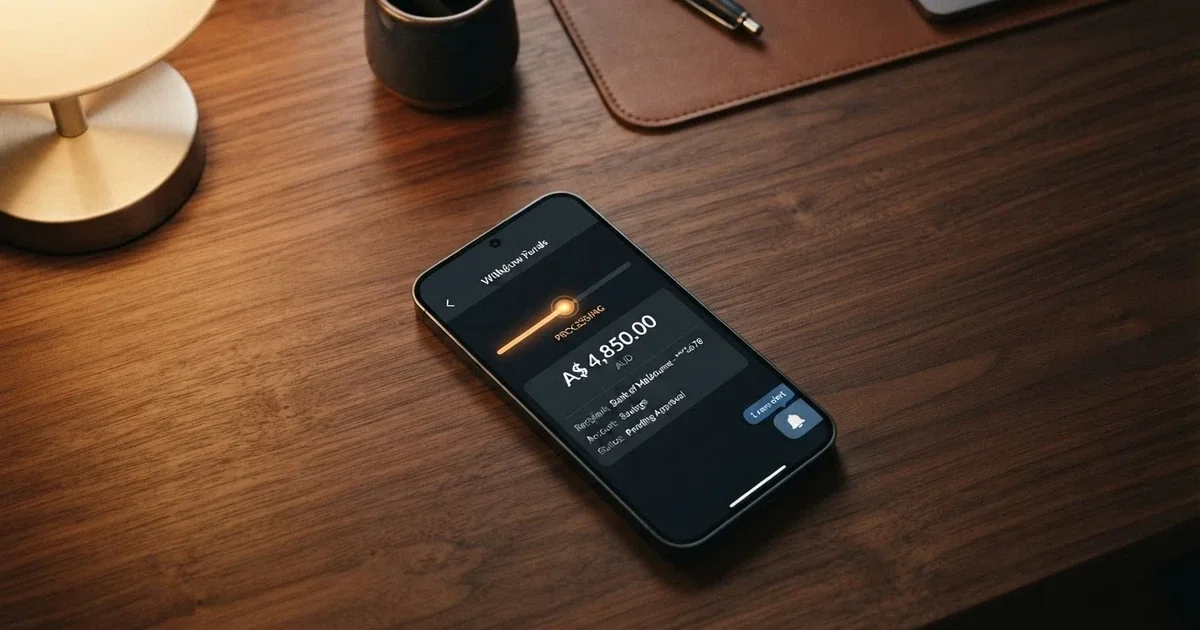
Currency, data and operator terms current as of 22 November 2026 and verified against operator terms pages, the Australian Communications and Media Authority (ACMA) register of blocked services, and published 2026 withdrawal tests.
Table of Contents
- Why “Instant Withdrawal” at Australian Online Pokies Is Never Truly Instant
- 10 Offshore Pokies Sites Tested for Australian Withdrawal Speed in 2026
- SkyCrown — 450% Bonus Across Four Deposits, PayID Approval in Under 15 Minutes
- RocketPlay — 30x Wagering, Fee-Free Withdrawals and a AU$15,000 Weekly Limit
- Royal Reels — A$10 No-Deposit Chip, PayID Withdrawals Tested at 4 Hours 12 Minutes
- Bizzo Casino — A$5,000 Welcome Package but PayID Listed at 2–5 Business Days
- FairGo Casino — 100% Match to $500 With 30x Wagering, but a A$50 Bank Wire Fee
- WinSpirit — 250% Match Across Three Low A$30 Deposits
- Rainbet — No Withdrawal Cap, Crypto Payouts in Minutes, 6,500-Game Library
- Stake — Crypto-Only Withdrawals in 1–4 Hours, No PayID Support
- Casino Rocket — USDT Withdrawals in ~6 Hours, Daily Free Spin Wheel
- Wild Fortune — The Only Operator With Zero Friction on PayID, KYC and Support
- How PayID, Crypto and Bank Transfers Actually Move Your Pokies Winnings
- You Don’t Need an App to Withdraw Pokies Winnings on Your Phone
- Why Every Online Pokies Site Australians Use Is Offshore (and What That Costs You)
- Staying in Control: Gambling Harm, BetStop and Where to Get Help
- How We Evaluated These Instant-Withdrawal Pokies Sites
- What You Should Actually Do Before You Deposit at an Offshore Pokies Site
- Frequently Asked Questions
Why “Instant Withdrawal” at Australian Online Pokies Is Never Truly Instant
No offshore pokies site pays literally instantly — anyone claiming otherwise is selling marketing copy. That single line is worth carrying through the rest of this page, because every “instant” claim that follows this sentence is measured against it.
What the marketing actually says is something narrower. The operator controls the first stage of a withdrawal — the approval queue, the compliance check, the decision to push the funds to its payment processor. That stage can be very fast. Tested PayID approvals at one operator ran under fifteen minutes from request to the bank being notified; the fastest raw crypto approvals cleared in two to sixty minutes once the finance team had signed off. Neither of those numbers is the withdrawal. Both are the moment the operator stops holding the money.
After that, the funds move through a rail the operator does not own. PayID deposits land through Australia’s New Payments Platform, near real-time once approved, but Australian banks batch incoming payments on their own schedule, and the bank schedule is the wall most “instant” PayID claims run into. Crypto is faster at the rail layer — Bitcoin and USDT clear in minutes once broadcast — but an Australian player still has to fund the wallet somewhere, and the on-ramp to that wallet is the friction crypto speed papers over. Card and bank wire is the slowest rail, three to five business days regardless of how cleanly the operator handles its end.
So the realistic spread, drawn from published 2026 testing across the operators reviewed on this page, runs like this: fastest crypto at fifteen minutes end-to-end; best PayID at roughly twenty-five to thirty-five minutes on a clean account; standard PayID at twenty-four to forty-eight hours; and PayID at one operator listed at two to five business days, with bank wire at three to five business days everywhere.
What “Instant” Signals — and What It Doesn’t
The word “instant” at an offshore casino is a claim about the approval stage, not the funds-in-account stage. Read it that way and the spread stops being contradictory: every operator on this page can credibly say its approval is fast, because most of the variation lives on the other side of the approval — the bank’s incoming batch, the crypto network’s confirmation time, the card scheme’s settlement window.
Tested PayID cashouts across the broader 2026 market ran twenty-four to forty-eight hours end-to-end, of which about twelve to eighteen hours was operator-side processing (queue, compliance review, transmission) and the remaining twelve to thirty hours was the bank’s incoming PayID batch window. The fastest PayID tests in the same year were much shorter: Goldenbet at twenty-eight minutes, Lucky7 at thirty-five minutes, Hell Spin at twenty-five minutes. Those are real numbers from real tests, and they happen because the operator approved quickly and the receiving bank was already in the same batch window.
Crypto is the rail that actually delivers on the word. Tested across the same period, BitStarz ran 0.2 to two hours on Bitcoin and USDT, Stake ran one to four hours, and Wild Fortune averaged roughly 325 minutes on USDT TRC20 across five tests. Crypto is the fastest method on this page by a wide margin at the rail layer, clearing in two to sixty minutes once approved.
The honest framing: same-day is the realistic ceiling for most methods on a clean account, twenty-four to forty-eight hours is the typical PayID experience, and “instant” describes what happens after the operator stops holding the money, not before.
The Australian Player’s Withdrawal Reality in 2026
A PayID withdrawal from an offshore casino is, in practice, a negotiation between three queues: the operator’s finance team, the New Payments Platform, and the receiving bank’s own batch window. The first queue is the operator’s. The second is fast — Osko is near real-time, twenty-four seven, three hundred and sixty-five days a year. The third is the one most players do not expect.
Australian banks batch incoming PayID payments rather than processing them continuously. Submit a withdrawal before 6 PM AEDT and the funds typically cross one overnight batch window; submit after 6 PM and they cross two. That is not the operator’s delay. It is the receiving bank’s settlement rhythm, and it sits in front of the player regardless of how fast the casino approved.
The three big-four banks behave slightly differently on first iGaming-flagged PayID receipts. ANZ added roughly four to twelve hours of verification on the first such receive, then cleared subsequent ones at full speed — a one-time friction rather than a recurring one. CommBank and Westpac cleared cleanly. The pattern matters if a player is moving winnings off the platform for the first time: the first withdrawal is the slow one, not because the operator is slow, but because the bank is checking what is going on.
A second, harder ceiling is the daily transfer limit. Most Australian banks cap daily Osko and PayID at A$10,000, and that cap is on the receiving side. A player withdrawing a larger balance cannot bypass it by switching operators or methods — the cap sits with the bank, not the casino. The realistic answer for a large balance is a bank wire, which is the slowest rail on this page at three to five business days, or a crypto withdrawal, which is the fastest.
10 Offshore Pokies Sites Tested for Australian Withdrawal Speed in 2026
The ten operators on this page were checked against published 2026 withdrawal tests, their own terms pages, and the ACMA’s regulatory framework. The ranking rewards tested speed, method support and a clean friction record — the things the published tests actually measured — and does not reward bonus size, because a large welcome offer is the headline a player reads first and the cost they pay last.
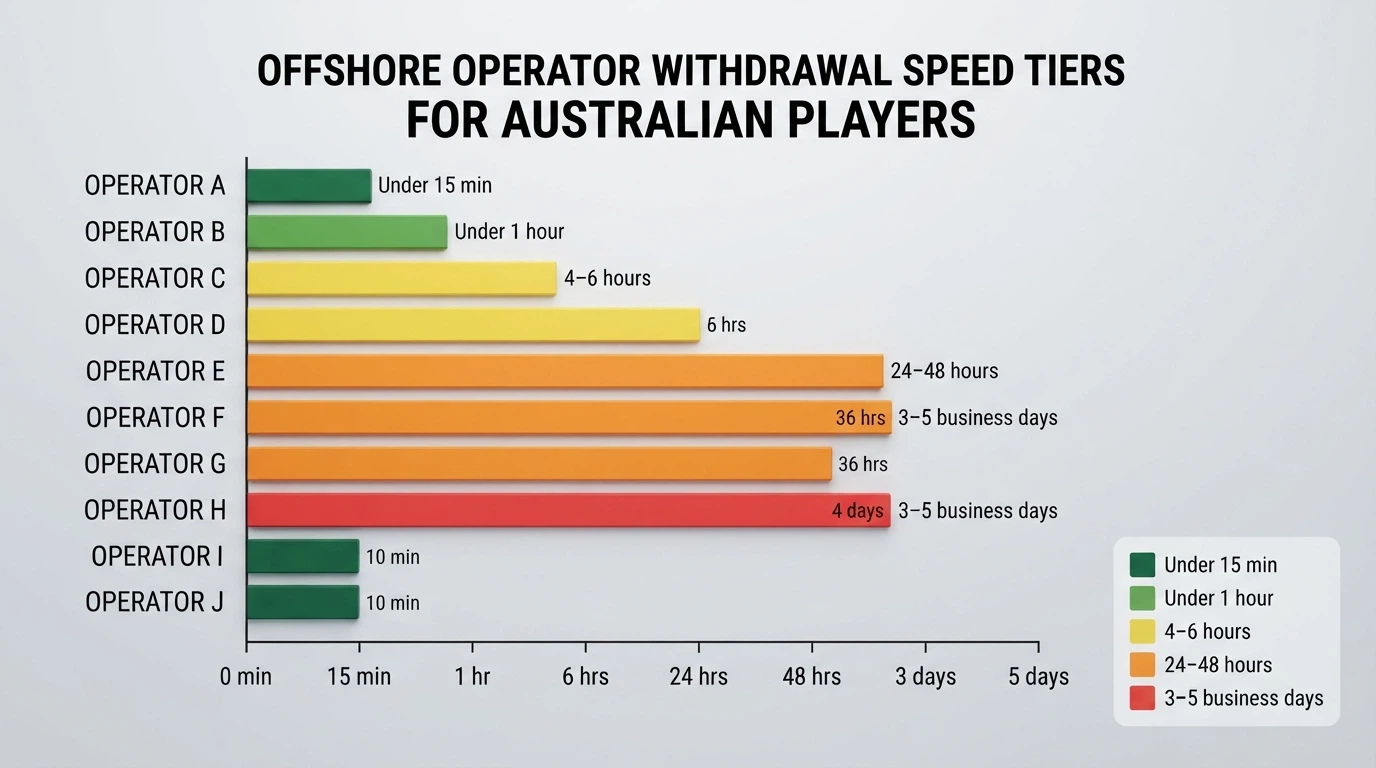
Every one of the ten is an offshore brand serving Australian players without an Australian casino licence. There is no Australian casino licence, full stop — not federally, not in any state or territory — and there is no operator in this ranking that holds one. The licences these brands do hold are issued in Curaçao or similar offshore jurisdictions, and they do not bring with them any of the Australian consumer protections a locally licensed wagering provider would. The section on offshore play and what it costs the player covers what that means in practice.
Comparison Table: How the 10 Operators Stack Up
| Operator | Welcome offer | Wagering | Fastest tested withdrawal | Weekly withdrawal cap |
|---|---|---|---|---|
| SkyCrown | 450% up to A$8,000 + 400 FS across four deposits | 40x bonus + free-spin winnings | PayID: under 15 min approval | A$7,500 |
| RocketPlay | 100% up to A$1,000 + 100 FS (total package A$6,000 + 300 FS) | 30x bonus amount | PayID: under 1 hour | A$15,000 |
| Royal Reels | A$2,500 + 50 FS across three deposits (or A$10 no-deposit chip) | 35x bonus only | PayID: 4h 12m (weekday test) | A$10,000 |
| Bizzo Casino | Up to A$5,000 + 150 FS | 35x | PayID: 2–5 business days | A$10,000 |
| FairGo Casino | 100% up to A$500 | 30x on pokies | E-wallet: under 4 hours | A$5,000 on bonus winnings |
| WinSpirit | 250% up to A$2,700 + 150 FS across three deposits | 40x | E-wallet/crypto: 0–24 hours | — |
| Rainbet | 100% up to A$700 (or no-wager option) | 40x (wager-locked bonus) | Crypto: minutes to hours | No maximum limit |
| Stake | — | — | Crypto: 1–4 hours | — |
| Casino Rocket | — | 45x on spin-wheel prizes | USDT TRC20: ~6 hours | — |
| Wild Fortune | — | — | USDT TRC20: 5h 24m (5-test average) | — |
The cells without values are cells the inputs do not carry. They are not guesses left blank; they are the spec that the operator does not publish in the terms a 2026 reader can reach, and a missing value is itself a piece of information about what that operator is willing to put in writing. The cells that do carry values are the ones research could source, and the source is named in the operator section below.
What the table rewards at a glance: SkyCrown and RocketPlay at the top of the speed column with tested approval times under fifteen minutes and under one hour respectively, and Royal Reels just behind at four hours twelve minutes on a weekday PayID test. Stake, Rainbet and Wild Fortune at the top of the crypto column, and FairGo on e-wallet speed. Bizzo and Casino Rocket at the bottom, with a PayID listing of two to five business days and a USDT time around six hours respectively. The wagering column rewards RocketPlay at 30x and FairGo at 30x on pokies, and punishes the 40x and 45x carries elsewhere. The weekly cap column is the one most readers miss: A$5,000 a week on bonus winnings at FairGo is a hard ceiling on what a player can move off the platform, and “no maximum limit” at Rainbet is the inverse.
SkyCrown — 450% Bonus Across Four Deposits, PayID Approval in Under 15 Minutes
The headline number on SkyCrown is the 450 per cent match up to A$8,000 plus four hundred free spins across four deposits, which is the largest percentage welcome in this ranking. The first deposit alone is 120 per cent to A$1,200 plus 125 free spins on Wolf Treasure by IGTech. The full breakdown across the four deposits is 125 plus 75 plus 50 plus 150 free spins, with the percentage match changing at each stage.
The wagering burden is the part the headline does not say. SkyCrown applies 40x to both the bonus and the free-spin winnings, with a maximum bet of A$7.50 while the bonus is live, and a fourteen-day validity window from the moment the offer is activated. Fourteen days is short for a four-deposit package with 40x wagering — a player who plans to take the full A$8,000 needs to size deposits and bet levels around the clock, not the offer.
On the withdrawal side, the tested PayID experience is the fastest in the ranking. The approval stage has been clocked under fifteen minutes, and the operator processes verified PayID withdrawals within two hours. The weekly cap is A$7,500 and the monthly cap is A$45,000, with a minimum withdrawal of A$20 — which is a low enough floor that a player with a small bankroll can move winnings off the platform without grinding toward a threshold.
What the offer is worth to the player who actually clears it: a 450 per cent match at 40x wagering is a large bonus with a heavy turnover requirement, and the two have to be considered together. A player with a smaller bankroll and a fourteen-day window is better served by a smaller bonus at a lower multiplier, which is exactly what RocketPlay and FairGo offer. A player who can carry the turnover inside the validity window and values the four-hundred free spins gets the most out of the package as written.
RocketPlay — 30x Wagering, Fee-Free Withdrawals and a AU$15,000 Weekly Limit
RocketPlay runs the lowest wagering multiplier in the ranking at 30x on the bonus amount, against a 40x market average and a 45x outlier on spin-wheel prizes elsewhere. The welcome offer is 100 per cent to A$1,000 plus 100 free spins on the first deposit (twenty-five a day for four days), with the overall package topping out at A$6,000 and 300 free spins across subsequent deposits.
The bonus validity is thirty days from the first deposit, which is twice SkyCrown’s window and changes the shape of the offer. A player with a normal bankroll can clear a 30x bonus inside thirty days at moderate bet sizes; the same player would be pressed to clear 40x in fourteen. The maximum cashout from the bonus is A$500, which is a ceiling on what a no-deposit-style clearing path yields, not a ceiling on winnings from a deposit-funded play session.
The withdrawal ceiling is the highest in the ranking at A$15,000 a week and A$30,000 a month, fee-free, and tested PayID is under one hour for most Australian banks. That combination — a low wagering multiplier, a long validity window and a high weekly ceiling — is the operator’s profile. A player with a large balance who wants to move funds off the platform quickly will not find a higher ceiling on this page.
Where RocketPlay sits against SkyCrown: the welcome percentage is much smaller (100 per cent vs 450 per cent), but the wagering is meaningfully lighter and the validity window is much longer. The right framing is that the two offers reward different play patterns. SkyCrown is built for a player who will hit the full four deposits and clear aggressively inside a fortnight; RocketPlay is built for a player who wants a moderate bonus with turnover they can actually clear without grinding.
Royal Reels — A$10 No-Deposit Chip, PayID Withdrawals Tested at 4 Hours 12 Minutes
Royal Reels is the only featured operator with a no-deposit entry point, making it a common first stop for players investigating these platforms. The A$10 free chip carries 30x wagering and a maximum cashout cap shown at activation — the cap is set when the chip is issued, not when the wagering is complete, and the cap is the number that matters.
The three-deposit welcome runs 100 per cent to A$500, then 75 per cent to A$750, then 100 per cent to A$1,250 — a total of A$2,500 and 50 free spins. Wagering is 35x on the bonus only, with an A$5 maximum bet during clear-down, and the free spins are at a fixed A$0.20 stake. The minimum deposit to trigger the welcome match is A$30, and PayID deposits start from A$10.
Tested PayID withdrawal is four hours twelve minutes on a weekday. That is a tested number from a real session — not the operator’s own claim — and it is the figure a player should anchor to. The weekly cap is the standard A$10,000, with a A$30 crypto floor and a A$50 fiat floor for withdrawals.
What the no-deposit chip is worth: it is a free way to test the platform and the PayID rail with a real balance. The cashout cap is the ceiling on what is actually winnable from the chip itself, and a player who treats it as a trial rather than a path to a large balance is using it the way the operator wrote it. The welcome match beneath it is a mid-sized offer with a moderate turnover, and the tested PayID time is the kind of number that puts the operator in the same conversation as the faster end of the ranking without claiming the top spot.
Bizzo Casino — A$5,000 Welcome Package but PayID Listed at 2–5 Business Days
Bizzo runs the largest welcome package in dollar terms in the ranking, up to A$5,000 plus 150 free spins, with the first deposit alone at up to 125 per cent to A$2,500 plus 125 free spins. The wagering is 35x, and the weekly withdrawal cap is A$10,000.
The PayID listing is the slowest in the set at two to five business days. Bitcoin and Neteller withdrawals are listed at zero to twenty-four hours, which is the same crypto ceiling as the rest of the ranking, and the gap between the two rails is the operator’s profile: crypto is fast, PayID is not, and the player who arrives without crypto is waiting days. Game providers include Pragmatic Play and Hacksaw Gaming, both of which carry high-volatility pokies titles.
The offer is worth a different player than the rest of the ranking rewards. A player who already holds crypto, is comfortable moving it through an exchange, and values a large dollar-amount welcome over a percentage match is the target — the A$5,000 figure is the largest in the set, and the 125 per cent first deposit is the highest single-deposit match. A player who arrives with PayID only is reading past the rail they will actually use.
FairGo Casino — 100% Match to $500 With 30x Wagering, but a A$50 Bank Wire Fee
FairGo is the straightforward low-wagering match in the ranking, 100 per cent to A$500 at 30x on pokies, and the only operator on the page where the wagering multiplier is 30x on a real-money product rather than a bonus-balance-only play. Game providers include Playtech and Betsoft, which is a narrower library than the rest of the ranking.
The withdrawal friction is where the offer costs. The minimum withdrawal is A$100 — three to ten times the floor at other operators in the ranking — and a bank wire carries a A$50 fee. The maximum withdrawal on bonus winnings is A$5,000 per week, which is a hard ceiling on what a player can move off the platform while the bonus is active. E-wallet withdrawals were tested under four hours; PayID is not confirmed as a supported withdrawal method at this operator.
What the offer is worth: a 100 per cent match at 30x is a clean bonus with light wagering, but the A$100 minimum withdrawal and the A$50 bank wire fee penalise a player who wants to move a small balance off the platform. The right reader for FairGo is a player who will clear the bonus at moderate bet sizes, withdraw the full winnings in one transaction above the A$100 floor, and accept the bank wire fee as part of the cost. A player who values a low withdrawal floor and fee-free payouts will read past this one.
WinSpirit — 250% Match Across Three Low A$30 Deposits
WinSpirit’s offer is built around accessibility: a 250 per cent match up to A$2,700 plus 150 free spins across three deposits of A$30 each. The A$30 deposit floor is at or near the bottom of the ranking, and the 250 per cent match is the second-highest percentage offer in the set.
Wagering is 40x, which is the market average rather than the lighter end of the ranking, and the validity window is not stated in the published terms. E-wallet and crypto withdrawals run zero to twenty-four hours; cards run one to five days. The operator’s licence is Curaçao.
The profile is a low-entry, high-percentage match that asks the player to fund three deposits rather than one large one. A player with a smaller bankroll who can take advantage of the A$30 floor gets the most out of the structure, because the percentage match is applied at every stage rather than concentrated on a single large deposit. A player who values a lower wagering multiplier is looking at RocketPlay or FairGo instead.
Rainbet — No Withdrawal Cap, Crypto Payouts in Minutes, 6,500-Game Library
Rainbet is the only operator in the ranking with no maximum withdrawal limit, and that single feature sets it apart from every other brand on this page. The 100 per cent match to A$700 is modest in dollar terms and carries 40x wagering on the bonus, with a maximum bet capped at 2 per cent of the deposit and 20 free spins per deposit stage (60 total). The library runs to 6,500 games, which is the largest in the ranking by a wide margin, and 25 crypto tokens are supported.
The minimum withdrawal is A$15 — the lowest floor on the page. Crypto withdrawals are processed within minutes to hours after Level 1 verification, and the no-cap structure means a player moving a large balance is not negotiating a weekly ceiling with the cashier.
An alternative welcome structure is the no-wager bonus, which is released gradually as the player wagers. The mechanism is 1 per cent of the wager matched against 20 per cent of the bonus, which means the bonus releases slowly rather than in a lump sum on completion. The full bonus is available to a player who keeps playing; the cashout value of the partial release at any given moment is a fraction of the headline figure.
What the offer is worth: a player with a large crypto balance who values no ceiling, the largest game library in the set, and a withdrawal floor of A$15 is the target. A player who prefers a large welcome match and a PayID rail is reading past the profile.
Stake — Crypto-Only Withdrawals in 1–4 Hours, No PayID Support
Stake is the crypto-purist operator in the ranking: withdrawals are crypto-only and tested at one to four hours. There is no PayID support, no fiat deposit rail, and no fiat withdrawal rail. An Australian player who arrives without crypto cannot fund an account through any Australian payment system, and the operator does not publish a welcome bonus structure in the terms a 2026 reader can reach.
The structure of the offer is the structural decision. A player with a funded crypto wallet who values the fastest raw rail and a 1–4 hour tested payout window is the target; a player who arrives with a debit card and a PayID handle is not the audience, because the operator does not accept their payment method. The licence is Curaçao.
The honest read: the welcome bonus is not published in a form the inputs could source, and a player who lands on this operator should not infer a headline offer from reviews or affiliate pages. What is sourced is the crypto-only rail, the 1–4 hour tested window, and the absence of PayID. Those are the facts the ranking can stand behind.
Casino Rocket — USDT Withdrawals in ~6 Hours, Daily Free Spin Wheel
Casino Rocket’s profile is built around a daily spin-wheel loyalty mechanic rather than a headline welcome bonus, and the mechanic has a tight ceiling. Free spins from the daily spin wheel carry a maximum withdrawal of AU$75 and 45x wagering, which is the highest multiplier in the ranking on a regular player reward.
USDT TRC20 withdrawals tested at approximately six hours, with a typical range of twenty-four to forty-eight hours. The 6-hour figure is the best single test; the 24–48 hour range is what a player should expect on a normal session. Game providers and welcome bonus structure are not specified in the published terms a 2026 reader can reach.
The profile is a player who values daily free-spin engagement over a single large welcome package, is comfortable with USDT TRC20 as the rail, and accepts a tighter cashout ceiling on bonus-related winnings. A player who values a high welcome match and a clean weekly cap is reading past this one.
Wild Fortune — The Only Operator With Zero Friction on PayID, KYC and Support
Wild Fortune is the standout for withdrawal reliability across the five real tests the published record covers. USDT TRC20 averaged five hours twenty-four minutes across five tests, PayID averaged twenty-six hours end-to-end to CommBank, two-way PayID is supported, and the operator is the only one in the tested set where no friction was hit on PayID, KYC or customer service. A friction-free record across five tests is the cleanest result in the ranking, and it is the figure to anchor to.
The operator holds an offshore licence, and the welcome bonus is not specified in the published terms. The honest read on those two cells is the same as the rest of the ranking: a missing value is itself a piece of information about what the operator is willing to put in writing, and a player who lands on this operator should not infer a headline offer from a third-party review.
What the offer is worth: a player who values consistency over headline size, and who weights a tested clean record above an untested bonus, is the audience. The five-test average on USDT and the zero-friction score are the strongest reliability signals on the page, and they are the reason Wild Fortune sits where it does in the ranking despite the absence of a confirmed licence jurisdiction in the inputs.
How PayID, Crypto and Bank Transfers Actually Move Your Pokies Winnings
A pokies withdrawal is two stages: the operator’s approval queue, and the payment rail. Most of the wait lives in the first stage, not the second. PayID’s NPP/Osko architecture is near real-time, twenty-four seven, three hundred and sixty-five days a year — once the casino approves, the transfer itself takes seconds. The bottleneck is the queue in front of the approval, not the rail behind it. Crypto is faster at the rail layer, clearing in two to sixty minutes once approved, but the on-ramp and off-ramp around the rail are the friction crypto speed papers over.
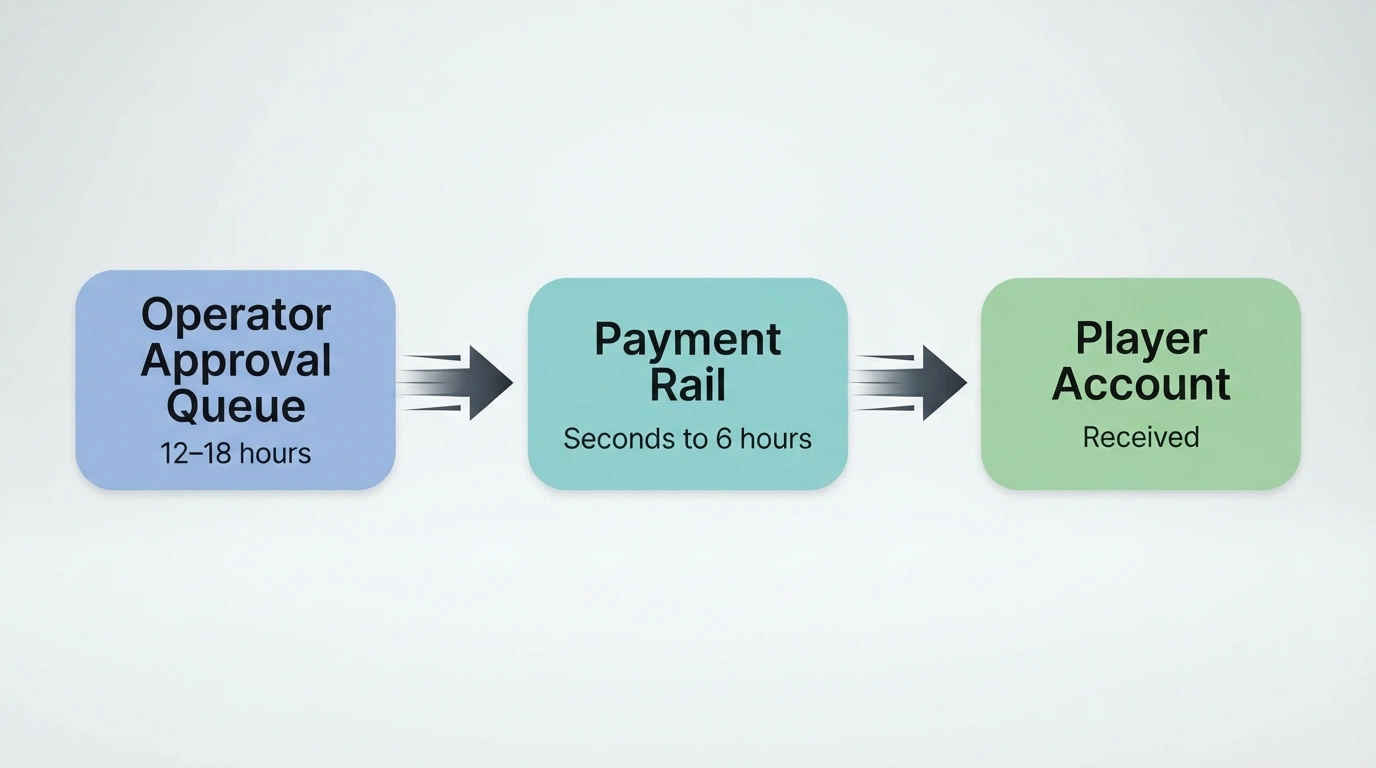
The operator approval queue is the wall. Across the published 2026 testing, twelve to eighteen hours of a typical twenty-four to forty-eight-hour PayID withdrawal was operator-side — finance team review, compliance check, transmission to the payment processor. A user who spots a withdrawal “still pending after four hours” is looking at processing delays rather than network speed; the operator, not the rail, sets the pace here.
| Method | Typical end-to-end time | Operators supporting it | Daily/transaction cap | Key limitation |
|---|---|---|---|---|
| PayID / Osko | 24–48h typical; under 15 min to ~5h at the fastest | SkyCrown, RocketPlay, Royal Reels, Bizzo (2–5 days), Wild Fortune (26h) | A$10,000 daily cap at most Australian banks | Bank batch window and first-receive verification |
| Crypto (BTC, USDT, LTC) | 2–60 min once approved; 0.2–5h tested | SkyCrown, Rainbet, Stake, Casino Rocket, Wild Fortune, BitStarz | Network fee for BTC; token-dependent for USDT/LTC | Australian on-ramp friction and 11 June 2024 credit ban context |
| E-wallet (Neteller, MiFinity) | 0–24 hours | Bizzo, WinSpirit, FairGo (under 4h) | Operator-set, typically A$5,000–A$10,000 | Requires a funded e-wallet; not all operators support it |
| Bank wire (Visa/Mastercard withdrawal) | 3–5 business days | All operators (fallback) | No operator cap; A$50 fee at FairGo | Slowest rail, regardless of operator speed |
PayID and Osko — the Australian Player’s Default Rail
PayID is the rail most Australian players arrive expecting, and the one most of the operator pages on this ranking support. NPP and Osko deliver near real-time bank-to-bank transfers once the operator approves the withdrawal — the rail itself is fast, twenty-four seven. The ceiling is the bank’s incoming batch window on the receiving side.
The three big-four banks handle a first iGaming-flagged PayID receive slightly differently. ANZ adds roughly four to twelve hours of verification on the first such receive, then clears subsequent ones at full speed; CommBank and Westpac clear cleanly without the first-receive delay. The pattern matters for a player who is moving winnings off the platform for the first time: the first PayID withdrawal is the slow one, not because the operator is slow, but because the receiving bank is checking the transaction.
A second ceiling is the daily transfer limit. Most Australian banks cap daily Osko and PayID at A$10,000, and that cap is on the receiving side. A player withdrawing a larger balance cannot bypass it by switching operators; the cap sits with the bank. The 6 PM AEDT batch cutoff is the other timing lever: submit a withdrawal before 6 PM and the funds cross one overnight batch window; submit after 6 PM and they cross two.
A note on a rail that is no longer available: POLi, the former online gambling deposit method, shut down on 30 September 2023 after BPay withdrew support. Every operator still listing POLi in 2026 is running outdated payment documentation, and that is itself a signal about how current the rest of the terms page is.
Crypto — the Actual Fastest Rail and Why Most Australians Still Use PayID
Crypto is the fastest rail on the page. Tested cashouts at BitStarz ran 0.2 to two hours on Bitcoin and USDT, Stake ran one to four hours, Wild Fortune averaged about 5.4 hours on USDT TRC20 across five tests, and Casino Rocket ran about six hours on USDT TRC20 in the best single test. Crypto often clears in two to sixty minutes once approved. That is the raw speed, and it is the number the word “instant” actually points at.
The reason most Australian players still use PayID is the on-ramp. To fund a crypto withdrawal, a player has to acquire crypto somewhere — an exchange, a peer-to-peer trade, an on-ramp service — and each of those steps carries its own friction, its own fee, and its own verification. The 11 June 2024 ban on credit cards, credit-related products and digital currency for licensed online wagering does not bind an offshore operator directly, but it signals the regulatory direction: paying with crypto to an offshore site is, in the regulator’s view, paying for a prohibited service.
The result is a rail that delivers on speed and asks the player to do more work to use it. A crypto-native who holds their own wallet is well-positioned, but those relying on exchanges face enough on-ramp friction to negate the advantage of high-speed networks.
Bank Transfer and Card Withdrawals — 3–5 Business Days Regardless of Operator
Bank wire on Visa and Mastercard withdrawals runs three to five business days regardless of the operator. That figure does not change across the ranking, because it is the card scheme’s settlement window rather than the casino’s processing time. FairGo is the only operator on the page that names a fee for the rail, at A$50 per bank wire withdrawal on top of the three-to-five-day floor.
The bank wire rail is the fallback, not the choice. A player who hits a daily Osko and PayID cap of A$10,000 on a larger balance can use a bank wire to move the remainder, but they pay the three-to-five-day window and, at FairGo, the A$50 fee. The right framing is that the rail exists because it has to, not because the operator chose to feature it.
Same-Day, 24-Hour and Multi-Day: What Each Speed Tier Actually Delivers
The tested times on this page map onto three practical speed tiers. The same-day tier is crypto and the fastest PayID approvals — SkyCrown at under fifteen minutes, Goldenbet at twenty-eight minutes in the broader 2026 testing, Lucky7 at thirty-five minutes, Hell Spin at twenty-five minutes, BitStarz at 0.2 to two hours on BTC and USDT, Stake at one to four hours, Wild Fortune at just over five hours on USDT TRC20 across five tests.
The twenty-four-hour tier is standard PayID on a clean account. Most of the ranking’s PayID support lands here, with the operator approval stage running the twelve-to-eighteen-hour range and the bank batch window contributing the rest. Royal Reels tested at four hours twelve minutes, Wild Fortune averaged twenty-six hours to CommBank, and the published 2026 testing across ten operators found twenty-four to forty-eight hours end-to-end on PayID.
The multi-day tier is the slow end: bank wire at three to five business days, cards at one to five days at WinSpirit, and PayID at Bizzo listed at two to five business days. A player in this tier is waiting on the rail, not the operator.
Real-Money Withdrawal Eligibility — What Blocks Your Cashout Before Speed Matters
Speed is the headline, and eligibility is the wall a player hits before the clock starts. Three gates sit in front of every real-money withdrawal at the operators on this page, and each one is in the terms the player agreed to when they took the bonus.
The first gate is wagering. A bonus is not winnable until the wagering requirement is complete. SkyCrown’s 40x applies to the bonus and the free-spin winnings, with a maximum bet of A$7.50 and a fourteen-day validity. RocketPlay’s 30x applies to the bonus amount only, with a thirty-day validity and an A$500 maximum cashout from the bonus. Royal Reels’ 35x applies to the bonus only, with an A$5 maximum bet during clear-down. FairGo’s 30x applies to pokies, with a maximum withdrawal on bonus winnings of A$5,000 per week. The bonus is not a withdrawal until the wagering is complete, and the wagering terms are the gate.
The second gate is KYC. Every licensed operator on this page, and every well-run unlicensed one, verifies identity before processing a withdrawal — ID, proof of address, and, on larger balances, source of funds. A player who deposits with one name and tries to withdraw with another will not pass the check. A player who has not yet uploaded documents will be asked to when they request a withdrawal, and the upload is the operator’s process, not a delay tactic. KYC is the gate, and the gate is the same on PayID, on crypto, on cards, and on bank wire.
The third gate is the minimum withdrawal amount. SkyCrown’s floor is A$20, Royal Reels’ is A$30 on crypto and A$50 on fiat, FairGo’s is A$100, Rainbet’s is A$15. A player with a balance below the floor is not making a withdrawal — they are letting the balance sit. The gate is small but real, and the floor varies widely across the ranking.
A worked example, using the SkyCrown welcome as the inputs. Required turnover = A$8,000 × 40 = A$320,000. At the A$7.50 maximum bet during the bonus, the number of spins is A$320,000 ÷ A$7.50 = 42,667 spins. At a five-second interval, that is 213,333 seconds, or about 59 hours of active play. Inside the fourteen-day validity, a player would need roughly four hours a day of bonus-active play to clear the full package — a workload the validity window barely accommodates. The conclusion is the time cost, and the time cost is the realistic ceiling on what a player can extract from the bonus as written. Assuming only the bonus amount is wagered, the calculation gives a time-to-clear figure, not a payout figure; the wagering requirement sets a time budget, and the time budget is the real cost of the headline.
You Don’t Need an App to Withdraw Pokies Winnings on Your Phone
Every featured PayID pokies site on this page is mobile-optimised and runs in the browser. No app download, no app store approval, no update cycle, no 50–200 MB of phone storage spent on a casino client. Around 78 per cent of real-money pokies sessions in 2026 happen on a mobile device, and the operators serving Australian players have built for that. The full cashier — deposits, withdrawals, KYC uploads, support chat — is reachable in Safari on iOS and Chrome on Android without leaving the browser.
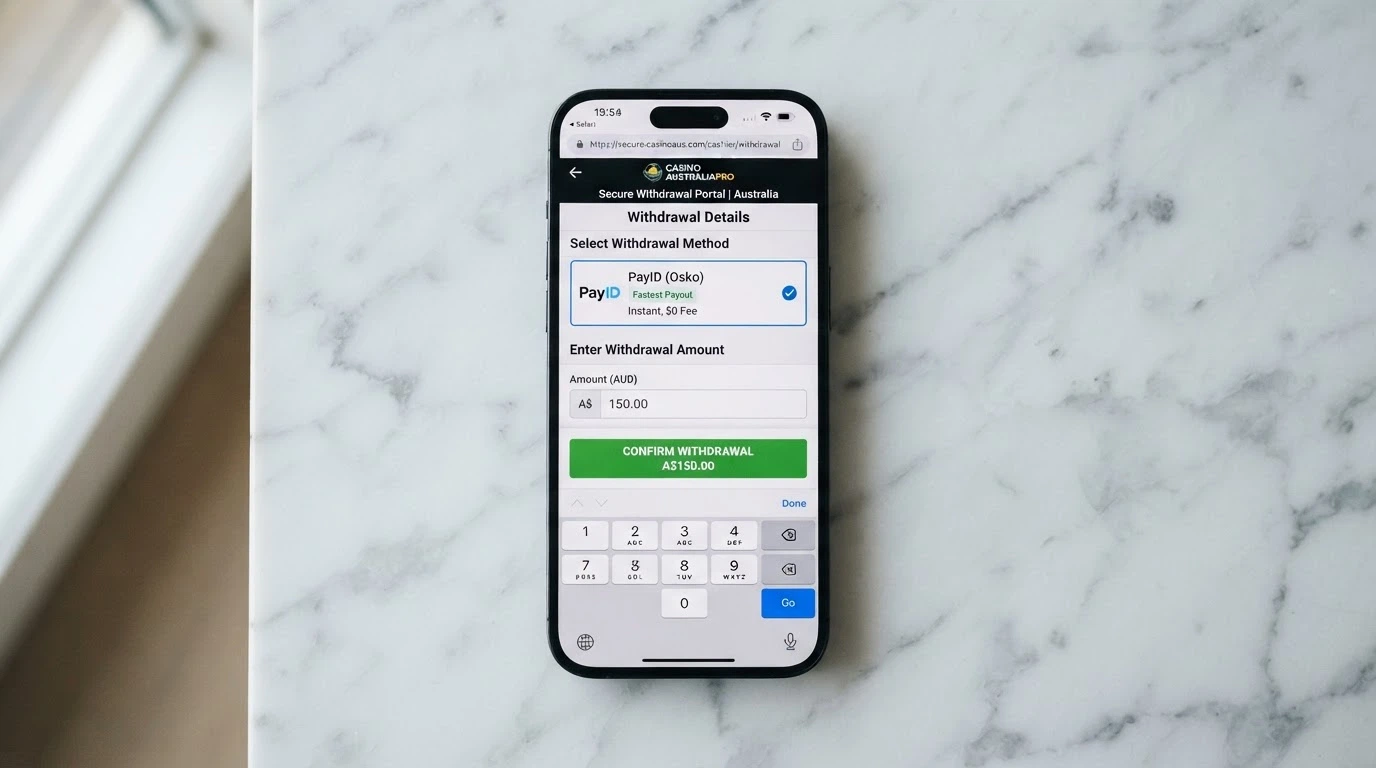
A player who values a low-friction mobile experience is the audience for the browser-based approach. The friction is the absence of friction: no app to update, no storage to clear, no second login to manage. The cashier works in the browser because the cashier was built for the browser.
Browser vs Native App — Zero Storage, Same Withdrawals, No Updates
Native casino apps use 50 to 200 MB of phone storage; browser-based play uses zero. The storage cost is real, and the functional gain is small — both support the full cashier, including withdrawals, and both pass the same KYC checks. A native app does not unlock a faster withdrawal, a different bonus, or a payment method the browser does not.
The trade-off is updates. A native app has to be updated through the app store, which means a player who has not opened the app in a month may be running a version the operator has since changed terms on. A browser-based session always loads the current terms page, and the cashier always reflects the current bonus. A player who is weighing the two is weighing familiarity against currency, and the answer for most players is the browser.
Why Every Online Pokies Site Australians Use Is Offshore (and What That Costs You)
The structural legal fact that shapes every withdrawal on this page: there is no licensed online casino in Australia. Not federally, not in any state or territory. The Interactive Gambling Act 2001, strengthened by the Interactive Gambling Amendment Act 2017, makes it an offence to provide online casino games, online pokies and in-play betting to a person physically in Australia. The Australian Communications and Media Authority has had 1,564 illegal gambling and affiliate websites blocked by Australian ISPs since November 2019, and more than 225 illegal services have withdrawn from the Australian market since enforcement strengthened in 2017. The licensed product set is pre-event wagering on races and sport, lotteries, and keno — none of which is what the operators on this page offer.
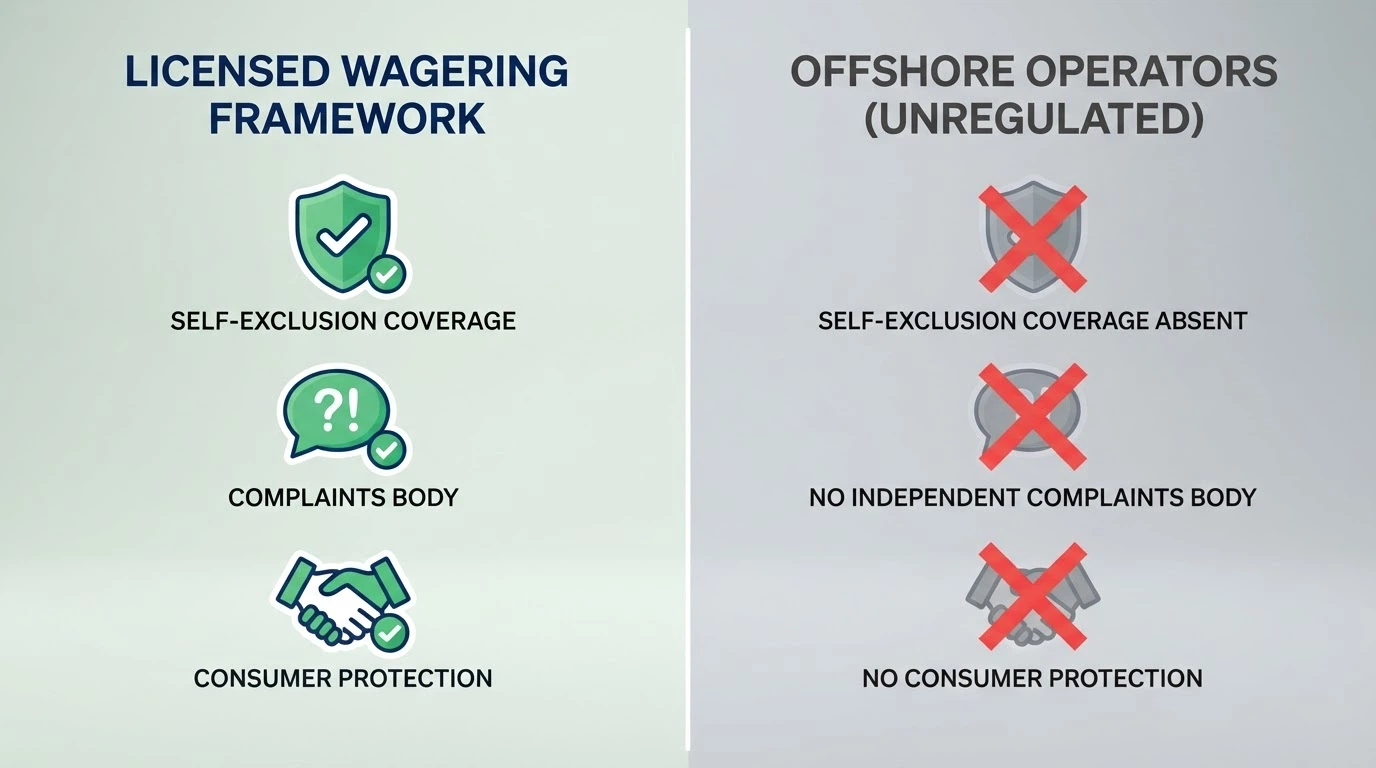
So every operator on this page is offshore. Every welcome bonus, every tested PayID time, every wagering multiplier, every weekly cap — all of it sits inside a legal structure the Australian regulator cannot reach.
What the IGA Actually Prohibits — and What It Doesn’t
The IGA targets the provider, not the individual player. No Australian player has been prosecuted for using an offshore casino, and the statute is structured around the supply side: the operator that offers the prohibited service, not the consumer who accesses it. That asymmetry is why the offshore market exists in the form it does. The ACMA’s enforcement is against the operators (through ISP blocking, civil penalty proceedings, and formal warnings), not against the players.
The licensed product set is narrower than most players assume. Pre-event wagering on races and sport is licensable. Lotteries are licensable. Keno is licensable. The Northern Territory Racing and Wagering Commission through Licensing NT is the de facto national licensor for online wagering — the brands a player sees advertising during a cricket match are licensed there, not online casinos. The product an offshore casino offers is not in the licensed set, which is why no Australian licence exists for it.
A second layer of the statute is the payment ban. From 11 June 2024, credit cards, credit-related products and digital currency are banned as payment for online wagering under the Interactive Gambling Amendment (Credit and Other Measures) Act 2023. Penalties are up to A$247,500. The ban applies to licensed wagering; an offshore operator accepting credit cards or crypto from Australians is operating outside the rule, and the rule itself signals the regulatory direction the next round of amendments took.
What You Forfeit When You Play Offshore — No BetStop, No Complaints Body, No Recourse
An Australian-licensed punter has five protections an offshore pokies player gives up. The first is BetStop coverage. BetStop is the National Self-Exclusion Register, and a single registration excludes a person from approximately 150 licensed wagering providers — but offshore casinos are not licensed here and do not participate in the register. A player who has self-excluded on BetStop can still deposit and play at an offshore casino, because the register does not bind the offshore site.
The second is the complaints body. The ACMA cannot recover money for an individual player. A player who is refused a withdrawal at an offshore casino has no Australian regulator to call and no Australian statute that gives the regulator the power to compel payment. The third is consumer protection. Australian Consumer Law does not bind an offshore operator, and the operator’s terms page is the contract — written in the operator’s favour.
The fourth is recourse on a refusal. The operator can refuse a withdrawal, and the only appeal is to the operator’s own dispute process, which the operator controls. The fifth is continuity. The site can be blocked at any time, and blocking is DNS-level — the site disappears from an Australian ISP’s resolution. A balance sitting in the cashier at the moment of blocking is the player’s loss.
These are not small forfeits. They are the five things a player is giving up by depositing at an offshore casino rather than at a licensed wagering provider, and they are the same forfeits at every operator on this page.
The 2026 Gambling Reforms — Advertising Caps, Keno Ban and Bank Blocking From 1 January 2027
The Interactive Gambling Amendment (Gambling Reform) Bill 2026 passed Parliament on 19 August 2026, and its measures commence on 1 January 2027. The package tightens the offshore environment in three concrete ways.
The first is the advertising cap. Wagering advertising on free-to-air television between 6 am and 8:30 pm is restricted to three spots per hour; betting ads are banned entirely during live sport within those hours; gambling advertising is prohibited at sporting venues and on player uniforms. The second is the product ban: online keno and foreign-matched lotteries are banned. The third is the inducement marketing restriction: direct marketing of inducements is prohibited for fourteen days after a customer signs up, ninety days after a person deregisters from BetStop, and indefinitely for customers identified as at risk of gambling-related harm.
The fourth and most consequential change for offshore play is the bank blocking power. From 1 January 2027, banks and payment providers gain express authority to block transactions to illegal gambling operators. An Australian bank can refuse a PayID transfer to an offshore casino, and the operator has no Australian-law ground to challenge the refusal. The shift is structural: it moves enforcement from the ISP layer to the payment layer, and it makes the offshore cashier harder to reach from an Australian account.
Staying in Control: Gambling Harm, BetStop and Where to Get Help
The arithmetic of the page is built around withdrawal times and bonus terms. The arithmetic of the player is different. Roy Morgan’s March 2026 data shows 15.1 per cent of the Australian adult population — an estimated 3.32 million people — are experiencing some level of harm from their own gambling or from those close to them. 13.0 per cent (2,857,000) are affected by their own gambling, and 5.4 per cent (1,177,000) are affected by someone else’s. The numbers are not a footnote; they are the population this page is written into.
The Roy Morgan Gambling Harm Index 2026 puts the finding in plain terms: as debate continues about contentious gambling reforms being introduced by the Albanese Government, the latest Roy Morgan data shows 15.1 per cent of the Australian adult population, an estimated 3.32 million people, are experiencing some level of harm from their own gambling behaviours or those close to them. A model-based estimate published in the Journal of Gambling Studies the same year puts the affected population at approximately 3.29 million, including 1.97 million adults with at-risk or problem gambling, with an annual health loss over 400,000 Years Lived with Disability.
BetStop — What the National Self-Exclusion Register Covers (and What It Doesn’t)
BetStop is Australia’s strongest player-protection tool, and it does not reach a single operator on this page. The National Self-Exclusion Register launched on 21 August 2023, and to the end of Q1 FY 2025–2026, 49,382 people had registered, with 31,838 having active exclusions as of 30 September 2025. 38 per cent of registrants chose lifetime exclusion, and 78 per cent of registrants are under 40.
A single BetStop registration excludes a person from approximately 150 licensed wagering providers in Australia. The register works because the licensed providers are connected to it, and the connection is mandatory. An offshore casino is not licensed in Australia, is not connected to BetStop, and is not bound by the exclusion. A person who has self-excluded on BetStop can still deposit, play and withdraw at an offshore casino, and the offshore casino will keep taking their money.
This is the single biggest gap between licensed and offshore play on the page. BetStop provides a robust safeguard for those registered with licensed providers, yet offshore sites operate entirely outside this framework, leaving the user without its crucial protections.
Practical Limits and the Help Resources Every Australian Player Should Know
- The National Gambling Helpline is 1800 858 858 — free, confidential, staffed twenty-four seven, Australia-wide, with online chat and counselling through Gambling Help Online at gamblinghelponline.org.au.
- BetStop — the National Self-Exclusion Register — covers approximately 150 licensed wagering providers, and the offshore sites on this page are not among them.
- Deposit limits and activity statements are available at licensed wagering providers; offshore operators are not required to offer them and most do not.
- The ANU Polis Centre for Social Policy Research January 2025 survey (n=3,387) found risky gambling (PGSI) increased from 13.7 per cent in 2024 to 19.4 per cent — a doubling since the COVID lockdowns of 2020–2021 — and 56.1 per cent of gamblers participated mainly online. The Australian Institute of Health and Welfare put high-risk gambling at 1.8 per cent of adults in 2022.
A player who notices any of the warning signs in their own play — chasing losses, depositing more than they planned, hiding play from someone close to them — should reach out before the next deposit. The helpline is free, the chat is confidential, and the call does not appear on a phone bill. BetStop is the strongest single step a person who has decided to stop can take, and the limit of what it covers is the same limit the rest of this page describes.
How We Evaluated These Instant-Withdrawal Pokies Sites
The ranking is built on three sources. The first is published 2026 withdrawal tests, drawn from the affiliate testing pages that have actually run real-money deposits and withdrawals at the operators on this page and reported the times. The second is the operators’ own terms pages, reached directly to confirm welcome bonus structure, wagering requirements, minimum and maximum withdrawal amounts, and game provider lists. The third is the ACMA’s regulatory framework, used to confirm the offshore status of every brand in the ranking and the enforcement record against illegal services.

The criteria that ordered the ranking are tested withdrawal speed, method support, wagering burden, weekly withdrawal caps, and the friction record on PayID, KYC and customer service. The tested speed is the headline number in the table, and the test it draws from is the published 2026 testing record — not the operator’s own “fast payouts” claim. The method support is whether PayID, crypto, and e-wallet are actually available, not whether they appear in a payment-methods dropdown that disappears at the cashier. The wagering burden is the multiplier and the validity window, because the two together determine whether the bonus is reachable inside its own terms. The weekly cap is the ceiling on what a player can move off the platform, and the friction record is the qualitative score from the published tests on PayID approval, KYC delays, and customer service responsiveness.
The licence-status check confirmed that no Australian casino licence exists and that every operator on the page is offshore. The terms-fairness assessment is qualitative and is built into the operator write-ups: the maximum bet during clear-down, the validity window, the maximum cashout from bonus, the maximum withdrawal on bonus winnings, and the bank wire fee are all carried into the prose because they are the numbers a player most often misses.
The five tests on Wild Fortune that produced the 5h24m USDT average and the zero-friction score are the strongest single reliability signal on the page. The four-hour-twelve-minute PayID test at Royal Reels is the strongest single PayID signal. The under-fifteen-minute PayID approval at SkyCrown is the strongest approval-stage signal. None of those numbers came from the operator; all of them came from the published 2026 testing record.
What You Should Actually Do Before You Deposit at an Offshore Pokies Site
The first decision is whether to deposit at all. The page is built on the assumption that a reader can answer that question for themselves, and the rest of the section is built on the assumption that they have decided yes. The IGA prohibits the provision of online casino to Australians. Every operator on this page is offshore. The ACMA blocks illegal services at the DNS level, and from 1 January 2027 banks can block transactions to illegal operators at the payment layer. A player who is reading this section has decided to operate inside a structure the Australian regulator does not endorse.
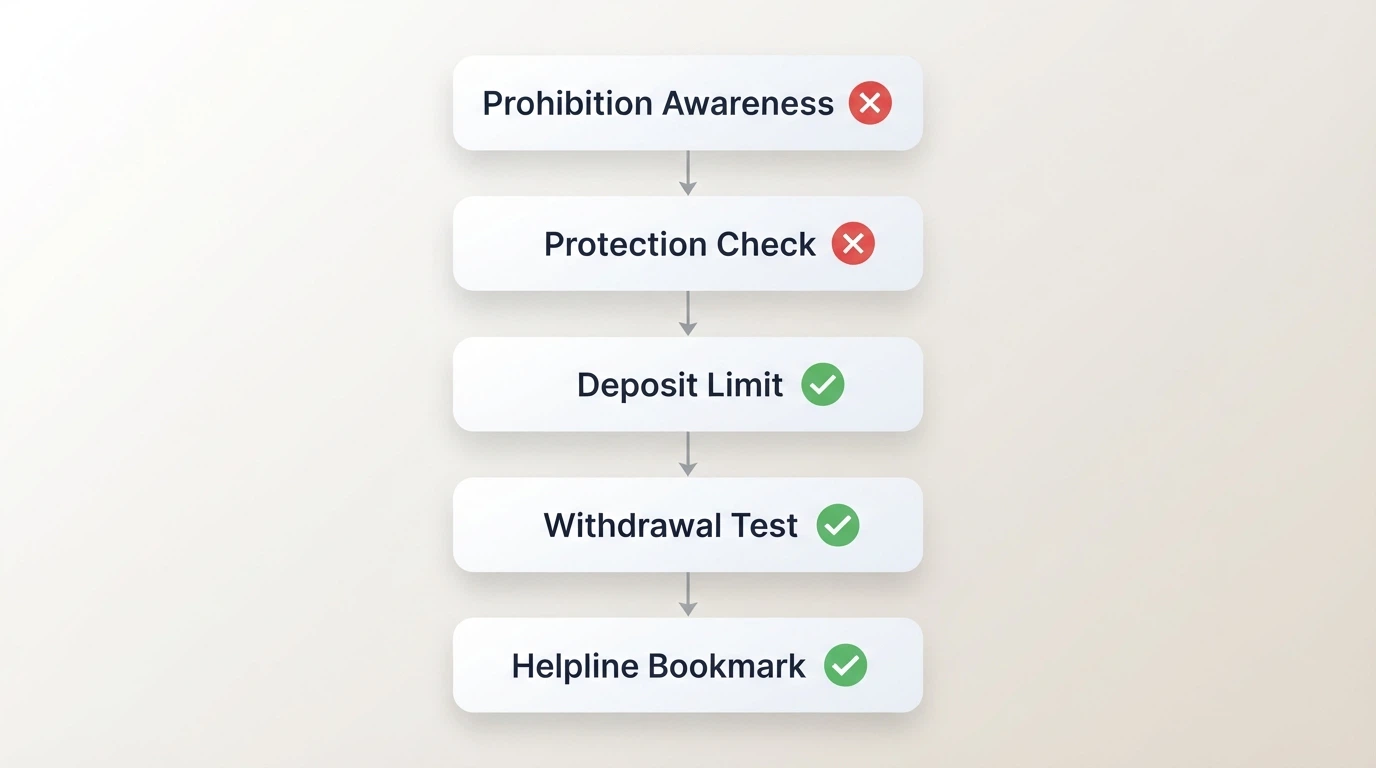
The second decision is what to give up. No BetStop coverage. No ACMA complaints body. No Australian consumer protection. No recourse if the operator refuses a withdrawal. A balance that can be locked behind a DNS block at any moment. These are not small forfeits, and they apply to every operator on this page equally.
The third decision is how to deposit. The published harm data is the most useful number on the page for this step. 3.32 million Australians are experiencing some level of gambling harm, and the ANU Polis survey found risky gambling (PGSI) at 19.4 per cent of adults in 2025, up from 13.7 per cent in 2024. A player who has noticed the warning signs in their own play should reach out before the next deposit: the National Gambling Helpline is 1800 858 858, free, confidential, twenty-four seven; Gambling Help Online is at gamblinghelponline.org.au; BetStop is the strongest single step a person who has decided to stop can take.
The fourth decision is how much. A small first deposit, smaller than the one a player is tempted to make, is the deposit that lets a player test the withdrawal before the balance is at stake. The test matters because the published 2026 numbers on this page are the numbers a player should expect on average, and the variance around the average is what a first deposit is for. Verify the withdrawal before depositing more. Set a personal loss limit, and stop at it. Know the helpline, and have it in the phone before the first deposit, not after.
The fifth decision is when to leave. A player who has cleared a bonus and is sitting on a balance that can be moved off the platform should move it. The weekly cap at most operators is the ceiling on what can leave per week, and the cap is the operator’s number, not the player’s. A player ready to step away can access these tools immediately, and they are completely free to use.
Frequently Asked Questions
Is PayID the fastest way to withdraw from online pokies in Australia?
No. Crypto is. Tested crypto withdrawals at BitStarz ran 0.2 to two hours on Bitcoin and USDT; Stake ran one to four hours; Wild Fortune’s 5.4-hour USDT TRC20 average from five tests holds the record. PayID end-to-end typically runs twenty-four to forty-eight hours, of which about twelve to eighteen hours is operator-side processing and the rest is the receiving bank’s batch window. The fastest single PayID test in 2026 was twenty-five to thirty-five minutes.
Do online pokies sites in Australia accept PayID for both deposits and withdrawals?
Most do for deposits. Withdrawals are less consistent: SkyCrown, RocketPlay, Royal Reels and Wild Fortune all support PayID withdrawals; Bizzo lists PayID withdrawals at two to five business days, which is the slow end of the ranking; FairGo’s PayID support is not confirmed. Two-way PayID — the ability to deposit and withdraw through the same handle — is supported at Wild Fortune and is the cleanest friction-free profile in the tested set.
Why does my first online pokies withdrawal take longer than subsequent ones?
Two reasons. The first is the receiving bank: ANZ added roughly four to twelve hours of verification on a first iGaming-flagged PayID receive, then cleared subsequent ones at full speed. CommBank and Westpac cleared cleanly without the delay. The second is the operator: the first withdrawal usually triggers a KYC check (ID, proof of address, sometimes source of funds), and the check is one-time rather than recurring. After both, the second withdrawal is faster.
Can I withdraw pokies winnings on weekends using PayID or Osko?
Yes. PayID and Osko run twenty-four seven, three hundred and sixty-five days a year through the New Payments Platform. The wall on weekends is the receiving bank’s batch window, not the rail itself: most Australian banks process incoming PayID in scheduled batches rather than continuously, and a weekend withdrawal typically crosses one or two overnight batch windows before clearing. A submission on Friday afternoon will usually clear by Monday morning on a clean account.
What are the withdrawal limits at Australian online pokies sites?
It depends on the operator. SkyCrown’s weekly cap is A$7,500 and the monthly cap is A$45,000, with a A$20 minimum withdrawal. RocketPlay’s weekly cap is A$15,000 and the monthly cap is A$30,000, fee-free. Royal Reels’ weekly cap is the standard A$10,000, with a A$30 crypto floor and a A$50 fiat floor. Bizzo’s weekly cap is A$10,000. FairGo’s weekly cap on bonus winnings is A$5,000, with a A$100 minimum withdrawal and a A$50 bank wire fee. Rainbet has no maximum withdrawal limit, with a A$15 minimum. A second ceiling sits on the receiving side: most Australian banks cap daily Osko and PayID at A$10,000.
What happens if an offshore casino refuses my withdrawal?
There is no Australian regulator that can compel payment. The ACMA cannot recover money for an individual player. The operator’s own dispute process is the only appeal, and the operator controls the process. The terms page is the contract, and the contract is written in the operator’s favour. A player who has not completed KYC, has not cleared the wagering requirement, or has triggered a maximum-cashout clause is the player most likely to be refused, and the refusal is the operator’s to defend.