
Quick Withdrawal Casinos in Australia: What Real Testing Shows
If you have ever watched a casino’s “instant withdrawal” countdown climb past ten minutes, then twenty, then push past the hour with a support ticket opened in between, you have met the gap between marketing and reality in this market. Independent testing of 14 Australian-facing platforms between January and July 2026 found that fewer than 30 percent of those claiming instant payouts actually delivered within the hour. The rest kept their money working for them while their players waited.

This page is the stopwatch version of that gap. It ranks ten AU-facing casinos by tested payout speed, names the payment methods that genuinely settle in minutes, and walks through what every Australian reader should know about the offshore legal reality that surrounds every brand on the list.
Current as of 22 November 2026; licence claims verified against the Curaçao eGaming register and ACMA enforcement records.
Table of Contents
- Why Speed Defines the Australian Online Casino Experience
- Your Payout Speed Is Decided the Moment You Choose a Payment Method
- Australia’s Fastest-Paying Online Casinos in 2026: Tested and Ranked
- Skycrown: The 2-Minute Withdrawal That Actually Delivers
- Neospin: Big Bonus, Fast PayID, but Watch the Wagering
- BitStarz: Crypto Speed With No Cashout Cap
- King Billy: Lower Wagering, Slower Payouts
- Stake: Crypto-Native Speed Without the Welcome Mat
- RocketPlay: Solid Bonus but Untested Payout Speed
- Royal Reels: Player Complaints Tell a Different Story
- FairGO: RTG Pokies and a 30x Wagering Standard
- Bizzo Casino: Pragmatic Play Titles, Unproven Payouts
- WinSpirit: Too Little Data to Call
- Fast-Payout Pokies: The Titles That Will Not Hold Up Your Withdrawal
- The Offshore Reality: Why No Australian Casino Licence Exists
- Playing Safely When the Safety Net Has Holes
- How We Evaluated and Ranked These Casinos
- What an Australian Player Should Actually Do About Fast-Payout Casinos
- Frequently Asked Questions
Why Speed Defines the Australian Online Casino Experience
Quick withdrawal is the difference between marketing and reality in the AU-facing offshore market. Few features are advertised more loudly, and few fail more often to deliver. Australian players value speed for a reason no other market quite shares: every site on this page sits offshore, beyond the reach of any Australian regulator. Speed is the only signal that cuts through the silence.
The phrase “instant withdrawal” carries no legal weight in Australia. There is no Australian definition to enforce. Operators say it, players read it, and the difference between a payout that lands in four minutes and one that drifts past a working week falls entirely on the casino’s internal process and the payment rail it sends the money through.
This page treats speed as something measured, not promised. The data behind the rankings came from SlotsPeak and Merchant Circle, with operator terms pages cross-checked for the limits and conditions that determine what a withdrawal actually costs the player.
The Real Definition of a Fast Payout in 2026
In the offshore market serving Australian players, three tiers of payout speed have settled into a working shape. Same-day means funds reach you before the casino’s overnight processing closes. Instant means the casino approves and releases the withdrawal in a single session, typically minutes. Next-day covers everything that does not arrive the same day but does land within twenty-four hours. Anything longer sits outside what an Australian player comparing casinos would call fast.
The fastest single withdrawal recorded in the tested set was at Skycrown, where a PayID cash-out cleared in 2 minutes 10 seconds. The median times behind that single are what a returning player should plan around: 9 minutes for PayID and 4 minutes for crypto. That is the benchmark the rest of the ranked list gets measured against.
What sits below “instant” is where most AU-facing operators land. Merchant Circle’s testing of 14 Australian-facing platforms between January and July 2026 found that fewer than 30 percent of those advertising instant payouts actually delivered within the hour. The remaining operators absorbed the withdrawal into a longer processing window, sometimes hours and often days. “Pending” status is the most common delay source, and it is also the stage where the casino still has the money.
Online vs Land-Based: Why Withdrawals Are a Different Game
A punter walking out of a Crown or Star casino in Melbourne or Perth can hand a cage their chips and walk out with cash in minutes. The venue is licensed domestically, the cash is already on the floor, and the chip-cash swap is a paperwork step rather than a banking one. There is no pending period because there is no processing chain to wait on.
Online, the cash-out is a digital transaction. The casino’s payment processor has to authorise the withdrawal, the chosen method has to clear, and any verification the casino has not already completed gets queued up at the moment the player wants to leave. Land-based skips every step the digital layer adds, and the digital layer is what every AU-facing offshore casino is built around.
That is the structural reason online payout speed varies so much. The casino does not have the player’s money sitting in a cage waiting to be picked up. It has a balance in a payment system that takes time to move, and every minute between approval and arrival is a minute the casino still controls the funds.
Real-Money Play and What It Means for Your Cash-Out
Demo mode runs on simulated credits and bypasses the entire payment pipeline. Nothing about a free-play session tells a player how fast a casino pays, because no real money is moving in either direction. The first real-money withdrawal is the test that matters, and it is almost always the slowest one a player will ever run.
The reason is verification. The casino has not previously confirmed identity, payment method or the right to move the money. KYC at the withdrawal stage is the single most common source of unexpected payout delays, and the platforms that enforce verification upfront process payouts four to eight times faster for returning players than those that wait.
Offshore operators do not carry the same liquidity cushion as a major domestic venue. A big win on the same day as sign-up is the exact scenario most likely to expose that thinness. If a player wants fast cash-outs across more than one session, finishing the verification before chasing the bonus is the move that pays for itself.
The Australian Context: Why Payout Speed Hits Differently Here
Australia has no licensed online casino sector. The Interactive Gambling Act 2001 makes it illegal for operators to offer online casinos, online pokies and in-play betting to anyone physically in Australia. The Act targets providers, not players; no Australian has been prosecuted for using these sites. But the prohibition is the legal floor that every brand on this page sits above.
Every operator on this list is therefore offshore. There are no Australian bank rails they can plug into the way a domestic operator could. PayID works because it rides on Australia’s New Payments Platform, which is open to anyone with an Australian bank account. Everything else is a workaround built by an offshore entity hoping Australian players will find the site before the ACMA does.
The ACMA has blocked 1,788 illegal gambling and affiliate websites since November 2019, and over 230 services have pulled out of the Australian market since 2017 enforcement began. The agency warns that Australians using illegal gambling services risk losing their money and that even a service that looks legitimate is unlikely to have customer protections.
Speed is what an Australian player can actually measure. Licence verification, dispute resolution and self-exclusion coverage all sit beyond the reach of any Australian regulator for offshore casinos. Withdrawal time is the only number that exists in plain view, and that is why it carries the weight it does.
Your Payout Speed Is Decided the Moment You Choose a Payment Method
The withdrawal method sets the floor time. Pick PayID and the floor is under a minute. Pick a legacy bank transfer and the floor is one to three business days, regardless of how fast the casino approves the withdrawal. The casino’s own processing speed sits on top of that floor: it can make a fast method faster or a slow method slightly less slow, but it cannot move the floor.
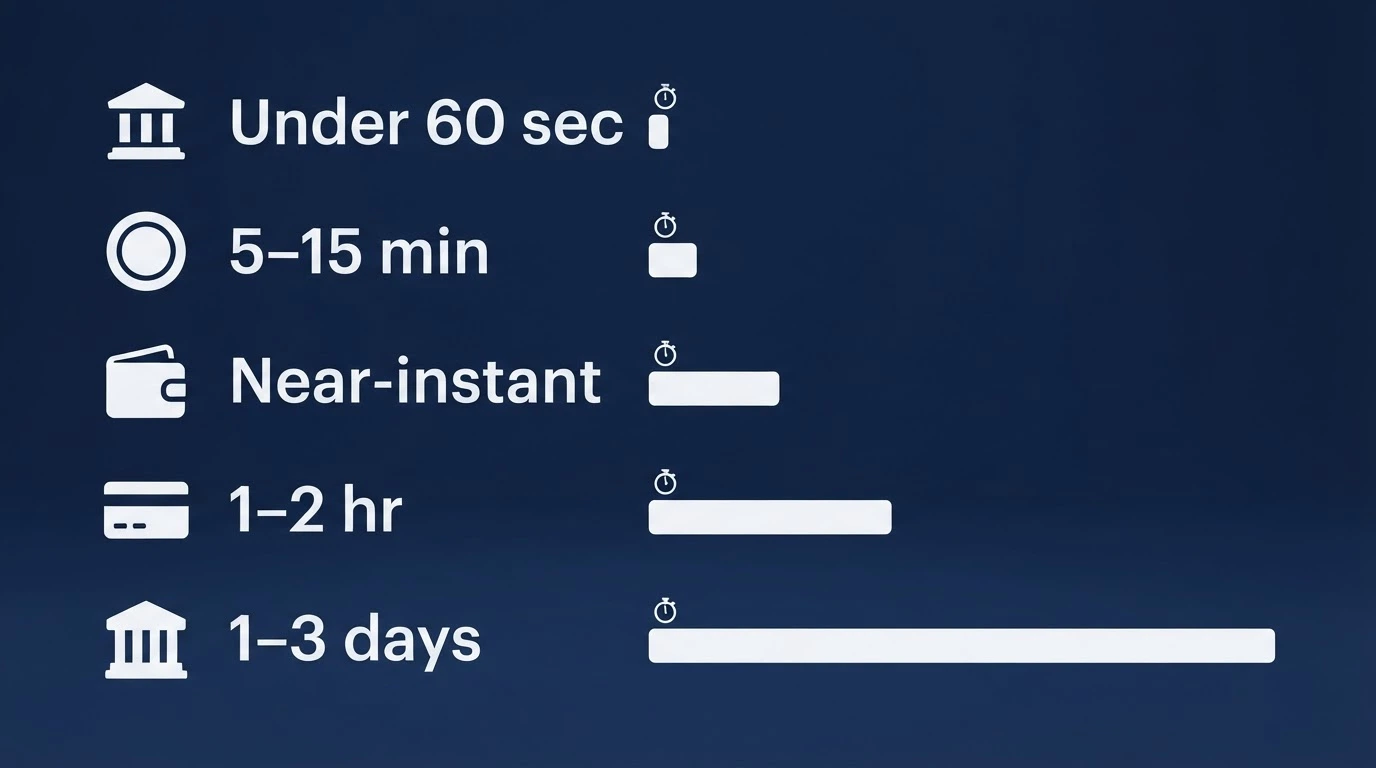
The single largest variable in payout time is therefore not the casino. It is the payment rail the casino sends the money through. The table below ranks the common AU-facing rails by median settlement time.
| Payment Method | Median Payout Time | Notes |
|---|---|---|
| PayID (NPP) | Under 60 seconds | AUD bank-to-bank; the fastest AUD rail available; offshore signal |
| USDT (TRC-20) | 5–15 minutes | Near-zero network fees; banned for licensed AU wagering |
| Bitcoin (on-chain) | 10–25 minutes | A$2–A$10 network fees; banned for licensed AU wagering |
| eZeeWallet | Near-instant to minutes | Operator-dependent; most e-wallets are offshore |
| Skrill / Neteller | 1–2 hours | Often excluded from welcome bonus eligibility |
| Debit card / bank transfer | 1–3 business days | Legacy BECS clearing system; common cap in the featured set |
The spread tells the story. Crypto and PayID sit in the minute-fast tier. E-wallets take an hour or two. Bank transfers clear the next business day at best, and often the one after that. A casino can be fast on a PayID withdrawal and slow on a bank transfer at the same time, and the difference is the rail, not the operator.
PayID Payouts: Under a Minute to Your Australian Bank Account
PayID transfers settle through Australia’s New Payments Platform in under sixty seconds, end to end, regardless of which casino is sending the money. The casino approves the withdrawal, the funds hit the NPP, and the player’s bank posts them in the same minute. That is the fastest AUD rail in the country.
The fact that PayID works at all on these sites is itself a signal. The Australian banks that participate in NPP are not regulated to send funds to illegal interactive gambling services, but they have not yet built the transaction-blocking layer the 2026 reform gives them express authority to deploy from 1 January 2027. For now, PayID is the AUD rail of the offshore market, and the leading operators accept it.
Skycrown’s tested median PayID time was 9 minutes, well under the threshold most players consider fast. Neospin’s PayID payouts typically land in under two hours, with per-request limits running between A$50 and A$5,000. BitStarz and King Billy both accept PayID as well, though neither was tested for a median time this run.
The trade-off for that speed is that PayID lands in a real, named Australian bank account. The trail it leaves is one an Australian regulator could follow if it ever wanted to.
Crypto Withdrawals: Fast but Outside Australian Rules
Crypto is the fastest withdrawal method tested across the featured set. USDT on TRC-20 has a median payout time of 5 to 15 minutes with near-zero network fees. Bitcoin on-chain sits at 10 to 25 minutes with network fees in the A$2 to A$10 range. Skycrown’s median crypto withdrawal came in at 4 minutes, the fastest tested median on the ranked list.
That speed carries a regulatory cost the AUD rails do not. The Interactive Gambling Amendment (Credit and Other Measures) Act 2023 banned credit cards, credit-related products and digital currency as payment for online wagering from 11 June 2024. An Australian-facing casino accepting crypto is not subject to Australian law; the prohibition applies to operators, and an operator offshore is beyond the regulator’s reach. The penalty for non-compliance is up to A$247,500, but that fine has no way of reaching a Curaçao-licensed brand.
Crypto also leaves no Australian banking trail. The deposit that bought the balance came from a wallet, the withdrawal goes back to a wallet, and the only name attached to the transaction is the one the casino used to verify the account. That is faster, and it is also the definition of operating outside Australian rules.
The “No Verification” Withdrawal: When It Works and When It Does Not
“No verification” casinos promise frictionless cash-outs. The promise breaks at the moment a player wins something worth withdrawing. KYC at the withdrawal stage is the most common source of unexpected payout delays, and the more a player has already won, the more thorough the verification tends to become.
Operators that enforce verification upfront process payouts four to eight times faster for returning players than those that wait. The pattern holds across the featured set: the sites that asked for ID and address at sign-up paid faster when the time came to leave. Truly no-KYC casinos are rare in the AU-facing market, and the ones that exist tend to cap withdrawals tightly enough that any big win turns into an instalment plan rather than a payout.
The practical takeaway: complete KYC before depositing the bonus intended to be cleared. The verification that delays the first withdrawal is the verification that prevents delays on the tenth.
Withdrawal Limits and Caps: The Fine Print That Traps Your Winnings
Daily and weekly caps are where fast casinos turn slow. The numbers themselves are not the trap. The trap is the moment a five-figure win arrives and the cap forces it out over two or three weeks.
A few patterns hold across the AU-facing offshore market:
- Daily caps commonly sit between A$2,000 and A$10,000 per day. Skycrown and Neospin both enforce a weekly cap of A$10,000, on the lower end of the featured set.
- Weekly caps typically range from A$5,000 to A$20,000. Larger operators set the higher end; smaller ones set the lower end.
- Minimum withdrawals at most AU-facing offshore casinos sit between A$20 and A$50. Some operators set A$100 or higher, which kills any small-win cash-out strategy.
A weekly cap of A$10,000 means a A$25,000 win takes three weeks minimum to clear, assuming nothing else gets queued behind it. The casino pays at speed; the cap is what slows the cash-out down.
Australia’s Fastest-Paying Online Casinos in 2026: Tested and Ranked
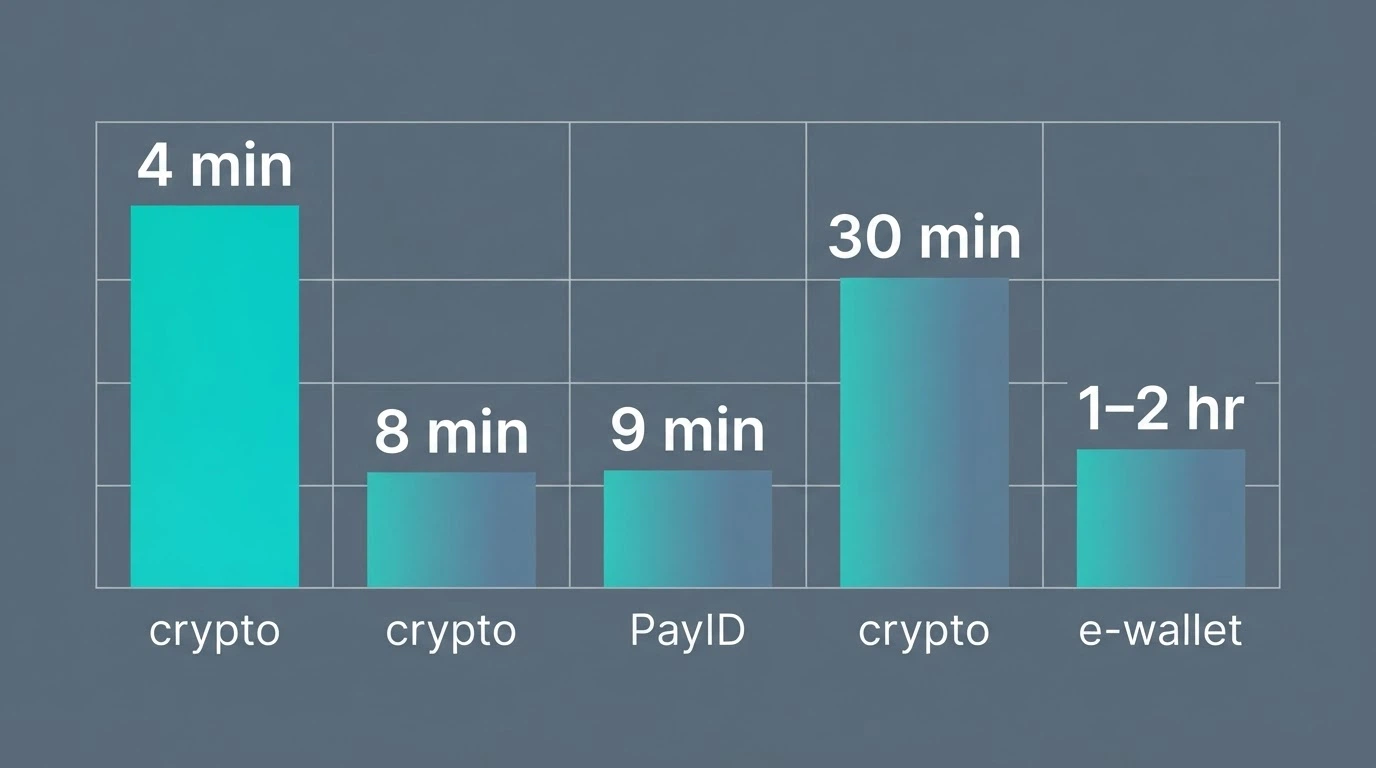
The ranked list below puts operators in tested speed order where data exists. The five brands with independently measured median payout times sit at the top (Skycrown, Neospin, BitStarz, King Billy and Stake), and the five without tested data follow in plan-listed order. The split is honest, not aesthetic: the bottom five are not slower than the top five, they simply have not been measured this run.
Every operator on this page is offshore, licensed by a regulator outside Australia, and operating in a market where no Australian licence is possible. The Licence column shows which offshore regulator authorises each brand, not whether the site is legal in Australia.
| Operator | Licence | Tested Payout Speed | Game Providers | Wagering |
|---|---|---|---|---|
| Skycrown | Curaçao (Hollycorn N.V.) | PayID 9 min median; crypto 4 min median | Pragmatic Play, Play’n GO, NetEnt, Evolution, BGaming | — |
| Neospin | Curaçao | PayID 22 min median; crypto 8 min median | Pragmatic Play, Play’n GO, NetEnt, Evolution, BGaming, Wazdan | 40x |
| BitStarz | Curaçao (Dama N.V.) | Crypto 8–10 min | Pragmatic Play, Play’n GO, NetEnt, Evolution, BGaming, Betsoft | — |
| King Billy | Curaçao (Dama N.V.) | Skrill/Neteller 1–2 hr; crypto same-day | Pragmatic Play, Play’n GO, NetEnt, Evolution, BGaming, iSoftBet | 30x |
| Stake | Curaçao | Crypto under 30 min | Pragmatic Play, Evolution, Hacksaw Gaming | — |
| RocketPlay | — | Not independently tested | BGaming, Pragmatic Play | 40x |
| Royal Reels | — | Not independently tested | — | — |
| FairGO | — | Not independently tested | RTG | 30x |
| Bizzo Casino | — | Not independently tested | Pragmatic Play, Evolution | 40x |
| WinSpirit | — | Not independently tested | — | — |
The five tested operators separate clearly on speed. Skycrown’s median times are the benchmark. Neospin comes in next, with PayID at 22 minutes and crypto at 8 minutes. BitStarz’s tested crypto payouts sit at 8 to 10 minutes. King Billy’s Skrill and Neteller options take 1 to 2 hours, with crypto same-day. Stake’s crypto withdrawals typically clear in under 30 minutes.
For the five operators without tested data, the table reads as gaps rather than answers. What those gaps mean for a player weighing a deposit is covered in the per-operator writeups that follow.
How the Speed Rankings Were Built
The tested payout times in the table come from independent testing by SlotsPeak and Merchant Circle, with operator terms pages used to cross-check withdrawal limits and the maximum-cashout conditions that determine what actually leaves the casino. SlotsPeak’s testing protocol measured median times from real deposits, not fastest singles. Merchant Circle’s testing of 14 Australian-facing platforms between January and July 2026 covered a different angle, namely how often “instant” claims actually delivered.
The numbers behind the ranking are median, not minimum. A fastest single withdrawal of 2 minutes 10 seconds is a useful headline, but it tells a reader nothing about what to expect on the second or tenth withdrawal. Median time is the figure a player can plan around. Operator-published times were not used, because the marketing numbers are the gap the testing was designed to measure.
Five of the ten featured operators have no independently measured payout data this run. Their positions in the ranking reflect plan-listed order, not measured speed. Where the absence of data matters, such as RocketPlay’s lack of any tested time and WinSpirit’s lack of any confirmed specifications, it is flagged in the writeup below.
Licensed vs Offshore: What the Comparison Table’s “Licence” Column Really Means
Every licence in the table is offshore. No Australian online casino licence exists, and none can exist under the Interactive Gambling Act 2001. The NTRWC, administered through Licensing NT, licenses wagering operators for sports and racing only; online casino sits outside what any Australian regulator is empowered to license.
The Curaçao eGaming licence dominates the featured set. Five of the ten operators either confirm a Curaçao licence outright or sit under a Curaçao-licensed parent company. What a Curaçao licence actually provides to an Australian player is limited: a registration number and a regulator the player can complain to in writing, with no enforcement power over Australian-facing services and no obligation to refund balances if the operator disappears. It is not the same protection a UK Gambling Commission or Malta Gaming Authority licence provides a European player, and it is not designed to be.
The five operators with no licence data in the table are not unverified for any reason other than that their licence status did not surface in this research pass. Some will hold Curaçao licences that simply did not appear on a regulator register this run; others may be licensed elsewhere. The absence of a confirmed licence is not, on its own, evidence of anything, but it is also not evidence of compliance.
Skycrown: The 2-Minute Withdrawal That Actually Delivers
Skycrown posted the fastest single withdrawal in the tested set: 2 minutes 10 seconds, end to end, from the player’s “withdraw” tap to the funds landing in an Australian bank account. The median times behind that fastest single are what a returning player should plan around, namely 9 minutes for PayID and 4 minutes for crypto.
The casino operates under a Curaçao eGaming licence through parent company Hollycorn N.V. The game roster runs through Pragmatic Play, Play’n GO, NetEnt, Evolution and BGaming, which covers the AU-favourite pokie category (high-volatility Pragmatic Play titles, the Play’n GO catalogue) and the live-dealer lobby Evolution runs. Weekly withdrawals cap at A$10,000.
What Skycrown offers is the rare combination of measured speed and a stable game library. The 2-minute headline is the marketing. The 9-minute median is what a player actually experiences. Both are fast, and both are real.
Neospin: Big Bonus, Fast PayID, but Watch the Wagering
Neospin pairs a headline AU$11,000 welcome package across four deposits with tested PayID payouts typically under half an hour. The first deposit alone is 100 percent up to AU$1,500 plus 100 free spins. The catch is the wagering requirement, set at 40x on deposit plus bonus, and a free-spin win cap that sits between AU$150 and AU$225 depending on which Neospin domain you read.
Tested median PayID time at Neospin is 22 minutes, with median crypto at 8 minutes. The fastest single withdrawal recorded was 4 minutes 50 seconds. PayID requests are limited between A$50 and A$5,000 per request, and weekly withdrawals cap at A$10,000. Maximum bet while a bonus is being wagered is between AU$7.50 and AU$10, depending on the game category.
The bonus’s real cost is worth working through once. A first-deposit bonus of AU$1,500 cleared at 40x wagering requires AU$60,000 of turnover before the bonus and any associated winnings become withdrawable. At a A$1 spin, that is 60,000 spins, about 83 hours of play at a five-second spin cadence, well over the lifetime of most bonus terms. The maximum bet of AU$10 while wagering cuts that to 6,000 spins and roughly 8 hours, on the assumption the player uses the highest allowed stake throughout. The expected loss against a slot paying around 96.5 percent RTP is roughly AU$2,100 in house edge over the clearing volume. None of that is money the player keeps, and the bonus itself does not return at the end of it.
For a player who already plans to deposit heavily, the math softens, since the bonus funds a fraction of the wagering the player would have done anyway. For a player chasing the headline figure with a smaller bankroll, the wagering does most of the damage.
BitStarz: Crypto Speed With No Cashout Cap
BitStarz is built for the crypto player. Tested AUD payouts clear in around 8 to 10 minutes via crypto, and the welcome package carries no maximum cashout stated on the operator’s promotions page, a contrast to most of the featured set, where cap conditions quietly limit what a player can actually withdraw from bonus winnings.
The first-deposit offer is 100 percent plus 180 free spins, with up to €400 or 4 BTC across the next three deposits. The casino operates under a Curaçao eGaming licence through parent company Dama N.V. Game providers run through Pragmatic Play, Play’n GO, NetEnt, Evolution, BGaming and Betsoft, covering the AU-favourite high-volatility pokie category and a deep live-dealer lobby.
Wagering on the welcome package was not confirmed from the operator’s terms this run. The industry-wide 40x is typical for Dama N.V. brands but should be verified before depositing. What BitStarz does offer that the rest of the featured set does not is the combination of tested crypto speed and no stated cashout cap, which is the closest thing to a flat payout a player at an offshore casino can find.
King Billy: Lower Wagering, Slower Payouts
King Billy’s 30x wagering on the welcome package is the lowest in the featured set, a meaningful contrast to the 40x standard at Neospin, RocketPlay and Bizzo. The package runs A$3,000 plus 300 free spins across four deposits, with no maximum cashout stated on the welcome. Minimum deposit is A$30.
Payout speed trails the crypto and PayID leaders. Skrill and Neteller withdrawals take 1 to 2 hours, and crypto is same-day but not minute-fast. King Billy operates under a Curaçao eGaming licence through parent company Dama N.V., and the game roster runs through Pragmatic Play, Play’n GO, NetEnt, Evolution, BGaming and iSoftBet.
The trade is the wagering-versus-speed question most AU-facing players eventually face. A 30x bonus cleared on a smaller bankroll takes less of the player’s balance than a 40x bonus of equivalent headline size. The slower Skrill and Neteller payouts are the cost. For a player who does not plan to withdraw frequently and would rather have a bonus that can actually be cleared, King Billy is the cleaner fit.
Stake: Crypto-Native Speed Without the Welcome Mat
Stake does not run a traditional welcome bonus. The platform sits on a rakeback and VIP model, with ongoing cashback on house edge rather than a sign-up match, and the absence of a bonus to clear means there is no wagering requirement to plan around.
Crypto withdrawals typically clear in under 30 minutes, putting Stake in the same speed tier as the tested crypto leaders. The casino operates under a Curaçao eGaming licence, with game providers running through Pragmatic Play, Evolution and Hacksaw Gaming. For a player who treats casino play as ongoing rather than as a sign-up-and-cash-out exercise, the model fits. For a player chasing a headline bonus figure, it does not.
RocketPlay: Solid Bonus but Untested Payout Speed
RocketPlay’s first-deposit offer is 100 percent up to EUR 1,000 plus 100 free spins on Aztec Magic by BGaming, delivered 20 per day over five days. Wagering is 40x on the deposit match and 40x on free-spin winnings as separate requirements. The free-spin win cap is A$300, and each batch of spins carries a 5-day validity from credit date.
No independently tested median payout time exists for RocketPlay this run. The operator is offshore, and BGaming and Pragmatic Play are confirmed on the game roster. Without tested speed data, a player cannot compare RocketPlay’s actual payout time against the leaders in the table, and the leader gap is exactly where speed claims get tested.
For a player considering RocketPlay, the move is to test the cash-out with a small win before committing a larger balance. If the test withdrawal clears within a day, the bonus terms become the deciding factor. If it does not, the platform has told the player what it would do with a larger win.
Royal Reels: Player Complaints Tell a Different Story
Royal Reels attracts Australian players, but the complaint record is the loudest signal on this page. Player forums report first-withdrawal delays of more than five working days and account closures following large wins. No independently tested payout speed exists for Royal Reels this run, and no confirmed game-provider list or licence details surfaced either.
The pattern matches what AU-facing player forums describe across multiple offshore brands: advertised “instant” payouts that turn into multi-day waits once a real win hits the cashier, and vague “bonus abuse” or “advantage play” claims used to close accounts before withdrawals clear.
A forum complaint record this consistent, against an operator this small, is the kind of risk a tested median time would not be needed to expose.
FairGO: RTG Pokies and a 30x Wagering Standard
FairGO runs a RealTime Gaming-focused game library, which sets it apart from the Pragmatic Play-heavy rest of the featured set. RTG has a long Australian-facing footprint, and the catalogue skews toward the high-volatility pokie category AU players tend to prefer. Wagering on the welcome sits at 30x, matching King Billy at the lower end of the featured set.
No independently tested payout speed exists for FairGO this run. FairGO is one of the longer-standing AU-facing brands in the offshore market, so it is the operator’s tested payout performance, not its existence, that is missing. For a player who already knows the RTG catalogue and trusts the brand, the 30x wagering is the cleaner part of the offer. The speed question stays open.
Bizzo Casino: Pragmatic Play Titles, Unproven Payouts
Bizzo carries Pragmatic Play and Evolution on its game roster, which puts the AU-favourite pokie category and a strong live-dealer lobby on the platform. Wagering on the welcome package sits at 40x, the industry-wide standard for the featured set.
No independently tested payout speed exists for Bizzo this run. Without tested times, the speed comparison against the leaders in the table is an open question. The game library is the strongest signal Bizzo offers this research pass, and Pragmatic Play’s high-volatility titles are what most AU-facing players are looking for.
For a player considering Bizzo on the strength of the game library, the move is the same as for RocketPlay: test a small withdrawal first, then judge. The bonus terms and game quality are visible. The speed is not.
WinSpirit: Too Little Data to Call
WinSpirit appears in the AU-facing market, but research carries almost no confirmed specifics, no tested withdrawal speed, no confirmed bonus terms, no confirmed game providers, and no confirmed licence holder. What can be said is that the operator is offshore. What cannot be said is anything more specific.
For a player considering WinSpirit, the data gap is the offer. Before depositing, a player should be able to confirm the licence holder on a regulator register, find independent testing of payout times, read the bonus terms with a stated maximum cashout, and identify the game providers on the platform. WinSpirit does not surface on any of those checks this research pass.
That does not mean WinSpirit is unsafe. It means the operator cannot be assessed on the criteria this page uses. A player choosing WinSpirit over a tested operator is choosing on factors the speed comparison table does not cover, and that is a legitimate choice, but it is one that should be made knowingly.
Fast-Payout Pokies: The Titles That Will Not Hold Up Your Withdrawal
The pokie a player chooses does not delay the withdrawal. The casino’s payment system does. A spin on Big Bass Bonanza takes the same time to clear whether the casino pays out in four minutes or four days, because the game outcome is independent of the cashier. What the pokie does determine is how much of the player’s balance the clearing volume costs, which is where RTP and volatility enter the picture.

The eight titles below all run at the AU-facing offshore operators featured above. Every figure is the figure the developer’s own published spec carries, with no operator restatement and no rounding. Volatility is the category the developer states; max win is the figure the game’s paytable publishes.
| Slot Title | Provider | RTP | Volatility | Max Win |
|---|---|---|---|---|
| Big Bass Bonanza | Reel Kingdom / Pragmatic Play | 96.71% | High | 2,100x |
| Sweet Bonanza 1000 | Pragmatic Play | 96.53% | High | 25,000x |
| Gates of Olympus 1000 | Pragmatic Play | 96.50% | High | 15,000x |
| Book of Dead | Play’n GO | 96.21% | High | 5,000x |
| Trigger Happy | Big Time Gaming | 96.58% | High | 50,000x |
| Burning Reels | Wazdan | 96.63% | Adjustable | 5,000x |
| Cosmic Clusters | Pragmatic Play | 96.45% | High | 5,000x |
| Bubble Up | Pragmatic Play | 96.52% | Medium | 10,000x |
The spread is tighter than most players expect. Big Bass Bonanza’s 96.71 percent RTP sits at the top of the table; Book of Dead’s 96.21 percent sits at the bottom, a difference of half a percentage point across the eight titles. Against a A$60,000 clearing volume, that half point is roughly A$300 in expected loss. Not nothing, but smaller than the difference a 40x wagering requirement makes to the same volume.
Pokies with the Highest Confirmed RTP at AU-Facing Casinos
The table above orders by RTP for ease of reference. Big Bass Bonanza leads the featured set at 96.71 percent, with Burning Reels at 96.63 percent and Trigger Happy at 96.58 percent just behind. Sweet Bonanza 1000 and Bubble Up sit in the middle of the pack, and Book of Dead rounds out the bottom at 96.21 percent, still well within the standard AU-facing pokie range.
Volatility tells the player something RTP cannot. Big Bass Bonanza, Sweet Bonanza 1000, Gates of Olympus 1000 and Book of Dead all run high volatility: long dry patches punctuated by larger hits, against which a smaller bankroll is vulnerable. Bubble Up is the only medium-volatility title in the table. Burning Reels is the only one with adjustable volatility, allowing the player to choose between low, standard and high settings.
Max win is the headline figure each game publishes, and the spread is wider than RTP would suggest. Trigger Happy at 50,000x and Sweet Bonanza 1000 at 25,000x sit at the top; Big Bass Bonanza’s 2,100x is the lowest. These are theoretical maxima, not expected outcomes, and the RTP figures above are the relevant number for what a session actually costs.
The Offshore Reality: Why No Australian Casino Licence Exists
The Interactive Gambling Act 2001 makes it an offence for gambling providers to offer online casinos, online pokies and in-play sports betting to anyone physically in Australia. The Act targets providers, not players; no Australian has been prosecuted for using these sites. But the prohibition is the floor that defines every brand on this page.

There is no Australian online casino licence. None exists federally, none exists in any state or territory, and none can exist under the current Act. A page promising “the best licensed Australian online casinos” describes something the law does not permit. The NTRWC, administered through Licensing NT, licenses wagering operators for sports and racing only. Online casino sits outside what any Australian regulator is empowered to license.
The prohibition is enforced. Maximum penalties for providing a prohibited interactive gambling service reach A$360,000 per day for individuals and A$1.8 million per day for bodies corporate under the criminal regime. Civil penalties run higher, up to A$2.475 million per day for an individual and A$12.375 million per day for a corporation. The ACMA has blocked 1,788 illegal gambling and affiliate websites since its first blocking request in November 2019, and over 230 illegal services have pulled out of the Australian market since 2017 enforcement began.
The IGA targets providers, but Australian players are not insulated from the consequences of using offshore sites. The ACMA warns that Australians who use illegal gambling services risk losing their money and that even a service that looks legitimate is unlikely to have important customer protections. There is no Australian consumer-protection framework covering these sites, no Australian dispute-resolution process, and no Australian regulator empowered to recover funds from an offshore operator that refuses a withdrawal.
What the ACMA Actually Does — And What It Cannot Do for Offshore Players
The Australian Communications and Media Authority enforces the IGA through investigation, formal warnings, civil penalty proceedings and DNS-level blocking of illegal sites. The agency’s quarterly enforcement cadence produces a steady stream of actions.
In Q4 2025 (October to December), the ACMA investigated 45 gambling sites, found 69 breaches of the IGA, issued 10 formal warnings and blocked 133 websites. Q3 2025 (July to September) saw 30 sites investigated, 44 breaches found, 20 warnings issued and 71 sites blocked. Q2 2025 (April to June) ran 24 investigations, 30 breaches, 10 warnings and 73 blocks. The numbers move quarter to quarter, but the cadence does not.
On 16 January 2026 the ACMA issued 8 infringement notices to Tabcorp Holdings Limited, each for A$19,800 and totalling A$158,400, for providing a prohibited in-play betting service. The Tabcorp matter is a domestic enforcement example, showing the ACMA will pursue a licensed Australian wagering operator that crosses the IGA line, not only offshore brands.
What the ACMA cannot do is recover money for an Australian player who has been denied a withdrawal by an offshore casino. The agency can block the site, fine the operator and refer the matter for further enforcement, but it has no power to compel an offshore entity to return a player’s balance. The DNS-level block prevents future Australian access; it does not refund past losses.
What IS Licensed in Australia — And Why That Matters
Wagering on races and sport placed before the event begins is licensed and legal in Australia, through operators licensed by state and territory regulators. The NTRWC, administered through Licensing NT, is the de facto national licensor for online wagering. Licences run for terms of up to 20 years, providing the long-term regulatory backbone the offshore casino market lacks.
The Northern Territory levies a 5 percent wagering tax on wagers minus payouts plus a 0.05 percent racing levy. Each state sets its own point-of-consumption tax, typically 10 to 15 percent of net wagering revenue. The tax regime funds the state-based harm-minimisation and consumer-protection frameworks that offshore operators do not participate in.
A licensed Australian wagering operator is required to offer customer-set deposit limits and activity statements. BetStop self-exclusion applies across every licensed wagering provider. Consumer disputes route through Australian regulators and through the Australian Financial Complaints Authority where applicable. None of these protections extend to the offshore casino market.
The practical implication is straightforward: a player who mistakes a licensed Australian bookmaker for a legal online casino is making a category error. The bookmaker offers legal wagering on sport and racing. The online casino is a different product, banned under the IGA, and the offshore operators offering it sit outside the licensing framework entirely.
The 2026 Reform: What Changes on 1 January 2027
The Interactive Gambling Amendment (Gambling Reform) Bill 2026 passed Parliament on 19 August 2026. Its measures commence on 1 January 2027.
The reform tightens advertising controls. Wagering advertising will be capped at three ads per hour between 6:00 am and 8:30 pm. A live-sport blackout will run from 15 minutes before to 5 minutes after live events. Radio ads will be barred during school hours. Broadcasting sporting odds will be banned outright. Online wagering ads will reach only logged-in, age-verified users who have not opted out. No ads inside sports venues or on player uniforms. Athletes, celebrities and influencers will be barred from promoting wagering.
Inducement controls run alongside. Direct marketing of inducements will be prohibited for 14 days after sign-up, for 3 months after BetStop deregistration, and indefinitely for at-risk customers. The 14-day post-signup window is the change that hits offshore casino marketing hardest, since sign-up bonuses cannot be marketed to a new account for the first two weeks.
The most consequential change for offshore casino players is the new authority for banks and payment providers to block transactions to illegal gambling operators, commencing 1 January 2027. That authority does not exist today in express form, and the reform gives it explicitly. For an Australian player depositing at an offshore casino in 2027, the bank may refuse the transaction at the AUD rail level, and AUD rails are the ones the ACMA can reach.
The Credit Card and Crypto Ban: A Payment-Method Litmus Test
Credit cards, credit-related products and digital currency are banned as payment for online wagering from 11 June 2024, under the Interactive Gambling Amendment (Credit and Other Measures) Act 2023. An operator that fails to enforce the ban faces penalties of up to A$247,500.
The legal deposit routes for licensed wagering are debit card, bank transfer, PayID and Osko, and BPAY. Crypto is not on the list. Credit is not on the list. Any Australian-facing online casino accepting either is operating outside Australian rules, not in a grey area but in direct contradiction to the prohibition.
The ban is the clearest payment-method signal in the AU-facing market. A site accepting a credit card or USDT is not subject to Australian law. The deposit may succeed, but the regulatory status of the operator is settled before the transaction clears. The payment method is the lie detector, and it does not require a regulator to read.
Playing Safely When the Safety Net Has Holes
Responsible-gambling tools exist in Australia. They are real, they are funded, and they cover the licensed wagering market. They do not cover the offshore casino market, and that gap is the most concrete harm of the offshore route.

About 2.1 percent of Australian adults, roughly 430,000 people, experience problem gambling, according to the Australian Institute of Health and Welfare. High-risk gambling sat at 1.8 percent in the most recent AIHW measurement. The numbers are not theoretical; they describe the population the harm-minimisation framework was built to serve.
BetStop, the National Self-Exclusion Register, went live in August 2023 and had 67,480 registrations as at 31 July 2026, of which 41,290 exclusions were still active. Seventy-eight percent of registrants were under 40, and 38 percent chose lifetime exclusion. A single BetStop registration excludes a person from every AU-licensed online and phone wagering service.
The offshore casino market sits outside BetStop. A person who self-excludes via BetStop is blocked from every AU-licensed wagering service, but an offshore casino will keep taking their money.
The BetStop Coverage Gap: Why It Matters for Offshore Casino Players
BetStop self-exclusion periods range from a minimum of 3 months to a lifetime. A registrant cannot apply to be removed in the first 3 months. The registration is the act; the waiting period is the consequence. For someone who has decided to stop gambling, BetStop is the most effective single tool the Australian framework provides.
The register covers approximately 150 licensed wagering providers in Australia. That is the universe of licensed operators, and it is the universe BetStop can reach. Offshore casinos, including every brand on this page, are not connected to the register. A BetStop registration does not block an offshore casino from accepting deposits or processing wagers. The exclusion stops at the licensed perimeter.
For a player who has self-excluded and is tempted to play at an offshore casino, the gap is the danger. The framework that says “you cannot bet” does not extend to the casino that takes the bet. The offshore route is the way around a BetStop registration that exists, and that is the harm the framework cannot close.
Deposit Limits and Self-Exclusion at Offshore Casinos: What to Expect
Offshore casinos typically offer their own responsible-gambling tools, including deposit limits, cooling-off periods and self-exclusion at the account level. What they offer is voluntary. AU-licensed wagering operators are required to provide customer-set deposit limits and activity statements; offshore casinos are bound by their own terms, not by Australian law.
The variability is wide. Some offshore casinos enforce customer-set deposit limits the same way a licensed operator would. Others offer the tools but do not enforce them, or impose limits only after the customer requests them rather than at sign-up. The difference between an enforceable limit and a voluntary one is the difference between a safety net and a sticker.
A player choosing an offshore casino should treat the responsible-gambling tools as a starting point, not a guarantee. Set the deposit limit before the first deposit. Keep a record of session time. If the casino offers an account-level self-exclusion option, know what it covers and what it does not. The BetStop coverage gap is the reason these habits matter at offshore casinos in a way they do not at licensed wagering operators.
Where to Get Help: Australian Gambling Support Services
If gambling is causing harm, to finances, relationships, work or mental health, the Australian help network is free, confidential and available 24 hours a day:
- National Gambling Helpline: 1800 858 858, free, confidential, 24/7, staffed by counsellors.
- Gambling Help Online: web chat, email support and self-help tools.
- BetStop, the National Self-Exclusion Register: free registration, three months to lifetime, covering approximately 150 licensed wagering providers.
These services exist because the prevalence numbers justify them. Roughly 430,000 Australian adults experience problem gambling, and the helpline, online chat and self-exclusion register are the response. Offshore casinos are not plugged into any of them, which is the practical reason to call the helpline before opening an offshore casino account.
How We Evaluated and Ranked These Casinos
The data behind this page came from independent testing sites: SlotsPeak for payout-speed measurements, Merchant Circle for AU-facing platform testing, PokiesAustralia for payment-method analysis, and CasinosHub and Betzoid for bonus-term compilation. Operator terms pages and the Curaçao eGaming register were used to cross-check licence claims and bonus terms. The ACMA’s quarterly enforcement reports and the agency’s blocked-services register were used to verify the offshore status of every operator on the page.

The ranking weights tested payout speed first. Where measured median times exist, namely Skycrown, Neospin, BitStarz, King Billy and Stake, they determined position. Where they do not, namely RocketPlay, Royal Reels, FairGO, Bizzo and WinSpirit, the position is plan-listed rather than measured, and the absence of data is flagged in the operator writeup.
The evaluation criteria after speed were bonus terms (wagering multiplier, maximum cashout, free-spin win cap), provider quality (the developer roster on each platform), and player complaint record (forum reports of withdrawal delays, account closures and dispute-resolution failures). No numerical weighting was applied, so the ranking is qualitative, and the table reflects the resulting judgment rather than a score.
Five of the ten featured operators have no independently measured payout data this research pass. That gap is acknowledged in the table and in the writeups, rather than papered over with operator-published times. The page describes what the data supports and notes where the data stops.
What an Australian Player Should Actually Do About Fast-Payout Casinos
The honest trade is speed versus safety, and the page walks both sides. Speed is real for a handful of operators: Skycrown’s 9-minute PayID median and 4-minute crypto median are the benchmark the rest are measured against, with Neospin and BitStarz close behind. The consumer-protection vacuum is real for all of them.

The practical steps that hold up against the data include completing KYC before chasing the bonus, as operators that verify upfront process payouts four to eight times faster for returning players than those that wait. Players should pick the payment rail deliberately, noting that PayID gives sub-minute AUD settlement and leaves an Australian banking trail, while crypto offers faster settlement but no Australian trail and signals an offshore operator—an important distinction once the 2027 bank-blocking authority commences. It is also wise to test the cashier with a small win before depositing heavily, as the fastest and slowest operators look identical at sign-up. Players should read the weekly cap before the welcome bonus, since a A$10,000 ceiling means a five-figure win takes weeks to clear, and keep in mind that the safety section noted BetStop does not cover offshore casinos.
The fewer-than-30-percent figure from Merchant Circle’s testing of 14 Australian-facing platforms is the single most useful number on this page. Most operators that claim instant payouts do not deliver. The five tested operators at the top of the ranking did. The five below them did not get tested this run, and that absence is itself the message.
Speed is the only signal an Australian player can measure at an offshore casino. The IGA prohibition ensures it is also the only signal the operator can be judged on, in plain view. Everything else, from dispute resolution to self-exclusion coverage to fund recovery, sits beyond the reach of Australian law for every brand on this page. A player who treats speed as the deciding factor should also treat the absence of everything else as the cost.
Frequently Asked Questions
Are instant withdrawal casinos in Australia actually instant?
Not for most operators. Independent testing conducted earlier this year found fewer than 30 percent of instant-payout claims actually delivered within an hour. The fastest tested medians were 4 minutes for crypto and 9 minutes for PayID, both at Skycrown. Most operators fall below that benchmark.
Why is my casino withdrawal taking so long in Australia?
Three causes account for most delays: KYC verification at the withdrawal stage, payment-rail floor times, and weekly withdrawal caps. Operators that verify upfront process payouts at significantly faster speeds for returning players. Bank transfers through the legacy BECS system take one to three business days regardless of how fast the casino approves.
What is BetStop and does it cover offshore casinos?
BetStop is Australia’s National Self-Exclusion Register, live since August 2023, with 67,480 registrations as at 31 July 2026. A single registration blocks every AU-licensed wagering provider, about 150 operators. Offshore casinos are not connected to the register, so a BetStop exclusion does not stop an offshore casino from accepting deposits or processing wagers.
What is the minimum withdrawal amount at Australian online casinos?
Minimum withdrawals at most AU-facing offshore casinos sit between A$20 and A$50. Some operators set the minimum at A$100 or higher, which makes any small-win cash-out strategy impractical. PayID at Neospin is limited between A$50 and A$5,000 per request, illustrating both the floor and the ceiling at a single operator.
Are winnings from online casinos taxable in Australia?
No, for the typical recreational player. Gambling winnings are not assessable income under section 6-5 of the ITAA 1997, and gambling losses are not deductible under section 8-1, unless the person is carrying on a business of betting. Recreational players keep their winnings without tax obligation and cannot offset losses against other income.
Can I use crypto to withdraw from an Australian online casino?
Yes, at offshore casinos, and crypto withdrawals typically clear in 5 to 25 minutes. The catch is regulatory: credit cards and digital currency are banned as payment for online wagering in Australia from 11 June 2024, so any operator accepting crypto is operating outside Australian rules. Speed is real; Australian consumer protection on the transaction is not.
Payout Speed by Game Type: Do Live Dealer Games Pay Out Differently?
The game category does not change the withdrawal method. A live-dealer blackjack win and a pokie win both leave the casino through the same cashier, on the same payment rail, with the same processing window. The withdrawal pipeline is identical because the pipeline is set by the casino and the payment provider, not by the game.
What does change is the size of the withdrawal. Live-dealer and table-game sessions tend to produce larger wins per session than pokies, both because the bet sizes are typically higher and because table players often run longer sessions. Daily caps of A$2,000 to A$10,000, common across the featured set, get hit harder by a single live-dealer session than by a pokie session of equivalent length.
The myth that table games pay out slower than pokies persists in player forums, but it confuses the game’s payout ratio with the casino’s payout speed. The two are unrelated. A live-dealer withdrawal clearing in 4 minutes is no faster and no slower than a pokie withdrawal of the same size clearing in 4 minutes. What slows the cash-out is the cap, not the wheel.